A monthly statement is the quiet workhorse of getting paid. It tells each customer what they owe, why they owe it and when it’s due, so they don’t have to ask and you don’t have to explain at the counter. Below you’ll find a customer statement template you can copy, what every line on it is for, a worked example with the math checked, and the routine that gets statements out on the same day every month.
Key takeaways
- One page, one balance, one due date. If a customer needs a second look to find what they owe, the statement isn’t done.
- Show the arithmetic. Previous balance, minus payments, plus charges, minus credits, equals new balance. Every line traceable to a receipt.
- Separate what’s past due. A small “past due” line gets more attention than a bigger total.
- Send on a fixed day. Customers learn the rhythm and start paying to it.
Why bother with a statement at all
Invoices are for single sales. A statement of account is for relationships: the regular on a house account, the contractor who picks up materials twice a week, the borrower paying back a small loan in installments. Each of them has many small transactions, and a statement rolls those into one number.
Without one, customers pay from memory, and memory always rounds down. “I thought I paid most of that last month” is not dishonest; it’s what happens when nobody sends a summary. A clear monthly statement replaces that guesswork with a shared record, and it gives you a natural, low-drama moment to mention anything that’s late.
Statements also protect you. When a customer disputes a balance six months from now, a run of monthly statements they received and paid against without complaint is strong evidence that the charges were right. And they make your own month-end easier: once every account has a statement, the total of all the new balances is your accounts receivable, the money customers owe you, in one number you can compare with last month.
The parts of a customer statement template
Here’s every section of the template further down, in order, and what it does for you.
Header: who, which account, which period
Your business name and contact details, the customer’s name and account number, the statement date and the period it covers (“September 1–30, 2026”). The account number matters more than it looks. If a customer has two accounts, or two customers share a surname, the number is what keeps payments landing in the right place.
Previous balance
Exactly the “new balance” from last month’s statement, copied over, never recalculated. If this number doesn’t match last month’s, something was edited after the fact, and you want to know that before the customer does.
Payments received
Each payment with its date, method and reference: “09/12/2026, check #1043, $400.00.” Customers check this line first, because it proves you saw their money.
New charges and credits
Each charge on its own line with the date and the receipt or ticket number. Returns and credits appear as negative amounts, also with dates. Resist the urge to lump a month of charges into one figure. Itemized lines answer questions before they turn into phone calls.
New balance and amount due
The arithmetic, shown plainly. Under it, the due date in bold, and the amount due by that date if it’s different from the full balance (for example, an installment plan where only this month’s payment is due).
Aging: current versus past due
A short line or box splitting the balance into current and past due, ideally with the days late. It’s the most persuasive line on the page and the least confrontational way to say “this part is overdue.”
How to pay and who to call
Accepted methods, where to send a check, what reference to use for a bank transfer, and one phone number or email for questions. Make paying easier than putting it off.
Worked example: one customer, one month
Quinn runs a fictional farm and garden supply store with about 20 house accounts. Here’s the September activity for one of them, Casey Brandt, a landscaper who charges materials through the month.
Casey’s September statement, worked out
| Date | Item | Amount | Running balance |
|---|---|---|---|
| 09/01 | Previous balance | $612.40 | |
| 09/03 | Charge, ticket 5512 | $86.25 | $698.65 |
| 09/12 | Payment, check #1043 | −$400.00 | $298.65 |
| 09/14 | Charge, ticket 5590 | $142.80 | $441.45 |
| 09/18 | Credit, returned edging | −$24.00 | $417.45 |
| 09/22 | Charge, ticket 5633 | $59.90 | $477.35 |
| 09/29 | Charge, ticket 5701 | $211.35 | $688.70 |
Check it the long way: $612.40 − $400.00 + ($86.25 + $142.80 + $59.90 + $211.35) − $24.00 = $612.40 − $400.00 + $500.30 − $24.00 = $688.70. The August balance of $612.40 was due on September 20, and only $400.00 came in, so $212.40 is past due. The rest, $500.30 − $24.00 = $476.30, is September activity and is current. $212.40 + $476.30 = $688.70, so the aging adds up.
Two small decisions are hiding in that example. First, Quinn applies payments to the oldest balance first, which is the common convention and should be stated in your terms. Second, the return is shown as its own dated line instead of being quietly netted against a charge. Both make the statement easy to audit by someone who wasn’t there.
The customer statement template
Copy this customer statement template into your word processor or spreadsheet. Keep the order; it matches the way people read a bill, top to bottom, ending at “what do I do now.”
Template: monthly statement of account
STATEMENT OF ACCOUNT

[Business name] | [Address] | [Phone] | [Email]

Customer: [Name or business]      Account: [No.]
Statement date: [MM/DD/YYYY]
Period: [MM/DD/YYYY] to [MM/DD/YYYY]

PREVIOUS BALANCE                      $[0.00]

PAYMENTS RECEIVED
[MM/DD]  [Method, reference]         -$[0.00]

CHARGES
[MM/DD]  [Ticket no., short item]     $[0.00]
[MM/DD]  [Ticket no., short item]     $[0.00]

CREDITS AND RETURNS
[MM/DD]  [Reason, ticket no.]        -$[0.00]

NEW BALANCE                           $[0.00]
  Current                             $[0.00]
  Past due ([X] days)                 $[0.00]

AMOUNT DUE BY [MM/DD/YYYY]:           $[0.00]

How to pay: [cash/check/card/transfer details]
Payment reference: Account [No.]
Payments apply to the oldest balance first.
Questions: [Name], [phone or email]
If you lend money rather than sell goods, swap “Charges” for “Installment due” and add one line for the original loan amount and the remaining principal. Borrowers want to see the finish line.
A cover note that goes with it
Statements sent with no message look like spam. One or two warm sentences make a difference, and they’re the right place to mention a past-due amount in a neutral tone.
Template: statement cover email
Subject: [Business] statement for [Month] - due [date]

Hi [First name],

Your [Month] statement is attached. The balance is
$[new balance], due by [due date].

[If past due:] $[amount] of that is from [last
month] and is now past due. If anything on the
statement looks wrong, just reply and we'll check.

Thanks for your business,
[Your name], [Business]
For Casey, the past-due line reads: “$212.40 of that is from August and is now past due.” No adjectives. The number does the talking. If you want ready-made wording for the follow-ups after that, see our guide to payment reminders for small businesses.
The monthly routine
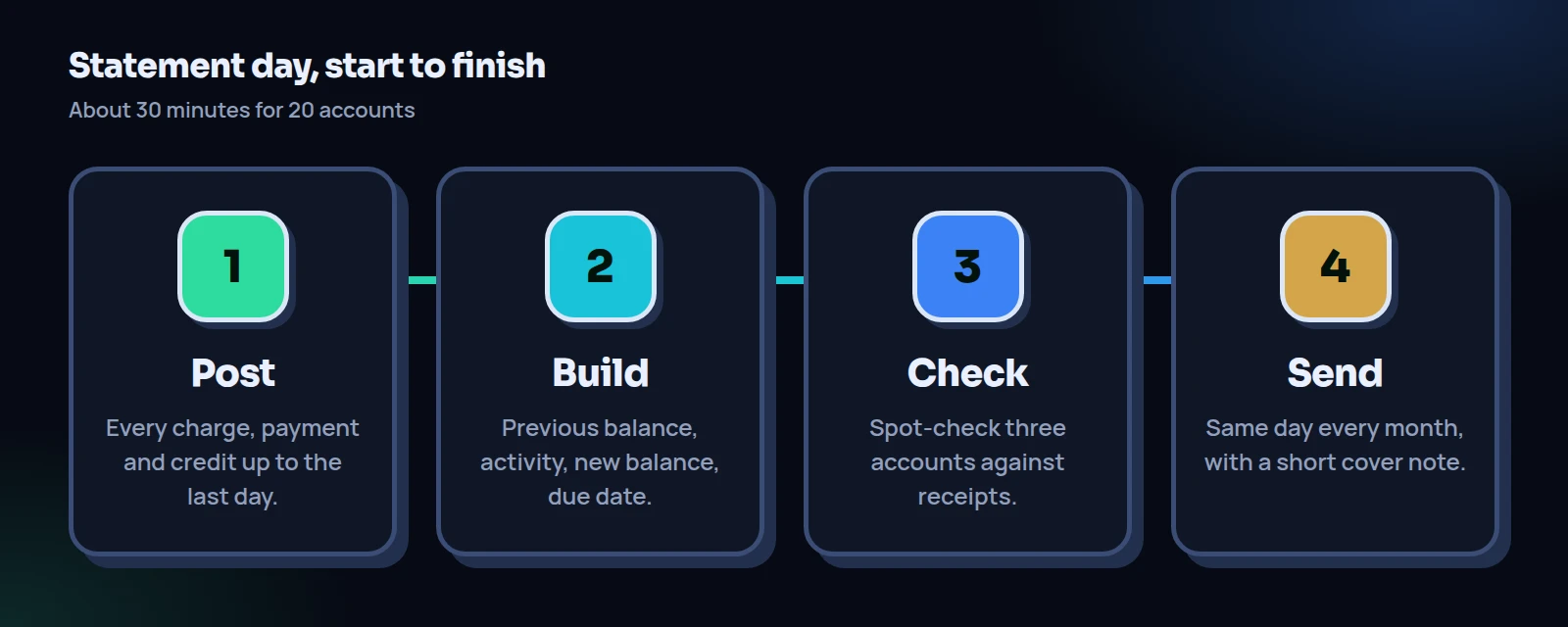
A customer statement template is only as good as its timing. Quinn’s statement routine for 20 accounts takes about half an hour, plus a few minutes on reminder days.
- Last day of the month
Post every charge ticket, payment and return for the month. Count the tickets against the receipt book so nothing is missing.
- 1st
Build each statement from the customer statement template. Copy last month’s new balance as the previous balance.
- 1st
Spot-check three random accounts against the paper receipts before sending anything.
- 1st or 2nd
Send every statement with the cover note. Same day, every month.
- 15th
Friendly reminder to anyone with a balance: “Your statement balance of $X is due on the 20th.”
- 21st
Short past-due note to anyone unpaid. Pause new charges if your terms say so.
Tip
Pick a due date about 20 days after the statement date. It gives customers one paycheck cycle to pay and leaves you time to follow up before the next statement goes out.
Adapting the customer statement template for loans
Small lenders, employers with staff loans and lending circles can use the same customer statement template with two changes. Swap the “Charges” block for the installment due this month, and add a short “Loan summary” block above the new balance: original amount, total repaid so far, and remaining balance. People paying off a loan care about the finish line more than the monthly detail.
Here’s how that looks for a fictional $1,500 loan repaid in 10 monthly installments of $150, no interest. After the fourth payment, the summary reads: original amount $1,500.00, repaid $600.00, remaining $900.00, next installment $150.00 due 11/20/2026, six payments left. Four lines, no ambiguity. If the borrower paid only $100 in October, the statement shows $50.00 past due on its own line, and the amount due by November 20 becomes $200.00.
If you charge interest, show how the payment was split between interest and principal. Borrowers who can see the principal going down are far more likely to keep paying on time than borrowers who only ever see the same installment amount.
Five mistakes that get statements ignored
A statement can be accurate and still sit unopened. These are the habits that push it to the bottom of the pile:
- No due date, or a vague one. “Due upon receipt” sounds strict but is easy to postpone. A real date such as October 20 gets planned for.
- Totals without lines. A single number with no itemization invites “let me check that first,” and checking takes weeks.
- Sending at random. If statements arrive on the 3rd one month and the 19th the next, nobody builds a habit around them. A steady statement routine teaches customers when to expect it.
- Mixing accounts. A business owner with a personal tab and a company tab needs two statements, not one combined list.
- Hiding the contact. If the only way to ask a question is to drive to the store, many people will wait until they’re next in, and pay then.
Fix those five and you’ll notice the difference within two cycles, mostly in fewer “what is this for?” calls.
Keeping the numbers clean between statements
Most statement errors are made weeks earlier, at the counter. Three habits prevent nearly all of them.
- Every charge has a ticket. Numbered, dated, signed or initialed. No ticket, no charge.
- Every payment is posted the day it arrives. Checks sitting in a drawer are how “I paid that” disputes start.
- Corrections are new lines, not edits. If a charge was wrong, add a dated credit with a reason. Never overwrite the original.
If you keep each account in IOUEZ as a signed agreement with payments recorded against it, the balance you copy into the statement is the same one your customer sees in the app, and the weekly summary email shows you who owes what every Monday. IOUEZ won’t lay out this exact statement for you, so treat the template above as the document and the app as the ledger behind it. For lenders and member groups managing many accounts, the organization plans are the place to start; the pricing page compares them.
Watch out
Don’t add fees or interest to a statement that your signed terms don’t mention. A surprise line item is the fastest way to turn a paying customer into a disputing one, and depending on your state, it can also raise legal questions. Change the terms in writing first.
How long to keep statements
Keep a copy of every statement you send, along with the tickets and payment records behind it. The IRS says records that support your tax return should generally be kept for 3 years, and 7 years if you claim a deduction for a bad debt. Since you rarely know in advance which account will go bad, many small businesses keep everything for 7 years. Digital copies are fine as long as they’re readable and complete.
If you also run small loans, our guide to loan tracking for small lenders covers the register and month-end close that statements feed into.
Frequently asked questions
What’s the difference between an invoice and a statement?
An invoice bills one sale. A statement summarizes all activity on an account over a period: the previous balance, payments, new charges and credits, and the new balance. Customers on account usually pay from the statement, not each invoice.
Can I use this customer statement template for loan repayments?
Yes. Replace the charges section with the installment due for the month, and add the original amount and remaining principal so the borrower sees progress. Keep the payment lines and due date the same.
Should statements show a past-due amount separately?
Yes. Splitting the balance into current and past due, with the days late, gets attention without sounding harsh. It’s also the clearest way to show which charges a payment covered.
Which day of the month should I send statements?
The 1st or 2nd is the most common choice, with the balance due around the 20th. The exact day matters less than sending on the same day every month.
How do I handle a customer who disputes a charge?
Pull the signed ticket, share it, and listen. If the charge was wrong, issue a dated credit on the next statement with a short reason. Don’t delete or edit the original line.
Do I need to send a statement if the balance is zero?
It isn’t required, but a short “nothing due this month, thanks” note on active accounts keeps the rhythm going and confirms the last payment arrived. Skip it for accounts with no activity at all.
Is a PDF statement by email good enough?
For most customers, yes, and it’s faster than mail. Keep a copy of what you sent and when. A few customers prefer paper; offer it to them rather than forcing everyone onto one channel.
Sources
- Internal Revenue Service, How long should I keep records?, the 3-year general rule and 7 years for bad debt deduction claims.
- Internal Revenue Service, Recordkeeping, on keeping supporting documents such as sales slips and receipts.
- U.S. Small Business Administration, Manage your finances, on bookkeeping, cash flow and the timing of payments.