Every shop that has been open long enough hears it: “Can I just pay you at the end of the month?” Offering store credit for customers, the old-fashioned house account, can lock in your most loyal buyers. It can also turn your register into an interest-free bank for people you barely know. This guide gives you a way to decide, account by account, plus the terms to write down when the answer is yes.
Quick answer
Offer a house account only to customers with a track record and steady buying, give each one a written limit and a short due date such as 30 days, and send a statement every month. Start with a small trial limit for newer customers. If your own bills can’t wait 30 days for the money, don’t offer credit at all.
What “store credit” means in this guide
The phrase gets used for two very different things. Sometimes it means a refund voucher you hand out instead of cash. Here it means the other kind: a customer takes goods or services now and pays you later, by an agreed date. Hardware stores call it a house account. Corner groceries call it a tab. Suppliers call it trade credit or “net 30.”
Whatever you call it, you are lending. The customer holds your inventory, and you hold their promise. That’s why store credit for customers deserves the same care you would give a small loan: a limit, a due date, a signature and a record of every payment.
Four questions to answer before anything else
Run through these for your business first, then again for each customer who asks. The first one is about you; the other three are about them. Store credit for customers only works when all four answers line up, so don’t skip the first just because a favorite regular is standing at the counter.
1. Can your cash flow wait?
If a regular charges $400 of goods every month and pays 30 days later, you are carrying $400 of their purchases at all times, and more if they pay late. Multiply by every account you plan to open. If that total would make you late on rent or a supplier invoice, your answer is already no, or “not yet.”
2. Do you actually know this customer?
A contractor who has bought from you every week for two years is a different risk from someone who walked in last month. Track record is the best signal a small shop has. You can also ask for a short credit application with a business name, address and a trade reference or two.
3. Is their buying predictable?
Steady, repeat purchases are easy to extend credit for, because both of you can see the pattern. A single big one-off order on credit is closer to a loan with no history behind it.
4. Could you close the account without a scene?
Credit is easy to give and awkward to take back. Before you open an account, decide what would make you close it, for example two late payments in six months, and put that rule in the terms. Then it’s a policy, not a personal judgment.
The decision tree
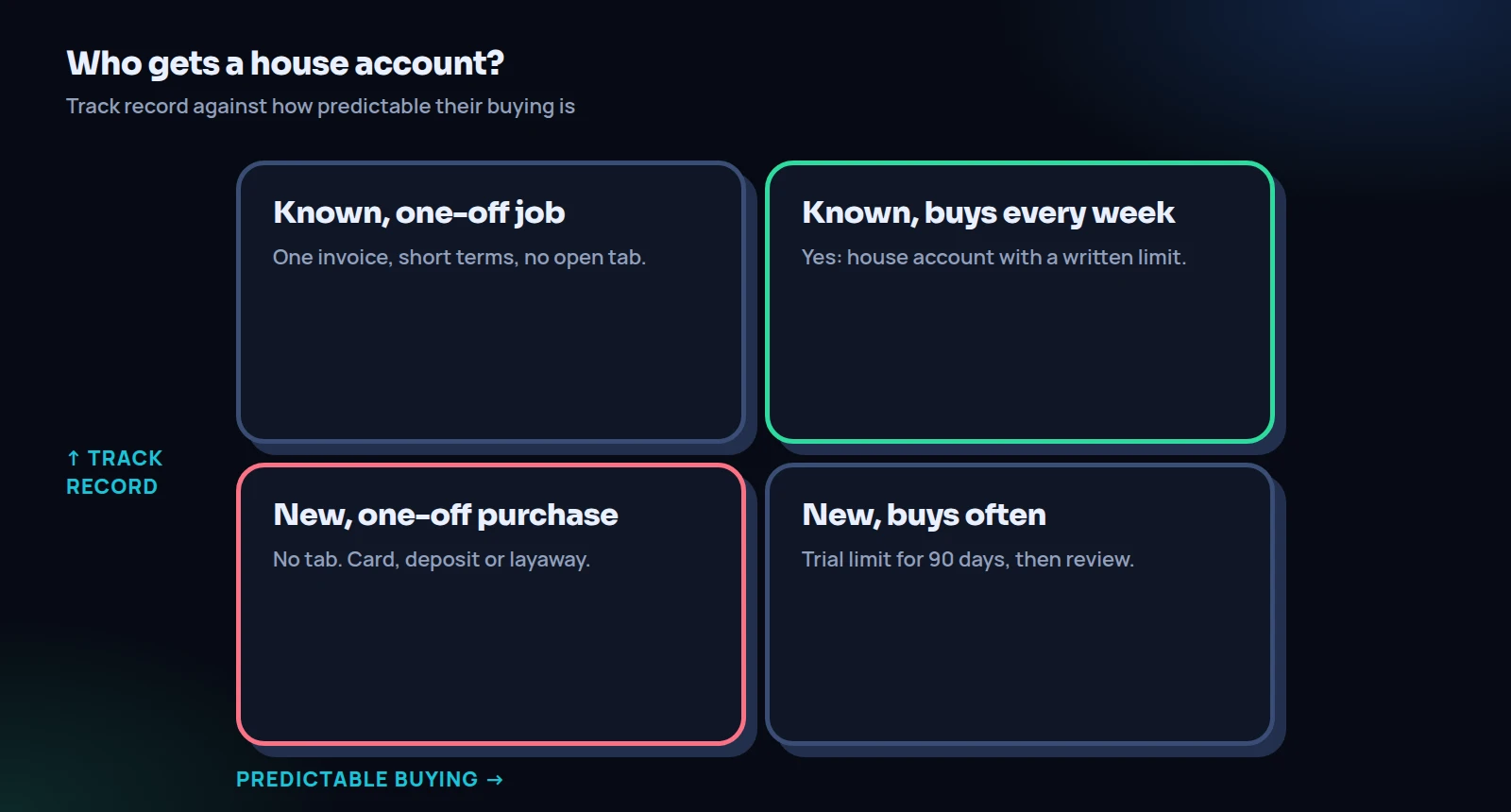
With the four questions answered, the decision about store credit for customers usually falls out on its own. Here’s the tree Morgan, the owner of a fictional hardware store called Elm & Pine, uses at the counter.
Would carrying 30 days of open tabs strain your own bills?
→No store credit for now. Revisit when you have a cash cushion.
Is the customer new, or buying once?
→No open tab. Offer card payment, a deposit or layaway.
New to you, but buying every week?
→Trial limit for 90 days, then review the payment history.
Known for a year or more, steady buying, always pays?
→Open a house account with a written limit and net 30 terms.
Already on account and paid late twice in six months?
→Pause new charges until the balance is current.
Branch 1: yes, open a house account
For the clear yes, do it properly from the first day. A handshake tab feels friendlier, but it is the setup most likely to end in a dispute about what was bought and when.
- Write the limit down. A specific dollar figure, such as $500, not “a reasonable amount.”
- Set the due date. “Statement balance due by the 20th of the following month” is easy to remember and gives you a clean cycle.
- Name who can charge. For business customers, list the people allowed to sign for purchases. Otherwise every employee of the company can run up the tab.
- Get a signature. Paper or electronic, both people should sign the terms.
- Keep every ticket. Each charge gets a receipt signed or initialed by the customer.
Morgan’s rule of thumb for the first limit is roughly one month of the customer’s typical spending. Someone who typically spends about $350 in a month gets a $400 limit. Our guide on how to set credit limits for customers works through the math for bigger accounts.
Branch 2: maybe, start with a trial limit
The trial limit is the middle path for customers you’d like to say yes to but can’t yet vouch for. Make the limit small, say $150 to $250, and the review date fixed, 90 days from opening. Tell the customer upfront: “We start every account at $200. If everything’s on time for three months, we’ll look at raising it.” Framed as policy, it doesn’t feel personal.
At the review, check three things: did they pay each statement by the due date, did they stay under the limit, and did they buy steadily? Three yeses earn a normal account. One late payment earns another 90 days at the same limit. More than that, close it kindly.
Branch 3: no, and what to offer instead
Saying no to store credit for customers doesn’t mean saying no to the sale. Most customers asking for a tab really want breathing room, and you can give that without becoming their lender:
- Card payment. The card issuer carries the credit risk. You pay a processing fee, which is often cheaper than one bad tab.
- Layaway. They pay in installments and collect the goods when it’s paid off. You keep the inventory until then.
- A deposit on special orders. 50% upfront for anything you have to order in covers your cost if they disappear.
- A smaller first order. Sell what they can pay for today and hold the rest for next week.
A script that works at the counter: “We keep house accounts for customers who’ve been with us a while. What I can do today is set this aside for you with a deposit, and you pick it up Friday.” No lecture, no judgment, and the door stays open.
Is store credit for customers worth it?
Here’s the honest trade-off, as Morgan sees it after a few years of running house accounts.
Pros
- Regulars buy from you instead of the big-box store down the road.
- Contractors and small businesses often place bigger, steadier orders on account.
- A monthly statement keeps you in touch with your best customers.
- You can say yes to a good customer in a tight month and earn real loyalty.
Cons
- You carry the cost of the goods until they pay, sometimes longer.
- Collecting from a friend or neighbor is awkward and time-consuming.
- Tracking charges and payments by hand invites errors and disputes.
- One unpaid tab can wipe out the profit from many good ones.
- Lending rules may apply if you add interest or longer payment plans.
The real cost of one bad tab
Owners often underestimate this. When a tab goes unpaid, you don’t lose the profit on the sale. You lose the cost of the goods too, and you have to sell a lot more to earn it back.
Worked example: a $500 tab that never gets paid
| Item | Amount |
|---|---|
| Unpaid house account balance | $500 |
| Morgan’s average gross margin | 30% |
| Profit earned per $100 of normal sales | $30 |
| Extra sales needed to earn back $500 | $500 ÷ 0.30 = $1,666.67 |
So a single $500 loss takes about $1,667 of new, fully paid sales just to break even. With eight accounts at a $500 limit, Morgan’s maximum exposure is 8 × $500 = $4,000. That is the number to compare with the cash cushion before opening account number nine.
There’s a tax wrinkle, too. The IRS explains that a business using the cash method generally can’t deduct an unpaid amount as a bad debt if it was never counted as income in the first place. If you use the accrual method and already reported the sale, the rules are different. Ask your tax preparer which applies to you before you write anything off.
Write it down: house account terms
Here is a short set of terms you can adapt. Keep it to one page. If you want to add interest, longer repayment plans or late fees, check your state’s rules first, since those can turn a simple tab into regulated lending.
Template: house account terms
HOUSE ACCOUNT AGREEMENT

Store: [Store name, address]
Customer: [Name or business name, address, phone]
People allowed to charge: [Names]

1. Credit limit: $[amount]. We may decline charges
   that would take the balance over this limit.
2. Statements: We send a statement on the 1st of each
   month listing every charge and payment.
3. Due date: The full statement balance is due by
   the [20th] of the month it is sent.
4. Receipts: Every charge needs a receipt signed or
   initialed by an authorized person.
5. Late payment: If a balance is not paid by the due
   date, new charges are paused until it is current.
6. Review: We review the limit every [6] months.
   Either side may close the account in writing;
   any balance stays due on the normal date.
7. Changes: Changes to these terms are made in
   writing and signed by both of us.

Store signature: ______________  Date: ________
Customer signature: ___________  Date: ________
Walk the customer through the terms out loud before they sign, especially the limit, the due date and the pause rule. Most disputes over house accounts start with “nobody told me that.” Give the customer a copy and keep the signed original with their account. If you track accounts in IOUEZ, you can create each house account as an agreement that both of you sign electronically, then record each payment against it, so the customer sees the same balance you do. Reminders go out the day before and on the due date, which takes the “just checking in” call off your plate.
Watch out
Fair lending rules apply to anyone who regularly extends credit, including retail stores. Under the Equal Credit Opportunity Act you can’t refuse an account or give worse terms because of race, color, religion, national origin, sex, marital status, age or receipt of public assistance. Write your yes/maybe/no criteria down and apply them the same way to every customer.
Keeping accounts healthy after you open them
Opening the account is the easy part. Keeping store credit for customers healthy is a monthly habit, and it takes less time than chasing one forgotten tab at the end of the year. Morgan blocks off the first morning of each month for it:
- Send statements on the same day each month. Our guide to monthly customer statements has a template and a routine.
- Remind before the due date, not after. A short note three days before the 20th gets paid more often than a stern one on the 25th. See payment reminders for small businesses for wording.
- Pause charges the day a balance goes late. Not as punishment, just as the written rule. It’s far easier to enforce when it’s automatic.
- Review limits twice a year. Raise them for customers who earned it. Lower or close the ones that keep slipping.
If you are starting to run dozens of accounts, or employees and family members also lend through the business, look at the tools for organizations and the plans on our pricing page before your spreadsheet grows its tenth tab.
Frequently asked questions
Is offering store credit for customers the same as lending money?
In practice, yes: the customer has your goods and you wait for payment. That’s why limits, due dates and signed terms matter. Adding interest or long payment plans can bring in state lending rules, so check before you do.
What credit limit should I start with?
A common starting point is about one month of the customer’s typical spending, and a small trial limit of $150 to $250 for newer customers. Raise it only after a few months of on-time payments.
Can I charge interest on a house account?
Possibly, but interest and finance charges are where state credit rules come in. Keep simple accounts interest-free, and if you want to charge interest or late fees, check with your state regulator or an attorney first.
How do I say no without losing the customer?
Make it about policy, not about them: “We open house accounts after customers have been with us a while.” Then offer an alternative such as a deposit, layaway or a card payment, so they still leave with a plan.
What should I do when a house account goes unpaid?
Pause new charges, send a clear statement with the balance and due date, then call. Offer a short payment plan in writing if they need one. Decide by a set date whether to keep collecting or write it off.
Do I need a credit application?
For individual regulars you know well, a signed set of terms may be enough. For business customers or larger limits, a short application with the business name, address and trade references is worth the five minutes.
Sources
- Federal Trade Commission, Equal Credit Opportunity Act, on the protected characteristics for creditors, including retail stores.
- Internal Revenue Service, Topic no. 453, Bad debt deduction, on why cash-method businesses generally can’t deduct unpaid amounts they never reported as income.
- U.S. Small Business Administration, Manage your finances, on cash flow and the timing of money in and out of a business.
- U.S. Small Business Administration, Apply for licenses and permits, on state rules that vary by business activity.