The customer who pays late is rarely a villain. More often they forgot, the invoice landed in the wrong inbox, or cash is tight and they’re embarrassed to say so. Good payment reminders for small businesses are written for that person: clear about the amount and the date, easy to act on, and firmer only step by step. Below is a reminder schedule, nine messages you can copy, and what to do at each stage when nobody replies.
Watch out
Never threaten something you don’t intend to do, never contact a customer’s employer or family about their debt, and never pretend to be a collection agency. Beyond being bad business, those moves can create legal problems, even for a small shop collecting its own invoices.
What makes payment reminders for small businesses work
Without making up statistics: in our experience, and in the experience of most owners who’ve done this for a while, the reminders that get paid share a few habits.
- They’re specific. Invoice number, exact amount, exact due date. “Just following up on that bill” gives the reader nothing to act on.
- They make paying the easiest next step. A pay link, bank details or “reply with a date” right in the message.
- They ask one thing. Pay, or tell me when. Not three questions and an update on your week.
- They start before the due date. A heads-up three days early is the cheapest reminder you’ll ever send.
- They escalate in tone slowly, and in steps the customer can see coming.
- They leave a record. Email or text you can find later, not only a hallway chat.
A reminder schedule you can actually keep
Consistency beats cleverness with payment reminders for small businesses. Pick a schedule, write it in your terms, and run it the same way for every customer so nobody feels singled out. Here’s the one Robin uses at a fictional print shop for net 30 invoices:
- 3 days before
Friendly heads-up with the amount, date and pay link.
- Due date
Short “due today” note. Many people pay on the day they’re reminded.
- 3 days late
Personal check-in. Assume it slipped through the cracks.
- 14 days late
Firmer email, asks for a payment date. Pause new work on credit.
- 30 days late
Phone call, then a written summary and a payment plan offer.
- 45–60 days late
Final notice with a clear deadline and the next step you will really take.
If an invoice is tied to a signed agreement in IOUEZ, the first part of this schedule runs itself: both sides get a “due tomorrow” and “due today” notice by push and email, and the agreement is flagged overdue for both of you if the date passes. That leaves your personal messages for the later steps, where a human voice matters most.
Before the due date: the heads-up
This is the message most businesses skip, and it’s the one that prevents the most chasing. It isn’t a demand. It’s a calendar nudge.
Message: 3 days before the due date (email)
Subject: Invoice 2291 due Monday, 10/20 Hi Drew, a quick heads-up that invoice 2291 for $1,240.00 is due this Monday, October 20. You can pay by card or bank transfer with this link: [pay link]. If you’ve already sent it, thank you, and please ignore this note. Robin, Northside Print Co.
The “if you’ve already sent it” line matters. It keeps the tone neutral and saves an awkward reply from a customer who paid yesterday.
On the due date
Keep it shorter than the first one. Text works well here if the customer has agreed to receive texts from you.
Message: on the due date (text)
Hi Drew, Robin from Northside Print. Invoice 2291 ($1,240) is due today. Pay link: [link]. Thanks!
A few days late: assume the best
At three days past due, most late invoices are simply forgotten. The goal is to get a date, not an apology. Ask an easy question they can answer in one line.
Message: 3 days late (email or text)
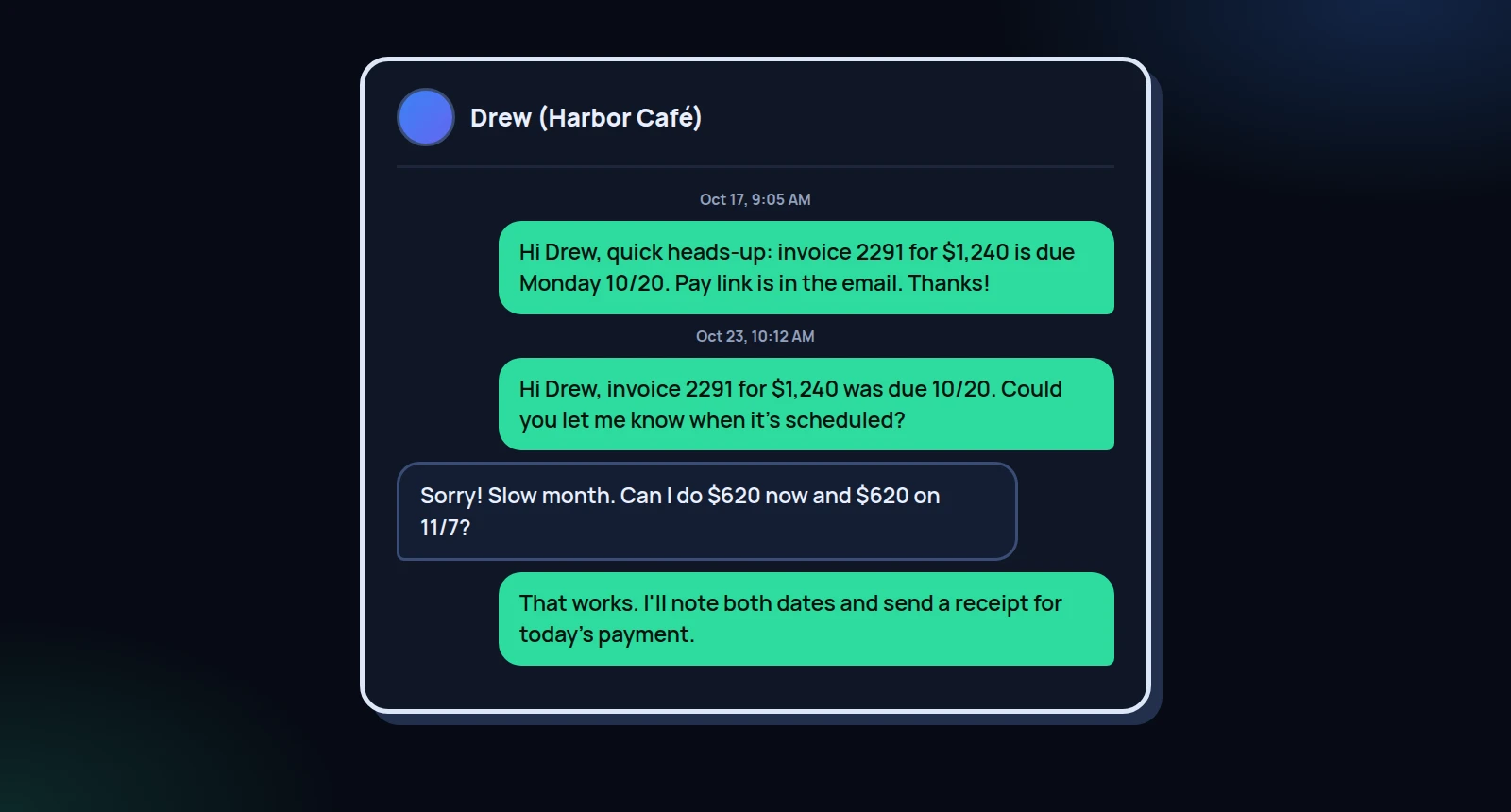
Hi Drew, invoice 2291 for $1,240.00 was due on 10/20 and I don’t see it on my side yet. Could you let me know when it’s scheduled? Here’s the link again in case it’s easier: [link].
If they don’t reply within 2 business days: “Hi Drew, just bumping this up. Is 10/20’s invoice still in your queue? Happy to resend it to whoever handles payments.”
Tip
For business customers, ask once who actually pays invoices. Sending reminders to the person who ordered, when a bookkeeper pays the bills, is the most common reason a friendly customer pays late.
Two weeks late: polite but firm
At 14 days, an overdue invoice needs a different tone. It shifts from “did you see this?” to “we need a date.” Keep it calm, add the consequence your terms already state, and offer a way out.
Message: 14 days late (email)
Subject: Invoice 2291 is now 14 days past due Hi Drew, invoice 2291 for $1,240.00 was due on October 20 and is now two weeks past due. Under our account terms, new orders on credit are paused until the balance is current. Could you reply by Friday with a payment date? If paying the full amount at once is hard right now, tell me, and we can set up two or three payments in writing. Robin
Notice what isn’t there: no “disappointed,” no capital letters, no “as I’ve said several times.” The facts are firm enough.
When they offer a partial payment or a plan
A customer who answers with “can I pay half?” is a customer who intends to pay. Say yes to a reasonable plan, but put the dates in writing right away so the plan is a commitment, not a mood.
Message: confirming a payment plan
Thanks, Drew, that works. To confirm: $620.00 today, October 23, and $620.00 on November 7, for invoice 2291. I’ll send a receipt for each payment. If anything changes before the 7th, just let me know before the date and we’ll sort it out.
Then record it. In IOUEZ, you can record the $620 as a partial payment against the agreement so both of you see the remaining $620, and the next reminder goes out on its own. On paper, write the plan on the invoice copy and date it.
Comparing channels
Different stages suit different channels. Here’s how they stack up for a small business.
| Text | Phone call | Letter | ||
|---|---|---|---|---|
| Best stage | Heads-up, 14 days | Due date, quick nudges | 30 days late | Final notice |
| Leaves a record | Yes | Yes | Only if you follow up in writing | Yes, especially if tracked |
| Gets read | Sometimes buried | Usually same day | If they pick up | Slow, but taken seriously |
| Can include a pay link | Yes | Yes | No | No |
| Watch for | Wrong inbox | Only text people who agreed to it | Calling at odd hours | Cost and delay |
A month late: pick up the phone
By 30 days, written reminders have usually done what they can. A short, calm call often gets further in two minutes than three emails did. Plan what you’ll say, and follow up in writing the same day.
Message: phone call outline at 30 days
“Hi Drew, it’s Robin from Northside Print. I’m calling about invoice 2291 for $1,240 from October. It’s now about a month past due. I’d rather sort this out with you directly. What would work for you: paying it this week, or splitting it over the next month?”
Follow-up email the same day: “Thanks for talking today. As agreed, you’ll pay $1,240.00 by November 21. I’ll send a receipt when it arrives.”
The final notice
Send a final notice only when you’ve decided what happens next, and only name a step you will actually take: sending the account to a collection agency, filing in small claims court, or writing it off and closing the account. A final notice with an empty threat teaches the customer that your deadlines are suggestions.
Message: final notice (email and letter)
Subject: Final notice: invoice 2291, $1,240.00 Hi Drew, invoice 2291 for $1,240.00 has been unpaid since October 20, and we haven’t been able to agree on a payment date. If we don’t receive payment or a written payment plan by December 12, we will [refer the balance to a collection agency / file a claim in small claims court]. We’d much rather settle this with you directly. You can pay here: [link], or reply to set up a plan. Robin, Northside Print Co.
When the late payer is a regular, or a friend
Small businesses have a problem big companies don’t: the person with the overdue invoice might be your neighbor, your kid’s soccer coach or your best customer for ten years. That’s exactly when owners stop following their reminder schedule and start “waiting for the right moment,” which never comes.
Payment reminders for small businesses only work if they go to everyone. Use the same schedule anyway, and say so out loud once: “I send the same reminders to everyone, so please don’t take them personally.” Then your Tuesday text isn’t about the friendship, it’s about the system. If you want to soften it, add one human line at the top (“Hope the new location is going well!”) and keep the amount, date and link exactly as specific as always.
Keep a simple reminder log
Every reminder you send is evidence that you asked clearly and gave the customer time. If an account ends up with an agency or in small claims court, a short log helps more than a pile of half-remembered phone calls. For each overdue invoice, note:
- the date and channel of each message (email, text, call, letter);
- what you asked for, and any date the customer promised;
- partial payments, with amounts and references;
- any dispute raised, and how you answered it.
A spreadsheet tab is enough. The point is that six weeks from now you can say “I reminded you on 10/17, 10/20, 10/23 and 11/3” without scrolling through three apps.
The legal guardrails, briefly
The federal Fair Debt Collection Practices Act is aimed mainly at third-party debt collectors, people who collect debts owed to someone else. The CFPB’s rule that implements it generally excludes a business collecting its own debts under its own name, and its employees doing that collecting. Two caveats: the FTC warns that a creditor who collects under a different name, one that suggests a third party is involved, can be treated as a debt collector, and the CFPB says companies can still be held accountable for unfair or deceptive collection practices.
Some states also have their own collection laws, and some of those reach businesses collecting their own debts. If you hand an account to an agency, the agency’s conduct is regulated, so choose one that follows the rules. And if your reminders involve a loan rather than an invoice, remember that lending as a business can need a state license; our guide to loan tracking for small lenders covers that.
Making payment reminders for small businesses a system, not a mood
The hardest part of reminders is sending them when you’re busy, when you like the customer, or when you’re annoyed. A written reminder schedule fixes all three, because the decision was made in advance. Put the schedule in your account terms, run it from a calendar or an app, and log every message you send.
Payment reminders for small businesses also work better when the paperwork behind them is clean. A monthly statement with an itemized balance (see our customer statement template) answers most “what is this for?” replies before they’re sent. If you run many accounts or loans with a team, look at the plans for organizations, and compare options on the pricing page.
Frequently asked questions
When should payment reminders for small businesses start?
Before the due date. A short heads-up about three days early, then a note on the due date, prevents a large share of late payments without any awkwardness. Firmer messages come later, in steps.
Is it okay to send payment reminders by text?
Yes, if the customer has agreed to hear from you by text. Keep texts short, include the amount, date and a pay link, and use email or a letter for anything formal like a final notice.
How many reminders should I send before calling?
Two or three written reminders are usually enough: before the due date, on the due date and a few days late. By 14 to 30 days late, a phone call followed by a written summary tends to move things faster.
Should I charge a late fee?
Only if your signed terms already say so, and only in the amount they state. Adding a surprise fee in a reminder tends to start a dispute. Check your state’s rules before adding late fees to your terms.
Does the FDCPA apply to my small business?
Generally not when you collect your own invoices under your own name, because the law mainly covers third-party collectors. It can apply if you use a different name that suggests a third party. State laws may also apply, so check with an attorney for your situation.
What if the customer disputes the invoice?
Pause the reminder schedule, ask what they think is wrong, and share the signed order or delivery record. Resolve the dispute first; reminders about a disputed amount only harden positions.
Sources
- Consumer Financial Protection Bureau, Regulation F, § 1006.2 Definitions, the definition of a debt collector and the exclusions for creditors and their employees.
- Federal Trade Commission, Think your company’s not covered by the FDCPA? You may want to think again, on creditors who collect under another name.
- Federal Trade Commission, Fair Debt Collection Practices Act, the text of the law.
- U.S. Small Business Administration, Manage your finances, on cash flow and the timing of incoming payments.