
If you own a duplex or a handful of units, you are running a small business whether you meant to or not. The money side comes down to four questions: who paid, who paid part, what you are holding as deposits, and what you can prove if anyone asks. This guide shows how to track rent payments with a rent ledger, a monthly routine, receipts and a deposit record, in the order the month actually unfolds.
Key takeaways
- One ledger per lease. Every charge and payment for that lease, in date order, with a running balance.
- Deposits are not rent. Record them separately, and check your state’s rules on where they’re held and when they’re returned.
- Write down partial payment plans before the grace period ends. A plan agreed on the 3rd is a plan; one discovered on the 20th is arrears.
- Receipt every payment, especially cash. Your receipts and ledger are your evidence.
Set up a rent ledger for each lease
The rent ledger is the single most useful record a small landlord keeps. It’s one running list per lease, not per property and not per person. When a tenant moves out and a new one moves in, start a new ledger, even for the same unit.
At the top, write the facts from the lease: tenant names, unit, lease start and end, monthly rent, due date, any grace period the lease gives, any late fee it states, and the security deposit amount and where it’s held. Below that, one line for every charge (rent, any agreed fees) and every payment, with a running balance.
Avery, a fictional owner of a four-unit building, uses a spreadsheet tab per lease and a single summary tab, the rent roll, that pulls the balance from each. Nothing fancy, but it answers “what does unit C owe right now?” in five seconds.
Tip
Post the rent charge on the 1st as its own line, then post payments against it. If you only record payments, a missing month is invisible. If you record the charge, a missing payment shows up as a balance.
The monthly calendar
Rent has a rhythm, and a routine built around that rhythm is the easiest way to track rent payments without it eating your evenings. Here’s Avery’s October, for leases with rent due on the 1st and a five-day grace period written into the lease.
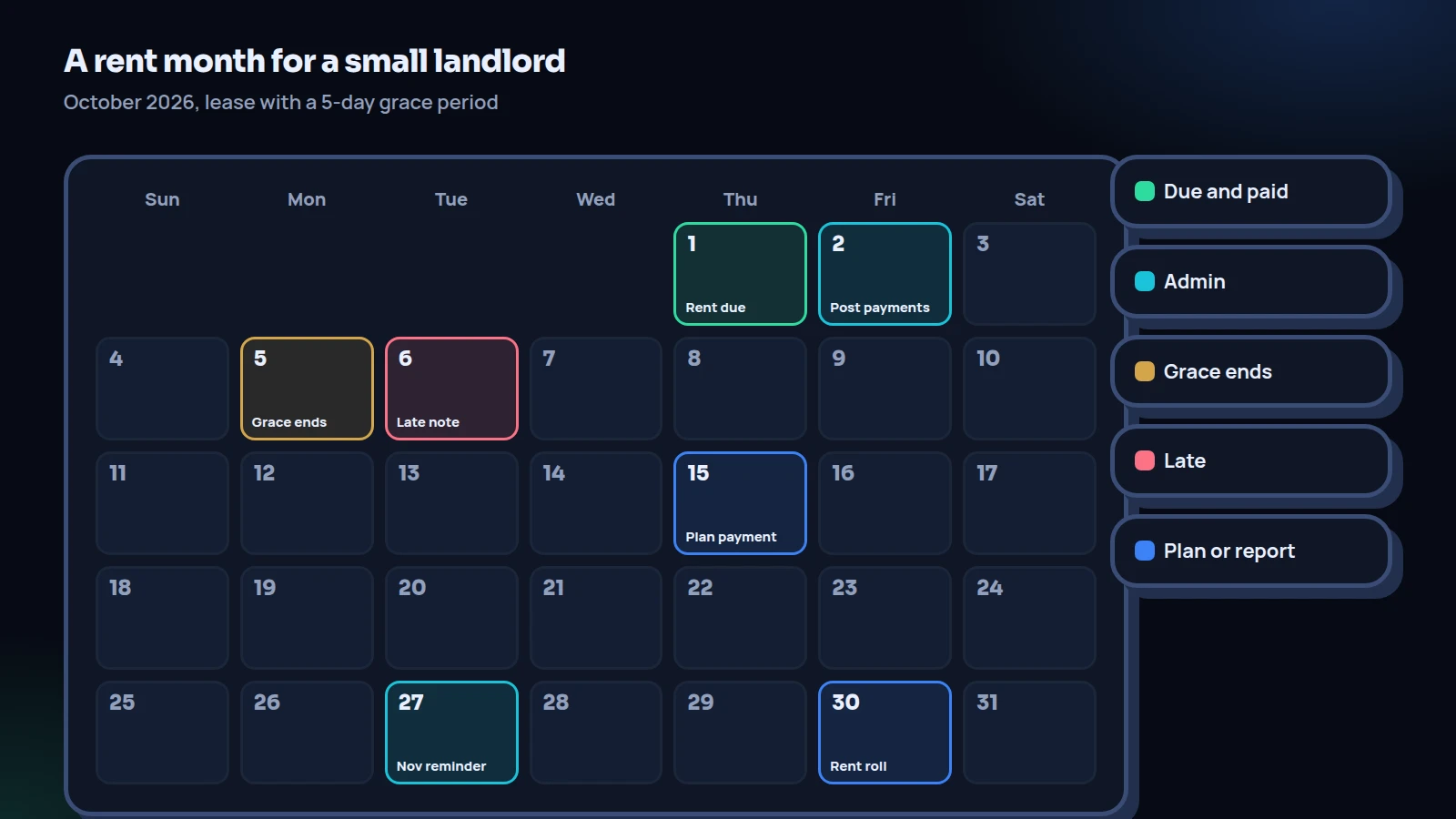
- 27th of the month before: a friendly reminder that rent is due on the 1st, with the amount and how to pay.
- 1st: rent charge posted to every ledger.
- 2nd: payments received so far posted, with dates and references.
- 5th: grace period ends (only if your lease gives one; some states set rules on grace periods and late fees).
- 6th: a short, factual note to anyone with an open balance.
- 15th: second half of any agreed partial payment plan.
- Last day: update the rent roll and reconcile to the bank.
Make payments easy to trace
The way tenants pay decides how much work it is to track rent payments later. Every method that leaves its own record saves you a step. Every method that doesn’t adds one.
- Bank transfer or online payment: the easiest to reconcile. Ask tenants to put a reference in the memo, such as “Unit A Oct rent,” so you aren’t matching anonymous deposits to names at month-end.
- Checks: fine, but deposit them promptly and note the check number in the ledger. A check sitting in your car for a week makes your bank balance and your ledger disagree.
- Money orders: keep a copy or photo before depositing, and write the receipt the same day.
- Cash: accept it if you must, and only with a numbered receipt on the spot. Never “I’ll write it up later.”
Pick a due date that matches how your tenants are paid where you can. A lease that starts mid-month can still have rent due on the 1st with a prorated first month; just show the proration math on the first ledger line so nobody wonders where the odd number came from. For a lease starting October 16 at $1,450 a month, for example, the first charge is $1,450 × 16 ÷ 31 = $748.39 for October 16–31.
How to track rent payments that arrive in pieces
Partial payments are where small landlords lose track. A tenant sends $900 by transfer, then $300 in cash a week later, then the rest after their next paycheck, and by month-end nobody is sure what’s still owed. The fix is the ledger plus one habit: agree any split in writing before the grace period ends.
Here’s how that looked for Jesse, a fictional tenant in Avery’s unit A, in October.
Worked example: one month with a partial payment plan
| Date | Entry | Charge | Payment | Balance |
|---|---|---|---|---|
| 10/01 | October rent | $1,450.00 | $1,450.00 | |
| 10/02 | Plan agreed in writing: $900 now, $550 on 10/15 | $1,450.00 | ||
| 10/02 | Payment, bank transfer ref 4471 | $900.00 | $550.00 | |
| 10/15 | Payment, cash, receipt #0217 | $550.00 | $0.00 |
Check: $1,450.00 − $900.00 − $550.00 = $0.00. Jesse asked on October 2, before the grace period ended, and the plan was written down that day, so Avery treated the month as on plan rather than late. Whether to charge a late fee in a case like this is up to the lease and your state’s rules; Avery’s lease says fees are waived when a written plan is agreed before the 5th.
Watch out
In some states, accepting a partial payment from a tenant who is already behind can affect your options if you later need to start an eviction. If a tenancy is heading that way, check your state’s rules, or ask a local attorney, before you accept a partial payment.
Security deposits: a separate record, and state rules
A security deposit belongs to the tenant until the lease ends and you’ve properly accounted for it. Treat it that way in your records: its own line on the ledger header, not mixed into rent.
The rules here are set mostly by states, and sometimes by cities or counties, and they vary a lot. Depending on where your property is, the rules may limit how large a deposit can be, require it to be kept in a separate or interest-bearing account, require you to pay the tenant interest, and set a deadline for returning it with an itemized list of any deductions. Even HUD’s handbook for its assisted housing programs notes that deposit laws differ between states and localities and tells owners to follow the stricter rule when they conflict.
So before you collect a deposit, look up your state’s landlord-tenant rules (your state attorney general or housing agency usually publishes a guide), and record:
- the amount and the date received;
- where it’s held, and the account if your state requires a separate one;
- any interest owed to the tenant, if your state requires it;
- the move-in condition, with dated photos or a signed checklist;
- at move-out, each deduction with a reason and the cost, and the date you returned the rest.
Tip
Take move-in photos with the tenant present and email them to both of you the same day. The email timestamp settles “that scratch was already there” arguments a year later.
Give a receipt for every payment
Receipts are the paper side of how you track rent payments. Bank transfers leave their own trail. Cash, money orders and checks handed over in person don’t, unless you create one. A receipt protects both of you: the tenant can prove they paid, and you can prove what you received and when. Number your receipts in order so a missing one stands out.
Template: rent receipt
RENT RECEIPT                         No. [0217]

Date received: [MM/DD/YYYY]
Received from: [Tenant name(s)]
Property / unit: [Address, unit]
Amount: $[0.00]   Method: [cash / check # / other]
For: [Month] rent [full / partial payment]

Rent due for [month]: $[0.00]
Paid this month including this receipt: $[0.00]
Balance remaining for [month]: $[0.00]

Received by: [Landlord or manager name]
Signature: ____________________
The “balance remaining” line is the important one. A receipt that just says “$550 received” doesn’t tell anyone whether the month is settled.
The rent roll: your whole building on one page
The ledgers track rent payments one lease at a time. Once a month, pull every ledger into a rent roll: one row per unit with rent due, rent paid and balance. It’s how you check your own numbers against the bank, and it’s what a lender, insurer or tax preparer will ask for.
Worked example: Avery’s October rent roll
| Unit | Rent due | Paid | Balance | Note |
|---|---|---|---|---|
| A | $1,450 | $1,450 | $0 | Plan completed 10/15 |
| B | $1,300 | $1,300 | $0 | Paid 10/01 |
| C | $1,200 | $600 | $600 | Late, note sent 10/06 |
| D | $1,350 | $1,350 | $0 | Paid 09/30 |
| Total | $5,300 | $4,700 | $600 |
Check: $1,450 + $1,300 + $1,200 + $1,350 = $5,300 due, and $1,450 + $1,300 + $600 + $1,350 = $4,700 collected, leaving $600 open. Bank deposits for October should total $4,700 too, minus anything paid in September for October (unit D paid a day early, which counts as advance rent; see the tax section below).
Unit A is Jesse’s, from the example above: paid in two parts, but paid. Unit C’s tenant, Jordan, gets the 6th-of-the-month note and, if they ask, a short written plan for the $600.
Rent, deposits and taxes
The IRS has clear rules on how rental income and deposits are treated, in Publication 527:
- Advance rent (money received before the period it covers) counts as rental income in the year you receive it, whatever period it covers and whatever accounting method you use. December’s early payment of January rent is income for December’s year.
- A security deposit you plan to return isn’t income when you receive it.
- Any part of a deposit you keep because the tenant didn’t meet the lease terms is income in the year you keep it.
- A “deposit” that will be used as the final month’s rent is advance rent, and is income when you receive it.
That last point catches people out, which is another reason to label deposits and last-month’s rent separately in your ledger. Keep the ledgers, receipts and bank records at least as long as the IRS recordkeeping rules require; when in doubt, ask your tax preparer.
When rent falls behind: turn arrears into a plan
When a tenant falls more than a month behind, a vague “pay what you can” tends to drift. A written repayment plan for the arrears, separate from ongoing rent, keeps both visible: current rent is still due on the 1st, and the back balance is paid down on its own schedule.
That’s where IOUEZ can help. You can set up the arrears as a signed agreement with the tenant, with an installment plan and due dates, record each payment as it arrives (partial payments included), and let the reminders go out the day before and on each due date. Both of you see the same remaining balance, so there’s no arguing about what’s left. For landlords with several buildings, see what the organization plans cover and compare them on the pricing page. For wording that stays firm without souring the relationship, our guide to payment reminders for small businesses has scripts you can adapt, and the monthly statement template works for tenants too.
Try it this month: start a ledger for each lease, post the rent charge on the 1st, and see how quickly you can answer “what does each unit owe?” If it takes more than a minute, your system is doing too little of the work.
Frequently asked questions
What’s the simplest way to track rent payments for a few units?
A rent ledger per lease (charges, payments and a running balance) plus a monthly rent roll that lists every unit’s balance. A spreadsheet is enough for a few units if you post the rent charge on the 1st and every payment the day it arrives.
Should I accept partial rent payments?
Many landlords do, as long as the plan is agreed in writing and recorded. If a tenant is already seriously behind and you may need to evict, check your state’s rules first, since accepting a partial payment can affect your options in some states.
Is a security deposit taxable income?
Not when you receive it, if you plan to return it. Any part you keep because the tenant broke the lease is income that year, and a deposit meant to cover the last month’s rent is advance rent, taxable when received, according to IRS Publication 527.
How fast do I have to return a security deposit?
It depends on your state, and sometimes your city. Many states set a deadline and require an itemized list of deductions. Look up your state’s landlord-tenant rules before the tenant moves out.
Do I need to give receipts for rent?
It’s good practice for every payment and especially for cash, and some places require it. A numbered receipt that shows the remaining balance protects you and the tenant.
How long should I keep rent records?
Keep ledgers, receipts, leases and deposit records for at least as long as the IRS recordkeeping rules require for your tax returns, generally 3 years and longer in some cases. Many landlords keep everything for 7 years.
Sources
- Internal Revenue Service, Publication 527, Residential Rental Property, on advance rent, security deposits and rental income.
- U.S. Department of Housing and Urban Development, HUD Occupancy Handbook 4350.3, Chapter 6, on security deposits in assisted housing and how state and local laws vary.
- Internal Revenue Service, How long should I keep records?, the retention periods for tax records.