
Every couple that moves in together runs into the same question within a month, usually in the grocery store: are we paying for this together, and if so, how? There are four common ways to split expenses as a couple, and on the same budget they leave each partner with very different amounts at the end of the month. Here’s one couple’s numbers run through all four, so you can see the trade-offs before you pick.
Example
Elliot and Finley have just signed a lease together. Elliot takes home $6,000 a month; Finley takes home $4,000. Their shared costs come to $4,000 monthly: rent $2,400, groceries $700, utilities and internet $300, and $600 for insurance, the car and household stuff. Elliot’s first suggestion is “let’s just go halves.” Finley does the math in their head and goes quiet.
Before you pick: what counts as shared?
Before you split expenses as a couple, agree what’s on the shared list at all. Rent and utilities, obviously. Groceries, almost always. But what about one partner’s gym membership, a car only one of you drives, the dog that was very much one person’s idea? Couples who skip this step end up arguing about the method when they’re really arguing about the list.
A simple test: if both of you use it most weeks, it’s shared. If one of you uses it and the other could happily live without it, it’s personal. Write the list down, total it, and only then choose how to split it. In our example, the $4,000 includes the car because Elliot and Finley share it; Finley’s climbing gym membership stays off the list.
The four ways to split expenses as a couple
Here’s what each method means, using Elliot and Finley’s $4,000 of shared costs and $10,000 of combined take-home pay.
1. The 50/50 split
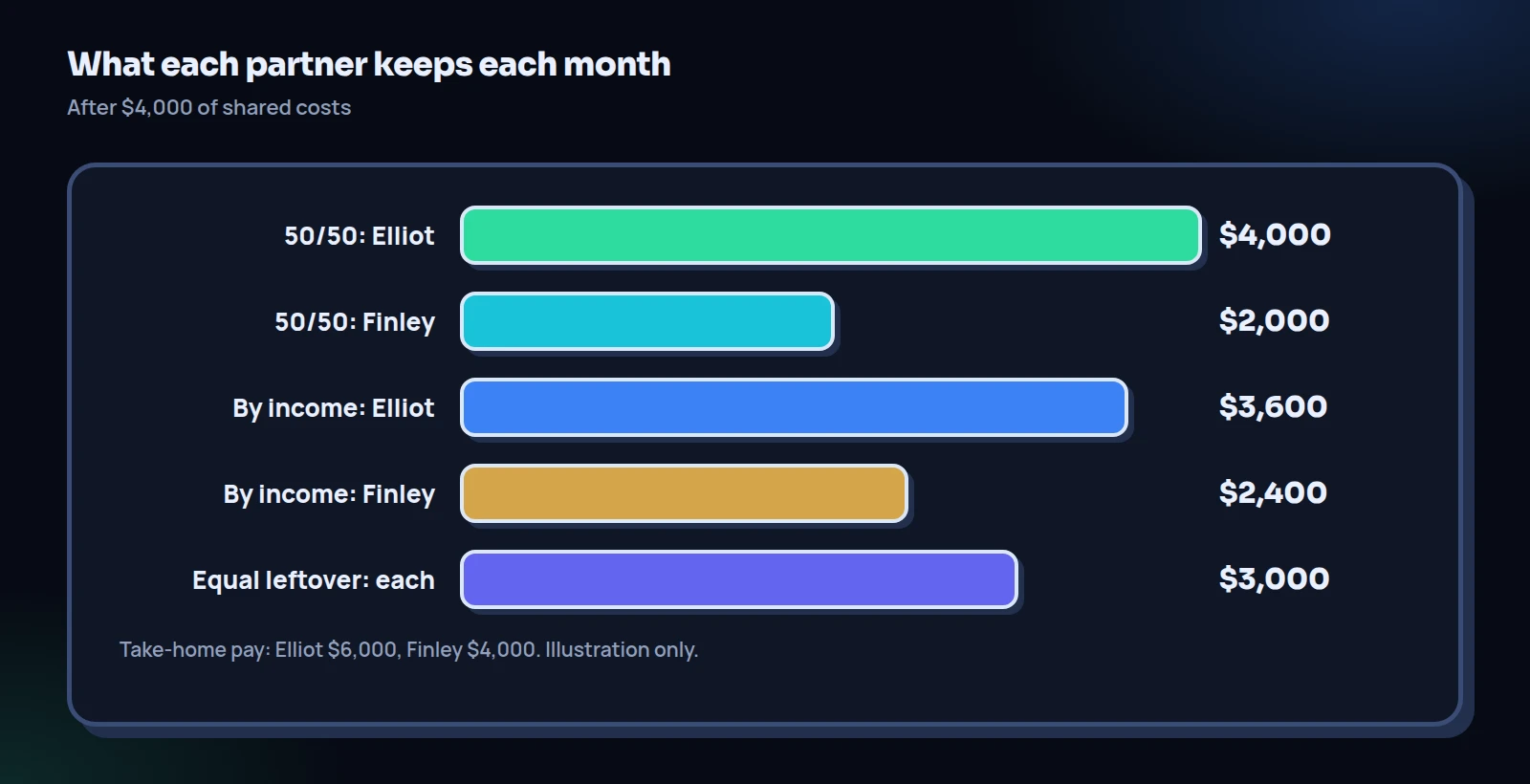
Each partner pays half of every shared cost: $2,000 each. Simple and symmetrical. Elliot keeps $4,000 of their pay for savings and personal spending. Finley keeps $2,000. Shared costs eat a third of Elliot’s income and half of Finley’s.
2. Split by income (proportional)
Each partner pays the same percentage of their income. Elliot earns 60% of the household’s $10,000, Finley 40%, so Elliot pays 60% of the $4,000 ($2,400) and Finley pays 40% ($1,600). Both spend 40% of their pay on shared costs. Elliot keeps $3,600, Finley keeps $2,400.
3. Equal leftover
Each partner ends up with the same amount after shared costs. The household has $6,000 left once the $4,000 is paid, so each keeps $3,000. Elliot pays $3,000 toward shared costs and Finley pays $1,000.
4. All in
Both paychecks go into one joint account. Shared costs, savings and personal spending all come from the pot, often with an agreed monthly allowance each for guilt-free personal spending. There’s no “split” at all, which is the point.
| 50/50 | By income | Equal leftover | All in | |
|---|---|---|---|---|
| Elliot pays | $2,000 | $2,400 | $3,000 | From the pot |
| Finley pays | $2,000 | $1,600 | $1,000 | From the pot |
| Elliot keeps | $4,000 | $3,600 | $3,000 | Agreed allowance |
| Finley keeps | $2,000 | $2,400 | $3,000 | Agreed allowance |
| Feels fair when | Incomes are close | Incomes differ | You think of money as fully shared | You’re long-term and aligned |
| Main risk | Lower earner is squeezed | Recalculating when pay changes | Higher earner feels taxed | Disagreements about spending |
Where the 50/50 split works, and where it hurts
The most common way to split expenses as a couple is also the oldest. A 50/50 split works beautifully when two people earn similar amounts and have similar spending habits. It’s clean, it’s easy to explain, and nobody ever feels they’re “supporting” the other.
It starts to hurt as the income gap widens. In our example, after shared costs Finley has $2,000 a month for everything else: savings, student loan payments, clothes, seeing friends. Elliot has $4,000. That gap shows up in small, corrosive ways. Elliot suggests a weekend away; Finley says it’s not in the budget. Elliot wants a nicer apartment; Finley can’t stretch to half of it. A 50/50 split can make the lower earner the one who’s always saying no, which isn’t good for anybody.
Our rule of thumb: when one partner earns more than about 20% more than the other, look hard at a proportional split before defaulting to halves.
Why we lean toward splitting by income
If we had to pick one way to split expenses as a couple with different incomes, it would be proportional. Each person contributes the same share of their pay, so the shared life costs each of them the same effort. Both partners keep a meaningful amount of their own money. And the higher earner still keeps more, which most people find fair.
Worked example: setting up a proportional split
| Step | Elliot | Finley | Household |
|---|---|---|---|
| Monthly take-home pay | $6,000 | $4,000 | $10,000 |
| Share of household income | 60% | 40% | 100% |
| Contribution to $4,000 shared costs | $2,400 | $1,600 | $4,000 |
| Joint savings goal: $500 | $300 | $200 | $500 |
| Kept for personal spending and savings | $3,300 | $2,200 | $5,500 |
Check: $2,400 + $300 + $3,300 = $6,000 for Elliot, and $1,600 + $200 + $2,200 = $4,000 for Finley. The joint savings goal (a vacation fund, an emergency cushion) uses the same 60/40 ratio as the bills.
The practical setup most couples use: a joint account for shared costs only. Each partner sends their percentage to it on payday, and rent, groceries and utilities come out of it. Everything else stays in separate accounts. Some people call this “yours, mine and ours.” It keeps the shared bills simple while leaving each partner some financial privacy.
Proportional split: pros
- Shared costs take the same share of each paycheck.
- Both partners keep real money of their own.
- Scales up or down as incomes change.
- Easy to automate with one joint account.
Proportional split: cons
- You need to talk about pay openly, which some couples find hard.
- Percentages need updating after raises, job changes or bonuses.
- Variable incomes (freelance, commission) make the ratio wobble.
- It can feel transactional early in a relationship.
Equal leftover and all in: the “we’re one household” options
Two more ways to split expenses as a couple take a different view entirely. Equal leftover treats the household as one unit for spending money: whatever’s left after shared costs is divided equally, no matter who earned it. All in goes one step further and pools everything.
Both work well for couples who think of their money as fully shared, often after marriage, after kids, or when one partner earns much less because they’re studying, caring for family or working part-time. The CFPB makes a related point worth reading even if you never fully merge: couples often share their financial lives but not the responsibility for managing them, and it helps to sit down together, take an inventory of income, expenses, debt and investments, and keep sharing as things change.
The risk with full pooling is different. Instead of arguing about who pays what, couples argue about who spends what. A monthly personal allowance for each partner, theirs to spend with no questions, takes care of most of that. Set it at an amount you’d both be comfortable seeing the other spend on something you consider silly.
Things that complicate how you split expenses as a couple
Real couples don’t have tidy spreadsheets. A few situations come up constantly:
- One partner has debt from before. Student loans or a credit card balance from before the relationship usually stay that partner’s responsibility, paid from their own share. If the other partner chooses to help, say clearly whether it’s a gift or a loan.
- One partner owns the home. If Elliot owned the apartment and Finley moved in, “rent” toward the mortgage doesn’t build Finley any equity. Many couples set Finley’s contribution closer to a fair share of costs rather than half the mortgage. Talk to a professional before mixing names on property.
- Unpaid work. If one partner does most of the childcare, cooking or caregiving, a straight income-based split can miss that contribution. Some couples adjust for it; at least name it.
- Variable income. For freelancers, base the percentage on a three-month average and revisit quarterly.
When life changes the numbers
Whatever way you split expenses as a couple, it’s a snapshot. Here’s what happens to Elliot and Finley’s split in two common changes.
One partner’s income drops
Finley goes back to school part-time and their take-home falls to $2,000. Household income is now $8,000. Under a 50/50 split, Finley would owe $2,000, all of their pay, which simply doesn’t work. Under a split by income, Elliot now earns 75% of the household’s money, so Elliot pays $3,000 and Finley pays $1,000. Elliot keeps $3,000; Finley keeps $1,000. Tight for Finley, but survivable, and it adjusted automatically without anyone having to ask for help.
This is the quiet strength of a proportional split: it bends when life does. A 50/50 arrangement has to be renegotiated in the middle of a stressful moment, often by the person who already feels like they’re falling behind.
A new shared goal
The couple decides to save $12,000 for a wedding over a year: $1,000 a month. Should it be 50/50 or proportional? There’s no rule. Some couples use the same ratio as their bills (60/40 here, so $600 and $400). Others decide a shared celebration should be shared equally ($500 each), and adjust other things to make it fit. Agree it explicitly; don’t let the bills ratio apply by default to something emotionally different.
A hybrid that many couples land on
After a year or two, plenty of couples settle on a mix: fixed shared costs (rent, utilities, insurance) by income, and smaller variable spending (dinners out, weekends away) 50/50 or taken in turns. It keeps the big numbers fair and the small ones light, and it means nobody needs a spreadsheet to buy takeout.
The money talk, in words you can use
The method matters less than the conversation. Couples who split expenses as a couple successfully usually aren’t the ones with the perfect formula; they’re the ones who talked about it before it became a grievance. Pick a calm evening, not the moment a bill arrives.
Message: opening the conversation
Can we sit down this weekend and figure out how we split the shared stuff? I don’t want either of us to feel stretched. I wrote down what rent, groceries and bills come to. Could we each bring our take-home pay so we can compare a few options?
If one of you is nervous about sharing numbers: We don’t have to decide anything today. Let’s just look at what 50/50 and a split by income would each look like for both of us, and sleep on it.
Write down what you agree, even in a shared note. Revisit it every six months or after any big change: a raise, a job loss, a move, a baby. The best way to split expenses as a couple at 27 may not be the best way at 35.
Tip
Automate the contributions on payday. A transfer that moves your share to the joint account the morning your pay lands takes the monthly “did you send your half?” conversation off the table forever.
When one partner lends the other money
Separate from day-to-day splitting, partners sometimes lend each other larger amounts: covering a car repair, a security deposit, a course. That’s a loan, not a shared expense, and it’s worth treating like one even inside a happy relationship. Agree the amount and a schedule, and write it down. IOUEZ lets you record it as an IOU you both sign, with reminders before each payment and a shared balance you can both see. Our guide to lending money to a partner covers how to have that conversation kindly.
For married couples, the IRS rules say gifts to your spouse are generally not taxable gifts (with special limits when a spouse isn’t a US citizen). Unmarried partners don’t get that treatment: large gifts between them follow the normal annual exclusion, $19,000 per recipient for 2026. Most day-to-day bill splitting never gets near these rules, but a big transfer for a down payment might.
If you share a home with friends rather than a partner, the same ideas apply in a different shape; see how roommates split rent and bills. And for quick math on any one shared bill, our split calculator does the arithmetic for you.
Frequently asked questions
What’s the fairest way to split expenses as a couple?
When incomes are similar, 50/50 is fair and simple. When one partner earns noticeably more, splitting by income usually feels fairer, because shared costs take the same share of each paycheck.
How do you calculate a proportional split?
Divide each partner’s take-home pay by the household total to get their percentage, then pay that percentage of each shared cost. With $6,000 and $4,000, that’s 60% and 40%.
Should we open a joint account?
Many couples find a joint account for shared bills only is the easiest setup. Each partner funds it with their share on payday, and personal spending stays separate.
Should we split by take-home or gross pay?
Take-home is usually fairer, because it’s the money each person actually has. If one partner has much higher retirement contributions, agree whether to count them.
How often should we revisit how we split expenses as a couple?
Every six months, or whenever income or costs change significantly. A ratio that was fair last year may not be after a raise or a move.
Is it unromantic to track who pays what?
Less unromantic than resentment. A clear system means you don’t have to think about money every day, which leaves more room for everything else.
Sources
- Consumer Financial Protection Bureau, Share financial information with your spouse now to avoid problems later (consumer advisory), on taking an inventory of household finances together.
- Internal Revenue Service, Frequently asked questions on gift taxes, on gifts to a spouse and the annual exclusion.
- Internal Revenue Service, IRS releases tax inflation adjustments for tax year 2026, including amendments from the One, Big, Beautiful Bill, which keeps the annual exclusion at $19,000.