
Every group trip has the same quiet moment near the end: someone opens their banking app, squints, and asks “so, who owes what?” There are really only five sensible ways to split trip costs, and each one gives a different answer for the same vacation. Below, we run one four-person beach trip through all five, with the actual numbers, so your group can choose a method before anyone books anything.
The trip we’ll use for every method
Here’s the illustration. Noor, Kai, Robin and Dev rent a beach house for four nights. Dev has a work thing and arrives a day late, so they stay three nights. Three of them rent a car; Dev takes the train and never sets foot in it. Kai, Robin and Dev book a kayak tour; Noor would rather read on the porch. On the last night they all go out for a big dinner, where Dev sticks to sparkling water while the other three order cocktails.
The bills, and who paid them at the time:
- Beach house: $1,500 for four nights, paid by Robin when booking.
- Groceries: $300, paid by Noor.
- Rental car and gas: $300, paid by Kai. Used by Noor, Kai and Robin.
- Kayak tour: $240 ($80 a person), paid by Kai. Joined by Kai, Robin and Dev.
- Final dinner: $360 including tax and tip, paid by Dev. Itemized, it came to Noor $105, Kai $95, Robin $100, Dev $60.
That’s $2,700 in total. Nothing exotic, and that’s the point: if you can split trip costs for this weekend, you can split them for almost any trip. Most trips look like this: one big shared cost, a few things only some people did, and one meal where somebody ordered the lobster.
Method 1: split everything equally
The simplest way to split trip costs: add it all up, divide by the number of people, done. $2,700 divided by 4 is $675 each. Nobody tracks anything during the trip except the receipts themselves.
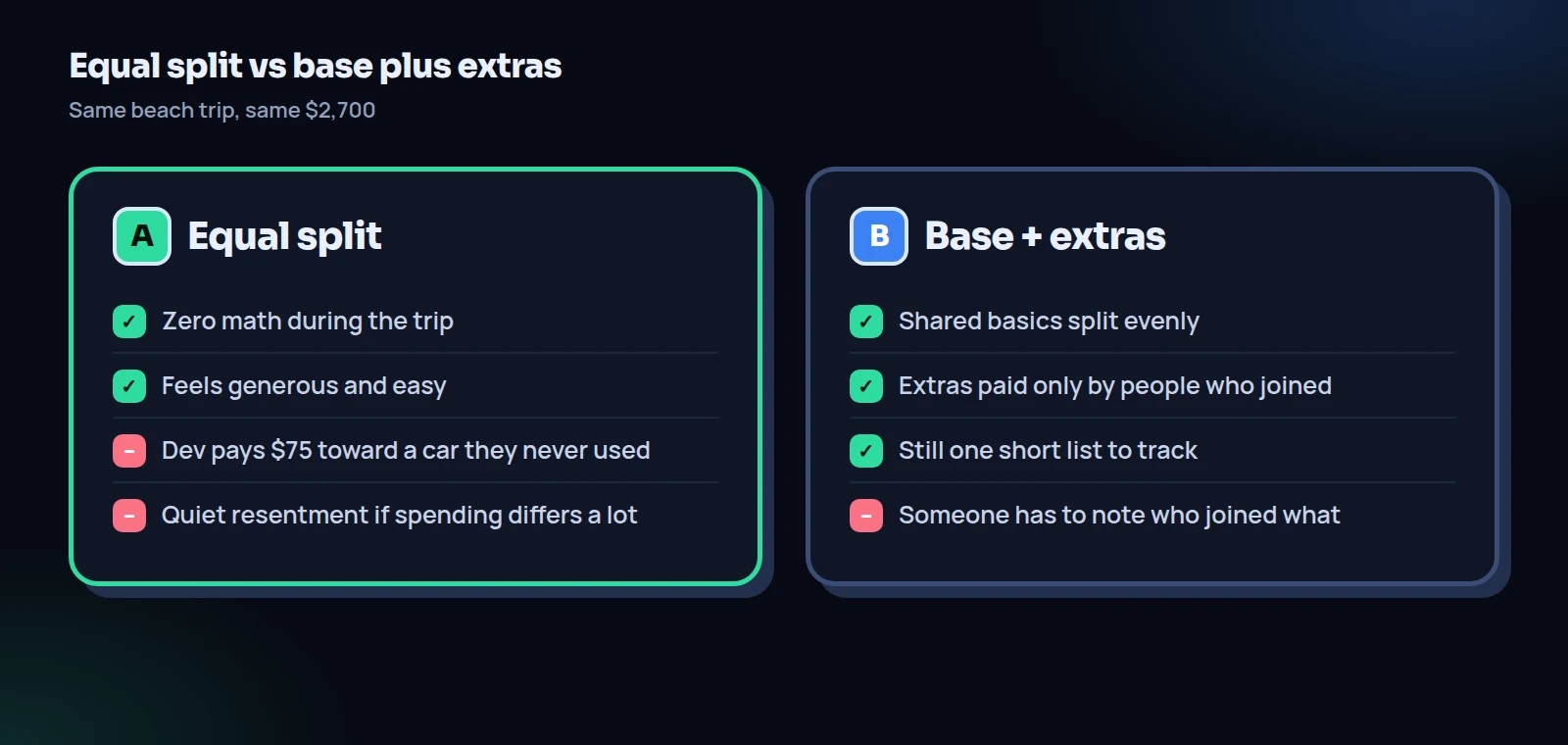
Equal splitting works beautifully when everyone does roughly the same things and spends at roughly the same level. It also feels generous, which matters on vacation. The trouble starts when the trip isn’t actually equal. Under this method Dev pays a quarter of a rental car they never rode in, and a quarter of the cocktails they didn’t drink. Dev might shrug that off. Dev might also remember it every time this group plans another trip.
Method 2: itemized, pay for what you used
An itemized split assigns every expense only to the people who used it, at the level they used it. The house and groceries split four ways ($375 and $75 each). The car splits three ways ($100 each for Noor, Kai and Robin). The kayak tour is $80 each for the three paddlers. Dinner follows the itemized check.
- Noor: $375 + $75 + $100 + $0 + $105 = $655
- Kai: $375 + $75 + $100 + $80 + $95 = $725
- Robin: $375 + $75 + $100 + $80 + $100 = $730
- Dev: $375 + $75 + $0 + $80 + $60 = $590
Check: $655 + $725 + $730 + $590 = $2,700. It’s the most precise answer, and precision has a cost. Somebody has to write down who ordered what at every meal, and the group starts feeling like a small accounting firm. Itemized splits are worth it for big, uneven items. For a $14 round of ice cream, they’re mostly a way to annoy each other.
Method 3: shares, for when people stayed different amounts
Shares (some apps call them weights) let you say “this person counts for more or less of this cost.” The classic case is nights. Dev stayed three nights, the others stayed four, so the house has 15 person-nights in total: $1,500 divided by 15 is $100 per person-night. Groceries work the same way: $300 over 15 person-nights is $20 each.
- Noor, Kai, Robin: $400 for the house and $80 for groceries each.
- Dev: $300 for the house and $60 for groceries.
Add the car and kayak by who used them, and dinner by the itemized check, and you get Noor $670, Kai $750, Robin $750, Dev $530. Check: $670 + $750 + $750 + $530 = $2,700.
Shares are also how you handle a couple sharing one bedroom (count them as two people, or as one and a half if that’s what the group agrees), or a kid who eats half as much. Agree the weights before the trip, though. Arguing about whether a nine-year-old counts as 0.5 or 0.75 of a person, at the end of a long week, is how family reunions get remembered for the wrong reasons.
Method 4: equal base, opt-in extras
This is the hybrid, and it’s our favorite for most friend trips. The shared basics (lodging, groceries, the group dinner) split equally. Anything optional (the car, the tour, the spa day, the bottle service) is paid only by the people who opted in.
The base here is $1,500 + $300 + $360 = $2,160, or $540 each. Then the extras:
- Noor: $540 + $100 car = $640
- Kai: $540 + $100 car + $80 kayak = $720
- Robin: $540 + $100 car + $80 kayak = $720
- Dev: $540 + $80 kayak = $620
Check: $640 + $720 + $720 + $620 = $2,700. Dev still pays a full quarter of the house despite arriving a day late, plus a slice of other people’s cocktails, but not a car they never used. You only track one short list (“who joined the extras”), not every coffee.
Method 5: the kitty
A trip kitty (or pot) is less a split rule than a way of holding money. Everyone puts the same amount in on day one, one person keeps it, and shared costs come out of it as you go. Say each friend puts $300 into the kitty: $1,200. It pays for the groceries, the car and the dinner, $960 in total, and $240 comes back at the end, $60 to each person.
A kitty is wonderful during the trip. Nobody fronts a big dinner, nobody keeps a running tab, and paying for things feels painless because the money is already “spent.” What it doesn’t do is decide fairness. Notice that in this version Dev paid a quarter of the car again, because the kitty paid for it. If you want the base-plus-extras result, extras have to stay out of the kitty and get paid separately. So pair the kitty with a rule: “the kitty pays for base costs; extras come out of your own pocket.”
Two practical notes. The kitty-holder should keep receipts, or at least photos of them. And if the kitty sits in a payment app balance, the CFPB points out that money held in a payment app may not have deposit insurance the way a bank account does, so move what’s left out of the app when the trip ends.
Five ways to split trip costs, side by side
Same trip, same $2,700. Here’s how the methods stack up on the things groups actually argue about.
| Equal | Itemized | Shares | Base + extras | Kitty | |
|---|---|---|---|---|---|
| Tracking during the trip | Receipts only | Every item, every person | Nights or weights, plus usage | One list of extras | One holder, receipts |
| Fair when spending differs | No | Very | Very | Mostly | Depends on the rule |
| Feels relaxed | Yes | Rarely | Somewhat | Yes | Yes |
| Main risk | Quiet resentment | Pettiness | Arguing weights late | Forgetting who joined | Kitty runs dry mid-trip |
| Best for | Similar budgets, similar plans | Big gaps in spending | Different lengths of stay | Most friend trips | Lots of small shared costs |
Worked example: what each person pays, by method
| Person | Equal | Itemized | Shares | Base + extras |
|---|---|---|---|---|
| Noor | $675 | $655 | $670 | $640 |
| Kai | $675 | $725 | $750 | $720 |
| Robin | $675 | $730 | $750 | $720 |
| Dev | $675 | $590 | $530 | $620 |
| Total | $2,700 | $2,700 | $2,700 | $2,700 |
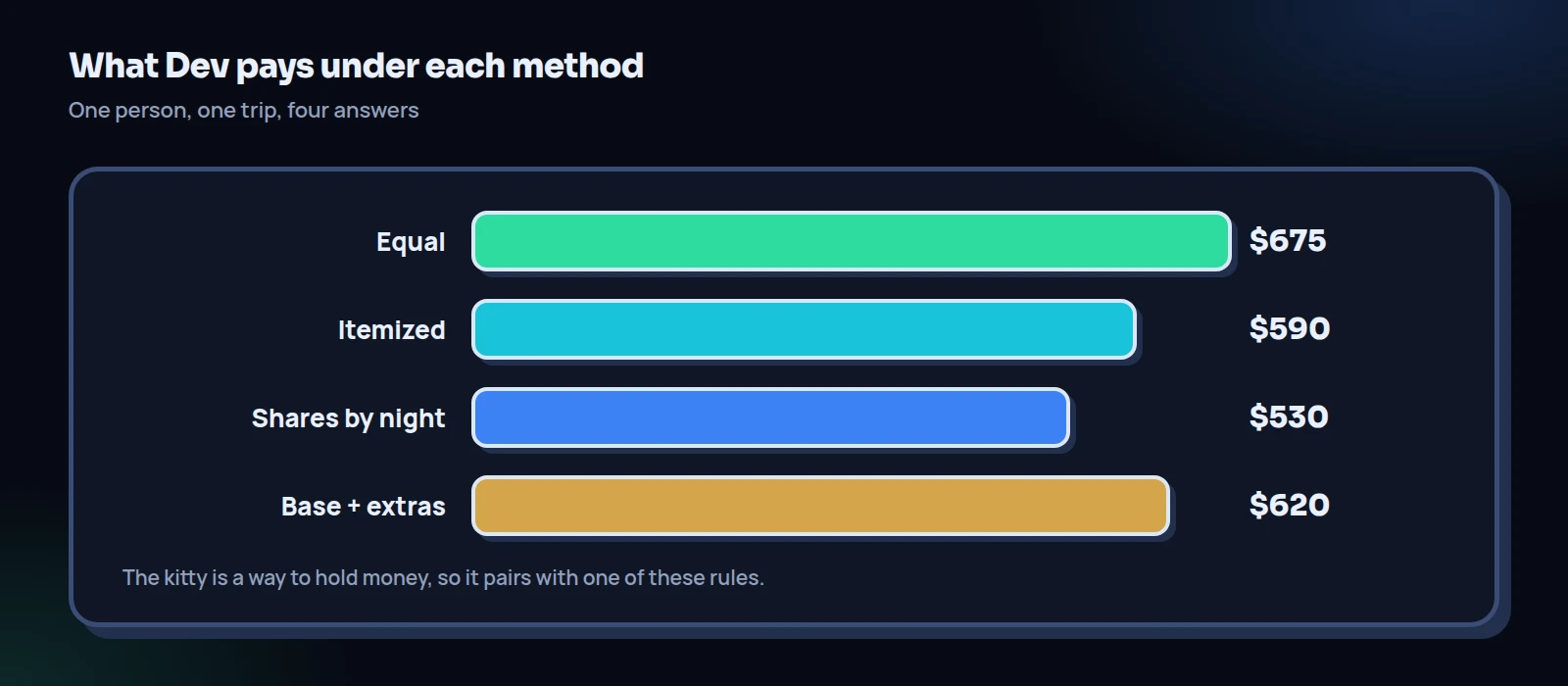
Every column adds up to the same trip. What changes is who carries the uneven parts. Dev’s number swings from $530 to $675 depending on the rule, a $145 difference for one person on one long weekend.
Which way to split trip costs should your group pick?
Here’s how we’d decide, quickly.
- Pick equal if everyone is doing the same things, budgets are similar, and you’d rather overpay by $20 than talk about $20. Good for a weekend where the plan is “the cabin and the lake.”
- Pick itemized if spending will differ a lot: one person is splurging on tasting menus while another is on a tight budget. Also good when you split travel expenses on work trips, where receipts go back to different employers.
- Pick shares if people stay different lengths of time, or you have couples and singles sharing rooms of different sizes.
- Pick base plus extras if you have a mix of shared basics and optional activities. That’s most trips, which is why it’s our default.
- Add a kitty if there will be lots of small shared costs (groceries, gas, tolls, beach chairs) and nobody wants to front them.
Deciding before the trip
- Nobody feels ambushed by a rule chosen after they spent the money.
- You can tell people the rough cost upfront, so they can say no early.
- The person who books the house knows what they’re fronting.
Deciding after the trip
- Everyone quietly argues for the method that’s cheapest for them.
- Receipts are lost, so “itemized” becomes guessing.
- The person who fronted the most waits the longest.
Agree how to split trip costs in one message
You don’t need a meeting. One message in the group chat, sent when the house is booked, does the job. Something like: “Proposal: house, groceries and the group dinner split evenly. Car, tours and anything optional paid by whoever joins. Kai is tracking the extras in a note. We settle up within three days of getting home. Thumbs up if that works.” Then wait for four thumbs.
Tip
Name one tracker per trip, not per expense. One person keeps the list of who paid what and who joined which extra. Everyone else just sends them a photo of each receipt. It’s a small job, and whoever does it should get the front seat.
For the money itself, a trip like this settles in very few payments if you net everything out first. With the base-plus-extras numbers, Robin fronted $1,500 but owes $720, so Robin is owed $780. Noor paid $300 and owes $640, so Noor owes $340. Kai paid $540 and owes $720, so Kai owes $180. Dev paid $360 and owes $620, so Dev owes $260. Three payments, all to Robin: $340 + $180 + $260 = $780. We explain the netting trick properly in how simplify debts works, and walk through the whole end-of-trip routine in our settle-up checklist.
Common mistakes that make trips expensive in the wrong way
Most money fights on trips aren’t about how you split trip costs. They’re about surprises. A few to avoid:
- Forgetting the deposit. Whoever books lodging often fronts hundreds or thousands of dollars weeks early. Ask for shares of the deposit as soon as it’s paid, not after the trip. You can split trip costs that arrive early just like the ones that arrive late.
- Mixing currencies without a rule. If you’re abroad, agree whether to convert at the rate on each person’s card statement or one rate for the whole trip. Card foreign transaction fees vary by card; the CFPB describes them as a fee for purchases made in a foreign currency or outside the US, so check yours before you leave.
- Letting refunds vanish. A canceled tour or a returned security deposit belongs to the whole group. Subtract it from the cost before you split.
- Splitting with someone who didn’t come. If a friend drops out after the house is booked, decide as a group whether they still owe their share. Do it kindly, but do it, or the remaining people quietly pay for an empty bed.
Watch out
Payment apps feel casual, but the FTC warns that sending money through one is a lot like handing over cash: it’s very hard to get back if it goes to the wrong person. Double-check the username before you send the settle-up payment, especially if you’ve never paid that friend through the app before.
When someone can’t pay their share of the split trip costs yet
It happens. Someone’s paycheck lands next week, or the trip cost more than they expected. That’s fine; just don’t let it turn into a vague “I’ll get you later.” If Noor can’t send Robin the full $340 right away, agree a small plan: $170 on the 1st and $170 on the 15th, say. Write it down.
That’s where IOUEZ helps. Robin can create an IOU for the $340 with those two due dates, Noor reviews and signs it on their own phone, and reminders go out before each date so Robin never has to send an awkward nudge. When Noor pays, they record the payment and both see the balance drop. If you’ve never set up a friendly repayment plan before, lending money to a friend covers the basics, and the bill calculator on our free calculators page handles quick per-person math with tax and tip.
Money friends send each other to split trip costs is personal, not business income. The IRS lists sharing the cost of a meal or a car ride as personal payments that shouldn’t be reported on a Form 1099-K, and suggests marking such payments as non-business in payment apps when you can.
The best way to split trip costs is the one your group agreed to before anyone paid for anything.
If you’re still in the planning stage, our guide to a group trip budget covers how to set a number everyone can live with before the first deposit leaves anyone’s account. Picking the split method is step two; agreeing what the trip should cost is step one.
Frequently asked questions
What’s the fairest way to split trip costs with friends?
For most groups, splitting shared basics equally and letting optional extras be paid by whoever joins them is the fairest balance of accuracy and effort. If spending will differ a lot, go fully itemized. If people stay different lengths of time, use shares by night.
How do you split trip costs when one person stays fewer nights?
Count person-nights. Divide the lodging cost by the total number of nights everyone stayed, then multiply by each person’s nights. In our example, $1,500 over 15 person-nights is $100 a night, so the person who stayed three nights pays $300.
Should couples count as one or two people?
Usually two, since they eat, drink and join activities as two. Some groups give a couple sharing one room a slightly lower lodging share. Either is fine if you agree before the trip.
Is a trip kitty a good idea?
For lots of small shared costs, yes. It saves anyone from fronting money during the trip. Just decide which costs the kitty covers, keep receipts, and return any leftover money when you get home.
How do you split trip costs if someone drops out?
Decide together whether they still owe their share of anything already booked, like the house. If the group can fill the spot or get a refund, pass that saving back to them. Agree it in writing so nobody pays for an empty bed by default.
When should we settle up after a trip?
Within a few days. Memories and receipts fade fast, and the people who fronted the most are waiting. Agree a settle-up date in the same message where you agree the split method.
What if someone disputes the total afterward?
Share the list of expenses with photos of receipts and who paid each one. Most disputes are about a missing refund or a forgotten payment, and they disappear once everyone can see the same list.
Sources
- Internal Revenue Service, Understanding your Form 1099-K, on personal payments such as sharing the cost of a meal or car ride, and marking payments as non-business.
- Federal Trade Commission, Mobile Payment Apps: How To Avoid a Scam When You Use One, on double-checking recipients and why payment app transfers are hard to reverse.
- Consumer Financial Protection Bureau, Is the money I keep in my payment app safe?, on deposit insurance and payment app balances.
- Consumer Financial Protection Bureau, Credit card contract definitions, which defines foreign transaction fees.