
Most small businesses set credit limits the way they’d guess the weight of a cake: a quick look and a confident number. The trouble is that gut-feel limits tend to be generous to the friendliest customers, not the most reliable ones. Here’s a way to set credit limits for customers using four numbers you already have, worked through for three illustrative accounts, with every step of the math shown.
First, fix your terms
A limit only means something next to clear terms. Before you set credit limits for customers, decide three things and write them on every account agreement and statement.
The payment window. Net 30 (pay within 30 days of the invoice or statement) is the common default for trade credit between businesses. Net 15 suits fast-moving goods like food, where your own suppliers want paying quickly. Longer terms, such as net 60, push more of your money into other people’s pockets and raise every limit the formula produces.
What counts as late. “Late” should be a date, not a feeling. If you quietly allow 10 days before chasing, build those 10 days into the formula, because that money is out whether you call it grace or not.
What happens at the limit. Will you decline a charge that goes over? Call first? Allow a one-time bump? Pick one rule and apply it to everyone. The worst setup is a limit that exists on paper but that staff ignore when a regular is standing at the counter with a full cart.
The four inputs you need to set credit limits for customers
Every limit in this method comes from four inputs. Gather them before you open the calculator.
1. What the customer actually buys
Take their average monthly purchases over the last three to six months. Use real invoices, not what they say they’ll buy once you extend credit. For a brand-new customer, use their first few cash orders, or a conservative estimate you’d be comfortable defending.
2. How long your terms let money stay out
On net 30 terms, a customer who buys steadily will always owe you about a month of purchases. Add the grace you realistically allow before you chase, say 10 days, and you get the number of days of purchases that will sit unpaid at any one time: 40.
3. How they’ve paid so far
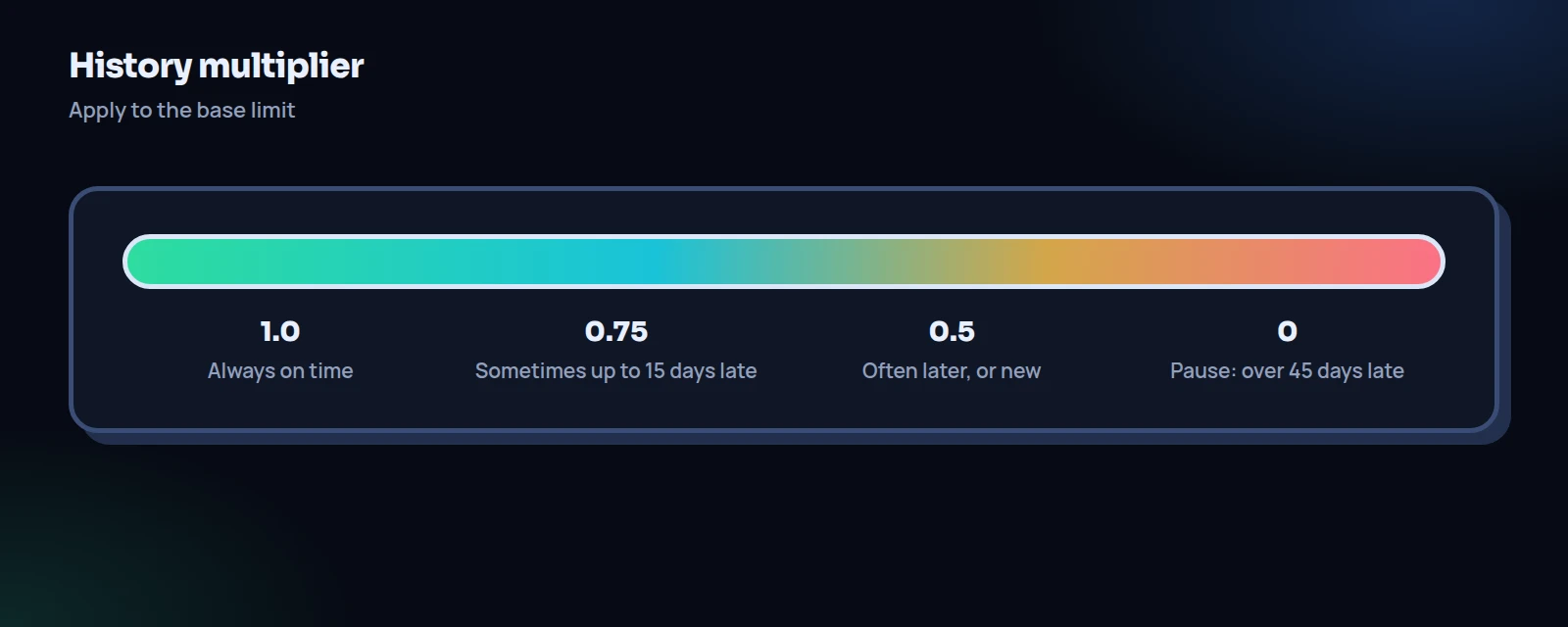
Payment history is the best predictor a small business has. We turn it into a simple multiplier, from 1.0 for customers who always pay on time down to 0.5 for slow payers and new accounts.
4. How much you can afford to lose
This is your risk budget, and it’s about you, not them. Take the cash cushion you could lose without missing payroll or rent, and decide what share any single customer may represent. We use 25% in the examples below. A smaller cushion means a lower cap for everyone.
The credit limit formula
Put the four inputs together like this:
Formula: base limit, then adjust, then cap
| Step | Calculation |
|---|---|
| Base limit | Monthly purchases × (terms days + grace days) ÷ 30 |
| Adjusted limit | Base limit × history multiplier |
| Final limit | The lower of the adjusted limit and your per-customer cap |
| Per-customer cap | Cash cushion × your chosen share (for example 25%) |
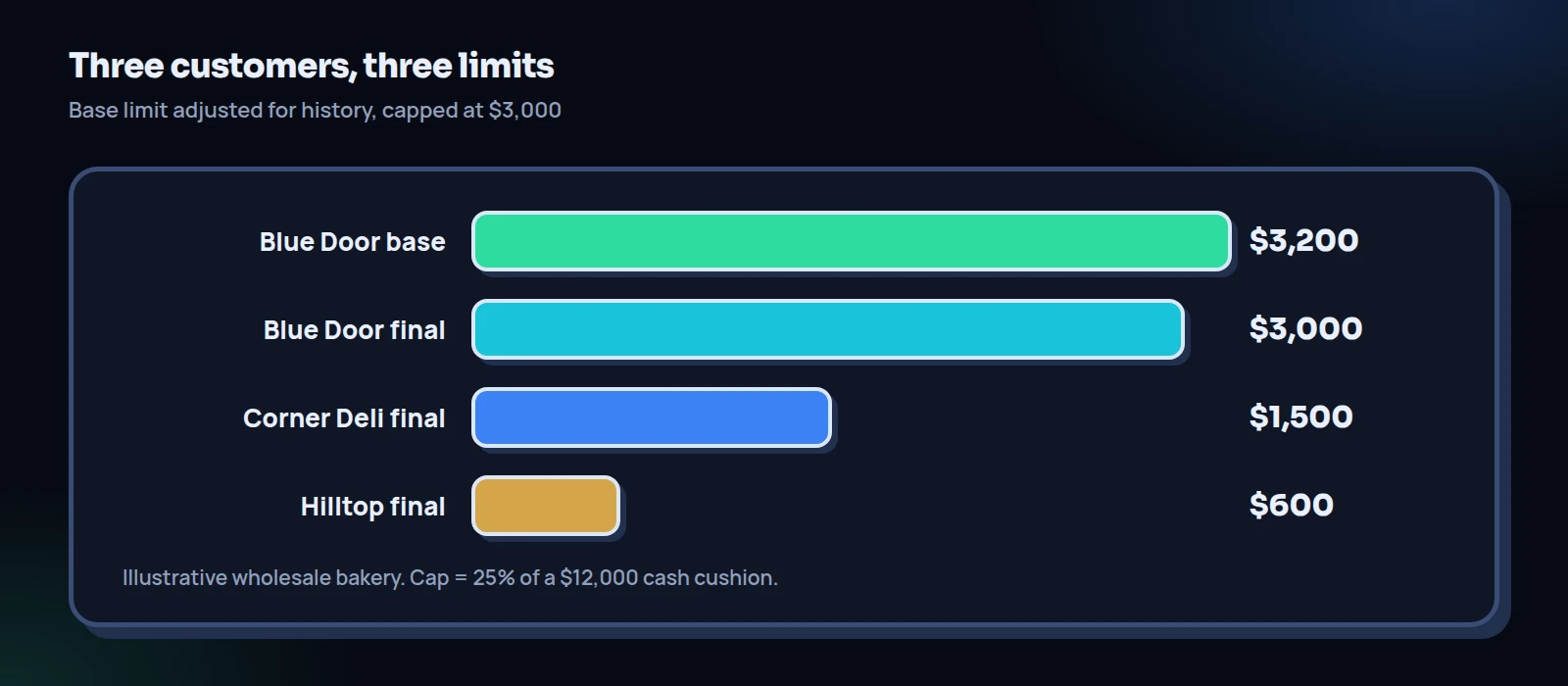
For a customer whose monthly purchases average $2,400, on net 30 with 10 days of grace: $2,400 × 40 ÷ 30 = $3,200 base limit. If they always pay on time, the multiplier is 1.0, so the adjusted limit stays $3,200. With a $12,000 cushion and a 25% cap, the cap is $3,000, so the final limit is $3,000.
Why divide by 30? Because the formula converts “days of purchases outstanding” into dollars. Forty days of a $2,400 month is one and a third months, and $2,400 × 1⅓ = $3,200.
Three customers, worked through
Kai runs a fictional wholesale bakery that sells bread and pastries to local cafés and shops on net 30 terms. Kai’s cash cushion is $12,000, so no single customer gets more than $3,000. Here’s how the method plays out for three accounts.
Worked example: Kai’s three wholesale accounts
| Customer | Monthly buys | Base (× 40 ÷ 30) | History | Adjusted | Final limit |
|---|---|---|---|---|---|
| Blue Door Café | $2,400 | $3,200 | Always on time, 1.0 | $3,200 | $3,000 (capped) |
| Corner Deli | $1,500 | $2,000 | Sometimes late, 0.75 | $1,500 | $1,500 |
| Hilltop Market | $900 | $1,200 | New (3 months), 0.5 | $600 | $600 |
| Total | $4,800 | $5,100 |
Check the middle row: $1,500 × 40 ÷ 30 = $2,000, and $2,000 × 0.75 = $1,500. The bottom row: $900 × 40 ÷ 30 = $1,200, and $1,200 × 0.5 = $600. Total credit Kai has committed is $3,000 + $1,500 + $600 = $5,100, well under the $12,000 cushion even if every account maxed out at once.
A credit limit isn’t a reward for being nice. It’s how much of your own money you’re willing to have sitting in someone else’s pocket.
What one default really costs
Before you approve a limit, run one more number: how much extra selling it would take to recover if that customer never paid. Divide the limit by your gross margin.
Worked example: recovering a lost balance
| Account | Limit | Kai’s margin | New sales to earn it back |
|---|---|---|---|
| Blue Door Café | $3,000 | 35% | $3,000 ÷ 0.35 = $8,571.43 |
| Corner Deli | $1,500 | 35% | $1,500 ÷ 0.35 = $4,285.71 |
| Hilltop Market | $600 | 35% | $600 ÷ 0.35 = $1,714.29 |
If losing $3,000 would mean selling more than $8,500 of bread just to get back to zero, ask whether the account is worth that risk. For Blue Door, with two spotless years, Kai decides it is. For a new café asking for the same limit, it wouldn’t be.
Adjusting limits over time
A limit is a starting point, not a life sentence. Put a review date on every account and use simple, written rules so the conversation is never personal.
- Raise after six clean months. If a customer paid every statement on time for six months, rerun the formula with their new purchase average and a better multiplier. Hilltop Market moving from 0.5 to 0.75 on the same $900 of monthly purchases would go from $600 to $1,200 × 0.75 = $900.
- Review when they keep bumping the ceiling. A balance above 80% of the limit on two statements in a row means either their business grew or their cash is tight. A quick call tells you which.
- Pause, don’t argue, when they’re late. Anything over 45 days late drops the multiplier to zero: no new charges until the balance is current.
- Lower limits in writing. Send a short note with the new limit and the reason, using the same rules you applied to everyone.
Tip
Don’t tell a new customer “your limit is $600 because we don’t trust you yet.” Say “every new account starts at half the normal formula, and we review after six months.” Same number, no hurt feelings.
Special cases the formula doesn’t cover
The formula handles steady customers well. A few situations need a judgment call on top of it.
Seasonal customers
A garden center that buys heavily in April and barely at all in November will look tiny or huge depending on which months you average. Use the average of their busiest three months, but drop the history multiplier one step for the season, since cash is often tightest right before their busy period pays off. Revisit the limit when the season ends.
One big order
A customer who normally buys $500 a week asks for a $6,000 order for a catering job. Don’t raise the limit for a one-off. Ask for a deposit that covers at least your cost of the goods, and put the rest on a short, separate invoice with its own due date.
Several locations, one owner
Set one limit per paying entity, not per location. If three cafés all pay from the same company account, they share one limit. Otherwise a single owner can quietly run up three times what you meant to extend.
Very small companies
When a customer is a one-person company, the business may have little to collect from if it closes. Some suppliers ask the owner to sign a personal guarantee for larger limits. That’s a legal document with real consequences for both sides, so talk to a lawyer before you use one.
Mistakes to avoid when you set credit limits for customers
- Starting from what they ask for. The customer’s request tells you what they want, not what they can pay. Run the formula first, then talk.
- Setting it once and forgetting it. Businesses grow and shrink. A limit that fit two years ago may be far too high, or far too low, today.
- Making exceptions for friends. The accounts you’re most comfortable with are often the ones nobody chases. Same formula, same review dates.
- Ignoring your own cash. A limit that fits the customer can still be wrong for you if your cushion has shrunk. The cap exists to protect the business, not to judge the customer.
Keeping the total under control
Individual limits can each look sensible and still add up to more than you can carry. Once a month, add up two figures: the total of all credit limits, and the total actually owed today. Kai’s limits total $5,100; on a typical statement date, about $4,300 is actually owed, since nobody sits exactly at their limit.
Compare the amount owed with your cash cushion. If what customers owe you climbs toward the cushion, stop opening new accounts until it comes back down, even if each new request looks fine on its own. Our guide to cash flow for small businesses shows how to plan around money that’s owed but not yet in the bank.
Watch out
Use the same formula and the same multipliers for everyone. Under the Equal Credit Opportunity Act, anyone who regularly extends credit can’t set worse terms because of race, color, religion, national origin, sex, marital status, age or receipt of public assistance, and an applicant who is denied credit has a right to know why. A written method makes your reasons easy to explain.
Telling customers their limit
Owners often dread this conversation more than the math. It goes better when the limit arrives as part of the account setup, in writing, with the reason attached. A short note works:
“Hi Taylor, your account with us is set up. Your credit limit is $1,500, based on your recent orders and our standard terms (net 30). We review every account twice a year, and limits usually go up as order history builds. Your first statement goes out on the 1st.”
Three things make that note land well. It gives a number, not a vague promise. It ties the number to a rule (“based on your recent orders”) rather than an opinion about the customer. And it tells them how the limit can grow, which turns a ceiling into a goal.
When you lower a limit, use the same structure: the new number, the rule that produced it, and what would bring it back up. “Because the last two statements were paid after 45 days, new charges are paused until the balance is current. Once you’ve had three on-time statements, we’ll restore the $1,500 limit.” The hardest part of any process to set credit limits for customers is saying the number out loud, so keep a version of these notes ready to copy.
Where the limit lives
The best limit in the world doesn’t help if nobody checks it at the counter. Write each customer’s limit on their account file, in your point-of-sale notes if it has a field for it, and on every monthly statement (“Credit limit: $1,500. Current balance: $1,180.”). Customers who can see their own limit tend to manage to it.
If you track customer balances as signed agreements in IOUEZ, each payment is recorded against the account and both sides see the same remaining balance; the limit itself stays your written rule. For the bigger question of who should get credit at all, start with our decision guide to store credit for customers, and if you lend money rather than goods, see what the organization plans include.
Try it now: pick your three biggest credit customers, write down their average monthly purchases, and run the formula. If any current limit is more than 25% above the result, that’s the account to review first. You can check the repayment math for any plan with our free loan and installment calculators.
Frequently asked questions
What’s the simplest way to set credit limits for customers?
Multiply their average monthly purchases by your terms plus grace days, divide by 30, adjust for payment history, and cap the result at a share of your cash cushion. It takes a few minutes per customer and gives you a reason for every number.
Should new customers get credit at all?
Only with a reduced limit, such as half the formula, and a review after a few months of on-time payments. Many businesses ask new customers to pay cash or card for the first few orders instead.
How often should I review credit limits?
At least every six months, and sooner when a customer’s balance stays above 80% of the limit or they pay late. Rerun the same formula each time so changes are consistent.
What if a good customer asks for a higher limit?
Rerun the formula with their current purchases and history. If the result supports it and it stays under your per-customer cap, raise it in writing. If not, explain the rule and offer a review date.
Do I need a credit report to set credit limits for customers?
Not for small trade accounts; your own payment history with them is often the most useful information. For larger limits or business customers you don’t know, trade references or a business credit report can help.
Can a customer go over their limit?
Only if your terms allow it and you approve it each time. A soft limit that everyone ignores is worse than none, because it gives you a false sense of control.
Sources
- Federal Trade Commission, Equal Credit Opportunity Act, on fair treatment for anyone who regularly extends credit.
- U.S. Small Business Administration, Manage your finances, on cash flow and the timing of money owed to you.
- Internal Revenue Service, Topic no. 453, Bad debt deduction, on how business bad debts are treated if a customer never pays.