Every freelancer eventually becomes an accidental lender: the work is done, the client has it, and the money is “in process.” Unpaid invoices are rarely about bad clients. Usually it’s vague terms, a missing purchase order or an invoice sitting in the wrong inbox. This playbook takes you from the first advance to the final notice, with what can go wrong at each step and what to do about it.
Example
Sky, a fictional freelance designer, takes on a $4,800 brand project for a small agency: 50% upfront, 25% at the first draft, 25% on final files. The $2,400 advance arrives in two days. The $1,200 draft invoice goes quiet for five weeks. Sky has done nothing wrong, and is now financing a client’s project interest-free. Here’s the playbook Sky put together afterward.
The playbook, step by step
Work through these in order. The first two happen before you open a design file or write a line of code, and they prevent more unpaid invoices than everything that comes after.
Agree payment terms before the work starts
Put the price, the payment schedule, the due period (net 15 or net 30) and how to pay in a short written agreement the client signs. Include a deposit or advance for anything larger than a week’s work. What can go wrong: terms agreed on a call and never written down. Fix it with a one-paragraph email: “To confirm what we agreed today…” and ask the client to reply “agreed.”
Take an advance, and track it as the client’s money
An advance (a deposit paid before work) protects you if the project stalls. In Sky’s case, $2,400 of the $4,800 total. Record what it covers: “Advance, applied to milestone 1.” What can go wrong: the client cancels mid-project and asks for the advance back. Say in the agreement whether the advance is refundable, and for which work.
Invoice the day you deliver
Every day between delivering and invoicing is a day added to how long you wait for payment. The invoice needs your name and business details, the client’s legal name, a purchase order number if they use them, a clear description, the amount, the due date and how to pay. What can go wrong: the client’s accounts team rejects the invoice for a missing PO number, and nobody tells you for three weeks. Ask at kickoff: “What do you need on an invoice for it to be paid?”
Send a heads-up before the due date
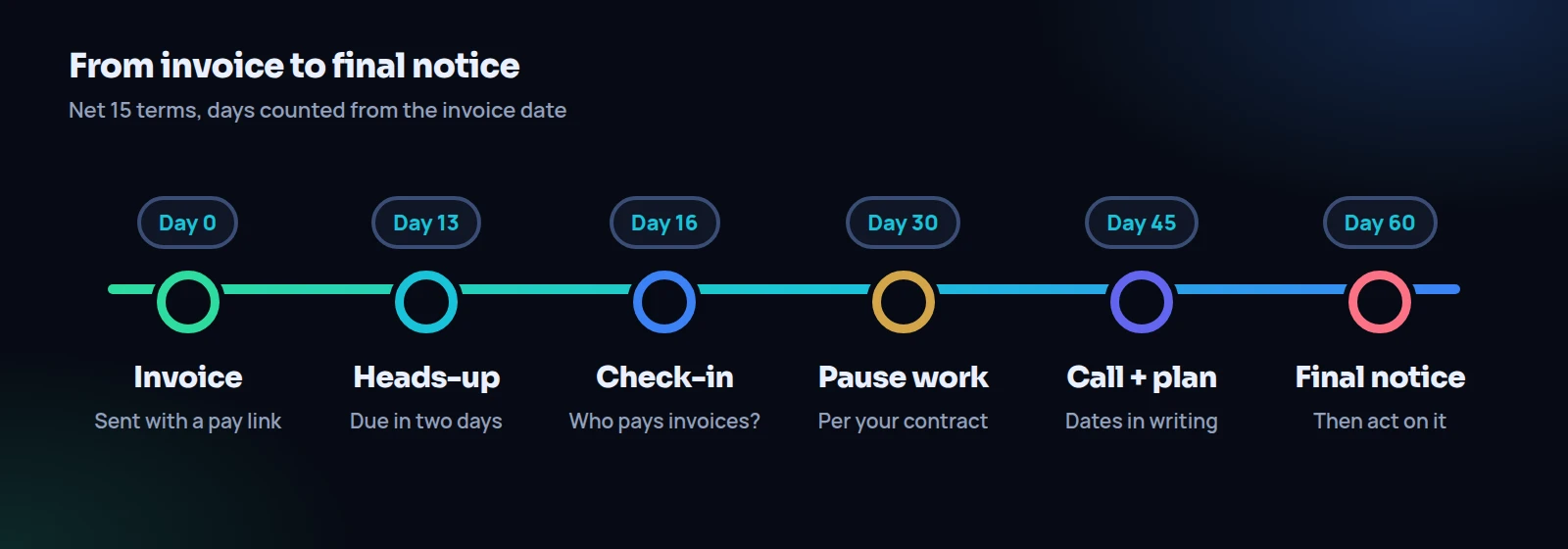
Two days before the due date, a short note with the amount and pay link. It isn’t chasing; it’s helping the invoice reach the top of the pile. What can go wrong: you send it to your project contact, who doesn’t pay bills. Copy whoever handles payments.
Check in the day after it’s late
Assume it slipped. Ask one question that’s easy to answer: “When is this scheduled?” What can go wrong: a vague reply (“I’ll chase it up”). Reply with thanks and a specific follow-up date: “Great, I’ll check back on Friday the 13th.”
Pause new work at 30 days
If your agreement has a stop-work clause, use it, calmly and in writing. Delivering more work while unpaid invoices pile up only makes the eventual loss bigger. What can go wrong: the client is on a deadline and pushes back. That’s your bargaining power, used politely: “Happy to restart as soon as invoice 014 is settled.”
Call, then offer a written plan
At around 45 days, call. If the client is short on cash, offer a payment plan with dates and confirm it in writing that day. Two payments of $600 that actually arrive beat one $1,200 promise that doesn’t. What can go wrong: the plan exists only on the call. Send the dates in writing within the hour.
Send a final notice, then follow through
At 60 days, send a final notice that names a deadline and the one step you will actually take next: a collection agency, a small claims filing, or writing it off. What can go wrong: threatening something you won’t do. Clients learn fast which deadlines are real.
Advances and milestones in one table
Keep one line per payment you expect on each project, not one line per client. It turns “I think they owe me some money” into a number. Here is Sky’s project after the draft invoice went late:
Worked example: a $4,800 project in three payments
| Payment | Amount | Invoiced | Due | Status |
|---|---|---|---|---|
| Advance (50%) | $2,400 | 09/01 | 09/01 | Paid 09/03 |
| First draft (25%) | $1,200 | 09/22 | 10/07 | Unpaid, 25 days late on 11/01 |
| Final files (25%) | $1,200 | Not yet | On delivery + 15 | Work paused |
| Total | $4,800 | $2,400 received |
Check: $2,400 + $1,200 + $1,200 = $4,800, and 50% + 25% + 25% = 100%. On November 1, Sky has received $2,400 and is owed $1,200 on an invoice that’s 25 days late (October has 31 days, so October 7 to November 1 is 25 days). The final $1,200 shouldn’t be invoiced, or the files delivered, until the draft payment arrives.
When you juggle several clients
One project is easy to keep in your head. Five overlapping ones are not, and that’s when a client advance gets mixed up with a final payment or applied to the wrong project. Three habits keep it straight.
Name every payment by project and milestone. “Brightline, advance, $2,400” rather than “Brightline payment.” When a client pays two invoices in one transfer, split it in your records the same day and note which invoice each part covers.
Keep advances separate in your head, and ideally in your bank. An advance is paid for work you haven’t done yet. If the project collapses after a week, part of it may need to go back, depending on your deposit clause. Some freelancers park advances in a separate savings account and move the money over as milestones are delivered. It’s a simple way to avoid spending money you might owe back.
Look at the total, not just the late ones. Add up everything clients owe you, invoiced or not, once a week. If one client accounts for most of that number, you have a concentration problem: a single slow payer can stall your whole month. Ask that client for smaller, more frequent milestones on the next project.
Here’s what Sky’s Monday list looked like with three clients: the agency owing $1,200 (25 days late), a café owing $650 (due Friday) and a nonprofit owing $900 (invoiced yesterday). Total owed: $1,200 + $650 + $900 = $2,750, and $1,200 of it, about 44%, was the late one. That one number told Sky where to spend Monday’s half hour.
Contract wording that prevents unpaid invoices
Short, plain clauses in your agreement do most of the work. Adapt these to your own services, and have a lawyer look over your standard contract once if your projects are large.
Template: payment terms clause
PAYMENT TERMS

1. Fee: $[total] for the work described above.
2. Schedule: [50]% advance before work starts;
   [25]% on delivery of [milestone]; [25]% on
   delivery of final files.
3. Due: Each invoice is due [15] days after its
   date. Pay by [bank transfer / card link].
4. Advance: The advance is [non-refundable once
   work begins / refundable minus work done at
   $[rate]/hour].
5. Pause: If an invoice is more than [15] days
   late, work may pause until it is paid, and the
   deadline moves by the same number of days.
6. Files: Final files are delivered once all
   invoices are paid.
7. Changes: Changes to scope or price are agreed
   in writing before the work is done.
Clause 6 is the quiet hero. Holding back final deliverables until the last invoice is paid is standard practice in many creative fields, and it turns the final invoice from a request into a handover.
Messages for the awkward middle
The hardest messages are the ones between “friendly reminder” and “final notice.” Here are two that stay firm without souring the relationship.
Message: pausing work at 30 days
Hi Reese, invoice 014 for $1,200 (first draft) was due on October 7 and is now [X] days late. As in our agreement, I’m pausing work on the final files until it’s settled; the delivery date will move by the same number of days. If there’s a problem on your side, let me know and we can set up a short payment plan.
If they reply with a plan: “Thanks, that works. To confirm: $600 on November 10 and $600 on November 24 for invoice 014. I’ll restart the final files once the first payment lands.”
For a full set of reminder wording at each stage, see our scripts for payment reminders for small businesses; they work just as well for one-person studios.
Agency, small claims or write-off
When unpaid invoices reach 60 days with no plan, you have three realistic options. None of them is free, so pick based on the amount and your time.
Pros
- Collection agency: no time from you, and a formal letter often prompts payment.
- Small claims court: designed for smaller amounts without a lawyer; a signed agreement and invoices are good evidence.
- Write-off: ends the stress, frees your time, and closes the file.
Cons
- Collection agency: typically keeps a share of what it collects; the client relationship is over.
- Small claims court: dollar limits and procedures vary by state, it takes time, and a judgment still has to be collected.
- Write-off: the money is gone, and for most freelancers it isn’t tax-deductible (see below).
A few places have laws aimed at protecting freelancers from late payment, for example requiring written contracts and payment by an agreed date. Check whether your state or city has one; it can change your options.
A tax point most freelancers miss
If you use the cash method of accounting, as most freelancers do, you report income when you’re paid. The IRS explains that a cash-method taxpayer generally can’t take a bad debt deduction for unpaid fees, because the fee was never included in income in the first place. Its own example is an architect whose client never pays. So writing off an unpaid invoice doesn’t create a deduction; it just means you never had the income. That’s one more reason to take advances: the advance is the part of the fee you know you’ll actually receive.
Keep the paper trail anyway. The signed agreement, the invoices, your reminder emails and any payment plan are what a collection agency or a small claims judge will want to see, and they’re what your tax preparer needs to confirm which fees were received in which year. Unpaid invoices that end in a write-off should still have a complete file, closed with a short note of the date and the reason.
Tip
Keep a separate list of “work delivered, not yet paid” and look at it every Monday. Unpaid invoices hide in inboxes; a list of three names and amounts is hard to ignore.
Tracking it without a full accounting system
You don’t need invoicing software to stay on top of advances and late payments, but you do need one place where each expected payment lives. If you agree a payment plan or a balance with a client, you can put it in IOUEZ as an agreement the client signs on their phone or the web. Each payment, including partial ones, is recorded against it, both of you see the same remaining balance, and reminders go out the day before and on the due date without you having to write them. If you run a small studio with several people sending invoices, see what the plans for organizations include and compare them on the pricing page. And for the money planning side, our glossary of cash flow for small businesses applies to freelancers too.
Checklist: before you start any project
- The price, schedule and due period are in a signed agreement.
- An advance is agreed for anything over a week’s work, and its refund rule is written.
- You know exactly what the client needs on an invoice (PO number, legal name, billing contact).
- You have the email of the person who actually pays invoices.
- The agreement has a pause clause and holds final files until payment.
- Your reminder dates are on the calendar the day you invoice.
- Every expected payment is on your “delivered, not paid” list.
Frequently asked questions
How long should I wait before chasing unpaid invoices?
Don’t wait at all for the first contact: send a heads-up two days before the due date and a check-in the day after it’s missed. Firmer steps such as pausing work come at around 30 days.
How big should a freelance advance be?
Many freelancers ask for 25% to 50% upfront, depending on project length and how well they know the client. New clients and long projects justify a larger advance or more milestones.
Can I charge late fees on unpaid invoices?
Only if your signed agreement says so and the amount is reasonable. Adding a fee that wasn’t agreed tends to start a dispute. Check any state rules that apply before putting late fees in your terms.
Can I deduct unpaid invoices on my taxes?
Usually not if you use the cash method, because you never reported the unpaid fee as income. The IRS explains this in its bad debt guidance. Accrual-method businesses follow different rules, so ask a tax professional.
Should I keep working for a client who pays late?
Pause new work once an invoice is significantly late, as your agreement allows. Continuing only increases what you could lose. Restart when the balance is paid or a written plan is in place.
Is small claims court worth it for a freelancer?
It can be for amounts within your state’s small claims limit, especially with a signed agreement and clear invoices. Weigh the filing fee and your time, and remember that winning a judgment doesn’t guarantee payment.
Sources
- Internal Revenue Service, Topic no. 453, Bad debt deduction, on why cash-method taxpayers generally can’t deduct unpaid fees, with the architect example.
- Internal Revenue Service, Recordkeeping, on the records self-employed people should keep for income.
- U.S. Small Business Administration, Manage your finances, on cash flow and the timing of payments.