A repayment plan is a guess about the future, and futures do not always cooperate. Jobs end, rent goes up, a car dies. The good news is that you can change the terms of an IOU without breaking the loan or the friendship, as long as you do it in the open, agree the numbers, and put the new deal in writing. Here is the playbook, step by step, with what tends to go wrong at each stage.
Watch out
The worst way to change an IOU is silently: just paying less, or just paying later, and hoping nobody mentions it. Silence turns a small adjustment into a question of trust. A two-line message before the due date avoids that entirely.
When it makes sense to change the terms of an IOU
Changing an IOU is not a failure. It is what a sensible plan does when circumstances shift. Common reasons include a job loss or cut in hours, a medical bill, a move, a new baby, or simply a plan that was too ambitious from the start. Lenders sometimes want changes too: they need the money back sooner, or they would rather forgive part and move on.
What all good changes have in common: both people agree, the new terms are specific, and the change is written down with both signatures. Everything in the playbook below serves those three things.
The playbook: seven steps to change the terms of an IOU
Raise it early, before a payment is missed
Borrowers: message the lender as soon as you know a payment will be a problem, ideally a week before the due date. Lenders: if you see two short or late payments in a row, ask gently rather than waiting. What can go wrong: waiting until after the miss. The same request lands very differently as a heads-up than as an excuse.
Agree the current balance first
Before discussing new terms, both people confirm what has been paid and what is left, using the payment records. “I have $1,650 paid and $1,350 remaining, does that match yours?” What can go wrong: negotiating a new plan on top of a balance you disagree about. Fix the number first; it is a separate conversation.
Name the kind of change you need
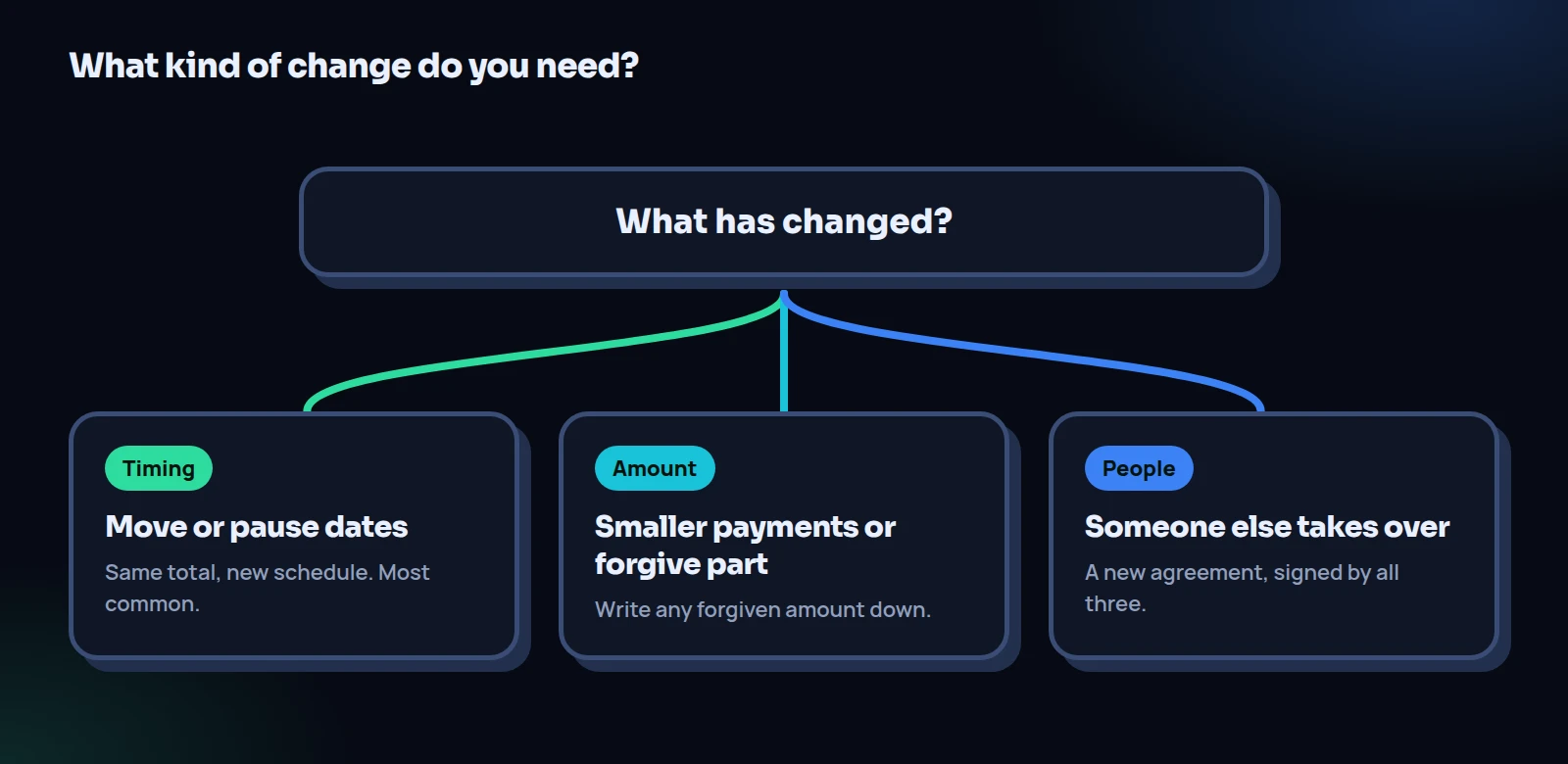
Most changes fall into three groups: timing (pause, move or stretch dates), amount (smaller payments, or forgiving part of the loan), or people (someone else takes over the debt). Be clear which one you are asking for. What can go wrong: a vague “can we figure something out?” that leaves the other person to guess and propose.
Make the trade feel fair to both sides
If the borrower gets more time, give the lender something solid in return: a firm end date, a slightly larger final payment, or automatic transfers. If the lender forgives part, say so as a clear choice. What can go wrong: a change that only helps one person, agreed reluctantly, and resented later.
Write the change as an amendment
A short document that refers to the original IOU, states the agreed balance, and sets out the new terms. Do not edit the original. What can go wrong: crossing things out on the old IOU, which leaves a confusing document that looks altered.
Both sign and date it
Same rule as the original: both people sign the same version, each dated. Keep the original IOU and the amendment together. What can go wrong: agreeing by voice and “writing it up later.” Later tends not to arrive.
Update the records and reminders, then watch the first payment
Change the due dates in your calendar, ledger or app. When the first payment under the new plan arrives, confirm it in writing. What can go wrong: old reminders firing on old dates, which feels like nagging about a plan you already changed.
Three ways to change the terms of an IOU
Once you have agreed the balance, the most useful question is: what actually changed? The answer usually points to one of three branches.
Timing changes
The total stays the same; the schedule moves. Options include a one-month pause added to the end, moving due dates to match a new payday, or stretching the plan with smaller payments over more months. These are the gentlest changes because nobody gives anything up except time.
Amount changes
Lower payments are really a timing change in disguise, since the total is the same. Forgiving part of the loan is different: the lender gives up money. If you do it, write the exact amount forgiven and that it is a gift, so nobody later wonders whether it is still owed. The IRS can treat forgiving a debt as a gift, though most friendly loans are far below the level where a gift tax return is needed. If the loan is large, ask a tax professional.
People changes
Sometimes a different person takes over the debt, such as a partner or parent. In legal terms, replacing one party with another, with everyone’s agreement, is called a novation, and the original borrower is released. Do not do this with a handshake. Write a new agreement that all three people sign, stating that the original borrower is released and the new one takes over the balance.
Messages to change the terms of an IOU without awkwardness
The hardest part is the first message. These are written to be specific, kind and short.
Message: borrower asking for a change
Hi Jamie, giving you a heads-up before the 15th. My hours got cut this month, so $250 is going to be tight. Could we do $125 a payment for the next four payments and add the rest to the end? I can still finish by October. Happy to talk it through.
If no reply in two days: Just checking you saw this before the 15th. If it’s easier, I’ll send $125 on the 15th as a start and we can sort the rest when you have a minute.
Message: lender proposing a change
Hey Riley, I’ve noticed the last couple of payments have been short, and that’s okay. Want to reset the plan so it actually fits? Let’s agree what’s left and pick an amount that works.
If you need more help with the conversation itself, our guide on what to do when a friend can’t pay you back covers gentler options, and restarting repayments after a missed payment covers the borrower’s side.
A sample amendment you can copy
Here is how Riley and Jamie wrote their change. Riley borrowed $3,000 from Jamie, repaid $1,650 on schedule, then had hours cut. They agreed to halve the payment for four months and extend the plan.
Template: IOU amendment
AMENDMENT TO IOU

This amendment changes the IOU dated [March 1, 2026]
between [Riley Chen] (Borrower) and [Jamie Ortiz] (Lender).

1. Balance
We agree that as of [June 10, 2026], the Borrower has
repaid $[1,650] and $[1,350] remains.

2. New payment plan
The Borrower will pay $[125] on the [15th] of each month
from [June 15] to [September 15, 2026], then $[250]
on the [15th] of each month from [October 15, 2026]
until the balance is paid. Final payment: $[100]
on [February 15, 2027].

3. Everything else stays the same
All other terms of the original IOU are unchanged.

4. Forgiven amount (only if any)
The Lender forgives $[0] of the balance as a gift.

By signing, we both agree to this amendment.

Borrower: ____________________  Date: __________
Lender:   ____________________  Date: __________
Check the math before signing. Four payments of $125 is $500, which leaves $850; three payments of $250 is $750, which leaves the final $100. It adds up to $1,350, and the plan ends on February 15, 2027. If your numbers do not add up, fix them now rather than in February.
Tip
Keep “everything else stays the same” in every amendment. It stops anyone from arguing later that the change quietly canceled other parts of the original, like “no interest.”
The legal side, briefly: why you change the terms of an IOU in writing
You do not need a lawyer to change the terms of an IOU between friends, but a few legal ideas explain why the steps above matter.
- Changes are agreements too. In traditional contract law, a change where only one side gives something up can be on shaky ground; this is called the pre-existing duty doctrine. States differ on how strictly they apply it, and many fair changes hold up fine. A written amendment both people sign, with something in it for each side, is the safest way to go.
- Accepting less does not always settle the debt. Accepting a smaller amount as full payment can count as a settlement, called “accord and satisfaction,” but only when both clearly agree to it. A partial payment on its own does not wipe out the rest. If you are settling for less, write “accepted in full settlement.”
- Written acknowledgments can affect time limits. According to the CFPB, in some states a partial payment or written acknowledgment of a debt can restart the statute of limitations. Amendments are a form of acknowledgment, which generally works in the lender’s favor. Rules vary by state.
- Interest changes still have limits. If you add or raise interest in exchange for more time, it has to stay within your state’s usury limits, which vary.
Four things not to do when you change the terms of an IOU
- Do not renegotiate by group chat. Money changes between two people belong in a private conversation, not in front of friends or family who will pick sides.
- Do not stack changes. Three informal changes in six months produce a plan nobody can reconstruct. If the plan keeps moving, stop and write one clean amendment that replaces them all.
- Do not tie the change to unrelated favors. “I’ll give you more time if you help me move” muddies a clean money agreement. Keep the loan about money.
- Do not leave the end date open. “We’ll see how it goes” sounds kind and usually means the loan stops being discussed. Every revised plan should have a final date, even a generous one.
None of these are legal rules. They are just the habits that keep the second version of a plan from becoming the start of the argument the first version avoided.
Changing terms in an app
In IOUEZ, the amount, interest and due date of a shared agreement are locked once both people have signed, so neither person can change them alone. That is a feature, not a limitation: it means any change to the terms of an IOU has to be agreed, rather than edited quietly. Agree the change first, then record it where both of you can see it, for example as a new agreement for the remaining balance that both people sign, with a note pointing back to the original. Keep a copy of the original and its payment history. Reminders then follow the new dates. The help center walks through the screens.
What a fair change looks like, in one picture
Six months after their amendment, Riley is back to full payments and Jamie has stopped checking the bank app every 15th. The loan will finish four months later than planned. Nobody got everything they wanted, and both of them got something they needed: Riley got breathing room, Jamie got a firm end date and a signed balance. When you change the terms of an IOU that way, the plan bends without the relationship cracking.
Frequently asked questions
Can one person change the terms of an IOU alone?
No. Changes need both people’s agreement. A lender cannot add interest, and a borrower cannot decide to pay less, without the other person agreeing, ideally in a written amendment both sign.
To change the terms of an IOU, do we need a new IOU or just an amendment?
For timing or amount changes, a short amendment that refers to the original works well. If someone else takes over the debt, write a new agreement signed by everyone involved.
Is a text message enough to change the plan?
A clear text where both people agree to specific new terms is much better than nothing. For anything beyond a one-time date change, a short signed amendment is clearer and easier to rely on later.
How do I forgive part of a loan properly?
Write the exact amount you are forgiving, that it is a gift, and the new remaining balance, and both sign. The IRS can treat a forgiven loan as a gift; for large amounts, check with a tax professional.
Can the lender ask for interest in exchange for more time?
Yes, if both agree and the rate stays within your state’s usury limits. For small friendly loans, we would usually trade time for a firm end date instead of interest.
What if we cannot agree how to change the terms of an IOU?
Start by agreeing the balance, then try a short trial, such as reduced payments for two months, and revisit. If you are truly stuck, a community mediation service can help. Court is a last resort.
Sources
- Legal Information Institute, Cornell Law School, Pre-existing duty doctrine (Wex), on modifications and consideration.
- Legal Information Institute, Cornell Law School, Accord and satisfaction (Wex), on settling a debt with alternative performance.
- Legal Information Institute, Cornell Law School, Novation (Wex), on replacing one party with another.
- Consumer Financial Protection Bureau, Can debt collectors collect a debt that’s several years old?, on how payments or acknowledgments can restart time limits in some states.
- Internal Revenue Service, Gift tax, on forgiving a debt as a gift.
- Legal Information Institute, Cornell Law School, Usury (Wex), on state interest limits.