
Someone you care about has asked to borrow money, and you already know the answer is no. The hard part is not the decision, it is the sentence. This page gives you ready-to-send messages to say no to lending money in eight common situations, with a follow-up for when they push back and a plan for when they go quiet.
Watch out
If the request is urgent, comes from a new number or an unfamiliar account, and asks for a wire, gift cards, crypto or a payment app, stop. The FTC says scammers pose as family and friends in trouble. Call the person back on a number you already know before you reply at all.
Three rules that make it easier to say no to lending money
Before the scripts, three habits. Saying no to a friend or a relative gets easier with practice, and these are what practice teaches. They are what make the words below work, and they hold no matter who is asking.
Answer later, not now. You do not owe anyone an instant reply about your money. “Let me look at my budget tonight” buys you a calm evening and makes your eventual answer sound considered rather than defensive.
Give a true reason, and only one. “I can’t without putting my own bills at risk” is honest and hard to argue with. A pile of excuses invites a debate about each one. Inventing a reason (“my money’s tied up”) invites the follow-up “until when?”
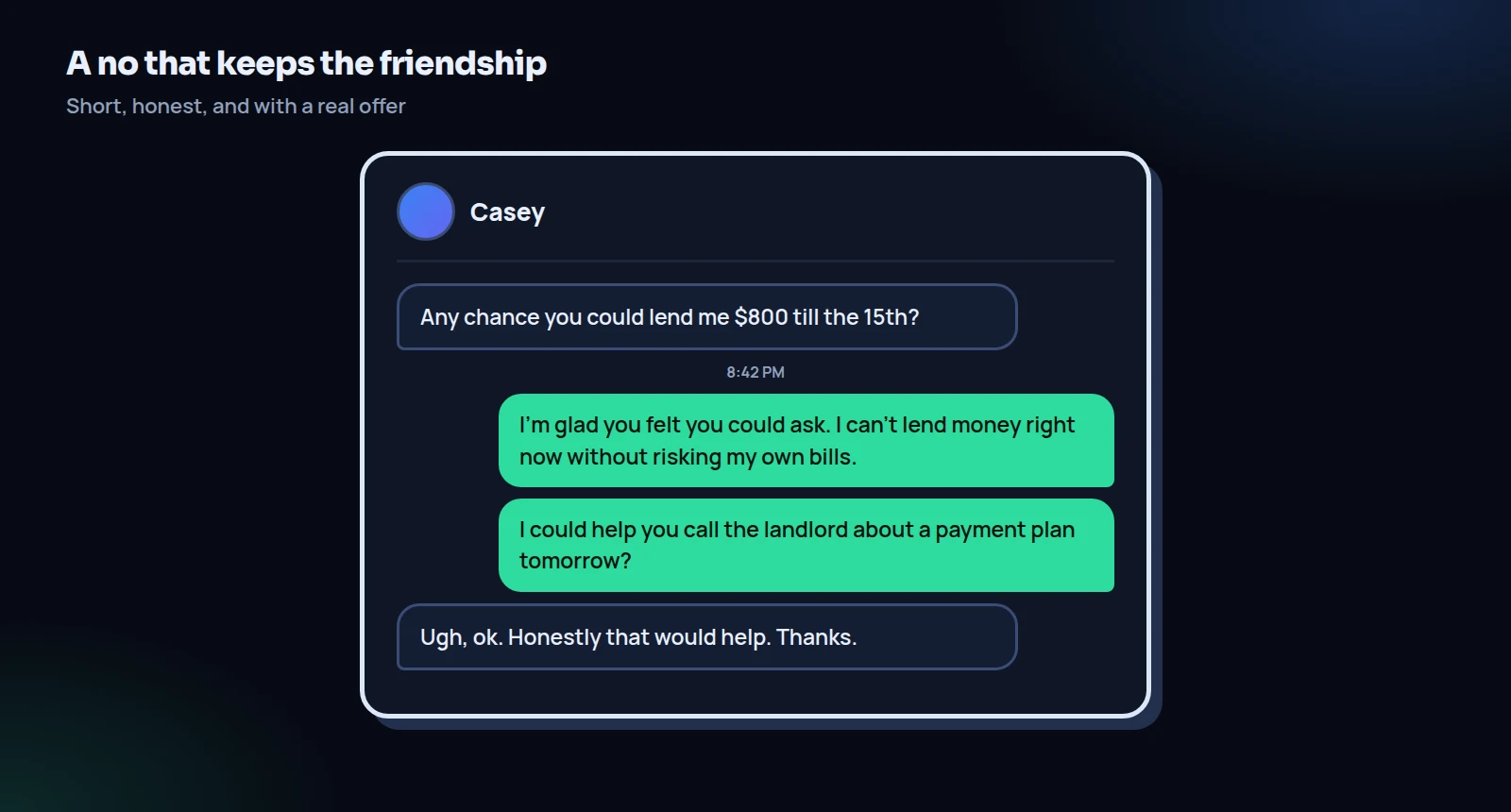
Offer something real, or nothing. A specific offer (“I can help you call the landlord tomorrow”) softens a no. A vague one (“let me know if there’s anything else”) just sounds like a polite exit. If you have nothing else to offer, a warm no on its own is fine.
Tip
Write your reply in your notes app first and read it once out loud. If it sounds like you are apologizing for having a budget, cut a sentence. Shorter is kinder than it feels.
Situation 1: a good friend in a real bind
This is the hardest one, because you would like to help, and the urge to say no to lending money fights with the urge to rescue. Lead with the relationship, then the no, then the offer.
Message: the warm no
Hey Taylor, I’m really glad you felt you could ask me. I’ve looked at my numbers and I can’t lend money right now without putting my own rent at risk. I hate saying that. Could I help another way? I’m free Thursday to go through options with you.
If they push back (“it’s only $500, you’ll have it back in two weeks”), do not renegotiate the amount on the spot. Repeat the same reason, more briefly: “I get it, and I know you’d pay it back. It’s my budget, not you. The answer’s still no, but my Thursday offer stands.” Saying the same thing twice, calmly, is usually where the conversation ends.
Situation 2: a relative who asks every few months
Repeat requests need a no that also sets a pattern. The second or third time you say no to lending money to the same person, the answer matters less than the rule behind it. You are not only answering this request, you are answering the next three.
Message: the boundary
I love you, and I’ve decided I’m not going to lend money to family anymore. It’s not about this time or about you. It keeps getting complicated between us and I’d rather it didn’t. I’m still happy to help you work on a budget whenever you want.
A blanket rule is easier to hold than a case-by-case no, because there is nothing to argue about. It also stops the question “but you lent money to my brother.” If you did, say so honestly and say the rule starts now. For more on deciding which family requests deserve a yes, see should you lend money to family.
Situation 3: there’s still an unpaid loan
If the person still owes you from last time, the earlier loan is your answer. Keep the tone factual, not punishing.
Message: close the first one first
I’d rather not start a new loan while the $400 from March is still open. Once that one’s settled, I’m happy to talk again. Want to set up a simple plan for it, maybe $50 a week?
This turns a no into a path forward. If they cannot repay the first loan, you have learned something important about the second one. When the original loan has stalled completely, our guide for when a friend can’t pay you back covers the options.
Situation 4: “Can you just co-sign for me?”
A co-signing request can feel smaller than a loan because no money leaves your account today. It is actually bigger. The FTC explains that if you co-sign, you may have to pay the full debt if the borrower does not, and that in many states the creditor can collect from you without first trying to collect from them. The CFPB adds that missed payments can show up on your credit report too.
Message: declining to co-sign
I looked into what co-signing means, and it would make me fully responsible for the loan. I’m not able to take that on, so I’m going to say no. I’m sorry, I know you were hoping I’d say yes. If it helps, I can sit down with you and look at lenders that work with first-time borrowers.
Mentioning what you learned makes the no about the arrangement, not the person. Very few people can argue with “it would make me fully responsible.”
Situation 5: you’re asked in person, on the spot
Face to face, at a dinner, in a parked car. It is hardest to say no to lending money with the person looking at you, and you will not have time to draft anything, so memorize one line that buys time.
Say it out loud: the pause
That sounds really stressful. I don’t make money decisions on the spot, so let me look at things tonight and text you tomorrow.
(Next day, by text) I thought about it, and I can’t lend money right now. I’m sorry. I’m around this weekend if you want to talk through other ideas.
Moving the no to text is not cowardly. It gives you the words you want, and it gives them a moment to react in private instead of in front of you.
Situation 6: a coworker or someone you barely know
You do not need a reason at all here. A short, friendly policy statement is enough, and the less personal it sounds, the better.
Message: the policy no
Sorry, I have a rule about not lending money, even small amounts. Hope it works out!
Say no to lending money at work early and the same way every time. Once a team knows you are not a lender, the requests stop, and nobody takes it personally because it was never personal.
Situation 7: you’ll help, just not with a loan
Sometimes the no is to the loan, not to helping. You might prefer to give a smaller amount as a gift, or pay one bill directly. Make it explicit that it is not a loan, so nobody spends months wondering.
Message: a gift instead
I can’t lend you $1,000, but I’d like to give you $150 toward the electric bill. That’s a gift, not a loan, so please don’t pay it back. I’ll send it to the utility directly if that’s easier.
Paying a bill directly is a quiet way to make sure the help goes where you meant it to. Deciding whether help should be a loan or a gift deserves its own thought; gift or loan: how to make it clear walks through both.
Situation 8: you said yes, and now you want to undo it
Maybe you agreed in the moment and regretted it on the drive home. As long as no money has moved, you can still change your answer. Do it fast and own it. It is still fine to say no to lending money after a yes; it is not fine to let them find out when the transfer never arrives.
Message: taking back a yes
I need to be honest with you. I said yes yesterday without really looking at my budget, and when I did, I realized I can’t lend the money after all. I’m sorry for getting your hopes up. I wanted to tell you right away so you have time to sort something else.
Speed is the kindness here. A next-day reversal is awkward. A reversal a week later, after they have planned around your money, is a real problem.
You can say no to lending money and still say yes to the person.
Phrases to skip when you say no to lending money
Some lines feel polite in the moment and cause trouble a week later. Most of them leave a door open that you meant to close, or they hand the other person something to argue with. Here are the usual suspects and what to say instead.
| Instead of | Try | Why it works better |
|---|---|---|
| “Maybe next month.” | “I can’t lend money, now or next month.” | A maybe becomes a promise in their memory. |
| “My money’s tied up.” | “I can’t without risking my own bills.” | There is no “until when?” to answer. |
| “You’d probably never pay me back.” | “It’s about my budget, not you.” | Keeps the no from becoming a verdict on them. |
| “I’ll think about it” (when you won’t) | “Let me check tonight and answer tomorrow.” | Sets a real deadline, and you keep it. |
| “Ask my partner.” | “We’ve decided not to lend money.” | Nobody else gets dragged into the role of villain. |
The pattern is simple. Every good version is short, true and final, and none of it is about the other person’s character. That is really all there is to how to turn down a loan request without leaving a mark.
When they push back, go quiet, or get angry
Most people take a kind no well, especially if they asked to borrow money from you only after trying elsewhere. Some take a beat of disappointment. A few do not. Here is what tends to work.
They push back
Do not add new reasons, and do not shrink the amount unless you actually want to. Repeat the original reason in fewer words: “I hear you. It’s still a no for me.” Any new detail you add becomes something to argue with.
They go quiet
Silence after you say no to lending money usually means embarrassment, not anger. Give it a few days, then send something that has nothing to do with money: a meme, a “how did the interview go?” It tells them the friendship is untouched. If you said you would help another way, follow through without being asked.
They get angry
Do not match the heat. “I understand you’re upset. I’m not going to change my answer, and I’d still like to be there for you in other ways.” Then leave the conversation. If they bring it up again later, the same sentence works again.
Other people get involved
In families especially, a no can travel. If a parent or sibling calls to lobby, you do not have to re-explain your budget to a committee. “That’s between me and Jamie, and I’ve given my answer.” Kind, and closed. You made one decision; you do not need to make it again for every relative who hears about it.
If you ever do say yes
None of this means lending is always wrong. If a future request passes your own budget test, make the yes as clear as your no: an exact amount, dates, both people signing a written record, and reminders so nobody has to chase. Our step-by-step guide on how to lend money to a friend covers that, and IOUEZ lets you set up the agreement, collect both signatures and log each payment in one place. Knowing that a good yes is possible makes it easier to say no to lending money when the situation is wrong.
Message: the closing note, a week later
Hey, thinking of you. How did things work out with the landlord? Still happy to help with that budget if you want a second pair of eyes.
Frequently asked questions
Is it rude to say no to lending money to a friend?
No. Protecting your own bills is responsible, and a short, warm reply is not rude. What feels rude is a vague answer that leaves the other person hoping, or a yes you later resent.
Do I have to give a reason?
You do not. With close friends and family, one true reason softens the message. With coworkers and acquaintances, “I don’t lend money” is a complete answer.
What if they say I lent money to someone else?
Be honest: yes, you did, and you have since decided not to lend anymore, or that one was different because of your budget at the time. You do not have to defend past decisions in detail.
How do I say no to co-signing a loan?
Explain that co-signing would make you legally responsible for the full debt, and that you cannot take that on. The FTC and CFPB both describe that risk, so you can point to it if they doubt you.
Should I offer a smaller amount instead?
Only if you actually want to. A smaller loan still needs dates and a written record, and a smaller gift should be called a gift. Offering less just to escape the conversation tends to backfire.
What if I think the request is a scam?
Do not send anything. Contact the person on a number or account you know is theirs and ask directly. The FTC advises exactly that for urgent requests from someone claiming to be a friend or relative.
Sources
- Federal Trade Commission, Scammers Use Fake Emergencies To Steal Your Money, how fake family emergencies work and how to check them.
- Federal Trade Commission, Cosigning a Loan FAQs, what a co-signer may owe and how creditors can collect.
- Consumer Financial Protection Bureau, Should I agree to co-sign someone else’s car loan?, credit report effects of missed payments for co-signers.