
Your cousin calls on a Sunday night, your mom mentions the furnace again, or your brother texts “can I ask you something?” and you already know what it is. Deciding whether to lend money to family is rarely about the dollar amount alone. It is about your budget, their plan, the history between you, and how you will both feel in six months. This guide gives you a way to decide calmly instead of on the spot.
Example
Jordan’s younger cousin Riley needs $2,400 to cover a security deposit and first month’s rent on a new apartment closer to work. Jordan has $9,000 in savings, a car payment and a vague feeling that saying no would come up at every holiday for the next decade. We will follow Jordan through the decision below. Their situation is an illustration, but the questions are the ones you will face.
The real question behind the request
When a relative asks, it usually sounds like one question: “Can you help?” There are actually three hiding inside it. Can you afford this? Will it come back? And what happens to the relationship if it does not?
Friends can drift apart after a bad loan. When you lend money to family, drifting apart is rarely an option, which is exactly why the stakes feel higher. You will still see this person at birthdays, weddings and in the group chat. A loan that goes sideways does not end the relationship, it just makes it heavier for years.
So before you decide whether to lend money to family, slow the clock down. You are allowed to say, “Let me look at my numbers tonight and call you tomorrow.” A day of thinking costs nothing. A rushed yes can cost a lot.
Tip
Ask for the details in writing, even by text: how much, for what, and by when they think they can pay it back. People who have a real plan answer quickly. Vague answers are information too.
Five factors to weigh before you lend money to family
These are the factors we would weigh, in order. The first one carries the most weight, and if it fails, the rest barely matter.
1. Your own cushion
Look at your savings after your next three months of bills. The money you lend should come from what is left over, not from what keeps your lights on. The Consumer Financial Protection Bureau suggests sizing an emergency fund by the unexpected costs you have actually faced before, which is a useful lens here too: if lending this amount would leave you unable to cover your own surprise car repair, it is too much.
For Jordan, $2,400 out of $9,000 leaves $6,600, which still covers a few months of their fixed costs. That passes.
2. The purpose
A deposit on an apartment near a new job is a bridge to something better. A loan to cover last month’s credit card bill, for the third time this year, is a sign of a deeper problem that your money will not fix. You are allowed to care about what the money is for, and a relative who is offended by the question is telling you something.
3. A believable repayment plan
“I’ll pay you back when I can” is a wish. “I start the new job on the 3rd, I get paid every other Friday, and I can send $200 each payday” is a plan. Ask for the second kind. If they cannot describe one, the honest category for this money may be a gift, which we cover below.
4. History
Has this person borrowed before? From you, or from someone else in the family? Did it come back? Past loans are the best predictor you have, and it is fair to say, “Let’s close out the $300 from spring first.”
5. The family ripple
Family money rarely stays between two people. If you lend to one sibling, another may ask. If a parent lends to one adult child, the others notice. Think about whether you would make the same offer to everyone in a similar spot, and whether you are fine with them knowing.
The decision tree
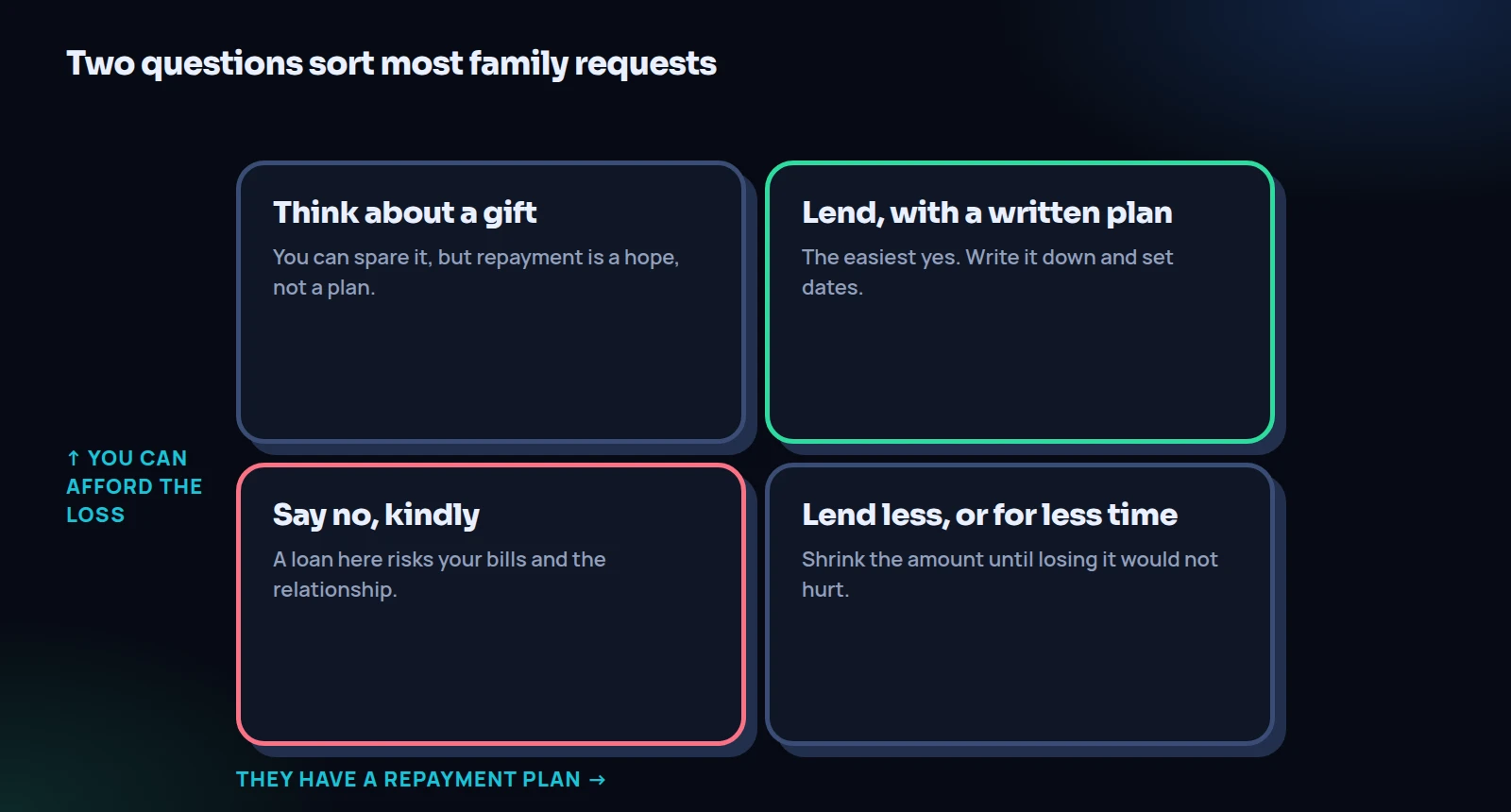
Once you have the facts, run through these questions in order. Stop at the first one that gives you a clear answer.
Would losing this money hurt your rent, bills or emergency savings?
→Say no, or lend a smaller amount you could truly spare.
Is an earlier loan to this person still unpaid?
→Settle or restructure that one before adding a new one.
Can they describe how and when they will repay?
→If not, decide whether you would give the money as a gift instead.
Would you resent them if a payment were late?
→Lend less, or set a schedule loose enough that you would not.
All clear?
→Lend money to family the way you would want to borrow it: written down, signed and on a schedule.
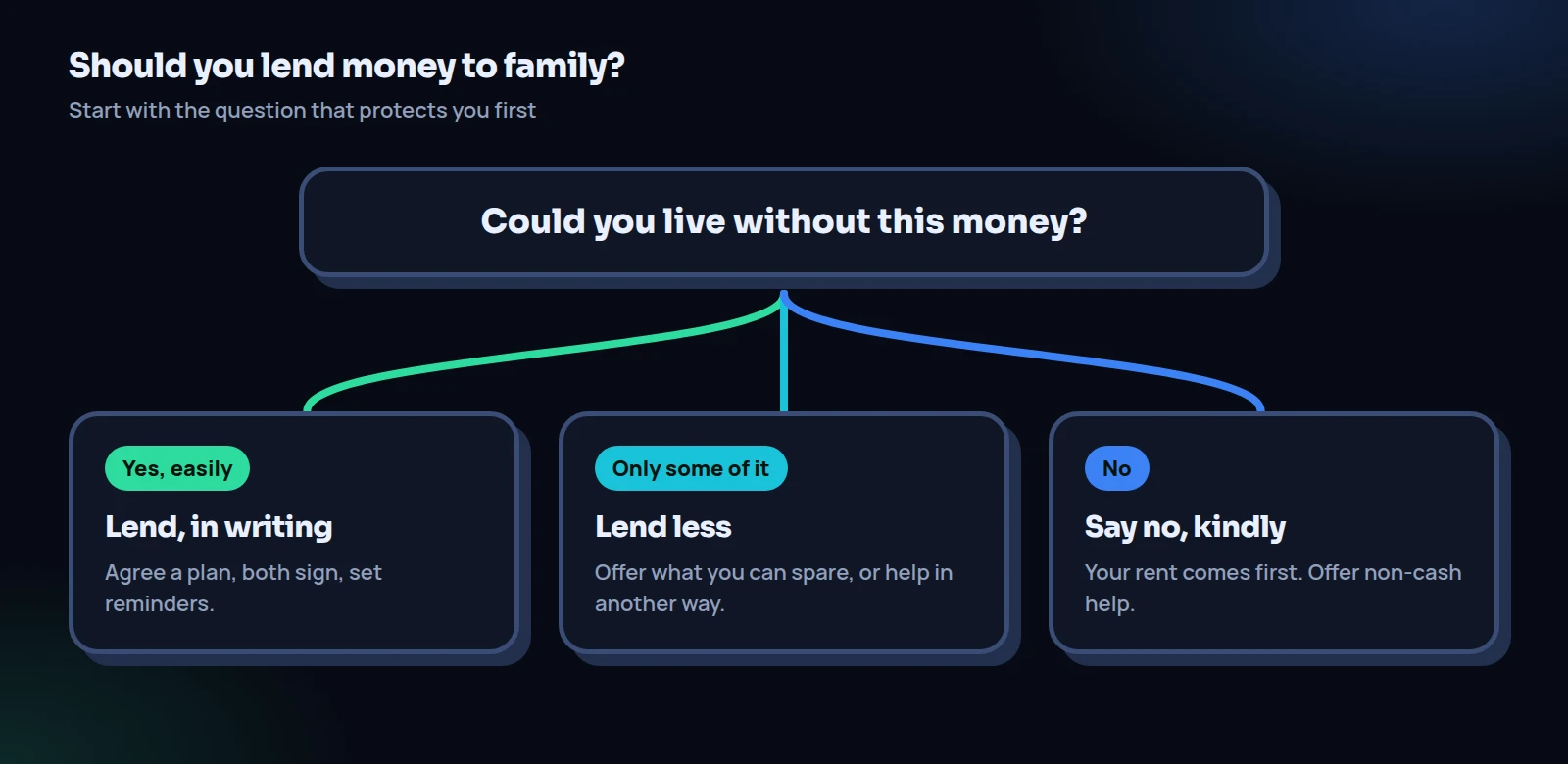
Branch one: yes, and how to lend money to family well
If you can afford it and they have a plan, the goal is to make the loan boring. Boring loans are the ones that come back.
- Pick an exact amount and an end date. “$2,400, repaid by June 30” beats “about two grand, sometime this year.”
- Match payments to their paydays. If Riley is paid every other Friday, a $200 payment the following Saturday is easier than a monthly lump.
- Decide on interest out loud. Most family loans carry none. That is normal for lending to relatives and, for smaller amounts, simpler for taxes too (more on that below).
- Write it down and both sign. A two-minute signed record answers every “wait, what did we say?” before it starts.
- Agree what happens if a payment slips. The simplest rule: they tell you before the due date, and you pick a new date together.
In IOUEZ, one of you creates the agreement with the amount, dates and any installment plan, the other reviews it on their own phone, and once both have signed, the terms lock. Payments get recorded against the balance, and reminders go out before each due date so you never have to be the one who brings it up. If you prefer paper, the habit is what matters: our personal loan agreement template gives you one to copy.
Jordan’s yes, on paper
| Term | What they agreed |
|---|---|
| Amount | $2,400, no interest |
| Purpose | Security deposit and first month’s rent |
| Payments | $200 every other Saturday, 12 payments |
| First payment | The Saturday after Riley’s second paycheck |
| If a payment will be late | Riley messages Jordan before the due date and they set a new one |
| Record | Signed by both, every payment logged |
Twelve payments over about six months. Small enough that a single missed week is a nuisance, not a crisis.
Branch two: less than they asked for
Sometimes the honest answer is “I can do some of it.” That is still help, and it is often the best version of yes. Lending $1,000 you can spare is kinder than lending $2,400 you will lie awake about.
Say the number plainly and do not over-explain: “I can’t do the full amount, but I can lend you $1,000, and I’m happy to help you figure out the rest.” Then help with the rest in ways that do not involve your bank account. Look over their budget with them. Point them to the landlord’s payment plan, or to a credit union. Drive them to the interview.
The same writing-down rules apply to a smaller loan. A $1,000 family loan without dates is just a smaller misunderstanding waiting to happen. If you are not sure where your own line sits, how much money to lend walks through the math with real numbers.
Branch three: no, said with care
A no protects you, and done well it protects the relationship too. Keep it short, make it about your situation rather than their character, and offer something you can actually give.
“I’ve looked at my numbers and I can’t lend money right now without putting my own bills at risk. I hate saying that. Can I help you look at other options this week?”
Avoid inventing reasons you will have to keep up later. “My money is tied up” invites “when will it be free?” The truth, said kindly, ends the conversation faster. For more wording, including what to say when someone pushes back, see how to say no when someone asks to borrow money.
Watch out
An urgent call from a “relative” who needs money wired right now, and asks you to keep it secret, is a classic scam. The FTC’s advice: hang up and call the family member back on a number you already know is theirs before you send anything.
When a gift makes more sense than a loan
There is a fourth branch most people forget, because not every request to lend money to family should become a loan. If you can afford the money, but you doubt it will come back, you can simply give it. A gift has no due dates, no reminders and no slow build-up of resentment. It is often the cleanest answer for a parent helping an adult child, or for a small amount to someone in a real crisis.
The key is to say which one it is. Money that is “sort of a loan” causes more family friction than either a clear loan or a clear gift. If you say “this is a gift, I don’t want it back,” mean it. If you might want it back one day, it is a loan, and it should be written down. Gift or loan? compares the two side by side, including the mortgage paperwork where the difference matters a lot.
Taxes, briefly, before you lend money to family
For most everyday amounts, taxes never come up. It still helps to know where the lines are.
- Interest-free loans of $10,000 or less. IRS Publication 550 says the below-market loan rules generally do not apply to a gift loan between individuals on any day the total outstanding between you is $10,000 or less, as long as the money is not used to buy income-producing assets.
- Larger interest-free loans. Above that, the IRS may treat the interest you did not charge as a gift to the borrower. The IRS publishes minimum rates every month, called the Applicable Federal Rates. Talk to a tax professional before a large family loan.
- Forgiving a loan. The IRS lists forgiving a debt among the transfers the gift tax can apply to. For 2026, you can give up to $19,000 to any one person without it counting as a taxable gift.
- A loan that is never repaid. To deduct a bad debt, IRS Topic 453 says you must show you intended a loan, not a gift, when the money changed hands. A signed agreement is how you show that.
Special cases: parents, siblings, partners, businesses
The five factors work whenever you lend money to family, but some relationships have their own wrinkles.
Siblings share parents, which means a loan between you can quietly become a family topic. Agree who else knows. The story in how to lend money to a sibling shows one way this goes well. Partners who do not share finances yet still need a clear record, maybe more than anyone; see lending money to a partner. And a relative’s business is a different kind of risk, because a loan to a company is only as good as the company; lending to a friend’s business lists the questions to ask first.
Lending to parents or grandparents tends to run the other way from the others: you are less likely to ask for it back on schedule, and that is fine if you decide it up front. Many people simply treat help to aging parents as a gift. Others keep a light record so siblings can see who has contributed what. Either works, as long as everyone knows which one it is.
If things change after you say yes
Life will interrupt the schedule at some point. A job falls through, a car breaks, a baby arrives early. The loan that survives is the one with an agreed way to bend.
Change the plan in writing, not just in conversation. Pausing for a month, lowering the payment from $200 to $100, or moving the end date are all reasonable. If the person stops paying and stops answering, when a friend can’t pay you back lays out the kind options in order, from a short pause to forgiving the balance on purpose.
Before you lend money to family: the short list
- I slept on it before answering.
- Losing this amount would not touch my rent, bills or emergency savings.
- I know what the money is for.
- They described how and when they will pay it back.
- Any earlier loan between us is settled or restructured.
- We agreed: amount, payment dates, interest (or none), and what happens if a payment slips.
- We both signed a written record.
- I would make a similar offer to others in the family in the same spot.
- If it is a gift instead, I said so clearly.
Frequently asked questions
Is it ever a good idea to lend money to family?
Yes, when you can afford to lose the amount, the purpose is clear, and there is a believable repayment plan. A written, signed agreement with set dates makes a good outcome far more likely.
How do I say no to a family member without a fight?
Keep it short and about your own budget, not their choices. Offer a kind of help you can actually give, such as reviewing their budget or finding other options together.
Should a loan to a family member have interest?
Most do not, and that is fine for smaller amounts. For interest-free loans above $10,000, the IRS rules on below-market loans may apply, so check with a tax professional first.
Do I need a written agreement when I lend money to family?
Writing it down is what keeps memories from drifting apart. A signed record of the amount, dates and payments protects both of you, and it is the evidence the IRS looks for if a loan later goes bad.
What if two relatives ask at the same time?
Before you lend money to family members in parallel, decide on your total budget for lending first, then split it by need and by plan. Being consistent matters more than being generous to one person.
Can I change my mind and make the loan a gift later?
Yes. Tell them clearly, close the loan in your records, and remember that forgiving a debt can count as a gift for tax purposes if it is above the annual exclusion.
Sources
- Internal Revenue Service, Publication 550 (2025), Investment Income and Expenses, below-market loans and the $10,000 exception for gift loans between individuals.
- Internal Revenue Service, Frequently asked questions on gift taxes, forgiving a debt as a gift and the $19,000 annual exclusion for 2026.
- Internal Revenue Service, Applicable Federal Rates (AFRs) rulings, the minimum rates published each month.
- Internal Revenue Service, Topic no. 453, Bad debt deduction, loan versus gift intent for loans to relatives and friends.
- Consumer Financial Protection Bureau, An essential guide to building an emergency fund, sizing savings by past unexpected expenses.
- Federal Trade Commission, Scammers Use Fake Emergencies To Steal Your Money, how to check a family emergency request.