
Most people use “IOU,” “promissory note” and “loan agreement” as if they were the same piece of paper. They are not, and the difference shows up exactly when you least want it to: the day you and the borrower remember the deal differently. This IOU vs promissory note comparison, with the loan agreement added as the third option, shows what each document proves, what it leaves out, and which one fits your loan.
Example
Casey lends Dev $2,400 for a moving truck and first month’s rent. Dev writes “IOU $2,400, Dev” on the back of an envelope and hands it over. Eight months later Dev has paid $900 and believes the rest was due “whenever things settle.” Casey believes it was due by spring. The envelope agrees with both of them, because it says nothing about either.
The one-sentence version of each
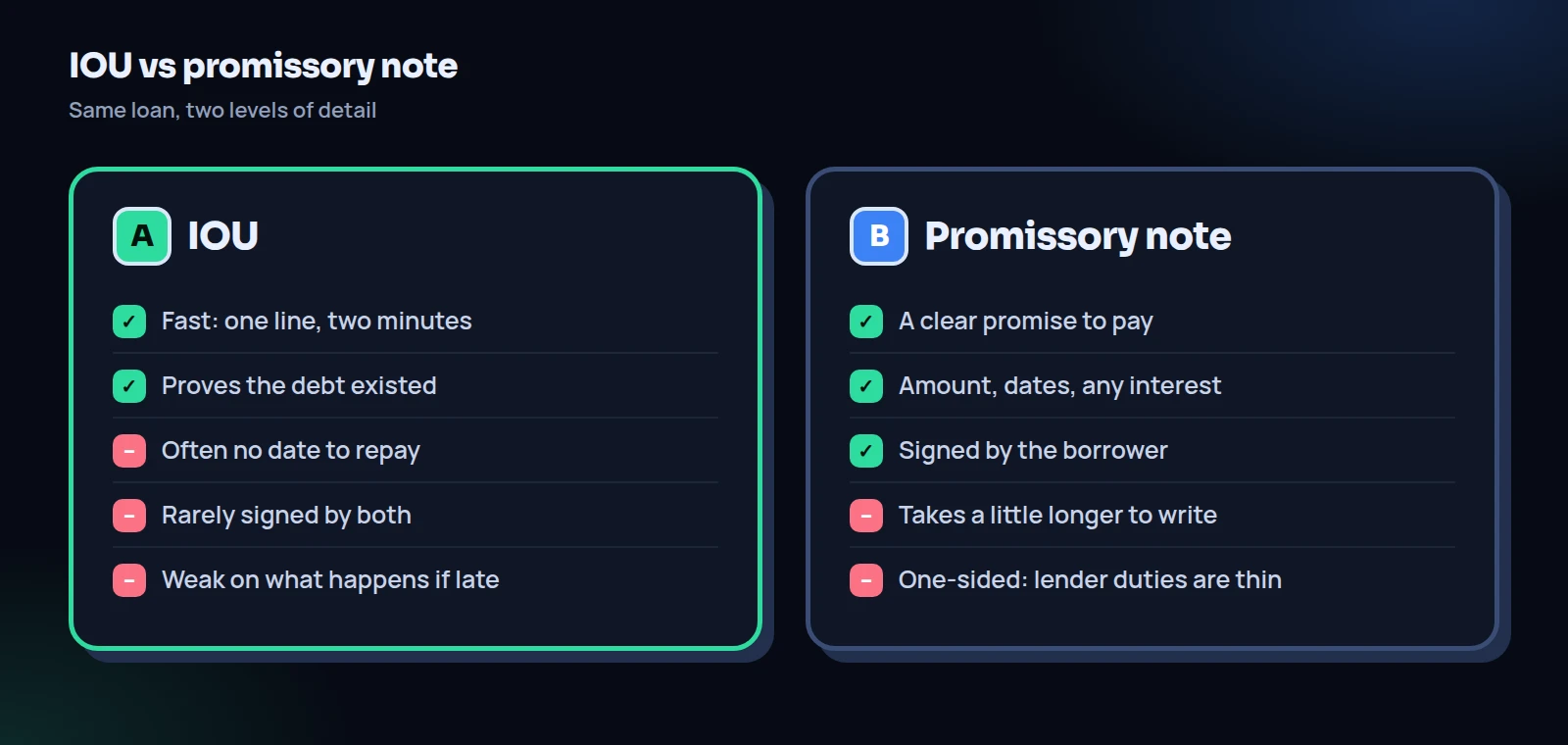
An IOU says a debt exists: “I owe you $2,400.” A promissory note says the borrower promises to pay it, with an amount and usually a date: “I promise to pay Casey $2,400 by May 1.” A loan agreement is a contract that sets out what both people will do, including payments, what counts as late, and what happens if plans change.
Think of them as three steps up the same staircase. Each one includes the one below it and adds detail. None of them is “the right one” for every loan. A $60 concert ticket does not need a loan agreement, and a $15,000 car loan deserves more than an envelope.
IOU vs promissory note vs loan agreement, side by side
| IOU | Promissory note | Loan agreement | |
|---|---|---|---|
| What it does | Acknowledges a debt | Promises to repay a set amount | Sets duties for both people |
| Who signs | Usually only the borrower, sometimes nobody | The borrower (the “maker”) | Both lender and borrower |
| Repayment terms | Often none | Amount, due date, any interest | Full schedule, late rules, changes |
| Typical length | One line | Half a page | One to several pages |
| Best for | Small, short loans between close people | Most personal loans up to a few thousand dollars | Large, long or business-related loans |
| Weak spot | Says nothing about when or how | Lender’s side is mostly silent | Takes more effort, can feel formal |
If you only remember one row of this IOU vs promissory note table, make it “repayment terms.” The middle column is highlighted because, for the kind of loans most people make to friends and family, a promissory note (or an IOU that has grown into one) is the sweet spot. It is short enough to write over coffee and clear enough to settle almost any “wait, what did we say?” moment.
The IOU: quick, friendly, thin
An IOU is the most informal of the three. Its main job is to show that money moved and that the borrower accepts the debt. Commercial law draws a neat line here. The Uniform Commercial Code defines a “promise” as a written undertaking to pay money signed by the person undertaking to pay, and adds that an acknowledgment of an obligation is not a promise unless the person also undertakes to pay it. A bare IOU is that acknowledgment.
That does not make it worthless. In a dispute, a signed IOU is still evidence the debt existed. It just leaves the most argued-about questions open: when, how much at a time, and what happens if a payment slips. If you want the basics first, our explainer on what an IOU is and how it works covers them.
IOU vs promissory note: the promise is the difference
A promissory note is a written, signed promise by one person (the maker) to pay a fixed sum of money to another (the payee). In the IOU vs promissory note debate, this is the key upgrade: the word “promise” plus a date. Most notes also state any interest, where payments go, and whether the whole balance becomes due if payments stop.
Some promissory notes are also “negotiable instruments” under Article 3 of the UCC. Roughly, that means an unconditional promise to pay a fixed amount of money, payable to bearer or to order, on demand or at a definite time, without other promises attached. Negotiable notes can be transferred to someone else, like a check. Between friends, negotiability rarely matters, and many simple notes do not meet the definition anyway. Do not let the jargon scare you off.
The loan agreement: both sides on paper
A loan agreement is a contract, not a one-way promise. Both people sign, and both have duties. The borrower agrees to the payment schedule. The lender might agree to accept payments by a certain method, to give notice before treating a missed payment as a default, or to send a statement of the balance on request.
Loan agreements earn their extra length on bigger or longer loans. If repayment will take more than a year, there is another reason to put it in writing: each state has a statute of frauds, a rule requiring certain contracts to be written and signed, and agreements that cannot be completed within one year are a common category. For a ready-made structure, see our personal loan agreement template.
Why a full loan agreement helps
- Both people sign, so neither can say they never agreed.
- Late payments and changes have a plan before they happen.
- Works for long schedules, interest and larger sums.
- Easy for a stranger, such as a judge, to read.
Why it can be overkill
- Feels formal for a $150 loan between best friends.
- More clauses mean more things to get wrong.
- Interest clauses must respect state usury limits, which vary.
- Nobody reads page three if the loan is tiny.
IOU vs promissory note in four everyday scenarios
Abstract comparisons only go so far. Here is how we would call the IOU vs promissory note choice in a few situations people actually find themselves in.
The $85 dinner you covered
A coworker forgot their wallet and you paid. They will send it Friday. A text that says “Owe you $85 for dinner, sending Friday” is an IOU, and it is enough. Writing a promissory note here would be strange, and slightly insulting.
The $750 vet bill
Your neighbor’s dog needed surgery and you fronted $750. They can pay $150 a paycheck. This is where the IOU vs promissory note difference starts to matter: five payments over ten weeks is a schedule, and schedules get forgotten. Write the promise, the dates and the amounts, and both sign.
The $4,000 tuition gap
A cousin is short for a semester and will repay over 18 months once they start working. That is long enough that a full loan agreement makes sense, partly because a plan over a year runs into the statute of frauds question in some states, and partly because 18 months is a lot of time for life to change.
The $12,000 loan to a friend’s food truck
Now you are in business territory. A loan agreement is the minimum, and a short session with a lawyer is cheap compared with the amount at stake. Questions about ownership, repayment from profits and what happens if the business closes do not fit on an IOU.
Which is “more legal”?
None of them is automatically more legal than the others. Many loan agreements are valid even when they are spoken out loud, though proving them is harder. What changes from IOU to note to agreement is how much the paper proves on its own, without anyone’s memory.
Ask what a stranger could figure out from the document alone. From an IOU: that a debt existed. From a promissory note: the debt, the promise, and the dates. From a loan agreement: all of that, plus what both people agreed to do if the plan changed. When the IOU vs promissory note question comes up in an actual dispute, that is usually the practical difference.
Pick this if…
Under about $300, paid back within a month, between people who see each other weekly?
→An IOU with full names, the date and a repayment date is plenty.
A few hundred to a few thousand dollars, repaid over months?
→A promissory note with a schedule, signed by both of you even though only the borrower must.
Over a year to repay, interest involved, or tied to a business or property?
→A full loan agreement. For property or five-figure sums, add a lawyer.
You do not actually expect it back?
→None of these. Call it a gift, say so clearly, and skip the paperwork.
The hybrid most people really need
Here is our honest opinion: for everyday personal loans, the label matters much less than the content. A document called “IOU” that includes a promise to pay, an amount written in numbers and words, a payment schedule, both full names and both signatures is doing the job of a promissory note. Call it whatever feels natural between you.
What we would not skip, whatever you call it:
- Full legal names of both people.
- The amount, written as “$2,400 (two thousand four hundred dollars).”
- The date the money was handed over.
- The repayment plan: amounts and dates.
- Interest, or the words “no interest.”
- What happens if a payment will be late.
- Signatures and dates from both people.
That list is short on purpose. If you would like the reasons behind each line and what tends to go wrong, the IOU details that matter goes through them one at a time.
Watch out
Templates downloaded from random sites sometimes include clauses that do not fit your state, such as a fixed interest rate above your state’s limit or a confession-of-judgment clause some states restrict. If a clause confuses you, delete it or ask a lawyer.
Back to Casey and Dev: IOU vs promissory note in hindsight
If Casey and Dev had used a one-page note, it would have said something like: “Dev promises to pay Casey $2,400, lent on August 20. Dev will pay $300 on the 1st of each month from September to April. No interest. If a payment will be late, Dev will tell Casey before the due date and they will agree a new date in writing.” Both sign. That is closer to a loan agreement than a bare note, and it would have taken them ten minutes.
Instead, they spent a tense evening comparing text messages. They sorted it out (Dev agreed to $300 a payment through June), but the conversation that would have been a calm planning chat in August became a negotiation in April. Changing terms after the fact is doable; our guide on changing the terms of an IOU fairly explains how.
Signing it: paper or phone
All three documents can be signed electronically. The federal ESIGN Act says a contract or signature relating to a transaction in or affecting interstate commerce may not be denied legal effect solely because it is electronic, and state laws based on the Uniform Electronic Transactions Act say much the same. In IOUEZ, the person who creates the agreement fills in the amount, dates and plan, and both people sign on their own devices; after that, the terms are locked and payments are recorded against it. The features page shows what is included.
Frequently asked questions
IOU vs promissory note: which is stronger?
A promissory note usually says more: it contains an explicit promise to pay and, typically, an amount, due date and the borrower’s signature. A bare IOU only acknowledges the debt. An IOU that includes the same details works much like a note.
Does the IOU vs promissory note choice change whether I need a notary?
Generally no. For a simple personal loan, neither document usually needs one. A notary confirms who signed, not whether the terms are fair or true. Some lenders notarize larger notes for extra proof of identity. Rules differ by state and by document type.
Is a loan agreement the same as a contract?
Yes. A loan agreement is a contract in which both people take on duties. A promissory note is mostly a one-sided promise by the borrower, though it can also be part of a larger agreement.
Can I turn an IOU into a promissory note later?
Yes. Write a new document that refers to the original debt, adds a promise to pay with a schedule, and is signed and dated by both of you. Keep the original IOU too.
What does “negotiable” mean on a promissory note?
Under UCC Article 3, a negotiable instrument is roughly an unconditional promise or order to pay a fixed amount of money, payable to bearer or to order, on demand or at a definite time. Negotiable notes can be transferred to other people. Most friendly loans do not need this.
When should I use a full loan agreement instead?
When the loan is large, will take more than a year to repay, carries interest, or is connected to a business or property. Those are the loans where both people’s duties should be in writing.
Sources
- Legal Information Institute, Cornell Law School, Promissory note (Wex), definition of a promissory note as a written, signed promise to pay a fixed sum.
- Legal Information Institute, Cornell Law School, UCC § 3-103. Definitions, on “promise” and acknowledgments of an obligation.
- Legal Information Institute, Cornell Law School, UCC § 3-104. Negotiable instrument, the Article 3 definition of a negotiable instrument and a note.
- Legal Information Institute, Cornell Law School, Statute of frauds (Wex), on contracts that must be in writing, including those not performable within one year.
- Legal Information Institute, Cornell Law School, 15 U.S. Code § 7001, General rule of validity (ESIGN Act).
- Legal Information Institute, Cornell Law School, Usury (Wex), on state interest rate ceilings.