
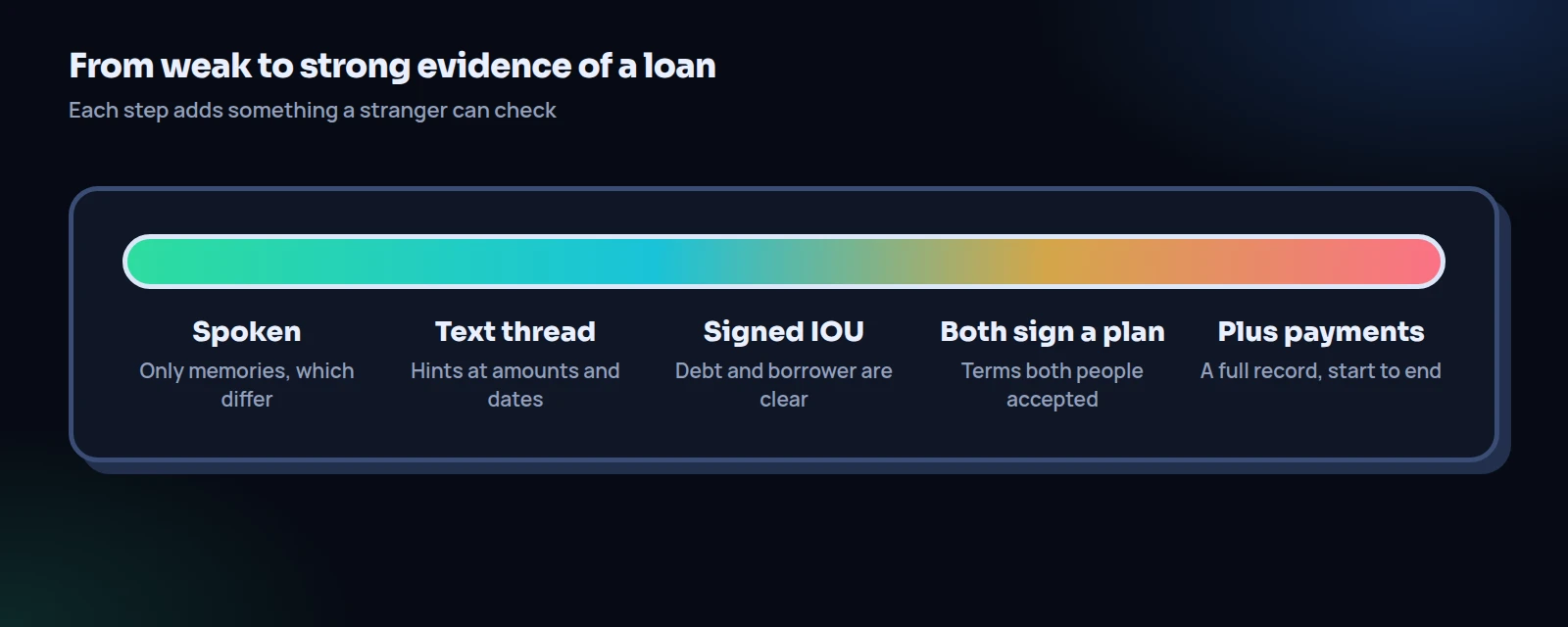
An IOU is a promise written for two people who trust each other. If that trust ever cracks, it has to make sense to a third person who knows neither of you. A stronger IOU is simply one that a stranger can read and understand: who lent what to whom, when, on what terms, and what has been paid since. The checklist below covers 11 details, why each one matters, and what we would skip.
Watch out
Do not add details after the fact. Rewriting an old IOU to look better, or backdating a new one, can wreck your credibility in a dispute. If something is missing, write a new dated document that both people sign, and keep the original.
Why the details decide disputes
Most money disagreements between people who know each other are not about whether a loan happened. They are about the edges. Was it $1,500 or $1,200? Was the $300 in March a payment or a birthday present? Was it due in June or “when things got better”? A stronger IOU closes those edges before anyone has a reason to argue them.
If a disagreement does reach a courtroom, it is usually small claims court, where people often represent themselves and judges look at documents, receipts and messages. The California courts’ self-help pages, for example, tell people to gather proof like receipts, emails and business records before filing. Your IOU is the center of that pile. The more it answers on its own, the less depends on whose story sounds better.
Who, how much and when
The first three details answer the questions a stranger asks before anything else. Get them wrong and nothing further down the page matters much.
1. Full legal names, not nicknames
“Kai” and “M.” are fine in a group chat. On an IOU, write the full legal names of both people, the way they appear on a driver’s license. If one of you has a common name, add a city or the last four digits of a phone number. Identity is the first thing anyone will question.
2. The amount, twice
Write the amount in numbers and in words: “$1,500 (one thousand five hundred dollars).” Banks do this on checks for a reason. A smudged zero or a stray digit can turn $150 into $1,500, and the words settle it.
3. The date money moved, and how
Note the exact date and the method: “sent by bank transfer on June 4, 2026” or “paid in cash on June 4.” Even better, keep the transfer confirmation with the IOU. This ties the paper to an actual movement of money, which is the strongest link in the chain. A stronger IOU points to its own proof.
Tip
Avoid cash for the loan itself when you can. A bank transfer or a payment-app transfer leaves a dated record with both names on it. If cash is the only option, have the borrower write “received in cash” next to their signature.
The terms: promise, plan and price
This is where most informal IOUs are thinnest, and where most arguments live. A stronger IOU spells out the deal, not just the debt.
4. A clear promise to repay
“I owe you” acknowledges a debt. “I will repay” promises something. Commercial law draws exactly this line: the Uniform Commercial Code says an acknowledgment of an obligation is not a “promise” unless the person also undertakes to pay it. Use the words “promises to repay” or “will repay.” It is a tiny edit that makes for a much stronger IOU.
5. A repayment plan with dates
“Soon” is not a date. Neither is “after I get my tax refund,” because refunds arrive at different times and in different amounts. Write a specific schedule, such as “$250 on the 15th of each month from July 2026 to December 2026,” or a single due date for a lump sum. If you need help shaping the numbers, our guide to building a repayment schedule both people can stick to has worked examples.
6. Interest, or the words “no interest”
Silence about interest invites a dispute about interest. If there is none, write “no interest.” If there is some, state the rate and how it is calculated. Interest limits, called usury laws, are set by each state and vary widely, so keep any rate modest and check your state’s rule before writing one in.
Proof that you both agreed
7. Both signatures, both dated
The borrower’s signature is the essential one: it shows they accepted the debt. The lender’s signature shows that both people agreed to the same terms, which matters when the dispute is about the terms rather than the debt itself. Each person should date their own signature. Our story on why both people should sign an IOU shows what goes wrong when only one does.
8. What happens if a payment will be late
One sentence handles this: “If a payment will be late, the borrower will tell the lender before the due date, and both will agree a new date in writing.” It sounds soft, but it does two hard things. It sets an expectation of communication, and it makes any later change something that has to be written down.
Keeping a stronger IOU strong after signing
An IOU is not finished when the ink dries. What happens over the following months decides how strong it really is.
9. A payment trail that matches
The IOU says what is owed. Proof of each payment says what was paid. A stronger IOU sits alongside a clean record of every payment: date, amount, method and a reference such as “IOU payment 3 of 6.” Mixed-purpose transfers (“$400 for rent and your loan”) are where trails get muddy, so keep loan payments separate. Our guide to keeping proof of repayment covers receipts, transfers and notes.
A strong IOU is the one a stranger can read without either of you in the room.
10. Copies that cannot quietly change
Each person should keep an identical copy. If the IOU is on paper, take a clear photo of the signed page on the day you sign it and send it to the other person. If you edit anything by hand later, both people should initial and date the change. For electronic records, federal law (the ESIGN Act) treats an electronic record as meeting a retention requirement when it accurately reflects the information and can be accurately reproduced later. That is a good standard to aim for even when no law requires you to keep anything.
This is one place where an app helps. In IOUEZ, once both people have signed a shared agreement, the amount, interest and due date are locked, so neither person can edit them without the other knowing. Payments are recorded against that agreement with dates and notes. The security page explains how records are protected.
11. Optional extras: witness or notary
A witness, someone who watched both people sign, can help if one person later claims they never signed. A notary goes further on identity: California’s own notary certificate states that the notary verifies only the identity of the signer, not the truthfulness, accuracy or validity of the document. For most personal loans neither is required. For larger loans, a notarized signature is a modest cost that removes “that is not my signature” from the list of possible arguments.
What does not make a stronger IOU
Some additions feel official but do little:
- Legal-sounding filler. “Whereas” and “heretofore” do not add strength. Plain sentences are easier for everyone, judges included.
- Threats. “If you don’t pay I will sue for triple” is not enforceable just because it is written, and it sours the relationship on day one.
- Unreasonable penalties. Large late fees or interest above your state’s limit can make parts of the document unenforceable.
- Stamps and seals. A decorative seal or a “certified” watermark from a template site has no legal effect.
Worked example: Morgan’s IOU, before and after
Morgan lent Kai $1,500 for a used laptop and a certification course. Here is what changed between their first draft and the version they both signed.
| Detail | First draft | Signed version |
|---|---|---|
| Names | “Kai owes Morgan” | Kai Okafor and Morgan Reyes, both of Tucson |
| Amount | $1,500 | $1,500 (one thousand five hundred dollars) |
| Money moved | Not stated | Bank transfer, June 4, 2026 |
| Promise | “Kai owes” | “Kai promises to repay” |
| Plan | “By the end of the year” | $250 on the 15th, July to December 2026 |
| Interest | Not stated | No interest |
| Late payments | Not stated | Kai tells Morgan before the due date; new date in writing |
| Signatures | Kai only | Both, each dated |
The second version took them about ten minutes. When Kai missed September because of a car repair, there was no argument about what had been agreed, only a short conversation about a new date, which they added in writing.
How a stronger IOU plays out if it ever gets that far
Picture the worst case for a moment. Morgan and Kai fall out, payments stop at $750, and Morgan files a small claims case. Small claims court is built to be simpler than a regular lawsuit, and people often speak for themselves. Morgan hands over four things: the signed IOU, the June 4 transfer confirmation, a printout of the three payments Kai made, and the written note from September moving one due date.
Now look at what Kai can argue. They cannot say the money was a gift, because they signed “promises to repay.” They cannot say the amount was different, because it is written in numbers and words and matches the transfer. They cannot say it was due “whenever,” because there is a schedule. They could argue about the September change, but that is in writing too. A stronger IOU does not guarantee any outcome, and every state runs its courts its own way, but it shrinks the argument to the parts that are actually unclear.
Compare the envelope version: “Kai owes Morgan $1,500.” Every one of those questions is back on the table, and the judge has to decide whose memory to believe. Most people would rather never be in either room. If you are, you want to be holding the first pile, not the envelope.
A note on time limits
Even the strongest document does not last forever in court. Each state sets a statute of limitations for suing over a debt, and the Consumer Financial Protection Bureau notes that most fall between three and six years, varying by state and type of debt. In some states, a partial payment or a written acknowledgment of the debt can restart that period. If a loan is sliding toward the edge of those limits, talk to a local attorney instead of guessing.
Checklist: a stronger IOU
- Full legal names of both people (plus a city or phone digits if names are common).
- Amount in numbers and words.
- Date the money moved, and the method, with the transfer record kept.
- The words “promises to repay.”
- A dated repayment schedule or a single due date.
- Interest stated, or “no interest.”
- What happens if a payment will be late.
- Signatures from both people, each dated.
- Every payment recorded with date, amount, method and reference.
- Identical copies kept by both; changes initialed or signed as a new record.
- Witness or notary considered for larger amounts.
Frequently asked questions
What is the single most important part of a stronger IOU?
The borrower’s signature next to a clear amount and a promise to repay. Without those, the rest of the document has little to stand on. After that, a dated repayment plan prevents the most common arguments.
Will a judge accept an IOU written on my phone?
Electronic signatures and records generally cannot be rejected just because they are electronic, under the federal ESIGN Act and state laws based on the Uniform Electronic Transactions Act. A judge will still weigh whether the record is clear and whether it can be tied to the people who signed it.
Do screenshots of text messages count as evidence of a loan?
They can support your account, especially messages where the borrower mentions the amount or the plan. They are usually weaker than a signed document, because they are scattered and open to interpretation. Keep them anyway.
Should I get my IOU notarized?
For most personal loans it is not required. A notary verifies the signer’s identity, not the content. It is worth considering for larger loans or when you do not know the borrower well.
Can I make an IOU stronger after it was signed?
Yes, by writing a new, dated document that both people sign, referring to the original. Do not edit or backdate the old one. Keep both.
How long can I wait before an IOU dispute becomes too old?
Each state sets its own statute of limitations. The CFPB says most fall in the three to six year range, varying by state and debt type. Check your state’s rule or ask a local attorney.
Sources
- Judicial Branch of California, Before you start a small claims case, on gathering proof such as receipts, emails and business records.
- Legal Information Institute, Cornell Law School, UCC § 3-103. Definitions, on the difference between acknowledging and promising to pay.
- Legal Information Institute, Cornell Law School, 15 U.S. Code § 7001, General rule of validity (ESIGN Act), including the rule on retaining electronic records.
- California Secretary of State, Acknowledgments, on the notary certificate verifying only the signer’s identity.
- Consumer Financial Protection Bureau, Can debt collectors collect a debt that’s several years old?, on statutes of limitations and how payments can restart them in some states.
- Legal Information Institute, Cornell Law School, Usury (Wex), on state interest limits.