Most small lenders don’t lose money because a borrower vanished. They lose it because a payment was recorded twice, a due date lived only in someone’s head, or nobody noticed a loan was 40 days late until it was 90. Good loan tracking for small lenders is mostly boring structure: one record per loan, one log for every dollar that comes in, and a short routine you run whether you feel like it or not. This guide sets that up in the order you’ll need it, with the numbers worked out.
Example
Dev runs a fictional storefront lender called Northgate Loans: 52 active loans, two staff, and a spreadsheet that has grown a tab for every year since opening. On a Monday in October, a borrower walks in with a receipt for a $300 payment that the spreadsheet says never happened. It did happen. It was typed into last year’s tab. Nothing about the loan was wrong; the system was. Everything below is what Dev changed.
Start with the questions your records must answer
Before choosing a tool, write down what you need to know on a normal morning. For almost every small lender it comes down to six questions:
- Who has a payment due today and tomorrow?
- Who is late, and by how many days?
- How much principal is out in total right now?
- How much did we collect this week and this month?
- What exactly did we agree with this borrower?
- Can I prove every payment, with a date and a reference?
If your current setup takes more than a couple of minutes to answer any one of those, that is the part to fix first. Fancy dashboards come later, if ever. Plenty of lenders with 30 loans run happily on a clean sheet and a phone calendar. Plenty with 300 loans are still guessing because nobody agreed on where a payment gets typed.
Tip
Ask your staff to answer the six questions for one random borrower while you watch. Where they hesitate, open a second file, or say “let me check with Sam”, is where your records are leaking.
One record per loan, not one row per person
The most common mistake in loan tracking for small lenders is tracking people instead of loans. A borrower who takes a second loan in March ends up with one long row where the two balances blur together. Give every loan its own ID and its own record, even if the same person has three.
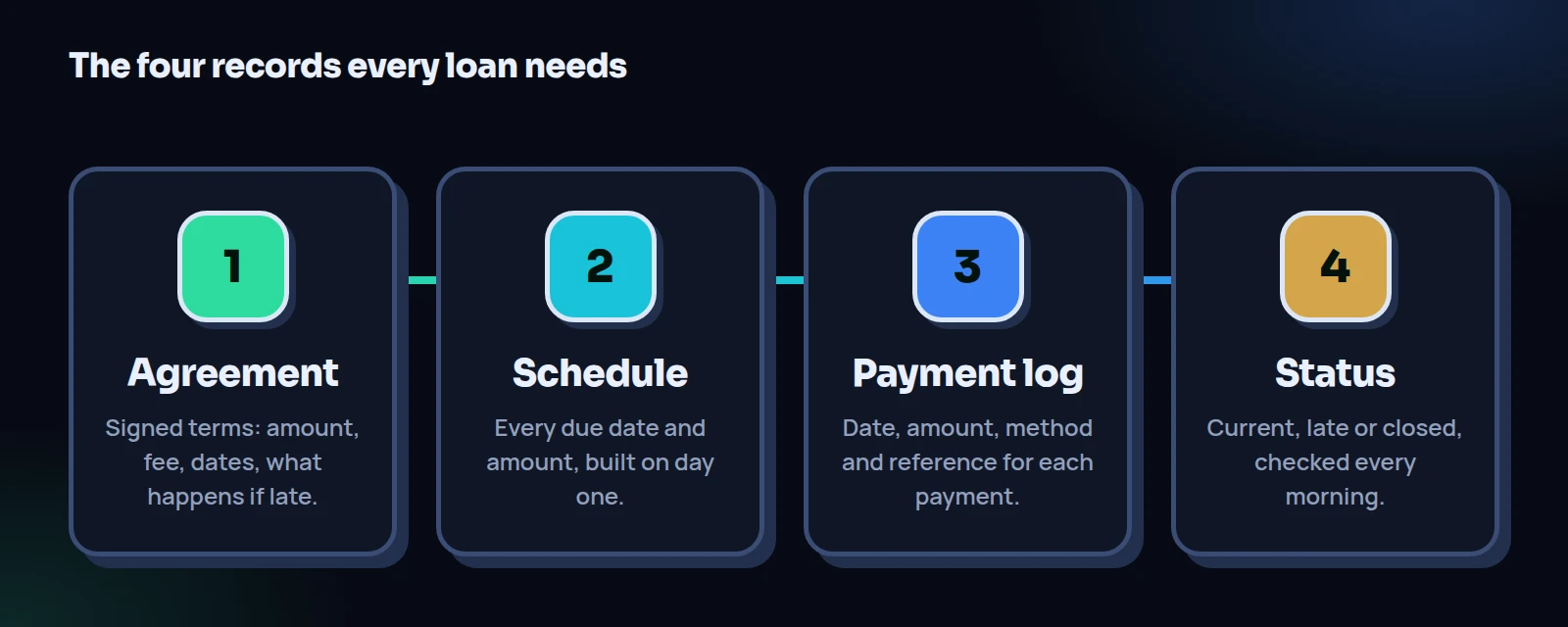
Your loan register is the master list. Each line is one loan and never gets deleted, only closed. Here is the minimum set of fields Dev settled on:
Worked example: a loan register line
| Field | Example | Why it matters |
|---|---|---|
| Loan ID | NG-2026-118 | Separates two loans to the same person |
| Borrower | Riley Ortega (fictional) | Who signed |
| Signed on | 10/05/2026 | Starts the schedule |
| Principal | $1,800 | What actually left your account |
| Fee or interest | $90 flat | Agreed in writing, never added later |
| Payments | 6 × $315, monthly on the 5th | Drives reminders and late checks |
| Status | Current / Late / Closed | Updated by the daily check |
| Agreement file | Link to the signed copy | Settles “that’s not what we said” |
The math: $1,800 principal plus a $90 fee is $1,890 total, and $1,890 ÷ 6 = $315 per payment. Write the total repayable on the agreement itself, not only the rate or the fee, so the borrower sees the same number you do.
Build the schedule the day the loan is signed
A schedule is just the list of due dates and amounts. Build it once, at signing, and never retype it. If terms change later, add a written change and a new schedule, and keep the old one.
For the loan above, the schedule runs November 5 through April 5. Watch for two traps. Months with fewer days: if you lend on the 31st, decide now whether February’s payment falls on the 28th or March 1, and write it down. And weekends: a due date on a Sunday should say what happens, for example “payments due on a weekend or bank holiday are on time if received the next business day.”
If you charge interest instead of a flat fee, put the method in the agreement in plain words (flat on the original amount, or on the declining balance) and show the full schedule to the borrower. A schedule they have seen and signed is the cheapest dispute prevention you will ever buy.
Record every payment the same way, every time
The payment log is where tracking usually breaks. Two people, two habits, two formats, and suddenly a $300 payment exists in one place and not the other. Pick a single place and a single format, then make it the only way a payment counts.
Each payment line needs:
- the loan ID it belongs to;
- the date received (not the date you got around to typing it);
- the amount, to the cent;
- the method: cash, check, card, bank transfer, app;
- a reference: check number, transfer ID or receipt number;
- who recorded it.
Partial payments go in as they are. If Riley pays $200 of a $315 installment, record $200, leave $115 open on that installment, and let the status show it. Don’t “round up” a partial into a full payment to make the sheet look tidy, and don’t hold cash in a drawer until the rest arrives.
Tip
Give every cash payment a numbered receipt, with a copy for the borrower. Missing numbers in the sequence show up at month-end, which is exactly when you want to find them.
The 10-minute morning check
Software doesn’t collect money; routines do. The heart of loan tracking for small lenders is a daily habit. Dev’s team runs the same check every working morning before opening the door:
- Post yesterday’s payments. Bank transfers, app payments and the cash receipt book, all into the payment log.
- Look at today and tomorrow. Who is due? Has a reminder gone out?
- Flip statuses. Any installment past its due date with money still open becomes Late, with the day count.
- Make the calls. A borrower one or two days late gets a friendly message, not a lecture. Most of them simply forgot.
That’s it. On a quiet day it takes five minutes; on the 1st and the 15th it might take twenty. The point is that nobody ever discovers a late loan by accident.
Paper, a spreadsheet or an app
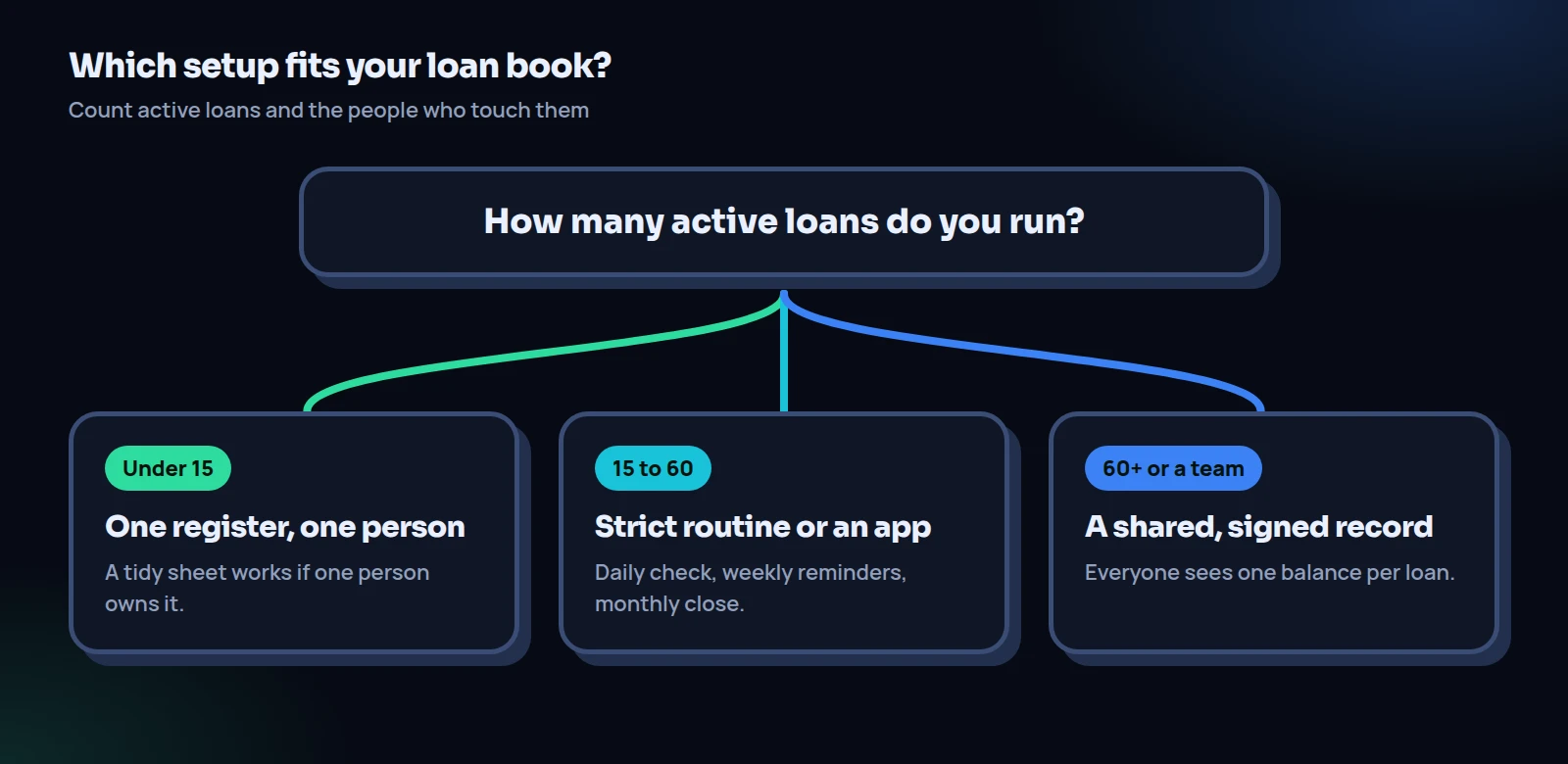
All three can work for loan tracking for small lenders with a small book. They fail in different places, so pick the failure you can live with.
| Paper ledger | Spreadsheet | Shared loan app | |
|---|---|---|---|
| Upfront cost | A notebook | Usually free | Free tier or a monthly plan |
| Typos and lost rows | Common, hard to spot | Common, easy to overwrite | Terms lock once both sign |
| Borrower sees the balance | Only if you tell them | Only if you send it | Yes, the same balance you see |
| Reminders | Your memory | Your calendar | Sent automatically |
| Signed agreement attached | In a folder somewhere | A link, if someone adds it | Part of the record |
| Best for | A handful of loans, one person | One careful owner | Growing books, more than one person |
A spreadsheet is fine until two people edit it. At that point you need either very strict rules (one person posts payments, everyone else reads) or a shared record where both sides of the loan see the same number.
The month-end close for loan tracking for small lenders
Once a month, prove that your records match your money. This is the step most small shops skip, and it is the one that would have caught Dev’s missing $300 in a week instead of a year.
Reconcile against the bank
Add up every payment logged for the month. Add up the deposits in the bank account, plus cash on hand. The two totals should match. If they don’t, the gap is a payment that was logged but not deposited, or deposited but not logged. Find it now, while people still remember.
Run an aging report
An aging report sorts your open balances by how late they are. You don’t need software for it; a filter on your register works. Here is Dev’s October close, with illustrative numbers:
Worked example: an aging report
| Bucket | Loans | Balance | Share of book |
|---|---|---|---|
| Current | 44 | $42,400 | 88.3% |
| 1–30 days late | 5 | $3,600 | 7.5% |
| 31–60 days late | 2 | $1,200 | 2.5% |
| 90+ days late | 1 | $800 | 1.7% |
| Total | 52 | $48,000 | 100% |
Late balances total $5,600, which is $5,600 ÷ $48,000 = 11.7% of the book. Watch that number move month to month. A jump from 8% to 12% tells you more about next quarter than any single loan does.
Each bucket gets a different action. Current loans get the normal reminder. The 1–30 group gets a personal call. Anything past 30 days gets a written note of the balance and a proposed plan. Past 90, decide on purpose: restructure, settle, or write it off. Don’t let a loan sit in that row because nobody wants to make the call.
Tip
Close the month on the same day every time, say the third business day. A month-end close that floats becomes a month-end close that doesn’t happen.
Keep the paper trail long enough
Loan tracking for small lenders isn’t only about collecting. It is also what you show your tax preparer. The IRS says to keep records that support income or deductions until the period of limitations for that return runs out, generally 3 years, and 7 years if you file a claim for a bad debt deduction. A lender that writes off a loan will want the signed agreement, the payment history and the collection notes for that loan, all in one place.
The IRS also notes in its bad debt guidance that you generally need to show you intended a loan, not a gift, when the money went out. A signed agreement with a schedule answers that question before anyone asks it.
Rules you can’t track your way around
Good records are necessary. They are not a license. If you lend money as a business, you may need a state lending license, and many states also cap rates and fees or require specific disclosures. The rules depend on your state, the type of loan and who you lend to, so check with your state’s financial regulator before you take on more borrowers, and talk to a lawyer about the details.
Watch out
Collecting your own loans in your own business name is treated differently from collecting for someone else. The federal Fair Debt Collection Practices Act mainly covers third-party collectors, but the FTC warns that a creditor who collects under a different name can be covered too, and the CFPB says unfair or deceptive collection practices can still create liability. Collect politely, truthfully and under your real name.
Fair lending rules also apply to anyone who regularly extends credit. Under the Equal Credit Opportunity Act you can’t turn someone down, or give them worse terms, because of race, color, religion, national origin, sex, marital status, age or receipt of public assistance. Writing your approval criteria down, and applying them the same way to everyone, protects you and your borrowers.
Where IOUEZ fits, and where it doesn’t
IOUEZ handles the record side of the routine above. Each loan is an agreement that both people sign on their own phones or on the web, and once both have signed, the amount, interest and due date are locked. Payments, including partial ones, are recorded against the loan so lender and borrower see the same balance. Reminders go out the day before and on the due date, and a loan that slips past its date is flagged as overdue for both sides. You can print or save a PDF of any agreement for your files.
It does not decide who qualifies for a loan, and it doesn’t replace your license or your lawyer. For lenders, co-ops, employers and landlords running many loans at once, see what the plans for organizations include today, and compare tiers on the pricing page. If you are still moving off a spreadsheet, our comparison of a signed record versus notes and spreadsheets covers the switch in more detail, and the guide to monthly customer statements shows how to send borrowers a clean monthly summary.
Checklist: loan tracking for small lenders
- Every loan has its own ID and its own line in the loan register.
- Every agreement is signed and shows the total repayable, not just a rate.
- The schedule is built at signing and never retyped.
- One person, one place and one format for posting payments.
- Partial payments are recorded as they are, never rounded.
- Cash payments get numbered receipts.
- The 10-minute morning check runs every working day.
- The month-end close happens on a fixed day: reconcile, then age.
- Records are kept at least 3 years, 7 for any written-off loan.
- You have confirmed your state’s licensing rules for lending as a business.
Frequently asked questions
What is the cheapest way to handle loan tracking for small lenders?
A single spreadsheet with a loan register tab and a payment log tab, owned by one person, costs nothing and works for a small book. The cost shows up later as errors when more people edit it. Many lenders move to a shared app once they pass a few dozen loans or hire help.
How often should I check for late payments?
Every working day. A short morning check that flips any installment past its due date to Late keeps small problems small. Waiting for the monthly close means some loans are already a month behind before anyone calls.
Should a partial payment count as a payment?
Record it as exactly what it is: a partial payment against that installment. The installment stays open for the balance, and the loan shows as late for the missing amount if the due date passes. Never round a partial up to make the books look neat.
What is an aging report?
It is a list of open balances grouped by how late they are, usually current, 1–30, 31–60, 61–90 and 90+ days. It shows where your risk is concentrated and which borrowers need a call this week.
Do I need a license to lend money to customers?
Possibly. Many states require a license for lending as a business, and the rules depend on the state, loan type and borrower. Check with your state’s financial regulator and a lawyer before you start or grow.
How long should I keep loan records?
The IRS says to keep records that support your tax return until the period of limitations runs out, generally 3 years, and 7 years if you claim a bad debt deduction. Many lenders simply keep every closed loan file for 7 years.
Sources
- Internal Revenue Service, How long should I keep records?, the 3-year general rule and 7 years for bad debt deduction claims.
- Internal Revenue Service, Topic no. 453, Bad debt deduction, on showing a loan was intended and the rules for business bad debts.
- Federal Trade Commission, Think your company’s not covered by the FDCPA? You may want to think again, on when creditors collecting their own debts are covered.
- Consumer Financial Protection Bureau, Regulation F, § 1006.2 Definitions, the definition of a debt collector and the creditor exclusions.
- Federal Trade Commission, Equal Credit Opportunity Act, the protected characteristics for anyone who regularly extends credit.
- U.S. Small Business Administration, Apply for licenses and permits, on state licenses that vary by business activity and location.