
When you owe money to several people at once, every message feels like a small alarm. Your roommate mentions their card bill. Your sibling says “no rush” in a way that sounds like a rush. A coworker asks, again, about that $250. It’s tempting to pay whoever asked most recently and hope the rest wait. There’s a better way to decide, and it starts with a list, not with your inbox.
When you owe money to several people, the real question
It isn’t “who do I pay?” It’s “how do I split the money I actually have so that nobody is harmed, nobody is surprised, and I can keep going?” That second question has a clear answer once you know four things about each person you owe. The answer is almost never “pay one person in full and ignore the others.”
Example
Emerson owes money in four places. Their roommate Reese covered $400 of Emerson’s share of rent and utilities in September, and Reese’s own card payment is due October 25. Their sibling Hayden lent $1,500 for a laptop, at $150 each month, and keeps saying there’s no hurry. Elliot, a coworker, lent $250 for a flight home with no date set, and has asked about it twice. There’s also a credit card with $1,200 at 24% APR and a $40 minimum. After rent, food, transport and insurance, Emerson has $450 each month for all of it. This is an illustration; we’ll follow it through.
First, protect the essentials
Before any of this, make sure the things that keep you housed, working and insured are covered. The CFPB’s guidance for when you can’t pay every bill puts housing, utilities, the costs of keeping your job (like a car payment and insurance if you drive to work) and court-ordered payments at the top of the list. It also warns against paying the “squeakiest wheel” just because they’re loudest.
That second point applies to people too. The friend who texts most often isn’t automatically the one who should be paid first. Emerson’s $450 is already what’s left after rent, food, transport and insurance, which is the right place to start.
Tip
Write every debt on one page before deciding anything: who, how much, any agreed amount and date, and one line about their situation. Seeing them side by side takes a lot of the panic out. A blank page and ten minutes is enough.
The four factors that decide who to pay first
For each person you owe, ask:
- Do they need it for their own bills? If someone is short on rent or a card payment because of you, that’s real harm, and it moves them up.
- Is there a fixed date? An agreed date is a promise. Missing it costs more trust than paying slowly on a loan that never had a date.
- Does the debt cost you money? Credit cards and loans charge interest; most friends don’t. Expensive debts can’t be ignored for long, but minimums keep them in check while you sort out people.
- How flexible are they, really? “No rush” from a sibling might be true. Check by asking, not by assuming.
These four questions work whether you owe money to several people or to several companies, and they work best when you answer them honestly rather than hopefully. If you’re not sure how someone would answer the first or fourth question, ask them. A short “Is the end of the month okay, or do you need it sooner?” saves a lot of guessing.
Notice what isn’t on the list: who’s the closest friend, who’ll be most annoyed, who you feel guiltiest about. Those feelings are real, but they make poor tiebreakers.
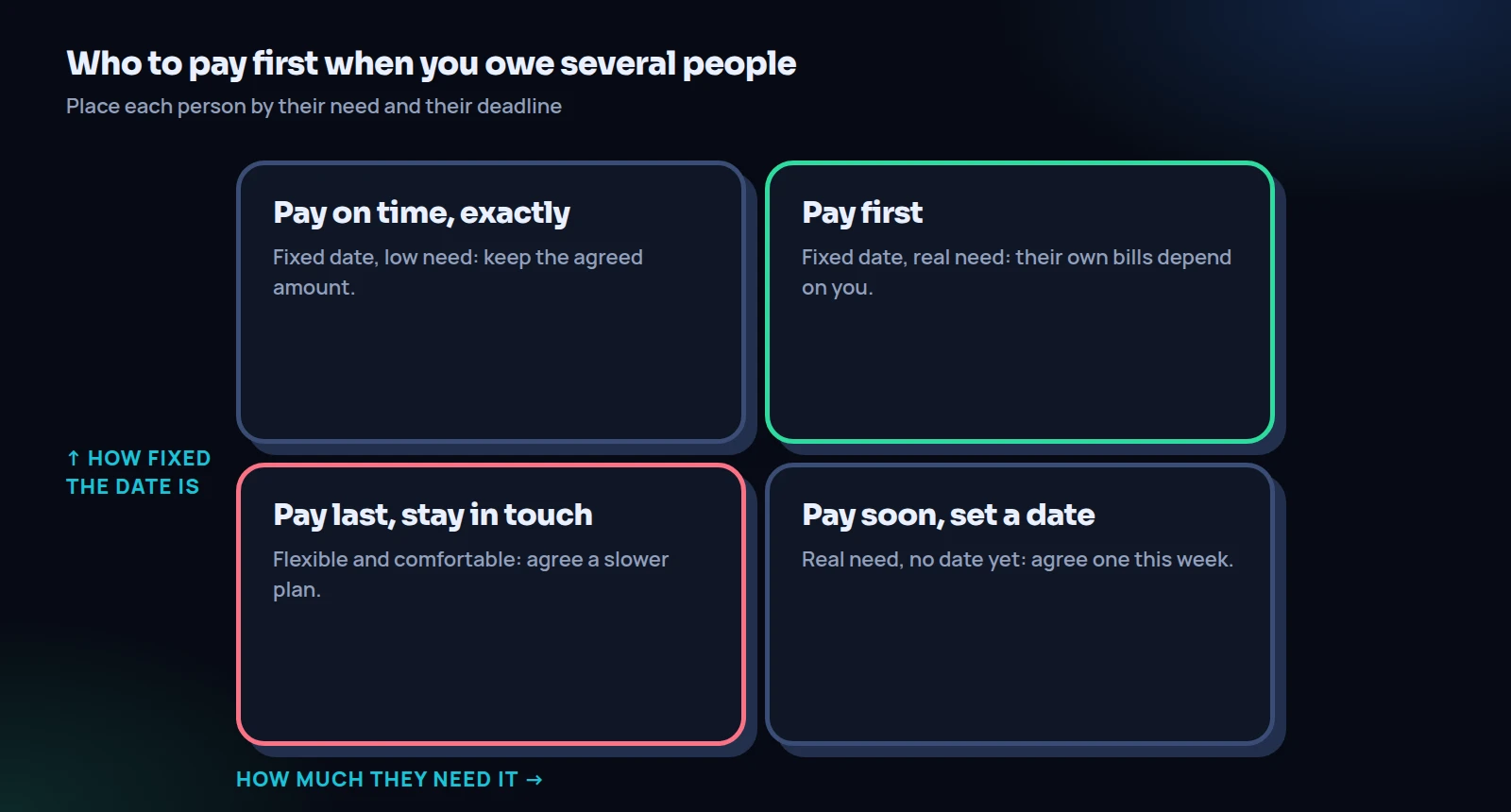
The decision tree
Run each person through these questions in order. The first “yes” decides where they go.
Is this an essential bill: housing, utilities, insurance, a car you need for work, or a court order?
→Pay it first, in full if you can. Everything else waits for this.
Does this person need the money soon to pay their own bills?
→Pay them next, as much as you can before their date.
Is there an agreed amount and date, or a minimum payment?
→Pay the agreed amount on time. If you can’t, ask to change it before the date.
Is there no date, but they keep asking?
→Send something now and agree a schedule this week.
Are they genuinely flexible, and have you confirmed it?
→Pay a smaller amount for now, with a written plan to catch up.
For Emerson, that sorts out quickly. Reese needs the money by October 25 for their own card bill, so Reese comes first. The credit card minimum is a fixed obligation, so it gets paid on time. Elliot has no date but keeps asking, so Elliot gets something now and a schedule. Hayden is flexible, but Emerson should confirm that rather than assume it.
What to do on each branch
Branch 1: they need it for their own bills
Pay as much as you can before their deadline, and tell them exactly when the rest is coming. If you can’t cover all of it, a partial payment plus a firm date is far better than nothing and a vague promise.
Message: to the person who needs it most
Hi Reese, I know your card’s due on the 25th. I’m sending $250 today and the other $150 on November 15. I’m sorry it’s not all at once, and thank you for covering me.
Branch 2: there’s an agreed amount and date
Keep the promise if you can. If you can’t, ask for a change before the date. Asking ahead turns a missed payment into a renegotiation; asking after turns it into an apology. Our playbook on restarting repayments after a missed payment helps if you’re already past the date.
Branch 3: no date, but they keep asking
The asking is the signal. Repeated questions from someone who never set a date usually mean they’re unsure whether the money is coming at all, not that they need it tomorrow. They need some certainty. Send a payment, even a small one, and propose a schedule so they can stop wondering.
Message: to the person with no date
Hey Elliot, sorry for the slow answer on the $250. I’ve sent $100 today, and I’ll send the last $150 on November 15. Does that work?
Branch 4: they’re genuinely flexible
Confirm it in words, then put the slower plan in writing. “No rush” said casually at dinner isn’t an agreement; a specific new amount is.
Message: to the flexible lender
Hayden, I want to be upfront: I’m catching up with a couple of people this month and next. Could I pay you $60 in October and $110 in November, then go back to the usual $150 from December? I’ll add the difference to the end.
Hayden’s agreed plan was $150 each month. October and November together come to $170 instead of $300, so $130 moves to the end of the schedule. Saying that number out loud is what makes “no rush” an actual agreement.
Emerson’s split, month by month
How Emerson splits $450 each month
| Month | Reese | Elliot | Hayden | Card min | Card extra |
|---|---|---|---|---|---|
| October | $250 | $100 | $60 | $40 | $0 |
| November | $150 (done) | $150 (done) | $110 | $40 | $0 |
| December | – | – | $150 | $40 | $260 |
By the end of November, Reese and Elliot are fully repaid. Hayden has received $170 against the $1,500, with $130 added to the end of the plan. From December, Hayden is back to $150 each month and the card gets an extra $260, because it’s the debt that costs money.
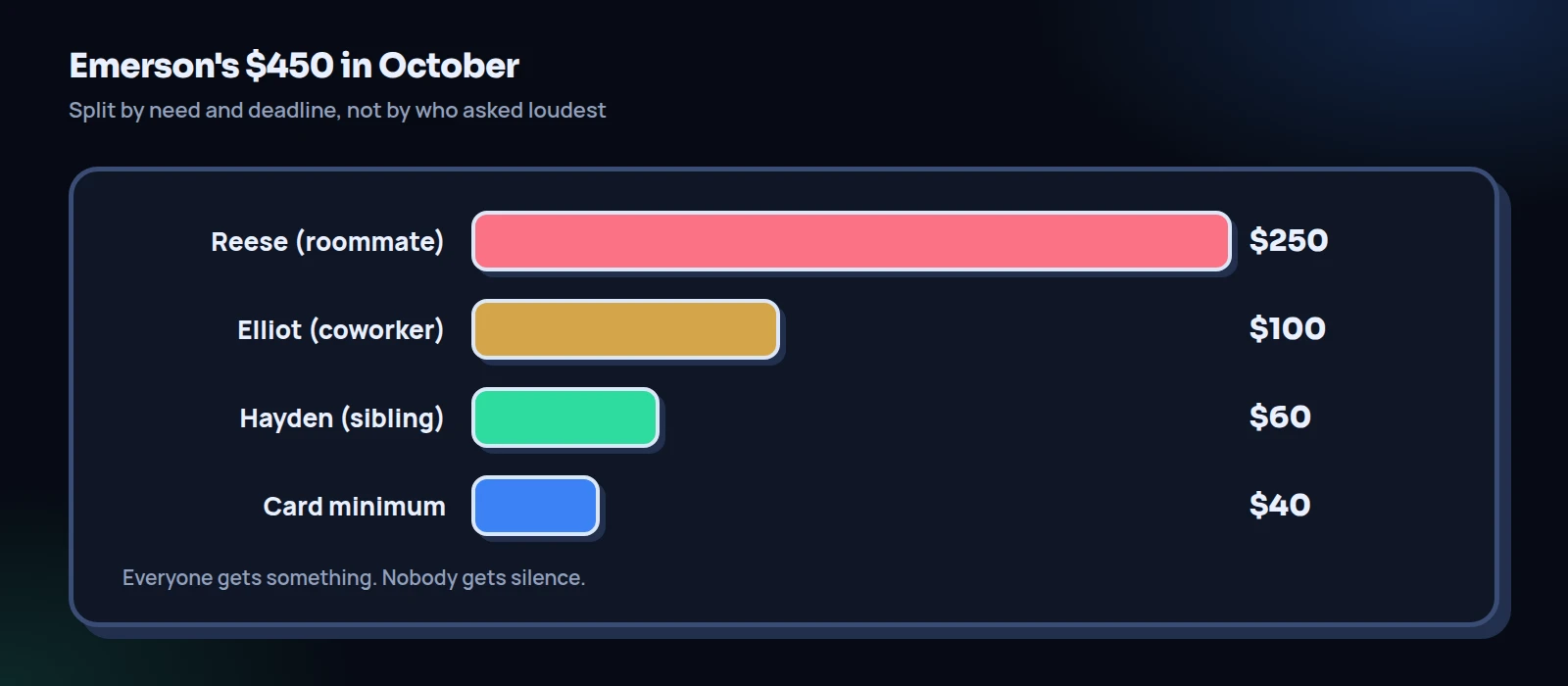
Why send extra to the card rather than to Hayden once the urgent debts are cleared? The card charges 24% APR and Hayden charges nothing, so every extra dollar on the card saves real money. Our comparison of snowball vs avalanche explains that logic, and when it makes sense to pay a friend early anyway.
Nobody you owe is owed silence. Even $20 and a date beats a perfect plan you haven’t shared.
Talk to everyone in the same week
When you owe money to several people, the worst outcome is that they compare notes and discover one got paid while the others got nothing and no explanation. You don’t need to tell anyone about your other debts. You do need to give each person their own clear answer, ideally within a few days of each other.
The FTC’s advice for anyone struggling with debt is to contact the people you owe as soon as you know there’s a problem, explain why, and try to work out a payment plan you can manage. That advice is written about banks and card companies, and it works at least as well with friends.
Watch out
Don’t borrow from one person to pay another. It feels like progress and isn’t: the total stays the same, you add one more relationship to the list, and the new lender often doesn’t know what the money is for. If the totals truly don’t add up, a nonprofit credit counselor can help you build a realistic plan.
If someone gets upset
Even with a fair plan, someone may not love their place in it. Hayden might feel that being family means being last. Elliot might feel a $100 payment is a brush-off. Listen first. Often the upset is about not being told, not about the amount, and it fades once they see a date.
If they push for more than you can pay, don’t make a promise you’ll break to end the conversation. Say what you can do and when: “I can’t do more than $100 this month without missing rent, but the rest is coming on November 15.” A firm, honest answer is easier to accept than a generous one that falls through. If they still disagree, offer to revisit the plan next month when you know more.
Mistakes people make when they owe money to several people
- Paying whoever asked last. The loudest person isn’t necessarily the one in the most need. The decision tree is there so your inbox doesn’t decide.
- Paying one person in full while the others hear nothing. It feels efficient. It usually leaves two or three people quietly resentful.
- Skipping card minimums to pay friends. Missed minimums add fees and can hurt your credit. Keep them going.
- Assuming “no rush” means no date. Confirm it, put the slower plan in writing, and stick to it.
- Hiding. Not answering feels safer for a day and costs more every day after.
Every one of these comes from the same place: trying to make the stress go away quickly. A plan you’ve told everyone about does that better than any shortcut.
Keep one list, and keep it current
Once you’ve made your plan, track it in one place. A single list with each person, the agreed amount, the next date and the balance left keeps you from double-paying one person and forgetting another. Update it the day each payment goes out.
If the loans are in IOUEZ, each agreement shows its own balance and payment history, and reminders go out as each payment comes due, so you’re not relying on memory for four different dates. For tips on keeping records that settle disagreements, see proof of repayment, and to find extra money for faster payoff, try the 30-day plan to pay back a friend faster.
Your next 90 days
- Day 1
List every debt on one page, with dates, amounts and each person’s situation.
- Days 2–4
Run each one through the decision tree and draft your split.
- Within a week
Message everyone with a payment, a date or both. Confirm any changed plans in writing.
- Month 1–2
Pay the most urgent people first, keep every minimum and agreed date.
- Month 3
Return to the original plans and send extra money to whatever costs the most.
Frequently asked questions
When you owe money to several people, who should you pay first?
Essentials first: housing, utilities, insurance, anything you need for work and court-ordered payments. Then people who need the money for their own bills, then fixed dates and minimums, then flexible lenders.
Should I pay off the smallest debt first?
It can help your motivation and clear a person off your list quickly. But a friend who needs money for their own rent should come before a small debt to someone who’s comfortable waiting.
If I owe money to several people, should I tell each of them about the others?
You don’t have to share details. It’s enough to say you’re catching up on a few things and give each person a clear amount and date.
Is it okay to make partial payments?
Yes. Partial payments with a firm date for the rest are usually welcome, as long as they’re agreed and not a surprise. Record each one so the balance stays clear.
What if the totals just don’t add up?
Talk to everyone early about slower plans, and consider a nonprofit credit counselor for help with a budget. Avoid borrowing from one person to pay another.
Sources
- Consumer Financial Protection Bureau, Behind on bills: Three steps to help you make tough choices in tight moments, prioritizing housing, utilities and income-related costs.
- Consumer Financial Protection Bureau, Your Money, Your Goals: Prioritizing bills, weighing the risk of not paying each bill and the “squeaky wheel” warning.
- Federal Trade Commission, How To Get Out of Debt, contacting creditors early, modified payment plans and credit counseling.