Lending to a friend can be one of the kindest things you do, or the start of a slow, awkward silence. The difference is rarely the money. It is how clearly you both agree, write down and follow up. If you have been asked to lend money to a friend, this guide walks you through every step, from deciding whether to lend at all to closing the loan with a smile.
Key takeaways
- Only lend what you could live without. If losing it would hurt your bills or your sleep, lend less or say no.
- Agree five things out loud first: the amount, what it is for, the payment plan, any interest, and what happens if things change.
- Write it down and both sign. A short, clear record protects the friendship as much as the money.
- Make paying back easy: small fixed payments, set dates and friendly reminders that neither of you has to remember to send.
- Plan the hard conversation in advance, so a missed payment becomes a quick chat, not a crisis.
Why money changes friendships (and why it does not have to)
Most friendships do not end because of one big argument about money. They fade because of small, unspoken things. The lender starts noticing new sneakers on social media. The borrower starts avoiding group dinners because they feel judged. Nobody says anything, and both people quietly decide the other one is being unfair.
Almost all of that tension comes from unclear expectations. One person thought “pay me back when you can” meant a few weeks. The other heard “whenever, no rush.” One thought it was a loan, the other half believed it was help between friends that might never be repaid. Neither of them was lying; they simply never said the details out loud.
The good news is that this is very fixable. When both people know exactly what was agreed, money stops being a mystery and becomes a simple plan you are working through together. Many people find that a clear, kind loan actually strengthens a friendship, because the borrower feels trusted and the lender feels respected.
Before you lend money to a friend: five honest questions
When you are asked to lend money to a friend, the pressure to answer on the spot is real. You do not have to. “Let me look at my budget tonight and get back to you tomorrow” is a perfectly kind reply. Use that time to ask yourself these five questions.
- Can I afford to never see this money again? Not “will they pay me back”, but “would I be okay if they could not.” If the honest answer is no, lend a smaller amount or say no.
- What is the money for? Covering rent after a job loss is different from funding a new gaming PC. You are allowed to care about the purpose.
- Is there a realistic plan to repay it? Ask how and when they expect to pay. A friend with a new job starting next month is in a different position from a friend with no income in sight.
- Have they borrowed before, and how did it go? Past behavior is the best guide you have. If an earlier loan is still open, settle that first.
- How would I feel if this turned into a problem? If you already feel a knot in your stomach, listen to it.
None of these questions mean you do not trust your friend. Anyone who has been asked to lend money to a friend has felt that tug between wanting to help and wanting to be careful. They mean you are taking the friendship seriously enough to protect it.
Decide how much: the “money you can live without” rule
Here is a simple rule that removes a lot of stress: only lend an amount you could live without for the full repayment period, and ideally forever. Look at your own savings, your upcoming bills and any emergencies you might face. The amount you can comfortably set aside is your limit, even if your friend asked for more.
If your limit is lower than what they need, you can still help. Lend part of it and help them find the rest, or offer a different kind of support: help with a budget, a lead on extra work, or a ride to the job interview. Lending less than asked is not stingy. It is honest.
Agree the terms out loud first
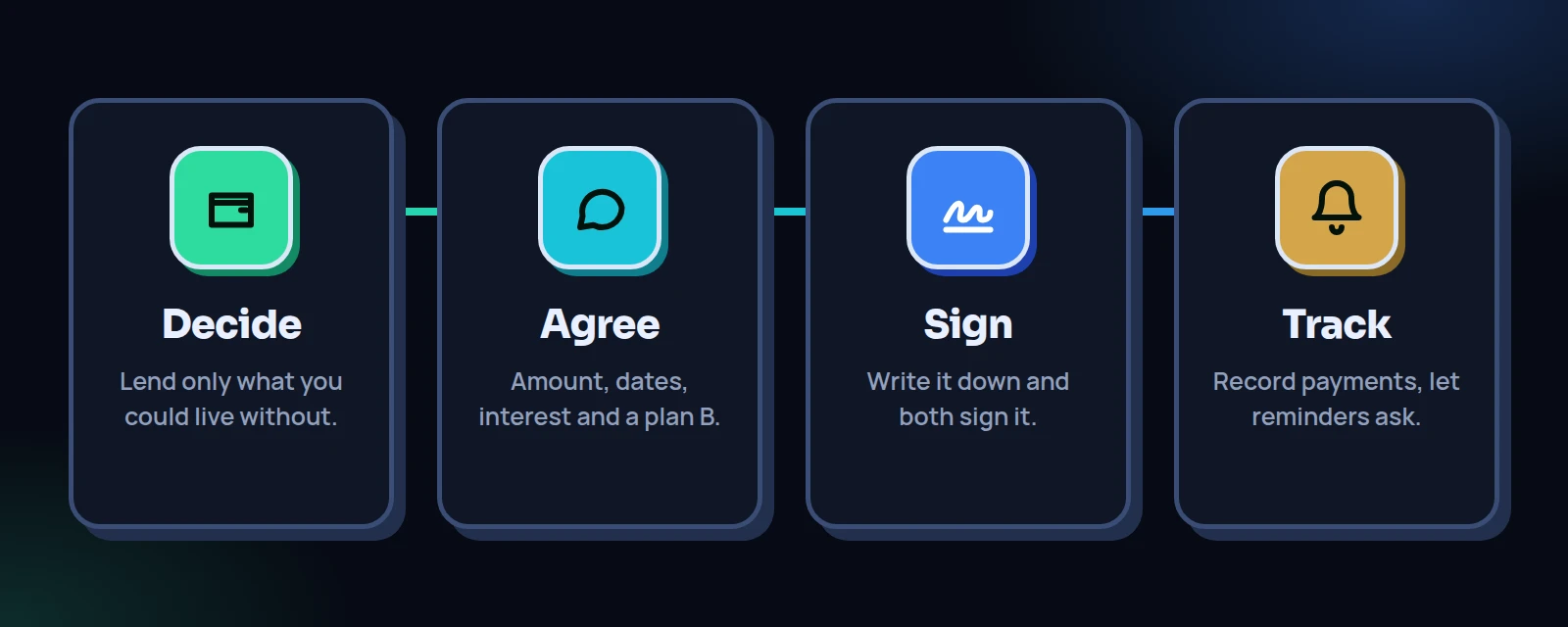
Before you lend money to a friend, have a short, relaxed conversation about the details. It can feel awkward for about two minutes, and then it is a relief for both of you. Cover these points:
- The exact amount. Not “around a grand”, but $1,200.
- The purpose. Saying it out loud keeps everyone honest and gives the loan context later.
- How it will be paid back. One lump sum on a date, or a set amount every week or month? Smaller, regular payments are usually easier for the borrower and less nerve-racking for the lender.
- Dates. When is the first payment due, and when should the loan be fully paid?
- Interest, or none. Most loans between friends have no interest. That is fine. If you do charge some, keep it simple and agree the exact number.
- What happens if life changes. Agree now that if a payment will be late, the borrower tells you before the due date, and you will work out a new plan together.
- How payments are made. Bank transfer, Zelle, Venmo, PayPal, cash? Choose a method that leaves a record.
One sentence makes all of this easier: “I’m happy to help, and I want us to still be great friends after, so let’s just agree the details so neither of us has to guess.”
Put it in writing (and both sign)
Tip
Not sure what to include? Our personal loan agreement template walks through every line.
Writing it down when you lend money to a friend can feel formal. In practice it is the opposite of distrust. A written record means neither of you has to rely on memory, and it settles small disagreements before they start.
A good personal loan record includes:
- Both full names and the date.
- The amount and the currency.
- What the money is for (optional, but helpful).
- The repayment plan: amounts and due dates.
- Interest, if any, written as a clear number.
- What happens if a payment is late, for example “we will agree a new date together.”
- Signatures from both people.
In the United States, the federal ESIGN Act says a signature or contract cannot be denied legal effect just because it is electronic. That means signing on your phones can be just as valid as signing on paper, as long as both of you clearly intend to sign. An app like IOUEZ makes this quick: one person creates the IOU, the other reviews it on their own device, and once both have signed, the terms are locked so nobody can quietly edit them later.
A worked example: Sam lends Alex $1,200
Alex’s car needs a $1,200 repair, and their paycheck does not land for three weeks. Sam has an emergency fund and decides they could live without $1,200 for six months, so they agree to help.
Over coffee, they agree on these terms: no interest, six monthly payments of $200, due on the 1st of each month, starting next month, paid by bank transfer. If a payment will be late, Alex will message Sam before the due date. Alex creates the IOU in the app with those details, Sam reviews it, and both sign on their own phones in under a minute.
Sam and Alex’s repayment schedule
| Payment | Due | Amount | Left to pay |
|---|---|---|---|
| 1 | Nov 1 | $200 | $1,000 |
| 2 | Dec 1 | $200 | $800 |
| 3 | Jan 1 | $200 | $600 |
| 4 | Feb 1 | $200 | $400 |
| 5 | Mar 1 | $200 | $200 |
| 6 | Apr 1 | $200 | $0 |
Two days before each due date, Alex gets a friendly reminder. When Alex pays, they record the payment and Sam sees the new balance straight away. In February Alex has an unexpected bill, so they message Sam on January 28 and agree to split that month into two $100 payments. Because the change is written down too, nobody has to remember it. The loan closes in April, slightly late, with the friendship fully intact.
Notice what made this work. The amount was one Sam could afford. The plan was small and regular. Both people could see the same numbers. And when life happened, there was already an agreed way to talk about it.
Make paying back easy
Most late payments are not about bad intentions. People forget, get busy, or feel embarrassed to admit they are short this month. When you lend money to a friend, you can design the loan so that paying back is the easy path. Our free repayment calculators show what different payment sizes look like before you agree.
- Match payments to paydays. If your friend is paid on the 15th, a due date of the 16th is far kinder than the 1st.
- Keep payments small and regular. Six payments of $200 feel manageable. One payment of $1,200 can feel impossible.
- Let reminders do the asking. An automatic, polite reminder two days before the due date means you never have to send the awkward text yourself. If you do need to write one, borrow the wording from our guide on how to remind someone to pay you back.
- Record every payment. A shared record means you will never disagree about whether March was paid.
- Say thank you. A quick “got it, thanks!” after each payment keeps the tone warm.
When things go off track
Even when you lend money to a friend with a perfect plan, payments sometimes slip. How you respond in the first week matters more than anything you agreed months ago. Start from curiosity, not accusation. Something like this works well:
“Hey, I noticed the payment for the 1st hasn’t come through yet. No stress, just checking in. Is everything okay? Happy to adjust the plan if this month is tight.”
If your friend is genuinely struggling, you have several kind options:
- Pause for a month and add the missed payment to the end.
- Lower the payment for a while, for example from $200 to $100.
- Move the due date to match a new pay schedule.
- Forgive part of the loan if you can afford to and want to. Say so clearly, and record it, so it is a gift you chose, not a debt you gave up on.
Whatever you decide, update the written record so both of you are looking at the same plan. If a friend stops responding entirely, give them a little time, then send one calm, written message that sets out the amount still owed and asks how they would like to settle it. Most people respond to clear, kind and specific far better than to frustrated and vague.
Going to court over a loan to a friend is a last resort, and usually not worth what it costs the friendship. If you ever consider it, every state has a small claims court for smaller amounts, and the dollar limits vary a lot from state to state, so check your local court’s website first. A signed record of the loan and of every payment is exactly the kind of evidence those courts expect to see.
A quick word on taxes in the United States
When you lend money to a friend, you will rarely come near the tax rules, but it helps to know where the lines are.
- Interest-free loans. The IRS treats some interest-free or low-interest loans as partly a gift. For loans between individuals, the special “below-market loan” rules generally do not apply on any day the total amount you have lent that person is $10,000 or less, as long as the money is not used to buy investments.
- Bigger loans. For larger amounts, the IRS publishes minimum interest rates every month, called the Applicable Federal Rates. Lending well above $10,000 with no interest can create tax effects for the lender.
- Forgiving a loan. If you forgive money you lent, the IRS can treat it as a gift. In 2026 you can give up to $19,000 per person without filing a gift tax return.
- Interest you receive is generally taxable income for the lender.
If your loan is above these amounts, talk to a tax professional before the money moves.
When to say no (and how)
Sometimes the kindest answer is no. That is true when lending would put your own rent, bills or savings at risk, when an earlier loan is still unpaid, or when you already know you would resent it. Saying no to a loan is not saying no to the friendship.
Keep it short, warm and about your situation, not their character:
Message: a kind no
I really wish I could, but I can’t lend money right now without putting my own bills at risk. Can I help another way? I’m happy to look at a budget with you or share that job lead.
A clear no today is far better for a friendship than a reluctant yes that turns into months of quiet resentment. If you would rather not lend money to a friend this time, our guide on how to say no to lending money has more wording for different situations.
Checklist: before you lend money to a friend
- I can live without this amount for the whole repayment period.
- I know what the money is for and how my friend plans to repay it.
- We agreed the exact amount, payment amounts and due dates.
- We agreed on interest (or no interest) as a clear number.
- We agreed what happens if a payment will be late.
- We chose a payment method that leaves a record.
- We wrote it down and both signed.
- Reminders are set, so neither of us has to remember.
- Every payment gets recorded and a quick thank-you.
Frequently asked questions
If I lend money to a friend, should I charge interest?
Most loans between friends have no interest, and that is completely fine. If you do charge interest, agree a simple, fair number up front and write it down. For larger loans in the US, the IRS publishes minimum rates (the Applicable Federal Rates), so check with a tax professional.
Is an IOU legally binding?
A clear written record signed by both people is much stronger than a verbal promise, and in the US electronic signatures generally count as much as signatures on paper. Whether a specific IOU can be enforced depends on your state and the details, so for large amounts speak to an attorney. This is not legal advice.
What if my friend never pays me back?
Start with a calm, specific message and offer to adjust the plan. Many people pay once the plan fits their situation. If nothing works, decide whether the amount is worth pursuing or whether you would rather forgive it and move on. If you forgive it, say so clearly and record it.
How do I remind a friend to pay without being awkward?
Agree on reminders when you set up the loan, so they are part of the plan, not a surprise. Automatic, friendly reminders before each due date remove most of the awkwardness, because you never have to start the conversation yourself.
Is it better to give the money than lend money to a friend?
If you can afford it and do not want it back, a gift can be simpler and kinder. Just say clearly that it is a gift, so nobody is left wondering. If you do want it back, call it a loan and agree the details.
How much is too much to lend money to a friend?
Any amount you could not live without for the full repayment period, or that would make you resent your friend if it were late, is too much. Your limit is set by your budget, not by what they asked for.
Sources
- Internal Revenue Service, Gift tax, explains that interest-free or below-market loans and forgiving a debt may be treated as gifts.
- Internal Revenue Service, Publication 550, Investment Income and Expenses, section on below-market loans and the $10,000 exception for gift loans between individuals.
- Internal Revenue Service, Applicable Federal Rates (AFRs) rulings, the minimum interest rates published each month.
- U.S. Code, 15 U.S.C. § 7001, the Electronic Signatures in Global and National Commerce Act (ESIGN), Legal Information Institute, Cornell Law School.
- Internal Revenue Service, IRS releases tax inflation adjustments for tax year 2026 (IR-2025-103), which keeps the annual gift exclusion at $19,000.