
Your friend’s coffee cart finally has a line around the block, and they need $8,000 for a second espresso machine. Or the startup is “three months from profitable.” Lending money to a friend’s business looks like a personal loan, but it carries business risk, and the person you are helping may not even be the one who legally owes you. These are the questions to ask before you say yes.
Quick answer
Lend to a friend’s business only money you could lose entirely, decide up front whether it is a loan or an investment, and get a signed agreement that names who owes you: the company, your friend personally, or both. Ask how repayments will come out of actual sales, not hoped-for ones.
1. Is this a loan or an investment?
It is whichever you both agree it is, and you need to agree before the money moves. The Small Business Administration describes the two kinds of funding plainly: debt financing is money that must be repaid over time, usually with interest, and the lender gets no ownership; equity financing is money given in exchange for a share of ownership, with no fixed repayment.
Your friend may be picturing one while you picture the other. A loan means you get your money back on a schedule whether the business booms or not, and you get nothing extra if it does. An investment means you share in the upside, and you might get nothing at all if it struggles. Saying “loan or investment?” out loud is the single most useful sentence in this whole conversation.
A common trap when lending money to a friend’s business is saying “loan” while quietly hoping for a slice of the success. If the business takes off, you may feel you deserve more than your money back, and your friend will point, correctly, at what you signed. Pick one and be content with it.
A loan
- A fixed amount comes back on fixed dates.
- You do not become part-owner or part of decisions.
- Easy to write down and track payment by payment.
- Ends cleanly when the last payment lands.
An investment
- No set repayment; you may wait years.
- You share the upside, and the losses.
- Ownership paperwork is more complex and varies by state.
- Raises questions about votes, profits and exits that friends rarely discuss.
This article assumes a loan. If you are leaning toward ownership, you have moved beyond a simple IOU and should talk to an attorney.
2. Who exactly will owe you the money?
If the business is an LLC or a corporation, the company may be the borrower, not your friend. That matters if things go badly. The SBA explains that with an LLC or corporation, business and personal liabilities are separate, which is the whole point of forming one. A debt that belongs to a closed company can be very hard to collect.
If you want your friend to be personally responsible too, the agreement can say so. This is often called a personal guarantee: your friend promises to repay personally if the company cannot. Many small business owners are used to signing these for banks, so asking for one is not an insult. Ask kindly: “Since the company could close, would you be comfortable guaranteeing it personally?”
Whoever signs, write it down precisely. Lending money to a friend’s business without naming the borrower is how two people end up with two different memories of who owed what. If the business is a sole proprietorship, the SBA notes that the owner’s business and personal liabilities are not separate. In that case, your friend is the borrower either way.
Watch out
Do not send business money to a personal account “to keep it simple.” Pay the account of whoever is named as borrower in your agreement, so the record matches the paperwork.
3. What will the money actually buy?
A specific purchase is a good sign; a general “runway” is a riskier one. An $8,000 espresso machine that lets a cart serve twice as many customers is something you can picture paying for itself. “Covering payroll for a couple of months while we figure things out” is money spent on a problem that may still be there when it runs out.
Ask for the quote, the invoice, or at least a list. You are not auditing your friend, you are making sure both of you mean the same thing by “the business needs money.” When you are lending money to a friend’s business, the purpose shapes everything else: how fast it can be repaid, how risky it is, and how you would feel if it vanished.
If the money buys equipment, you can also talk about what happens to that equipment if the loan is not repaid. Some lenders take the item as security for the loan. Secured loans involve extra paperwork that varies by state, so if that matters to you, it is a job for an attorney rather than a template. Even without it, knowing exactly what the money bought makes the loan feel less abstract to both of you.
4. Where will each repayment come from?
From real sales the business already makes, ideally. Ask your friend to show you roughly what comes in and goes out in a normal month. You do not need audited accounts. A screenshot of their sales app, or three months of bank statements with private details hidden, tells you a lot.
Worked example: Rowan’s coffee cart
| Per month | Amount |
|---|---|
| Average sales | $11,500 |
| Beans, milk, cups, supplies | −$4,100 |
| Permit, insurance, commissary rent | −$1,600 |
| Rowan’s own pay | −$4,200 |
| Left over | $1,600 |
Drew is considering lending Rowan $8,000. With $1,600 left each month, a $500 monthly payment leaves Rowan a buffer of $1,100 for slow weeks. Sixteen payments of $500 repay the loan in a little over a year. If the second machine lifts sales the way Rowan expects, the buffer grows. If it does not, there is still room. These figures are an illustration; ask your friend for theirs.
If the honest answer is “from next year’s growth,” the loan depends on a forecast. That does not make it wrong, but it does make it an investment-sized risk dressed as a loan.
5. What happens if the business closes?
You will probably lose some or all of it, so plan for that now. Plenty of small businesses close for reasons that have nothing to do with effort: a lease ends, a road is torn up, a supplier doubles prices. If the company is the borrower and it closes, there may be nothing left to repay you with.
Agree in writing what happens in that case. Maybe the personal guarantee kicks in with a smaller monthly payment. Maybe the equipment you paid for becomes yours to sell. Maybe you agree the remaining balance turns into a gift. Any of those beats discovering at the worst moment that you each assumed something different.
There is a tax angle too. IRS Topic 453 says business bad debts come from your own trade or business; all other bad debts are nonbusiness bad debts. For most people lending to a friend’s company, that means a nonbusiness bad debt, which is deductible only when it is totally worthless and only as a short-term capital loss. You must also be able to show you intended a loan, not a gift, and that you took reasonable steps to collect.
6. Have they tried other sources first?
Ideally yes, and a good answer tells you the plan has been tested. Banks and credit unions lend to small businesses every day, and the SBA’s Microloan program offers loans up to $50,000 through nonprofit lenders. If your friend has been turned down, ask why. Sometimes it is paperwork and time in business; sometimes it is that the numbers do not work, which you would want to know.
Being the first call can be a compliment. If lending money to a friend’s business is the only option they have left, treat that as a warning, because it means nobody whose job is judging business risk has said yes.
7. Should you charge interest?
You can, and when lending money to a friend’s business, interest is more common than with a personal loan. A business is borrowing to make money, so a modest rate is reasonable. Interest you receive is generally taxable income, and the IRS publishes monthly minimum rates, the Applicable Federal Rates, that matter for larger interest-free or low-interest loans. Check your state’s interest rate limits too.
If you keep it interest-free to stay friendly, write “no interest” in the agreement so the decision is on record. On larger amounts, ask a tax professional before you settle on zero.
8. What should the paperwork say?
The basics of any loan, plus the details specific to lending money to a friend’s business. Name the borrower exactly as the business is registered, and add your friend as guarantor if you agreed that. State the amount, purpose, repayment schedule, interest, and what happens if a payment is late or the business closes. Both people sign; if a company is borrowing, your friend signs on its behalf and, separately, as guarantor.
Tip
Start from a personal loan agreement template and add three lines: the registered business name as borrower, your friend’s personal guarantee, and what happens if the business closes. For more than that, or for any ownership stake, pay for an hour with a local attorney.
Then keep the record alive. IOUEZ lets you set up the agreement with an installment plan, have both people sign on their own devices, and log each payment as it arrives, so the balance is never a matter of memory. The features page shows what is included.
9. How will you hear how things are going?
Agree on a light, regular update so you are not tempted to inspect the business every time you walk past it. A short message once a quarter with sales, how the new equipment is working out, and whether payments are comfortable is plenty. It keeps you informed without making you a manager.
This question protects the friendship more than the money. Lenders who feel in the dark start counting customers and noticing new purchases. Borrowers who feel watched start avoiding the lender. A simple agreed update stops both habits before they form.
You could put it like this: “I don’t need to know everything. Could you send me a quick note each quarter on how sales are going and whether the payments still feel comfortable? If anything changes, I’d rather hear it early.” That last sentence is the important one. Bad news that arrives early can be planned around; bad news that arrives as a missed payment feels like a broken promise.
10. Could you lose it all and stay friends?
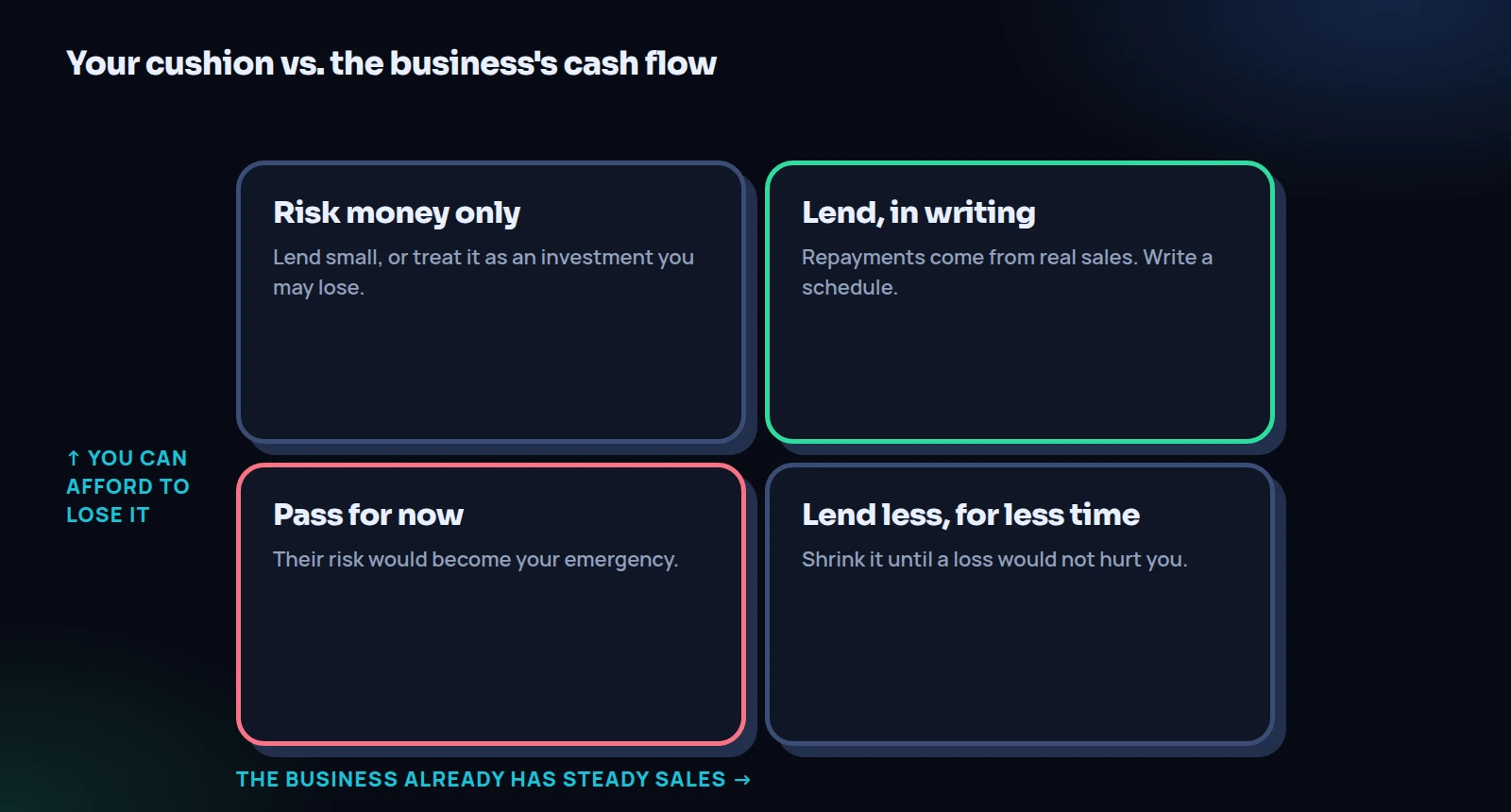
If the answer is no, lend less or do not lend. Lending money to a friend’s business adds a whole layer of risk your friend cannot fully control, on top of the normal risks of any personal loan. Work out your own limit first with the “money you can lose” rule, and remember that a business loan is closer to the “tight” end of that scale than a loan to cover rent.
If you would rather help without lending money to a friend’s business, you have options. Buy gift cards for your office. Leave reviews. Introduce them to a customer. Help them prepare a microloan application. None of that strains the friendship, and some of it is worth more than cash.
Checklist before lending money to a friend’s business
- We agreed whether this is a loan or an investment.
- The agreement names the borrower exactly, and any personal guarantee.
- I know what the money will buy, with a quote or invoice.
- Repayments come from sales the business already makes.
- We agreed what happens if a payment is late or the business closes.
- Interest (or no interest) is written down as a clear number.
- The money goes to the account named in the agreement.
- We set a regular, light update.
- I could lose the full amount and stay friends.
Frequently asked questions
Is lending money to a friend’s business riskier than a personal loan?
Usually yes. Repayment depends on the business doing well, and if the company is the borrower, it may close with nothing left. A personal guarantee from your friend reduces that risk.
Can I get a share of the business instead of repayment?
That is an investment, not a loan, and it involves ownership terms that vary by business type and state. Talk to an attorney before agreeing to equity.
What if the business is doing well but payments stop?
Talk early and refer to the written schedule. If the agreement includes a personal guarantee, your friend is responsible even if the company says it cannot pay.
Can I deduct the loss if the business never repays?
Possibly. The IRS treats most such losses as nonbusiness bad debts, deductible only when totally worthless, as a short-term capital loss. You must show it was a real loan and that you tried to collect.
Should a small business loan from a friend have interest?
It can, and a modest rate is common for business loans. Interest is taxable income for you, and your state may limit the rate you can charge.
What is a sensible amount when lending money to a friend’s business?
Only an amount you could lose entirely without touching your own emergency savings, and no more than the business can repay from current sales.
Sources
- U.S. Small Business Administration, Fund your business, the difference between debt financing and equity financing.
- U.S. Small Business Administration, Choose a business structure, how LLCs and corporations separate business and personal liabilities.
- U.S. Small Business Administration, Microloans, loans up to $50,000 through nonprofit intermediary lenders.
- Internal Revenue Service, Topic no. 453, Bad debt deduction, business versus nonbusiness bad debts and the totally worthless rule.
- Internal Revenue Service, Applicable Federal Rates (AFRs) rulings, the minimum rates published each month.