The payment date came and went. Maybe your friend messaged to apologize, maybe they went quiet. Either way, when a friend can’t pay you back, it can feel like there are only two choices: chase them or write it off. There are actually at least seven, and most of them keep both the friendship and a fair share of your money intact.
Key takeaways
- Ask before you assume. “Can’t pay” and “won’t pay” need very different responses.
- Start gentle. A pause or smaller payments solve most short-term problems.
- Write down every change, so the new plan is as clear as the old one.
- Forgiving on purpose is a real option, and very different from giving up.
- The formal route exists, but it is a last resort with real costs.
When a friend can’t pay you back, first find out why
Before you pick an option, you need to know what is going on. A friend who lost a shift this month needs something very different from a friend who has lost their job, and both need something different from a friend who is avoiding you. A short, curious message usually tells you which.
Message: the first check-in
Hey Jesse, I noticed the payment for the 1st hasn’t come through. No stress, I just wanted to check in. Is everything OK? If this month is tight, let’s figure out a plan that works.
(If no reply after a week) Hi, following up on my message about the loan. I’m not upset, I’d just like to know where things stand so we can sort out a plan together. Can we talk this week?
Most people answer a message like this, because it is clearly an offer of help rather than an accusation. Their answer points you to the right option below. If your friend tells you what is happening, believe them unless you have a real reason not to.
Option 1: pause for a month or two
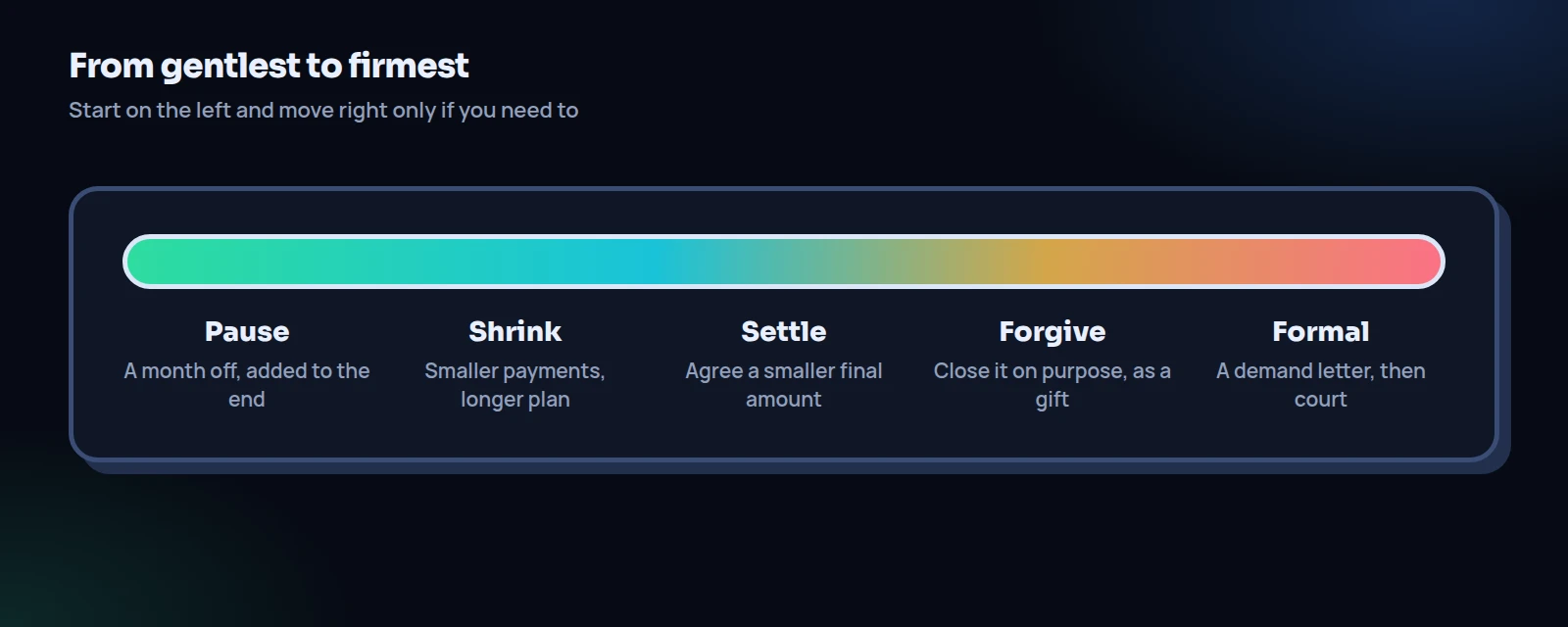
The simplest fix for a temporary setback, and the first thing to offer when a friend can’t pay you back this month. Skip one or two payments and add them to the end of the schedule. Total owed does not change; the finish line moves back a little.
Pros
- Instant relief for your friend.
- You still get the full amount.
- Easy to explain and to record.
Cons
- Only works if the problem really is temporary.
- Repeated pauses can turn into an open-ended loan.
Pick this if your friend has a clear date when things improve, like a new job starting or a bonus landing. Set an end to the pause, not just a start.
Option 2: lower the payment, stretch the plan
When a friend can’t pay you back for longer than a month or two, smaller payments over more months often work better than a pause. Halving a $200 payment to $100 doubles the remaining time, but it keeps money moving and keeps the habit alive.
Pros
- Keeps a regular rhythm going.
- Your friend can still feel they are honoring the deal.
- You still get the full amount, just slower.
Cons
- A long tail can make the loan feel endless.
- Small payments are easier to forget, so reminders matter more.
Pick this if your friend has some income but less than before. A new payment plan should be one they can make on a bad month, not a good one.
Option 3: move the due date
Sometimes the problem is not the amount, it is the timing. A payment due on the 1st, when your friend is paid on the 15th, means the loan always competes with rent. Moving the date to the 16th can turn a missed payment into an easy one.
This option costs you nothing at all, which makes it a good first question whenever a friend can’t pay you back on schedule. It is also one of the most overlooked. When you first ask what is going on, ask when their paychecks land.
Tip
Whatever you change, update the written agreement and confirm it with your friend. In IOUEZ, you can adjust the plan and keep each recorded payment against the balance, and reminders move to the new due dates, so neither of you has to remember the new rules.
Option 4: accept something other than money
Occasionally a friend who cannot pay in cash can pay in another way: fixing your car, building your website, watching your dog for a month while you travel. If you would have paid someone for that work anyway, valuing it against the loan can be a genuinely good deal for both of you.
Pros
- Your friend can contribute something real right now.
- You get something you needed.
Cons
- Agreeing a fair value can be awkward.
- Unfinished work can become a new argument.
- There can be tax questions for larger amounts.
Pick this if the work is something you would really pay for, and you agree a specific dollar value in writing before it starts.
Option 5: settle for a smaller final amount
If a friend can’t pay you back in full but can pay something now, you can agree a reduced amount that closes the loan. For example, $1,500 is still owed, your friend can scrape together $900 over three months, and you agree that $900 settles it.
Pros
- A clear end date for both of you.
- You recover a real portion of the loan.
- Your friend gets a fresh start.
Cons
- You accept a loss.
- The forgiven part may count as a gift for tax purposes.
Pick this if the full amount is unrealistic and you would rather close the chapter than wait years. Write down that the smaller sum settles the loan in full, so nobody revisits it later.
Option 6: forgive the loan, on purpose
Forgiving a loan is not the same as giving up on it. Giving up is silence and quiet resentment. Forgiving is a clear decision, said out loud and written down: “I’ve decided to forgive the rest of the loan. You don’t owe me anything. I want you to focus on getting back on your feet.”
Pros
- Ends the stress for both of you.
- Often saves the friendship outright.
- The borrower generally does not owe income tax on a debt forgiven as a gift.
Cons
- You lose the money.
- The IRS can treat a forgiven debt as a gift from you.
- You cannot later deduct a debt you chose to forgive as a gift.
On the tax side, the IRS lists forgiving a debt among the transfers the gift tax can apply to. For 2026, the annual exclusion is $19,000 per person, so for most friendly loans no gift tax return is needed. For the borrower, IRS Topic 431 lists amounts canceled as gifts among the exceptions to canceled-debt income.
Pick this if you can afford the loss, you value the friendship more than the balance, and your friend can’t pay you back in any realistic timeframe. Close the loan in your records so it never resurfaces. If you think it might have been a gift all along, gift or loan? is a useful read for next time.
Option 7: the formal route
When a friend can’t pay you back, this option rarely fits, and it fits even less when they can pay and simply won’t. Even then, the formal route is the last resort, because it costs time, money and almost certainly the friendship. It usually has two stages.
A written demand. A calm, factual letter or email: the amount lent, the date, the payments made, the balance, and a reasonable deadline to pay or propose a plan. Keep it short and unemotional. Sometimes this alone brings a reply, because it shows you are serious.
Small claims court. Every state has a court for smaller civil claims, and the dollar limits and filing rules differ from state to state, so check your local court’s website. A signed agreement and a record of every payment are the kind of evidence these courts expect. Do not wait forever either: the CFPB notes that most states have statutes of limitations between three and six years for debts, some longer, and the limit can depend on the type of debt and your state.
Pros
- A legal route to recover money owed.
- A clear outcome either way.
Cons
- Filing fees, time and stress.
- Winning a judgment is not the same as being paid.
- Very likely the end of the friendship.
Pick this if the amount matters a lot to you, your friend can pay but will not, and you have accepted that the friendship is already over.
What not to do while you wait
Some moves feel satisfying for a minute and make everything harder for months. When a friend can’t pay you back, steer clear of these.
- Venting to mutual friends. It will get back to them, and it turns a private problem into a public humiliation. People who feel humiliated rarely pay faster.
- Posting about it online, even vaguely. “Some people don’t pay their debts” is not as anonymous as it feels.
- Adding interest or fees nobody agreed to. If it is not in what you both signed, it is a new demand, and it reads as punishment.
- Contacting their family or employer. It crosses a line most friendships cannot come back from.
- Sending messages daily. One clear message, then a follow-up a week later, is plenty. More than that feels like pressure, not a plan.
None of this means staying silent. It means keeping the conversation between the two of you, in writing, and calm. That is also what protects your options later if you ever need the formal route.
What if it is truly lost?
If the money will not come back and you did not forgive it as a gift, there may be a small tax consolation. IRS Topic 453 says a nonbusiness bad debt can be deducted only when it is totally worthless, as a short-term capital loss, and only if you can show you intended a loan (not a gift) and took reasonable steps to collect. The IRS also says that if you lent to a friend with the understanding they might not repay it, it counts as a gift, not a loan. A signed agreement and a record of your reminders are exactly the evidence that helps here.
How it played out for Sky and Jesse
Example
Sky lent Jesse $1,800, repaid at $200 each month. After four payments, Jesse was laid off. Sky sent the check-in message above. Jesse replied the same day, embarrassed, and explained. They agreed on Option 1, a two-month pause. When Jesse found part-time work, they moved to Option 2, $100 each month, with the due date moved to the day after payday (Option 3). Six months later, with $400 left, Sky decided to forgive the rest (Option 6) as a birthday present. Every change went into the shared record. The friendship survived; so did most of the money. This is an illustration, not a real user story.
Notice the order. Sky started on the gentle end and moved only when something changed. That is the whole idea behind this list: when a friend can’t pay you back, the best option is usually the gentlest one that still works.
Avoid this next time
Often a friend can’t pay you back simply because the schedule never fit their budget. Many of these situations are easier to handle if the loan was set up clearly from the start: an amount you could afford to lose, a schedule that matched payday, an agreement about what happens if a payment slips, and reminders so neither of you has to remember. How to lend money to a friend covers that setup, and if you would rather not lend at all next time, these scripts help you say no kindly. You can see how agreements, reminders and payment records fit together on the how it works page.
Frequently asked questions
What should I do first if a friend can’t pay you back on time?
Send a short, friendly check-in to find out what happened. Their answer tells you whether a pause, smaller payments or a new date is the right fix.
Should I charge a late fee?
Most people do not between friends, and adding one after the fact rarely helps. If you agreed one in writing beforehand, you can still choose to waive it.
Can I take a friend to small claims court?
Yes, every state has a small claims or similar court, with its own dollar limits and rules. A signed agreement and payment records make your case much clearer. It is usually a last resort.
If I forgive the loan, do I owe gift tax?
Forgiving a debt can count as a gift. For 2026, gifts up to $19,000 per person fall under the annual exclusion, so most friendly loans need no gift tax return.
Can I deduct a loan my friend never repaid?
Possibly, as a nonbusiness bad debt, if it was a real loan, it is totally worthless and you tried to collect. You cannot deduct an amount you chose to forgive as a gift.
What if my friend just stops replying?
Silence is the hardest version of this. Give it a week or two, then send one calm written message with the balance and a request to talk. If there is still nothing, decide whether to forgive, wait, or take the formal route.
Sources
- Internal Revenue Service, Frequently asked questions on gift taxes, forgiving a debt as a gift and the $19,000 annual exclusion for 2026.
- Internal Revenue Service, Topic no. 431, Canceled debt, amounts canceled as gifts.
- Internal Revenue Service, Topic no. 453, Bad debt deduction, nonbusiness bad debts, worthlessness and loan versus gift intent.
- Consumer Financial Protection Bureau, Can debt collectors collect a debt that’s several years old?, the usual range of statutes of limitations on debts.