
“IOU” is a phonetic joke that became a legal habit: say the letters out loud and you get “I owe you.” So what is an IOU in practice? It is a short written note in which one person admits they owe another a specific amount of money. It can be scribbled on a napkin or signed on two phones, and how much it helps you later depends almost entirely on the details you put in it.
Quick answer
An IOU is a written acknowledgment of a debt: “I, Jordan, owe Rowan $400.” At its most basic it proves that a debt exists. Add a promise to pay, a date, signatures from both people and a payment plan, and it starts to look like a simple loan agreement, which is far more useful if anyone’s memory gets fuzzy.
What is an IOU, exactly?
The shortest honest definition: an IOU is evidence. It records that money changed hands and that one person accepts they owe it back. That is all a classic IOU does. It does not, by itself, set a due date, an interest rate or a plan for what happens if things go sideways.
The word dates back centuries, to merchants and soldiers who scrawled “I.O.U.” with an amount and a name on whatever paper was handy. The format survived because it is so easy. Nobody needs a lawyer to write three letters and a number.
That ease is also its weakness. Ask ten people what is an IOU and most will describe something like “a note saying I owe you money.” Ask the same ten what it should contain and you will get ten different answers. That gap is where most arguments between friends start.
What is an IOU next to a promise to pay?
There is a useful distinction hiding in commercial law. The Uniform Commercial Code, the model law most states have adopted for checks and notes, defines a “promise” as a written undertaking to pay money signed by the person undertaking to pay. It then adds a line that fits the IOU perfectly: an acknowledgment of an obligation is not a promise unless the person also undertakes to pay it.
In plain English, “I owe you $400” admits a debt. “I owe you $400 and will pay it back by June 30” admits a debt and promises to repay it. The second sentence is doing much more work. That is the core of the IOU meaning for everyday people: the more you write, the less anyone has to guess.
Example
Jordan borrows $400 from Rowan to cover a security deposit. Version one is a sticky note on Rowan’s fridge: “IOU $400, J.” Version two is a short record both of them sign: “Jordan owes Rowan $400, lent on March 3 for an apartment deposit. Jordan will repay $100 on the 1st of each month from April to July.” Six months later, version one is in the recycling and nobody is sure whether the $150 Jordan sent in May was rent money, a concert ticket or a payment. Version two answers that before anyone asks.
How an IOU works from start to finish
Most IOUs follow the same short life. Money moves first, or a bill gets paid on someone’s behalf. Then the debt is written down, ideally on the same day while both people remember the numbers. Payments come in over weeks or months. Finally, the debt is cleared and someone, ideally both people, confirms it is closed.
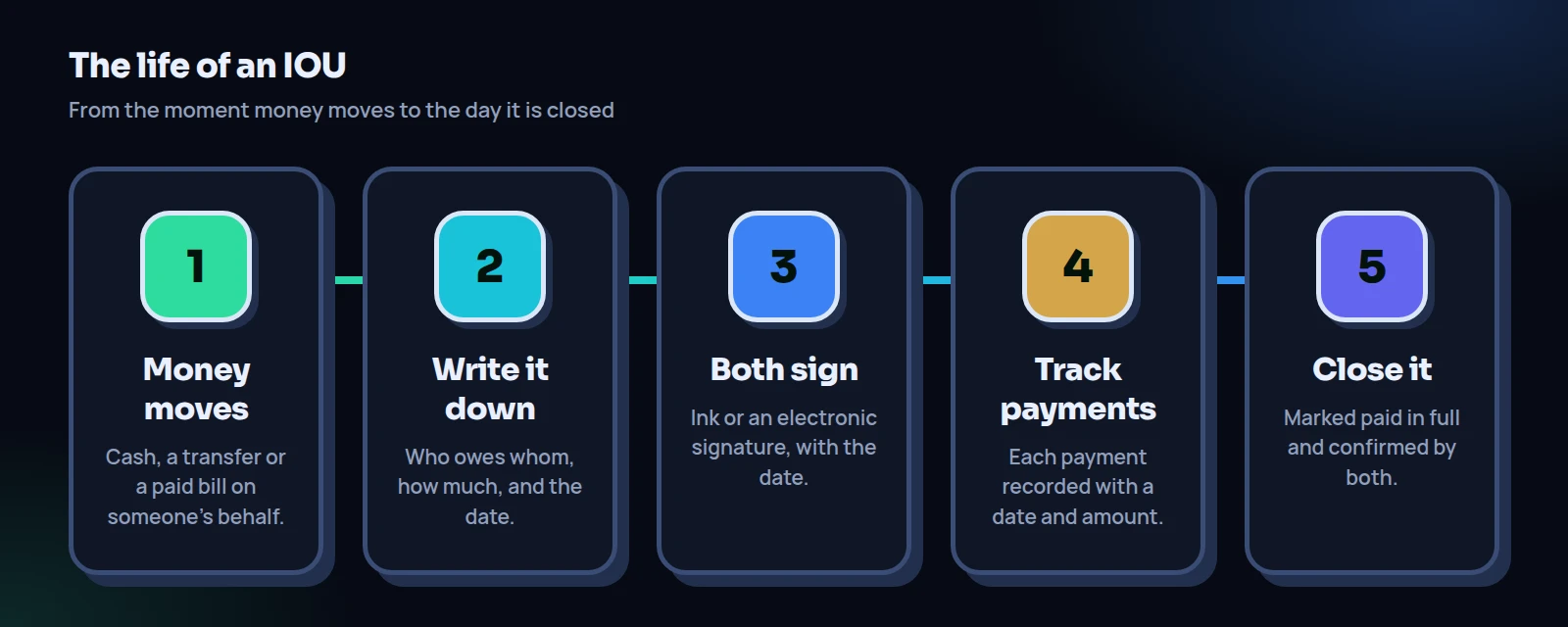
The steps people skip are the middle ones. Signing feels formal, so it gets dropped. Payment records feel like bookkeeping, so they live in three different apps. And closing gets forgotten entirely, which is how a debt that was repaid in 2024 can turn into an awkward question in 2027.
What is an IOU made of? The vocabulary in plain English
If you are reading about IOUs for the first time, the words around them can sound heavier than they are. Here is the short list we wish someone had handed us.
- IOU
- A written note that acknowledges a debt. Usually short and informal.
- Lender (creditor)
- The person who handed over the money and is owed it.
- Borrower (debtor)
- The person who received the money and owes it.
- Principal
- The amount borrowed, before any interest or fees.
- Interest
- Extra money paid for the use of the loan, usually a yearly percentage. Most loans between friends have none.
- Promissory note
- A signed written promise to pay a set amount, often with a due date and interest. More formal than an IOU.
- Loan agreement
- A fuller contract that sets out both people’s duties: payments, what counts as late, what happens on default.
- Installment
- One of a series of scheduled payments, such as $100 on the 1st of each month for four months.
- Due date
- The day a payment, or the whole debt, should be paid.
- Default
- Failing to pay as agreed. Between friends, it usually means “we need to talk,” not “see you in court.”
- Electronic signature
- A signature made on a screen, by typing, drawing or clicking, with the intent to sign. Under federal law it generally cannot be refused just because it is electronic.
- Witness
- A third person who sees the signing and can later say so. Rarely required for a simple IOU, sometimes helpful.
- Statute of limitations
- The time limit for filing a lawsuit to collect a debt. It is set by state law and differs by state and by type of debt.
- Paid in full
- The balance is zero. Worth confirming in writing so the record ends cleanly.
You do not need to memorize any of this. The terms that matter most day to day are principal, installment, due date and paid in full, because those are the numbers people argue about.
Is an IOU legally binding?
Often it can help a lot, but “binding” is the wrong way to think about it. In most US states, a loan agreement does not have to be written down at all to be valid; a spoken agreement to repay can be a real contract. The trouble with spoken agreements is proving them. A signed IOU is evidence that the debt existed and that the borrower accepted it.
There are exceptions where writing matters more. Every state has a “statute of frauds,” a rule that certain contracts must be in writing and signed by the person bound. Agreements that cannot be completed within one year are a common example. A repayment plan stretching over 18 months may fall into that category in some states, which is one more reason to write it down and have both people sign.
Watch out
An IOU without a date, an amount in numbers and words, or the borrower’s signature is much weaker evidence. “IOU 4 hundred” on the back of a receipt proves very little about who owes whom, or when.
If an IOU ever ends up in front of a judge, it will most likely be in small claims court, where the dollar limits vary by state. California, for example, lets an individual sue for up to $12,500. Small claims judges look for exactly the things a good IOU contains: who, how much, when, what was paid back, and whether both people agreed. For a deeper look at what makes a note persuasive, see what makes an IOU stronger in a dispute.
What is an IOU used for? Everyday uses
IOUs show up anywhere money moves between people who trust each other enough not to call a bank. A few patterns we see over and over:
- Bridge money between paychecks. A friend covers a $280 car repair until Friday.
- Shared costs fronted by one person. One roommate pays the $1,150 security deposit and the other owes their half.
- Family help with an end date. A parent covers a semester’s books and expects it back over the summer.
- Small business tabs. A regular customer takes supplies now and settles at the end of the month.
- Group trips. One person books the rental house and everyone else owes a share.
- Bigger personal loans. A sibling lends $5,000 toward a used car, repaid over two years.
The first four are classic IOU territory. The last two often deserve more than an IOU: a group trip needs a split, not a single debt, and a $5,000 loan over two years benefits from a full agreement with a schedule. Our comparison of IOUs, promissory notes and loan agreements goes through where each format fits.
What is an IOU on paper? Three IOU examples
Here are three IOU examples for the same $600 loan between Jordan and Rowan. All three are “IOUs.” Only one would make a stranger nod and say, “Yes, that is clear.”
Worked example: one $600 loan, written three ways
| Version | What it says | What it proves | What is missing |
|---|---|---|---|
| Thin | “IOU $600. J” | Someone with the initial J owed $600 at some point | Full names, date, signature, plan |
| Better | “I, Jordan Ellis, owe Rowan Park $600, borrowed on 9/14/2026.” Signed by Jordan | A specific person accepted a specific debt on a date | When and how it gets repaid |
| Solid | Names, $600 (six hundred dollars), purpose, date, three payments of $200 on Oct 15, Nov 15 and Dec 15, no interest, signed and dated by both | The debt, the plan, and that both people agreed to it | Nothing important; just keep the payment records |
The solid version takes maybe four extra minutes to write. It also turns every future question (“was the November payment late?”) into something you can look up instead of argue about.
If you want to build the solid version yourself, the step-by-step guide on how to write an IOU walks through every field with a copyable sample.
What is an IOU not? Four common mix-ups
Part of answering “what is an IOU” is knowing where the idea ends. An IOU is not:
- A gift receipt. If you never expect the money back, say so clearly and skip the IOU. Mixing the two causes more hurt than either one alone. The piece on gift or loan helps you decide.
- A payment record. The IOU says what is owed. It does not show what was paid. You need separate proof for each payment: transfers, receipts, or notes both people confirm.
- Security for the loan. A basic IOU does not give the lender any claim on the borrower’s car, house or paycheck. Secured loans need different, more formal paperwork.
- A license to charge any interest you like. States set their own interest limits, called usury laws, and they vary. Most friendly loans skip interest entirely.
A quick word on taxes
An interest-free IOU between friends rarely touches the tax system. A few lines to know: interest you receive on a personal loan is generally taxable income, according to the IRS. Very large interest-free loans between individuals can be treated partly as a gift under the IRS below-market loan rules, with an exception for gift loans between individuals of $10,000 or less (as long as the money is not used to buy income-producing assets). And forgiving a debt can count as a gift. If your IOU is in five figures, ask a tax professional before the money moves.
What is an IOU on a phone? Same idea, fewer lost napkins
The modern version of an IOU lives on a phone. That changes the logistics, not the logic. Federal law, the ESIGN Act, says a signature, contract or record relating to a transaction in or affecting interstate commerce may not be denied legal effect solely because it is electronic. Nearly every state has adopted the Uniform Electronic Transactions Act, which says much the same at the state level. The longer explanation, myths included, is in our guide to electronic signatures for personal loans.
In IOUEZ, one person creates the agreement with the amount, date and payment plan, and the other person reviews and signs it on their own device. Once both have signed, the terms are locked, so neither person can quietly change the amount later. Payments get recorded against the agreement as they happen, and reminders go out before due dates. It is the “solid” IOU from the table above, minus the fridge magnet. You can see the whole flow on the how it works page.
Tip
Whatever tool you use, write the IOU on the day the money moves. Memories of amounts drift within weeks, and “it was $600, right?” is a much easier conversation on day one than on day ninety.
So, what is an IOU good for, and when should you use one?
For small, short, friendly loans, yes. A clear IOU costs nothing and settles most disagreements before they start. For loans over a few thousand dollars, loans that will take more than a year to repay, or loans tied to a business, treat the IOU as a starting point and move up to a fuller agreement. And if you are still deciding whether to lend at all, start with how to lend money to a friend.
Frequently asked questions
What is an IOU in simple words?
It is a note that says one person owes another a certain amount of money. The letters stand for “I owe you.” A good one also includes both names, the date, how and when it will be repaid, and both signatures.
Is an IOU legally binding?
An IOU is usually treated as evidence that a debt exists. Whether it can be enforced in a particular case depends on your state’s contract rules and the details written down. A signed, dated IOU with a repayment plan is much stronger than a bare “IOU $500.” This is general information, not legal advice.
What is the difference between an IOU and a promissory note?
An IOU mainly acknowledges a debt. A promissory note is a signed written promise to pay a set amount, often by a set date and sometimes with interest. In practice the line blurs: an IOU that includes a promise to repay and a schedule starts to work like a simple note.
Does an IOU need a witness or a notary?
For a simple personal loan, most states do not require either. A notary confirms the signer’s identity, not the content of the document. A witness can help if one person later claims they never signed, but clear signatures and good records usually matter more.
What is an IOU in digital form, and does it count?
Yes. Under the federal ESIGN Act and state electronic transaction laws, a signature generally cannot be refused just because it was made electronically. What matters is that both people clearly intended to sign and that the record can be kept and reproduced later.
What is an IOU’s shelf life? How long does it stay valid?
The debt usually does not expire on its own, but every state sets a time limit for suing to collect it, called the statute of limitations. The Consumer Financial Protection Bureau notes that most fall in the three to six year range, varying by state and type of debt.
Sources
- Legal Information Institute, Cornell Law School, UCC § 3-103. Definitions, defining “promise” and noting that an acknowledgment of an obligation is not a promise unless the obligor also undertakes to pay.
- Legal Information Institute, Cornell Law School, 15 U.S. Code § 7001, General rule of validity (ESIGN Act), on electronic signatures and records.
- Uniform Law Commission, Electronic Transactions Act, the uniform state law on electronic records and signatures.
- Legal Information Institute, Cornell Law School, Statute of frauds (Wex), on contracts that must be in writing, including those that cannot be performed within one year.
- Consumer Financial Protection Bureau, Can debt collectors collect a debt that’s several years old?, on statutes of limitations generally falling in the three to six year range.
- Judicial Branch of California, Before you start a small claims case, on the $12,500 limit for individuals in California small claims court.
- Internal Revenue Service, Topic no. 403, Interest received, and Publication 550, Investment Income and Expenses, on taxable interest and below-market loans.
- Legal Information Institute, Cornell Law School, Usury (Wex), on state interest rate limits.