Nobody enjoys having to remind someone to pay you back. You lent the money because you care about the person, and now you are rehearsing a text in the shower and deleting it three times. The good news: a reminder is not an accusation. It is a piece of information, and the right words make it easy for the other person to answer.
Quick answer
Send a short, friendly message that names the amount, the date and how to pay, and leaves a door open (“no stress if you need a few days”). Start a few days before the due date, not after it. If a payment is late, move up one step at a time: a check-in, then a new written plan, then a calm final note. Keep every message in writing.
Why it feels so hard to remind someone to pay you back
Most lenders wait too long. They tell themselves the borrower will remember, then a week passes, then a month, and by the time they finally speak up the message carries all that stored-up frustration. The tone comes out sharp, the borrower feels ambushed, and both people end up defending themselves instead of sorting out a $200 payment.
The fix is timing, not courage. A reminder sent before anything has gone wrong is just logistics. “Your payment is due Saturday” is the same kind of sentence as “your dentist appointment is Tuesday.” It only becomes loaded when it arrives late and hints at a judgment.
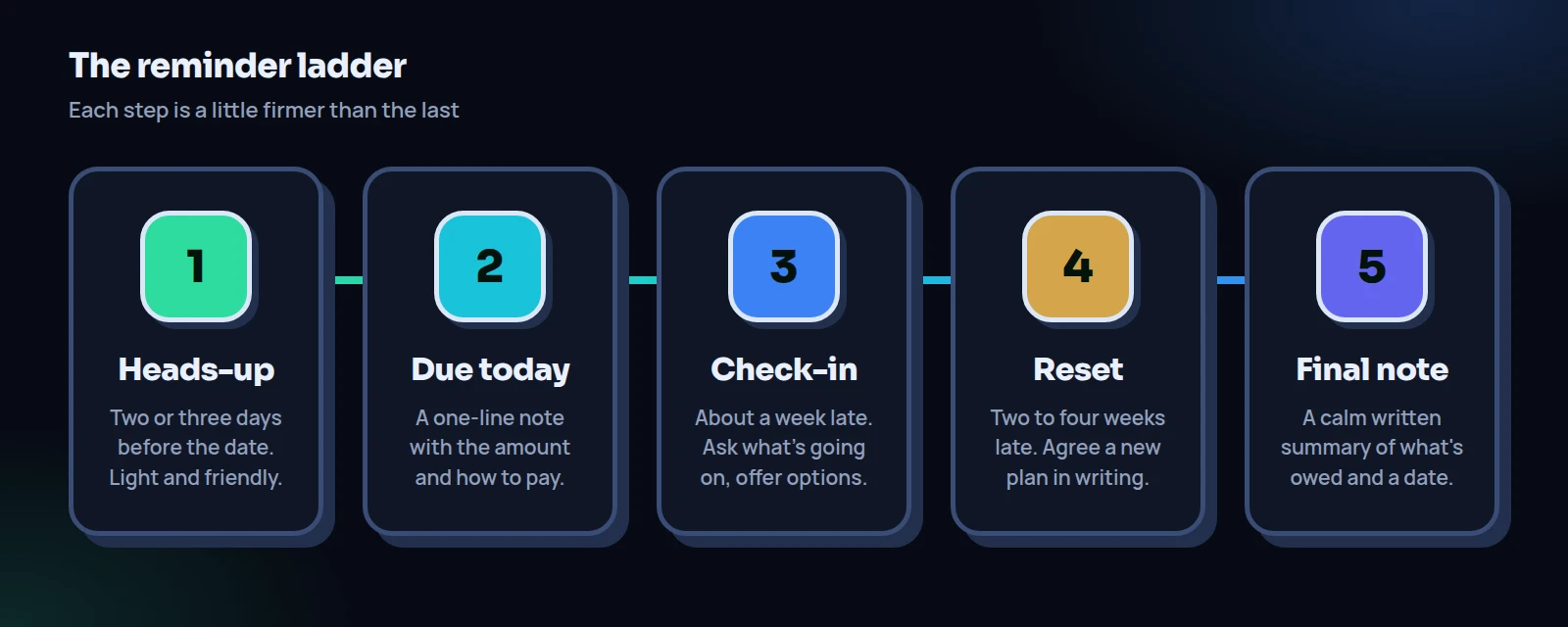
So the scripts below follow a ladder. Each rung is a little firmer than the last, and you only climb when the previous one didn’t work. Most loans between friends never get past the first two rungs.
Rung one: the heads-up before it’s due
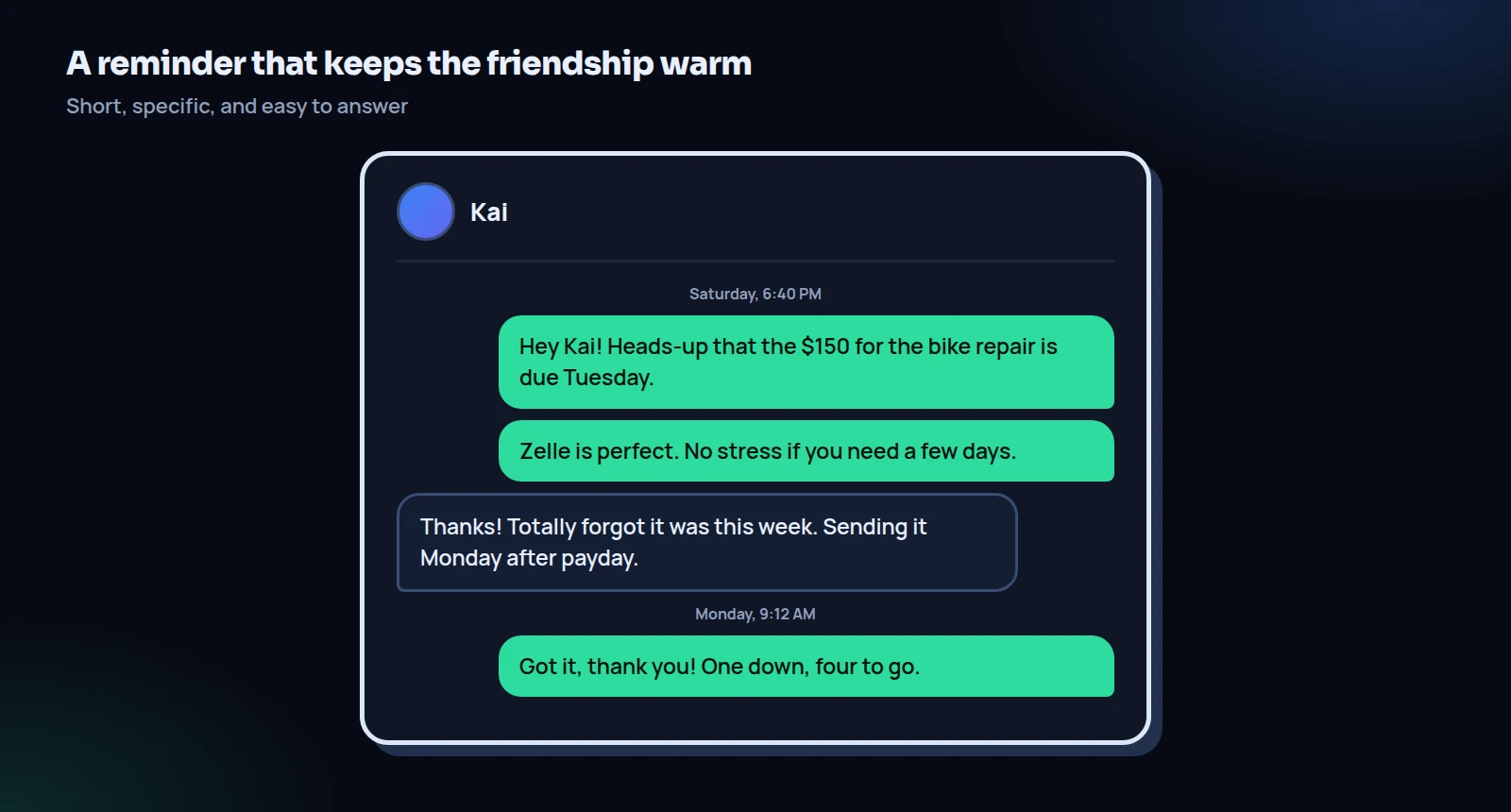
Send this two or three days ahead. It gives the borrower time to move money around and makes paying on time the easy option. Mention the purpose of the loan if it helps jog their memory, and always say how to pay, so they don’t have to ask.
Message: the friendly heads-up
Hey Kai! Heads-up that the $150 for the bike repair is due Tuesday. Same as before, Zelle is perfect. No stress if you need a few days, just let me know.
That last line matters. It tells the borrower that being honest is safe, which means you hear about problems early, while they are still small. A borrower who feels they will be judged for being short tends to go silent instead.
If you set up the loan in IOUEZ, the app sends both of you a reminder as each payment comes due, so this first nudge does not have to come from you at all. That is the single biggest reason to use reminders: the system asks, and you get to stay the friend. You can see the flow on the how it works page.
Rung two: the due-date message
If the payment hasn’t arrived by the end of the due date, one line is enough. Keep it as plain as a calendar alert.
Message: due today
Hi Kai, just a reminder that today’s the day for the $150. Thanks!
(If you prefer a softer version) Morning! Today’s the $150 day. Shout if anything’s changed.
Resist the urge to add an explanation of why you need the money. You don’t owe anyone a reason for wanting what was agreed, and the explanation makes the message longer and heavier than it needs to be.
Rung three: about a week late, the check-in
Now you know something is off. Maybe they forgot, maybe their hours got cut, maybe they are embarrassed. Your goal at this stage is to find out which one, not to win. Ask a real question and offer a real option.
Message: the one-week check-in
Hey Kai, I haven’t seen the $150 from the 14th come through yet. Is everything okay? If this month is tight we can move it or split it in two, I’d just like to know what to expect.
(If no reply in 2–3 days) Hi again, just following up on the $150. A quick yes, no or “next week” is totally fine.
The follow-up lowers the bar for replying. People often stay quiet because they think they need a full plan before they can answer. Telling them a one-word reply is welcome removes that excuse.
Watch out
Don’t remind people in public. A comment in a group chat, a joke at dinner or a post on social media turns a private money matter into a public embarrassment, and that is the fastest way to lose both the money and the friend.
Rung four: two to four weeks late, agree a new plan
If a payment is weeks late, the original plan is probably not working. Insisting on it will just produce more missed dates. Offer to reset it, and write the new version down so you are both looking at the same numbers.
Message: let’s reset the plan
Hi Kai, the $150 from July 14 is still open, and with August’s payment that’s $300 left in total. I’d rather fix the plan than keep chasing dates. Would $75 every two weeks work better, starting on the 15th? If you have a different idea, I’m listening. Let’s agree something by Friday and I’ll update our agreement.
Notice the structure: the current balance, a concrete proposal, an invitation to counter, and a soft deadline for agreeing. That gives the borrower something specific to say yes to. For the details of rebuilding a plan after a miss, see our playbook on restarting repayments after a missed payment.
When they’ve gone quiet
Silence is the hardest situation, because you start filling it with stories. Before you assume the worst, try one different channel. If you have been texting, call once. If you have been calling, send a short email. People sometimes mute a thread out of guilt and never see the follow-ups.
Message: breaking the silence
Hey Kai, I’ve sent a couple of messages about the loan and haven’t heard back, so I wanted to try here. I’m not upset, I just don’t know where things stand. Can we talk for ten minutes this week? Any evening works for me.
A reminder is information, not an accusation. Send it early and it stays that way.
Give it a week. If you still hear nothing, it is time for the final written note below. If you have been texting all along, our guide on how to ask for money back by text covers read receipts, voice notes and group-chat traps in detail.
When they paid part of it
A partial payment is good news, even if it isn’t the full amount. Thank them for what arrived, confirm the new balance, and ask about the rest in the same breath. Don’t let a partial payment pass in silence, or the leftover amount tends to become fuzzy.
Message: thanks for the partial payment
Got the $100, thank you! That leaves $50 from this month and $300 after that. Want to add the $50 to the next payment, or send it separately next Friday?
Record the partial payment the same day, with the amount and the date. In IOUEZ, you log the payment with its amount, date and method, and the agreement shows the new balance to both of you. Our guide to keeping proof of repayment explains which records hold up best if there is ever a disagreement about who paid what.
The final written note
This is the last friendly rung. It is still polite, but it is complete: what was lent, when, what has been repaid, what remains, and a date by which you would like either the money or a plan. Send it in writing, by email or message, so there is a record.
Message: the final note
Hi Kai, I want to settle the loan from March properly. I lent you $750 on March 3 for the bike repair. You’ve repaid $450 (in April, May and June), so $300 is still open. Could you either pay the $300 or send me a plan you can stick to by October 31? I’d really like to sort this out between us. Thanks for reading this.
Leave out threats, ultimatums and anything about the friendship itself. A calm, factual note is more likely to get a response, and if you ever do need to show it to anyone else, it shows you as reasonable.
A borrowed rulebook: how often is too often?
Friends are not debt collectors, and the federal rules for collection agencies don’t apply to you. Still, those rules are a useful sense check for what feels like pressure. The FTC explains that collectors can’t contact people before 8 a.m. or after 9 p.m. unless they agree, and the CFPB’s Regulation F presumes a collector is harassing someone if they call about a debt more than seven times in seven days.
We’d aim far below that. Between friends, one reminder per rung is plenty, with at least a few days between them. If you find yourself sending a third message in a week, stop and call instead, or move to the next rung. Repeating the same message louder doesn’t help anyone.
Worked example: Morgan’s reminders for a $750 loan
Morgan lent Kai $750 for a bike repair, to be repaid in five payments of $150 on the 14th of each month. Here is when each message went out, as an illustration.
| Date | Rung | Message | Result |
|---|---|---|---|
| Apr 11 | Heads-up | “$150 due Tuesday” | Paid Apr 13 |
| May 14 | Due today | “Today’s the $150 day” | Paid May 15 |
| Jun 21 | Check-in | “Is everything okay?” | Paid Jun 24 |
| Jul 21 | Check-in | “Haven’t seen the $150” | No reply |
| Aug 4 | Reset | “$75 every two weeks?” | Agreed |
By August, Kai had repaid $450 and owed $300. The reset turned that into four payments of $75. Nothing dramatic happened; Morgan just kept moving one rung at a time.
Wording that helps, and wording that backfires
Small word choices change how a payment reminder message lands. A few swaps we’d make every time:
- “Just a reminder that the $150 is due Tuesday” instead of “You still owe me.” The first is about a date; the second is about a person.
- A specific amount instead of “the money.” Vague reminders invite vague answers.
- One question instead of three. “Does Friday work?” is easy to answer. “Where is it, why is it late and when will you pay?” is not.
- “I’d like to know what to expect” instead of “I need this money.” You are asking for information, which is a smaller ask.
- No sarcasm. “Must be nice to afford concert tickets” feels satisfying for about a minute and costs you the conversation.
A polite reminder to pay back money is still allowed to be direct. Polite means clear and respectful. It does not mean so soft that the other person can’t tell it’s a reminder.
Set it up so you rarely have to remind someone to pay you back
The best time to plan reminders is the day you lend. When you agree the amount and dates, say out loud: “I’ll set up reminders so neither of us has to remember.” That turns every later message into part of the plan rather than a surprise. A written schedule helps too; our template for a repayment schedule both people can stick to shows how to set dates that match the borrower’s paydays.
In IOUEZ, the borrower signs the agreement on their own device, and from then on both of you get reminders as each due date arrives, plus an overdue notice if a date passes. If you want to prompt them yourself, the agreement has a Request payment button that sends a payment request to the borrower, so you never have to compose the awkward text. If you are still deciding whether to lend at all, start with how to lend money to a friend.
Want the first reminder sent for you, every time? Create the agreement in IOUEZ, add the due dates, and let the app nudge both of you.
Set up remindersWhen you remind someone to pay you back and it isn’t enough
Sometimes the honest answer from the borrower is “I can’t pay right now.” That is a different problem from forgetting, and more reminders won’t fix it. You might pause the plan, lower the payments, or forgive part of the loan. Our guide to what to do when a friend can’t pay you back weighs seven kind options side by side, and if you are wondering whether to add a fee for late payments, read late fees between friends first.
If the amount is large and the borrower refuses to engage at all, every state has a small claims court with its own dollar limits and rules. Check your local court’s website. A signed agreement and a clean record of reminders and payments are exactly what those courts want to see, which is one more reason to keep every message in writing.
Checklist: before you remind someone to pay you back
- I know the exact amount due and the date it was due.
- I’ve checked my own records to be sure the payment didn’t already arrive.
- My message names the amount, the date and how to pay.
- It includes an easy way to say “I need more time.”
- I’m sending it privately, not in a group chat.
- I haven’t already sent this same reminder in the last few days.
- I’ll record any payment or new plan the same day.
Frequently asked questions
How long should I wait before I remind someone to pay you back?
Don’t wait at all for the first one: send a friendly heads-up two or three days before the due date. If the date passes, a one-line note that day is fine, and a proper check-in after about a week.
Is it rude to remind someone to pay you back?
No. When you ask for your money back, you are asking for what was agreed, and that is not rude. What makes a reminder feel rude is tone and timing: public reminders, sarcasm, or a message that arrives after weeks of silence. A short, private, specific message is polite.
Should I remind them by text, call or email?
Use whatever channel you agreed the loan on, usually text. Switch channels once if they go quiet, and use writing for anything important, like a new plan or a final note, so there is a record.
Do debt collection laws apply to me as a friend?
The federal Fair Debt Collection Practices Act covers debt collectors who regularly collect debts owed to others, not individuals collecting their own personal loan. Its limits on timing and frequency are still a sensible guide to what counts as too much. State rules vary.
What if they keep promising and not paying?
Stop accepting vague promises and ask for a specific new plan with dates, then write it down. If two reset plans fail, send a final written note and decide whether to pursue the money or let it go.
Can an app send the reminder so I don’t have to?
Yes. In IOUEZ, once both people sign the agreement, both of you get reminders as each payment comes due and a notice if it goes overdue, so the first nudge never has to come from you.
Sources
- Consumer Financial Protection Bureau, What laws limit what debt collectors can say or do?, defines who counts as a debt collector under the FDCPA.
- Federal Trade Commission, Debt Collection FAQs, the 8 a.m. to 9 p.m. contact window and the seven-calls-in-seven-days limit for collectors.
- Electronic Code of Federal Regulations, 12 CFR 1006.14, Harassing, oppressive, or abusive conduct, the Regulation F call-frequency presumption.
- Consumer Financial Protection Bureau, Debt collection key terms, plain-English definitions of creditor and debt collector.