An installment plan for a personal loan turns one big, scary number into a series of small, ordinary ones. Instead of “you owe me $1,800,” it becomes “$150 every other Friday.” That shift changes how the borrower feels about the debt and how often you have to think about it. This guide walks through setting one up in the order you’d actually do it.
Key takeaways
- Match the rhythm to payday. Weekly, every two weeks or monthly, whichever lines up with when money actually lands.
- Size each payment for a bad month, not a good one. A plan that survives a tight month is a plan that finishes.
- Write down every date, not just “monthly.” A list of dates removes most arguments before they start.
- Agree what happens if a payment slips and whether extra payments shorten the plan.
- Interest is optional. If you add it, put the exact dollar amount in writing.
Why an installment plan for a personal loan beats “pay me back when you can”
An open-ended loan has no finish line, so it never quite feels urgent to the borrower and never quite feels safe to the lender. A lump sum on a single date has the opposite problem: it asks the borrower to find a large amount all at once, which is often exactly what they couldn’t do in the first place.
An installment plan for a personal loan sits in between. Each payment is small enough to fit into a normal budget, and there’s a visible end date. Both people can see progress, which matters more than it sounds. Watching a balance drop from $1,800 to $1,650 to $1,500 is quietly motivating for the person paying, and reassuring for the person waiting.
If you haven’t lent the money yet, our guide on how to lend money to a friend covers the conversation before the plan.
Step one: pick the rhythm
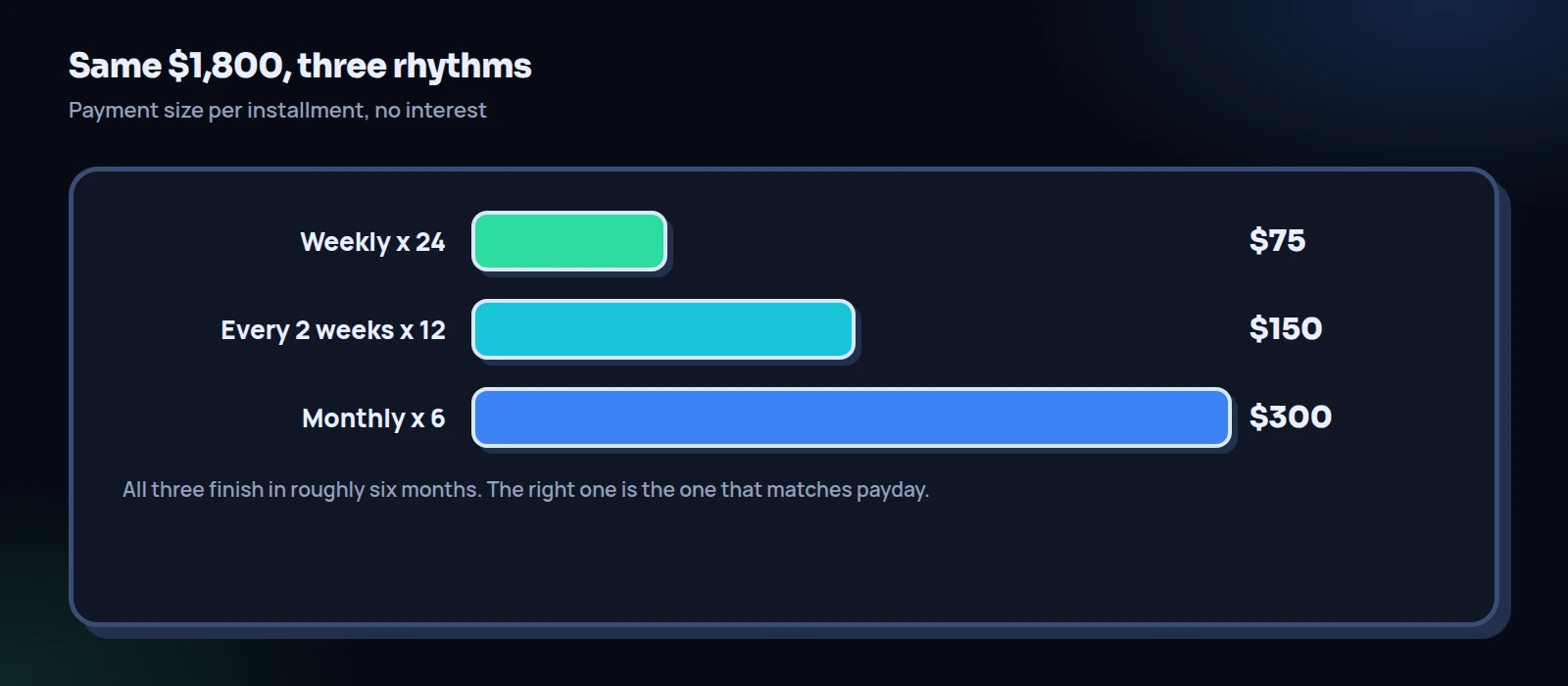
The payment frequency matters more than the amount. A plan with payments due three days before payday will fail even if the amount is tiny. Start by asking the borrower one question: “When do you get paid?”
- Weekly. Good for people paid weekly or with irregular gig income. Small amounts, lots of them.
- Every two weeks. Matches a very common US pay cycle. Payments are due the day after payday, every other week.
- Twice a month. For people paid on fixed dates, say the 15th and the last day of the month.
- Monthly. Simplest to track, but each payment is bigger, and a single slip feels larger.
Tip
Every-two-weeks and twice-a-month sound the same but aren’t. Biweekly payments happen 26 times a year, so two months each year have three paydays. Twice a month is exactly 24. If you pick biweekly, write out the actual dates so nobody is surprised by the third payment in a month.
Step two: size the payment for a bad month
The temptation is to set the payment as high as possible so the loan disappears fast. Resist it. The right payment is the one the borrower could still make in a month when the car needs tires and their hours get cut.
Here’s a simple way to find it. The borrower looks at their take-home pay per paycheck, subtracts rent, bills, food, transport and any other debt payments, and sees what’s left. Then they take a chunk of that leftover, not all of it. Leave room for life.
Example
Ari borrows $1,800 from Noor to cover a security deposit and the first month’s rent on a new apartment. Ari takes home $1,450 every other Friday. After their share of rent, utilities, groceries, gas and a phone bill, about $290 is left per paycheck. They could pay $290, but one surprise would sink the plan. They settle on $150 per paycheck, which leaves $140 of breathing room.
That gives twelve payments: $1,800 divided by $150. On a biweekly rhythm, that’s about 24 weeks, or a little under six months. Noor would have liked it faster. But a six-month plan that finishes is worth more than a three-month plan that collapses in week five.
Step three: choose the first date
Make the first payment due the day after the borrower’s first paycheck that comes after the loan, and not before. If Ari gets the money on October 28 and is paid on Thursday, November 5, the first installment is due Friday, November 6.
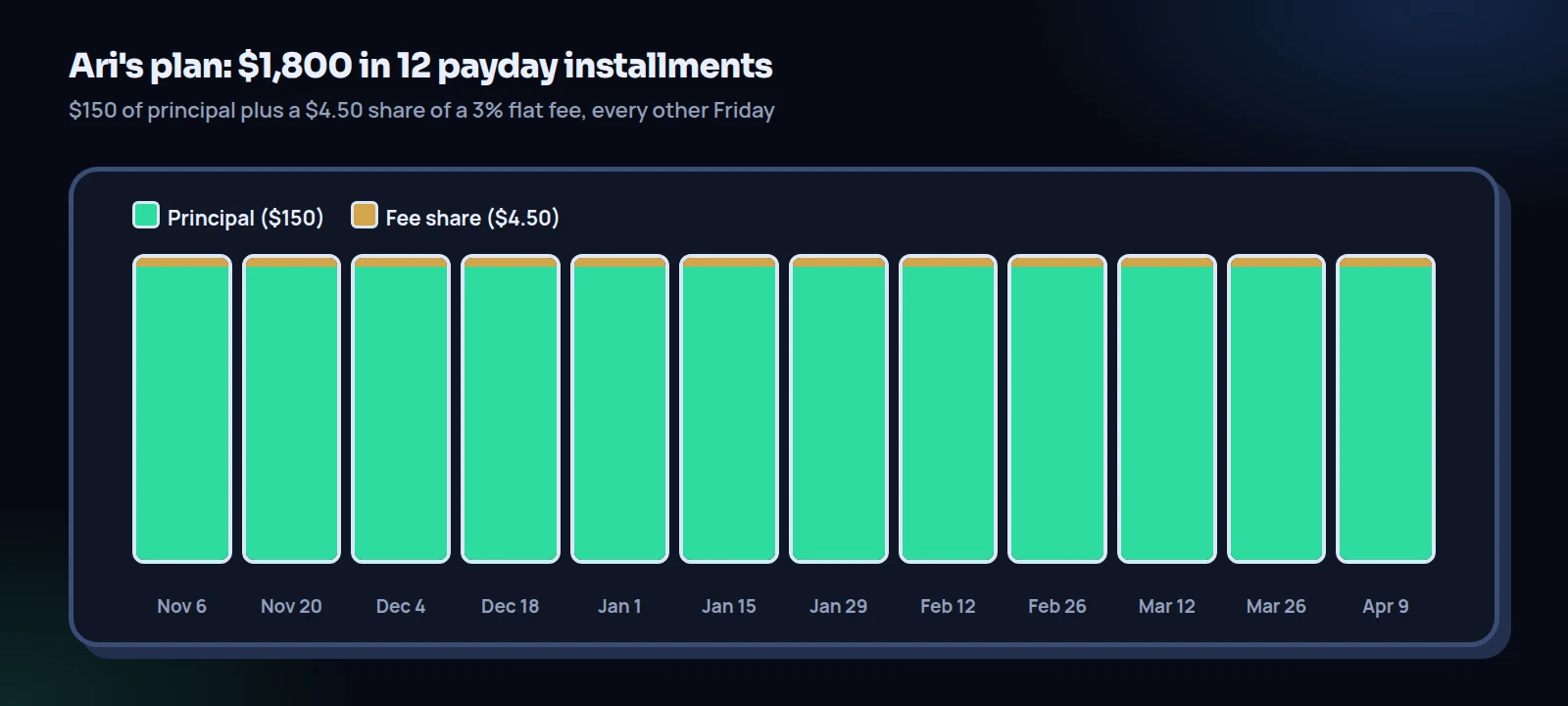
Then list every date. Not “every other Friday” but the actual twelve dates: November 6, November 20, December 4 and so on through April 9. It takes two minutes and saves a lot of “wait, was that this week?”
Tip
Scan your list for holidays. In Ari’s plan, January 1, 2027 lands on a Friday, a bank holiday when transfers may not process. Agree up front that a payment due on a holiday is on time if it arrives the next business day.
Step four: decide on interest (or none)
Most installment plans between friends carry no interest, and that’s fine. If you do want something for the use of the money, keep it simple and agree it as a dollar figure, not just a percentage.
Noor and Ari agree on a flat 3% fee on the $1,800, which is $54 in total. Spread over twelve payments, that’s $4.50 per installment, so each payment is $154.50 and the total repaid is $1,854. Writing “$154.50 every other Friday, $1,854 in total” leaves no room for confusion later. If you’re weighing a flat fee against a yearly rate, our article on simple interest vs a flat fee runs the numbers both ways.
On the tax side: the IRS says interest you receive is generally taxable, and for loans between individuals, the below-market loan rules generally don’t apply on days when the total outstanding is $10,000 or less, as long as the money isn’t used to buy income-producing assets. Above that, look at the IRS’s monthly Applicable Federal Rates before deciding on zero interest.
Step five: handle the leftover cents
Not every loan divides neatly. $1,000 over six payments is $166.666… per payment. The clean fix: five payments of $166.67 and a final one of $166.65. Put the odd amount at the end, where it’s easy to see, rather than spreading pennies around.
The same applies to fees. If a flat fee doesn’t split evenly, add the remainder to the last payment and write that down too.
Step six: agree what happens when life happens
Every plan should answer three questions before the first payment is due. Spending five minutes on them now saves an awkward conversation later.
- What if a payment will be late? A good default: the borrower tells the lender before the due date, and the missed amount moves to the end of the plan.
- What if the borrower pays extra? Decide whether extra money shortens the plan (fewer payments) or lowers the remaining payments. Shortening is simpler.
- What if the borrower wants to pay it all off early? They should be able to, with no penalty. If you charged a flat fee, agree whether any of it is refunded for early payoff.
Watch out
“We’ll figure it out if it happens” is not a plan. It’s the most common reason installment plans between friends fall apart: a payment slips, nobody knows the rule, and both people assume the other one is being unreasonable.
If a payment does get missed, our playbook for restarting repayments after a missed payment covers how to reset without blame.
Step seven: propose it without sounding like a bank
The numbers are the easy part. Saying them out loud to someone you care about is harder. Frame the plan as something that protects the friendship and makes life easier for the borrower, because it does. A short, warm proposal works better than a spreadsheet slid across the table.
“I’m really glad I can help. To keep it simple for both of us, how about $150 the day after each payday, starting November 6? That gets us done by April. If a payment’s ever going to be tricky, just tell me before the date and we’ll move it to the end.”
Then stop talking and let them respond. They may suggest a different amount or start date, and that’s a good sign: a borrower who shapes the plan is far more likely to stick to it. Agree, adjust, then write it down.
Step eight: write the installment plan for a personal loan down and sign it
An installment plan for a personal loan only works if both people are looking at the same version. Write down the names, the amount, the fee if any, every due date and payment amount, the payment method and the three “what if” answers. Then both of you sign.
Noor and Ari’s plan, the first four rows
| # | Due | Payment | Left after payment |
|---|---|---|---|
| 1 | Nov 6, 2026 | $154.50 | $1,699.50 |
| 2 | Nov 20, 2026 | $154.50 | $1,545.00 |
| 3 | Dec 4, 2026 | $154.50 | $1,390.50 |
| 4 | Dec 18, 2026 | $154.50 | $1,236.00 |
The full table runs to payment 12 on April 9, 2027, when the balance reaches $0. The “left” column counts down from $1,854, the total including the fee.
For a ready-made layout, use our repayment schedule template, or build the dates on the installment calculator, which handles weekly, every-two-weeks and monthly plans.
Step nine: track payments as they land
The plan is only as good as the record of what’s been paid, and this is where many friendly loans quietly drift. Nobody disputes a payment on the day it happens; the trouble starts three months later, when neither person can remember whether the December payment was $150 or $100. Each time money arrives, note the date, amount and method, and update the balance. Confirm it to the borrower with a quick “Got it, thanks, $1,545 left!” Small confirmations keep both of you in sync and make payments feel noticed.
In IOUEZ, in the web app or on Android, you can set up a loan to repay in installments, choosing weekly, every-two-weeks or monthly payments and seeing the amount per payment before you save it. Add the schedule before you both sign, because signing locks the terms. Once both of you sign, reminders go out as each payment comes due, and every payment you record updates the balance you both see. Our guide to proof of repayment explains which records matter if there’s ever a dispute.
Tip
Ask the borrower to put a short note on each transfer, like “Rent loan 3/12.” Months later, when you’re scrolling through your banking app, you’ll know exactly what each payment was for.
Three loan sizes, three plans
The same method scales up and down. Here’s how it might look for three illustrative loans, all without interest:
- $300 for a car battery and tow. Three payments of $100 every two weeks. Done in six weeks; a short note with the dates is plenty.
- $1,800 for a deposit. Ari’s plan: twelve biweekly payments of $150, about six months.
- $6,000 toward a used car. Twenty-four monthly payments of $250, two years. At this size, a signed agreement with every date listed is a must, and it’s worth reading the tax notes above before you settle on zero interest.
Notice that the bigger the loan, the more the plan needs to survive change: job moves, new rent, a baby. Long plans should include a check-in, say every six months, where you both look at whether the payment still fits. Agreeing to repay a loan in installments is a promise about the future, and the future rarely sits still.
When an installment plan isn’t the right tool
An installment plan for a personal loan works best when the borrower has steady income and simply needs time. They don’t fit every situation. If the borrower has no income in sight, a schedule just creates a string of missed dates; a pause, a smaller loan or a gift might be kinder. And if you’d be upset to wait six months, the honest answer may be to lend less.
For larger family loans, you may also want a more formal agreement. Our guide to a personal loan agreement template walks through the clauses worth adding.
Want the dates, reminders and running balance handled for you? Set up the installment plan in IOUEZ and both of you will see the same schedule.
Create an installment planFrequently asked questions
How many payments should an installment plan for a personal loan have?
As many as it takes to keep each payment comfortable in a bad month. For most loans between friends that’s somewhere between a few months and a year. Longer plans are fine, as long as there’s a clear end date.
Are biweekly payments better than monthly?
Only if the borrower is paid biweekly. Payments that line up with payday are easier to make. Biweekly plans also have 26 payments a year, so two months have three payments.
Should I charge interest on an installment plan?
It’s optional. Many friends charge nothing. If you add a fee or interest, agree the exact dollar total in writing and remember that interest you receive is generally taxable income.
What if the borrower wants to pay it off early?
Let them, with no penalty. Agree in advance whether extra payments shorten the plan or lower later payments, and whether any flat fee is reduced for early payoff.
Can I change an installment plan for a personal loan after we’ve started?
Yes, if you both agree. Write the new dates and amounts down, and keep a record of the old plan and what was paid under it.
Sources
- Internal Revenue Service, Topic no. 403, Interest received, interest received is generally taxable income.
- Internal Revenue Service, Publication 550 (2025), Investment Income and Expenses, below-market loans and the $10,000 exception for gift loans between individuals.
- Internal Revenue Service, Applicable federal rates (AFRs) rulings, the minimum rates published each month.
- Legal Information Institute, Cornell Law School, usury, interest-rate limits are set by state statutes and differ by state.