When you owe a friend money, it follows you around. It’s there when they pick the restaurant, when you post vacation photos, when their name lights up your phone. Even if they’re relaxed about it, you probably aren’t. If you want to pay back a friend faster than your plan says, a focused month can do more than you’d think. Here is a 30-day plan, day by day.
Before you start: know the real number
Open your messages, your banking app or your agreement and write down three things: the exact amount you still owe, the regular payment you agreed, and the date of the last one. Not “about $700.” The real figure, to the dollar.
This step sounds trivial and isn’t. Most people who owe money carry a slightly wrong number in their head, usually a higher one, which makes the debt feel heavier than it is. Seeing the true balance often turns “I’ll never get this done” into “that’s actually reachable.”
Example
Avery borrowed $900 from Rowan last summer to cover a car repair and agreed to repay $150 on the 1st of each month. They’ve made one payment, so $750 is left, and the plan says the last payment lands on March 1. Avery would like to be done before the holidays. This is an illustration; we’ll follow it through the month.
The 30-day plan at a glance
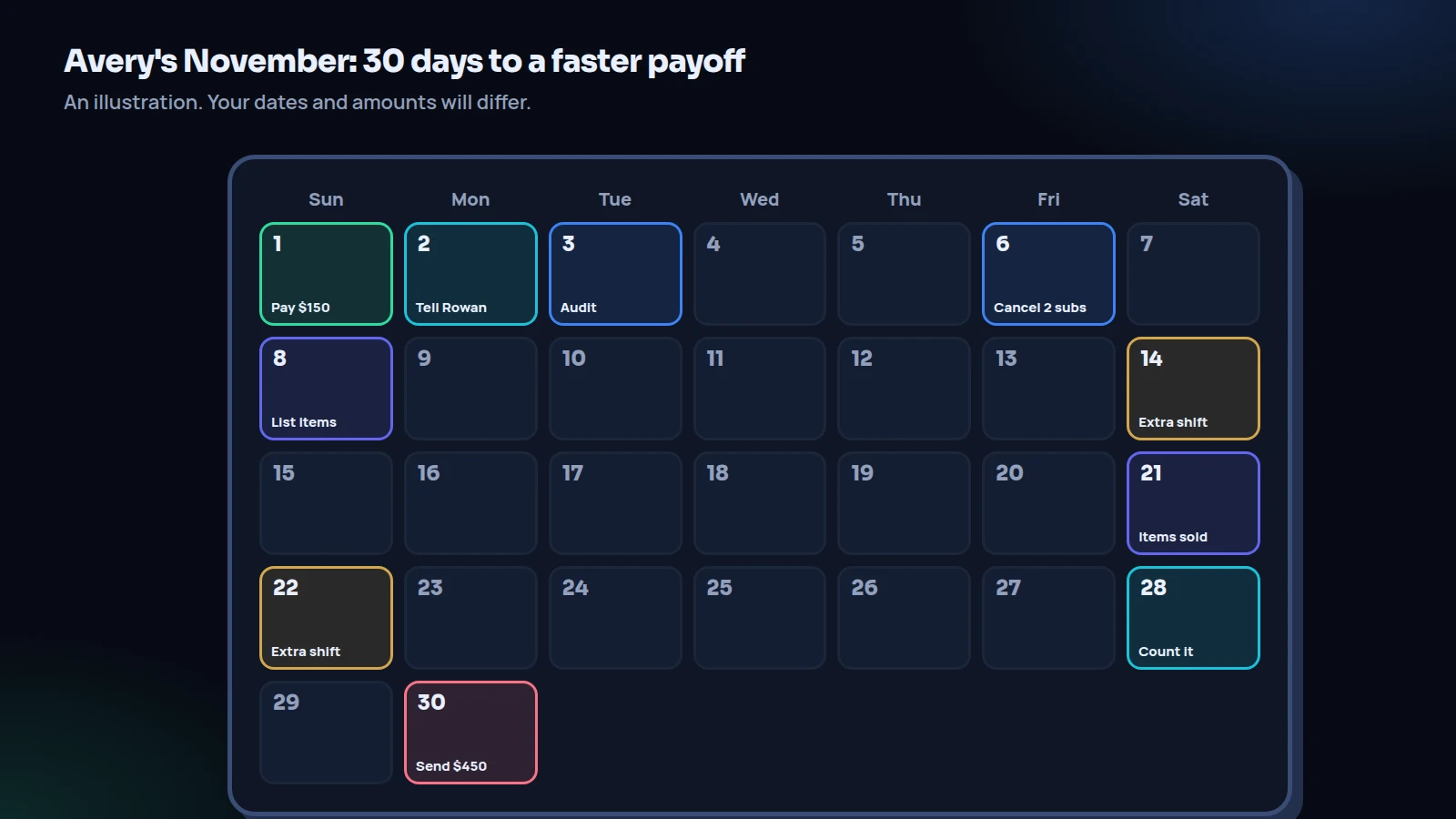
The month has five moves: pay what’s due, tell your friend, find money you’re already spending, turn stuff into cash, and earn a little extra. On day 30 you send everything you’ve gathered, minus a small buffer.
- Day 1
Make the regular payment on time. The faster plan sits on top of the normal one, never in place of it.
- Day 2
Tell your friend what you’re doing. One short message, no big promises.
- Days 3–5
Run a spending audit. Go through last month’s statements line by line.
- Days 6–7
Cut what you won’t miss. Cancel or pause subscriptions and set up any savings you found.
- Days 8–21
Sell things you don’t use. List them in week two, sell them by week three.
- Days 8–28
Earn a little extra. A couple of extra shifts or a weekend job, nothing that burns you out.
- Day 30
Send the extra payment. Keep a small buffer and record it the same day.
Day 1: pay what’s due
It’s tempting to skip this month’s payment and “save it up” for a big one at the end. Don’t. Your friend is expecting the regular payment, and a missed date erodes trust faster than an early finish builds it. Pay it, on time, the normal way.
Avery sends Rowan $150 on November 1. Balance: $600.
Day 2: tell your friend
This is the step people skip, and it’s the one that does the most for the friendship. Your friend may be quietly wondering whether you’ve forgotten. Telling them you’re working on paying faster replaces that worry with good news. Keep it low-key and don’t promise a specific number you might miss.
Message: the heads-up to your friend
Hey Rowan, sent this month’s $150, thank you again for helping me out with the car. I’m trying to pay the rest off faster, so you might see an extra payment at the end of the month. Didn’t want it to be a surprise!
Notice what’s not in there: no apology spiral, no detailed budget, no deadline. Just a clear signal that you’re on it. If you agreed the loan with written terms, check whether extra payments shorten the plan or reduce later payments, so you both expect the same thing. Our guide to installment plans for personal loans explains the difference.
Days 3–5: the spending audit
Pull up last month’s bank and card statements and go through every line. You’re not judging yourself; you’re looking for money that leaves your account without making your life noticeably better. Mark each item: keep, cut, or reduce.
The usual suspects are subscriptions you forgot about, delivery fees, convenience purchases on the way to work, and “free trials” that became paid months ago. The CFPB’s reducing-debt worksheet starts in a similar place: write down what you owe and what you pay each month before deciding what to change.
Tip
Search your statements for the word “recurring” or sort by merchant. Repeating charges are easy to miss one at a time and obvious when you see six of them in a row.
Days 6–7: cut what you won’t miss
Act on the audit while it’s fresh. Avery cancels two streaming services they’d stopped watching ($28 together) and decides to pack lunch three days a week for the rest of the month, which they estimate saves about $60 over the remaining weeks.
Whatever you save, move it somewhere you won’t spend it. A separate savings account, or even a note in your banking app, works. Money that stays in your checking account tends to disappear into the week.
Days 8–21: sell what you don’t use
Most homes have a few hundred dollars sitting in a closet. Avery lists an old game console and a bike they haven’t ridden in two years on a local marketplace on day 8. Both sell by day 21 for $260 in total.
List early, because things take time to sell, and price to sell rather than to get top dollar. Meet buyers in a public place and take payment before handing anything over. The goal is cash this month, not the best possible price next year.
Days 8–28: earn a little extra
An extra shift, a weekend of dog-sitting, an evening of freelance work. Avery picks up two extra shifts on November 14 and 22, which brings in $180 after tax.
Watch out
Never borrow from somewhere expensive to pay back a friend faster. The FTC notes that a typical two-week payday loan fee of $15 per $100 works out to an annual rate of 391%. Swapping an interest-free friendly loan for one of those makes your situation worse, not better.
The same goes for running up a credit card to clear the friend loan. Your friend almost certainly isn’t charging you interest. A card almost certainly is. If you’re juggling several debts at once, our comparison of snowball vs avalanche shows how to decide what to pay first.
What not to cut
A spending audit can tip into punishment if you let it. Cutting things that keep you healthy, employed or sane just moves the cost somewhere else. We’d leave these alone during your 30-day push:
- Insurance and medical costs. A canceled health plan or skipped prescription is not savings.
- Anything you need to get to work. Gas, transit passes, the phone plan your job depends on.
- Minimum payments on other debts. Missing those adds fees and can hurt your credit.
- The one small thing that keeps you going. A weekly coffee with a friend is cheaper than burnout.
The aim is a month that feels focused, not miserable. If the plan makes you dread every day, scale it back. A smaller extra payment you actually make is worth more than a heroic one you abandon in week two.
If your income is irregular
Gig workers, freelancers and anyone on tips can’t count on a fixed amount landing on fixed days. The plan still works; you just reorder it. Make the regular payment from the first decent week of the month, not on a set date, and send extra money in smaller pieces as it arrives rather than saving it all for day 30.
Small, frequent extra payments have a bonus: they’re harder to accidentally spend. A $60 transfer the evening after a good shift is easier than keeping $450 untouched for three weeks. Just tell your friend that’s the plan, so a string of odd amounts doesn’t look confusing, and record each one.
Day 28: count it up
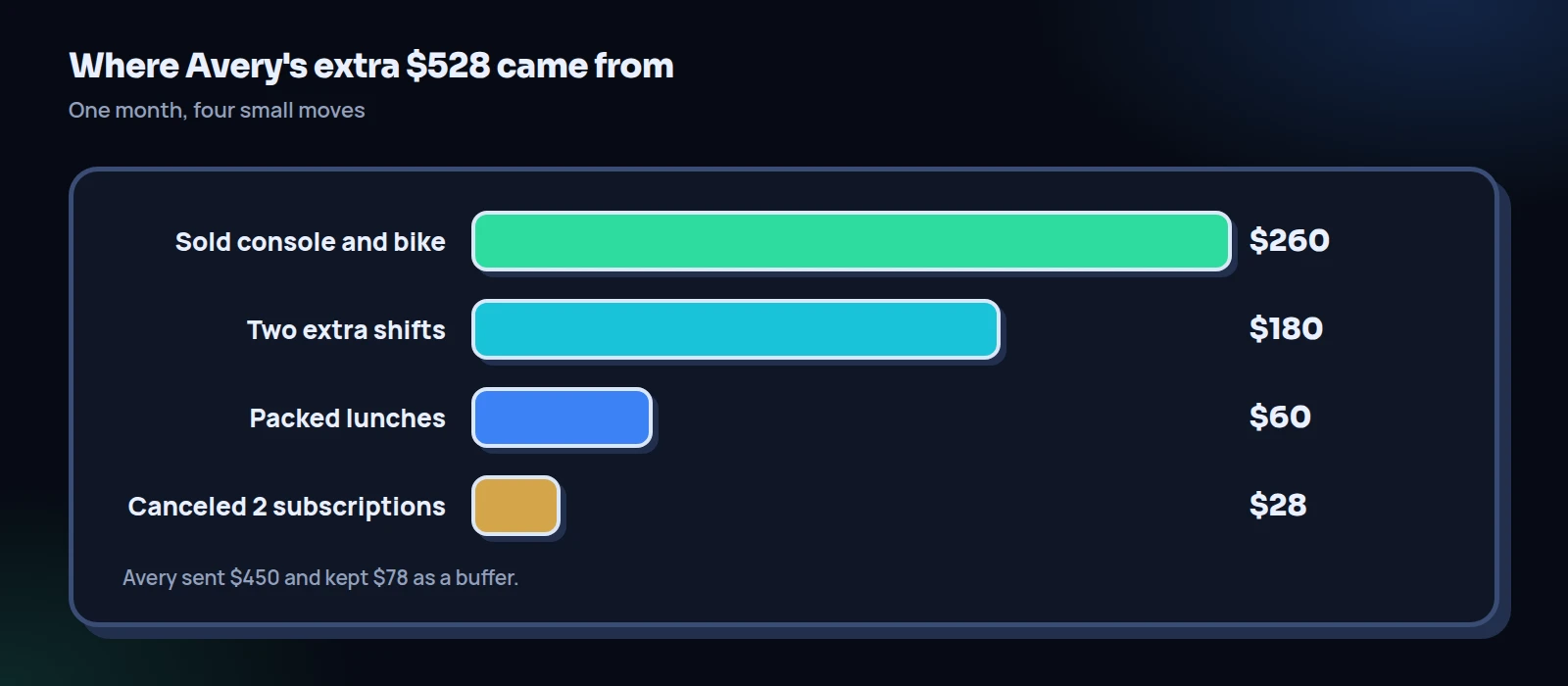
Add up everything you gathered. Avery has $528: $260 from selling, $180 from shifts, $60 from lunches and $28 from subscriptions. Then decide how much to send and how much to keep. Leaving yourself with zero is how a good month turns into a missed payment next month.
Avery keeps $78 as a buffer and plans to send $450. That buffer isn’t wasted: if the car makes a strange noise in December, Avery can deal with it without missing the final $150 payment, which would undo some of the goodwill the month just built. A good rule of thumb is to keep enough to cover one regular payment, or whatever amount lets you sleep.
Avery’s balance, before and after the 30 days
| Date | Payment | Balance after |
|---|---|---|
| Nov 1 | $150 (regular) | $600 |
| Nov 30 | $450 (extra) | $150 |
| Dec 1 | $150 (regular) | $0 |
Without the plan, the $600 left after November 1 would have taken four more monthly payments, ending March 1. With it, the loan closes December 1, three months early.
Day 30: send it and say so
Send the extra payment with a clear note on the transfer, like “Car loan, extra payment.” Then message your friend so they know what it is, and confirm the new balance together.
Message: the extra payment
Just sent an extra $450! By my count that leaves $150, which I’ll send on the 1st as usual and then we’re square. Let me know if your numbers look different.
“Let me know if your numbers look different” is small but important. It invites a quick check while everything is fresh and avoids a mismatch months later. If the loan is in IOUEZ, record the payment with its date and method so you both see the updated balance; our guide to keeping proof of repayment covers what to save.
The fastest way to pay back a friend is rarely one big sacrifice. It’s four small moves in the same month.
If 30 days isn’t enough
Not everyone has things to sell or room for extra shifts. That’s fine. Even a smaller extra payment shortens the loan and shows good faith. If you found $100 instead of $528, send $75 and keep the rest as a cushion. You can repeat the plan next month with whatever worked best.
And if, after an honest look, you can’t even make the regular payment, the plan to pay back a friend faster turns into a different conversation: asking for a pause or a smaller payment before the next due date. That conversation goes much better when it happens early. Our playbook for restarting repayments after a missed payment has the words for it, and the FTC’s advice on getting out of debt makes the same point: contact the people you owe before you fall behind, not after.
Why it’s worth it to pay back a friend early
When you pay back a friend ahead of schedule, you get more than a closed balance. You get back the ease you had before the loan: dinners without the background hum, texts that are just texts. Your friend gets their money sooner and a clear signal that lending to you was a good decision.
It also changes how you feel about money in general. A month of small wins tends to stick. Many people who try a focused month like this keep one or two of the habits afterwards, like the packed lunches or the yearly subscription check.
If you’re on the other side and someone owes you, you might find our guide on how to remind someone to pay you back useful too.
Checklist: your 30-day payoff month
- I know the exact balance, my regular payment and the next due date.
- I made this month’s regular payment on time.
- I told my friend I’m working on paying faster.
- I went through last month’s statements line by line.
- I canceled or paused what I won’t miss and set the savings aside.
- I listed things to sell early in the month.
- I’m not borrowing from anywhere expensive to do this.
- I kept a buffer before sending the extra payment.
- I recorded the payment and confirmed the new balance with my friend.
Frequently asked questions
Should I tell my friend I’m trying to pay them back faster?
Yes, briefly. It reassures them you haven’t forgotten, and it means an extra payment won’t be a confusing surprise. Avoid promising an exact amount until you have it.
Is it better to pay back a friend or a credit card first?
Financially, the card usually costs more because it charges interest and your friend usually doesn’t. Keep making your friend’s agreed payments, put extra money toward the most expensive debt, and talk to your friend if your plan changes.
What if I can’t find any extra money this month?
Keep making the regular payment and repeat the spending audit next month. If even the regular payment is hard, ask your friend for a smaller payment or a pause before the due date.
Should I take a payday loan to pay back a friend?
No. The FTC notes that a typical two-week payday loan fee of $15 per $100 works out to an annual rate of 391%. That’s far more expensive than an interest-free loan from a friend.
Does an extra payment change the rest of the plan?
It depends on what you agreed. Usually extra money shortens the plan, so the last payment comes sooner. Confirm with your friend so you both expect the same thing.
Sources
- Federal Trade Commission, How To Get Out of Debt, building a budget and contacting creditors early to work out a modified plan.
- Federal Trade Commission, What To Know About Payday and Car Title Loans, the $15 per $100 two-week fee and 391% APR example.
- Consumer Financial Protection Bureau, Your Money, Your Goals: Reducing debt worksheet, listing what you owe and where your money goes.