If you’re going to charge a friend anything for a loan, the choice usually comes down to simple interest vs flat fee. “Five percent interest” and “a $60 fee” on a $2,000 loan sound like roughly the same deal. They aren’t. Depending on how the money is repaid, one can cost almost twice as much as the other, and the borrower usually can’t tell which is which until the math is done for them.
First, do you need to charge anything?
Most loans between friends carry no interest at all. Interest between friends is optional, not expected, and we think zero is the right default for small amounts. On a $500 loan repaid over a few months, even a generous rate earns you a few dollars, which is rarely worth the awkwardness of asking. We’d skip it entirely below about $1,000.
Charging something starts to make sense when the amount is large, the term is long, or the money would otherwise be earning interest in your savings. It can even make the loan feel more like a fair arrangement and less like a favor. If that’s where you are, read on. If you haven’t decided whether to lend at all, start with how to lend money to a friend.
The three deals, in plain English
- Flat fee
- A fixed dollar amount added once to the loan, like “$60 on top of the $2,000.” It doesn’t change with time or with how fast the borrower pays.
- Simple interest on the declining balance
- Interest charged each month only on what’s still owed. As the borrower pays down the loan, each month’s interest shrinks. This is how most bank installment loans work.
- Simple interest on the original amount
- Interest charged on the full starting amount for the whole term, even after half of it has been repaid. It’s simple to calculate and easy to overcharge with.
- Effective annual rate
- What a deal works out to as a yearly percentage of the money actually owed over time. It’s the fair way to compare a fee with an interest rate.
The worked example: Quinn lends Jamie $2,000
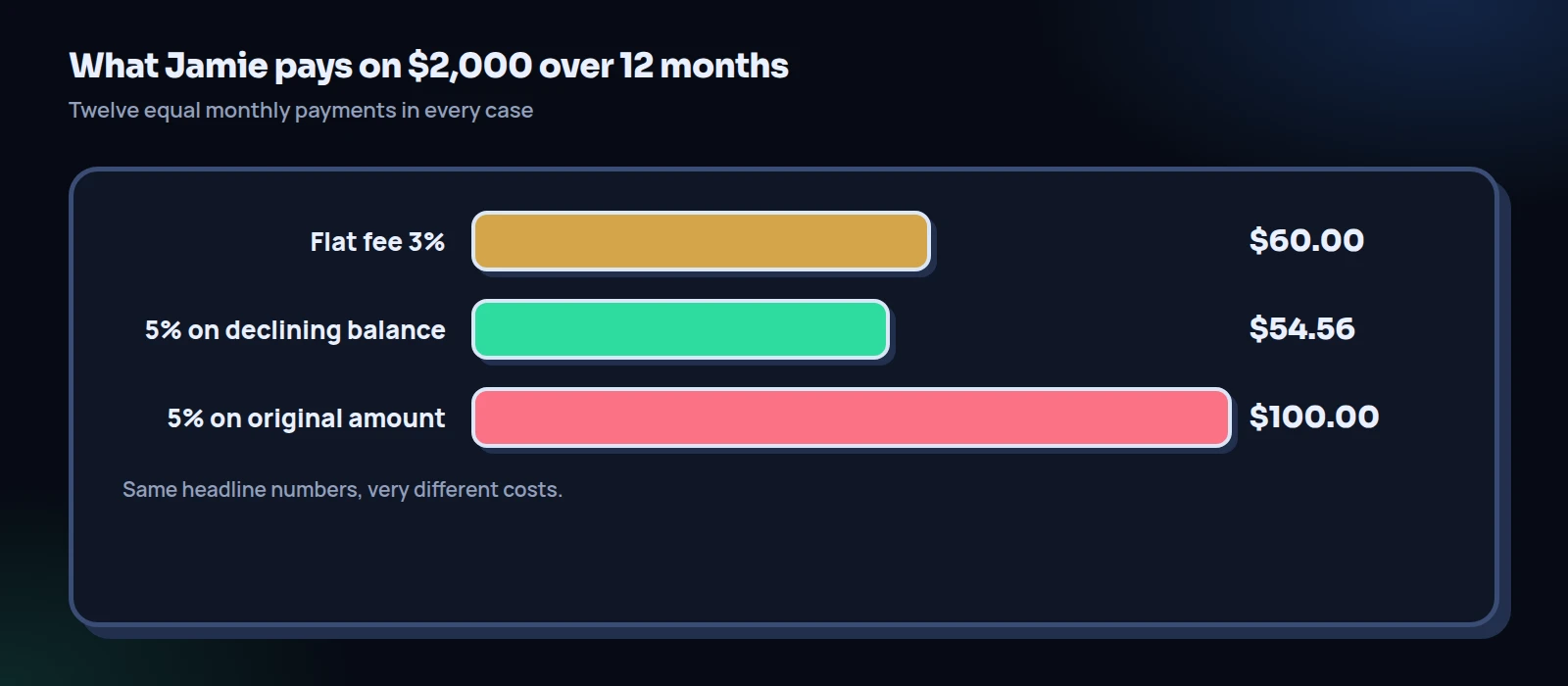
Here’s an illustration. Jamie needs $2,000 for a dental bill and will repay Quinn in twelve equal monthly payments. Quinn is happy to lend but would like something for the year the money is tied up. Their three options, side by side:
Simple interest vs flat fee on $2,000, 12 equal payments
| Deal | Monthly payment | Total repaid | Cost to Jamie |
|---|---|---|---|
| Flat fee of $60 (3%) | $171.67 | $2,060.00 | $60.00 |
| 5% a year on the declining balance | $171.21 | $2,054.56 | $54.56 |
| 5% a year on the original amount | $175.00 | $2,100.00 | $100.00 |
The flat-fee plan is eleven payments of $171.67 and a last payment of $171.63, which adds up to exactly $2,060. The declining-balance payment comes from the standard loan formula; we checked it by building the full twelve-month table.
Look at the middle and bottom rows. Both say “5% a year.” One costs Jamie $54.56, the other $100. The difference is what the 5% is charged on. On the declining balance, Jamie pays interest only on what they still owe, which falls from $2,000 to zero over the year. On the original amount, Jamie pays interest on $2,000 for all twelve months, including the months when they owe only a few hundred dollars.
Doing the declining-balance math by hand
You don’t need a finance degree to check the middle row. Each month, take what’s still owed, multiply by the yearly rate, and divide by 12. That’s the month’s interest. Whatever is left of the $171.21 payment goes toward the balance.
The first three months at 5% a year
| Month | Owed at start | Interest | To principal | Owed after |
|---|---|---|---|---|
| 1 | $2,000.00 | $8.33 | $162.88 | $1,837.12 |
| 2 | $1,837.12 | $7.65 | $163.56 | $1,673.56 |
| 3 | $1,673.56 | $6.97 | $164.24 | $1,509.32 |
Month one: $2,000 × 0.05 ÷ 12 = $8.33. Each month the interest drops a little and more of the payment goes to the balance. Add up all twelve interest amounts and you get $54.56.
Compare that with interest on the original amount: $2,000 × 0.05 = $100 for the year, or $8.33 every single month, including month twelve, when Jamie owes only about $170. That’s the whole difference in one line.
Why the flat fee looks cheaper than it is
A $60 fee on $2,000 is 3%, which sounds lower than 5%. But Jamie isn’t borrowing $2,000 for a year. They borrow $2,000 for the first month, about $1,830 for the second, and so on down to about $170 in the last month. On average, Jamie owes a bit over $1,000 across the year.
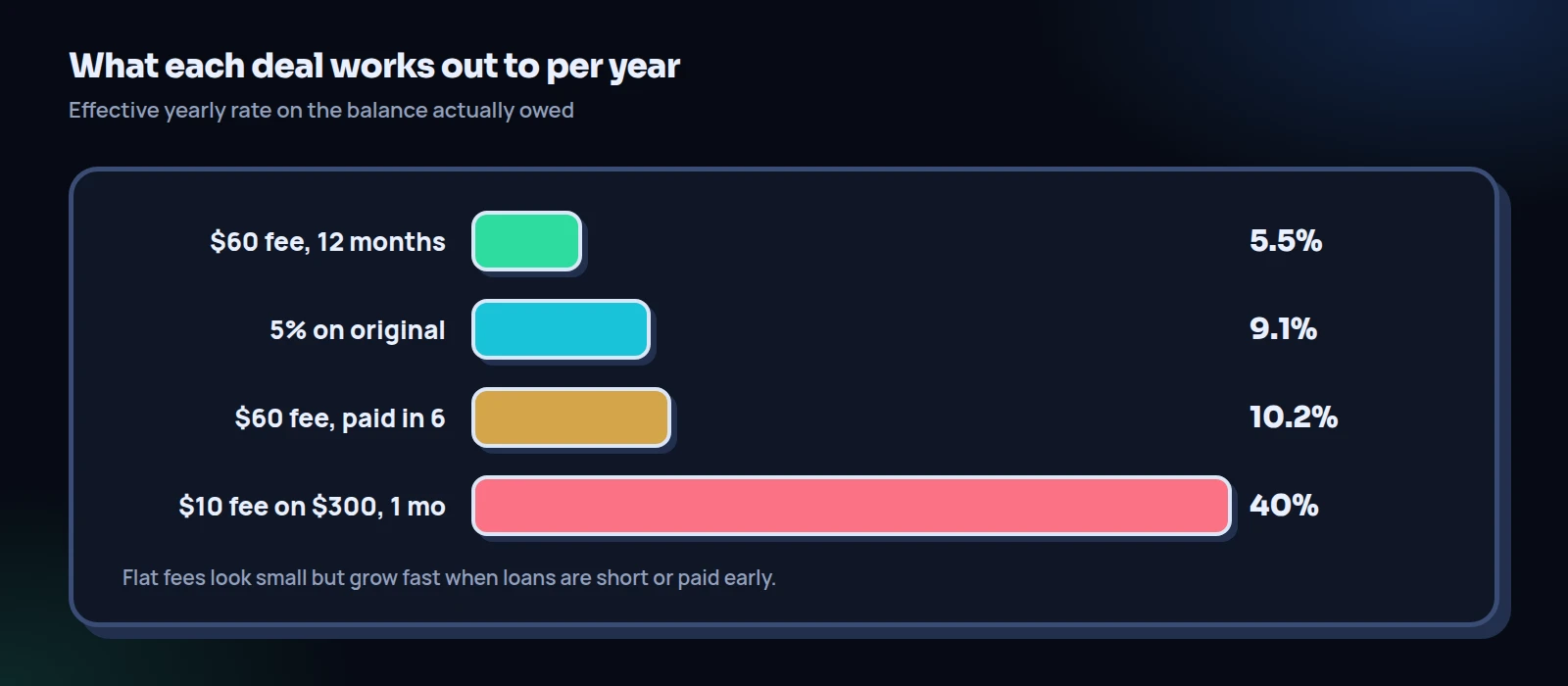
When you work out what $60 is as a yearly rate on that shrinking balance, you get about 5.5%. So the “3% fee” is really a little more expensive than “5% on the declining balance.” Not by much here, but the gap grows fast in two situations: when the loan is short and when the borrower pays early.
The early payoff test
Say Jamie gets a tax refund in month four and wants to clear the loan in six months instead of twelve. This is where simple interest vs flat fee really separate.
With interest on the declining balance, paying faster means paying less: six equal payments of $338.21 cost Jamie $29.26 in total. With a flat fee, Jamie still owes the full $60, even though Quinn’s money was out for half as long. As a yearly rate, that $60 over six months works out to about 10.2%.
That’s the core problem with flat fees: they quietly punish the borrower for doing exactly what you’d want them to do. If you use one, we’d build in a refund for early payoff. A simple version is “$5 for each month the loan is open, up to $60,” so paying in six months costs $30.
What about a single lump-sum repayment?
Everything changes when the borrower repays in one go. If Jamie borrows $2,000 and pays it all back on one date a year later, the whole amount is out the whole time. Then 5% simple interest is $100, a $60 fee is $60, and both are honest descriptions of the cost. For lump-sum loans, simple interest vs flat fee is mostly a question of which number you’d rather say out loud.
The catch is that lump sums are harder for borrowers. Finding $2,060 on one day is much tougher than finding $171.67 twelve times. If you’re choosing a lump sum mostly to keep the interest math easy, we’d pick installments and do the math instead.
The small, short loan trap
Flat fees feel natural on small loans: “Lend me $300 till payday and I’ll give you $310.” Ten dollars sounds harmless. But $10 on $300 for one month is 3.3% for the month, which works out to 40% a year. That’s a rate you’d never accept from a bank.
Watch out
States set limits on how much interest can be charged, and the limits vary by state. Fees charged for the use of money can count toward those limits. A friendly “$10 for a month” on a small loan can work out to a very high yearly rate. For a personal loan between friends this rarely becomes an issue in practice, but if you’re charging anything meaningful, keep the effective yearly rate modest.
For short loans between friends, the cleanest options are no charge at all, or a rate per year that you apply to the balance for the days it’s actually out. For $300 over one month at 5% a year, that’s $1.25. Most people would rather skip it.
The tax side, briefly
If you charge interest, the IRS generally treats the interest you receive as taxable income, and you’re expected to report it even if nobody sends you a form. A fee charged for lending money may well be treated the same way, so ask a tax professional if the amounts are meaningful.
Going the other direction, charging zero on a big loan has its own rules. For loans between individuals, the IRS’s below-market loan rules generally don’t apply on days when the total outstanding is $10,000 or less, as long as the money isn’t used to buy income-producing assets. Above that, the IRS publishes minimum rates every month, the Applicable Federal Rates, and lending well above $10,000 at zero can create tax effects for the lender.
So which is fairer: simple interest vs flat fee?
For most loans repaid in installments, simple interest on the declining balance is the fairest option. The borrower pays only for money they actually have, early payoff is rewarded, and the cost lines up with how long your money was really out. It’s also how most bank loans work, so it’s easy to explain.
Flat fee: when it works
- Lump-sum loans repaid on one fixed date
- When both of you want one number and no math
- When you include an early payoff refund
- Longer loans, where the yearly rate stays modest
Flat fee: when to avoid it
- Short loans, where the yearly rate balloons
- Installment plans with a fee “per year” that’s really on the original amount
- Borrowers likely to pay early
- Anywhere the effective rate would make you uncomfortable
A flat fee is perfectly reasonable for a lump-sum loan repaid on one date. “$2,000 now, $2,060 back on June 1” is clear, and since the whole amount is out the whole time, the fee and a rate are basically the same thing.
The one deal we’d avoid is “5% on the original amount” for an installment loan. It sounds like normal interest but costs nearly double what most people expect. If you’ve already agreed that, it’s worth a friendly conversation to switch.
Same percentage, different base, double the cost. Always ask: five percent of what?
Three quick scenarios
Here’s how we’d handle three common situations, as illustrations rather than rules.
$400 until the end of the month. Charge nothing. At any sensible yearly rate the interest is a dollar or two, and a fee big enough to notice would work out to an eye-watering yearly rate. Write down the date and move on.
$2,000 over a year, in monthly payments. If you want something, use a modest rate on the declining balance and write the exact monthly payment and total. If you both prefer one simple number, a flat fee is fine, as long as you add an early payoff refund.
$8,000 for a car, repaid over three years. This is where the choice of simple interest vs flat fee matters most, because small differences compound into real dollars over 36 payments. Use declining-balance interest, put the full schedule in writing, and keep an eye on the $10,000 IRS threshold if you lend more later. A signed agreement is a must at this size; our personal loan agreement template shows what to include.
Whatever the size, the test is the same: could you explain the total cost to the borrower in one sentence, and would they agree it sounds fair? If the answer is yes, you’ve probably picked well.
How to write it down
Whatever you choose, write the dollar amounts, not just the percentage. “5% interest” can be read three ways. “$171.21 monthly for 12 months, $2,054.56 in total” can be read one way. Add a line for early payoff: who benefits and how.
If you use IOUEZ, note how the interest field works: the percentage you enter is applied once to the amount, so 3% on $2,000 makes the total $2,060. In other words, it behaves like a flat fee written as a percentage. For declining-balance interest, work out the total with the loan calculator first, then use that figure. Our guide to installment plans for personal loans covers picking the dates, and the repayment schedule template has a table you can copy.
Try it with your own numbers: put the amount, rate and number of payments into the loan calculator and compare the total with your flat fee.
Open the calculatorsFrequently asked questions
Simple interest vs flat fee: which is cheaper for the borrower?
On an installment loan, simple interest on the declining balance is usually cheaper, and it gets cheaper still if the borrower pays early. A flat fee costs the same no matter how quickly the money is repaid.
Is a 3% flat fee the same as 3% interest?
No. On a $2,000 loan repaid in twelve monthly payments, a 3% flat fee works out to about 5.5% a year on the balance actually owed, because the borrower owes less and less each month.
What’s a fair interest rate between friends?
Many friends charge nothing. If you charge, a modest yearly rate on the declining balance is the fairest approach. State law sets limits that vary by state, and large loans have IRS rules to consider.
Do I have to pay tax on interest from a friend?
Interest you receive is generally taxable income, according to the IRS, even if you don’t get a tax form for it. Ask a tax professional about your situation.
How do I calculate interest on the declining balance?
Each month, multiply what’s still owed by the yearly rate divided by 12. A loan calculator does this for every month at once and gives you the equal payment amount.
Should a flat fee be refunded if they pay early?
We think so. A simple pro-rata rule, like a fixed amount for each month the loan is open, keeps a flat fee fair and rewards early payoff.
Sources
- Internal Revenue Service, Topic no. 403, Interest received, interest is generally taxable and must be reported even without a Form 1099-INT.
- Internal Revenue Service, Publication 550 (2025), Investment Income and Expenses, below-market loans and the $10,000 exception for gift loans.
- Internal Revenue Service, Applicable federal rates (AFRs) rulings, the monthly minimum rates.
- Legal Information Institute, Cornell Law School, usury, interest ceilings are set by state statutes and differ by state.