
If you missed a loan payment to a friend or relative, you’re probably feeling some mix of embarrassment and dread right now. That’s normal. Here’s the reassuring part: one missed payment rarely damages a friendly loan. What damages it is the silence that often follows. This playbook gives you seven steps, in order, to restart repayments this week.
Watch out
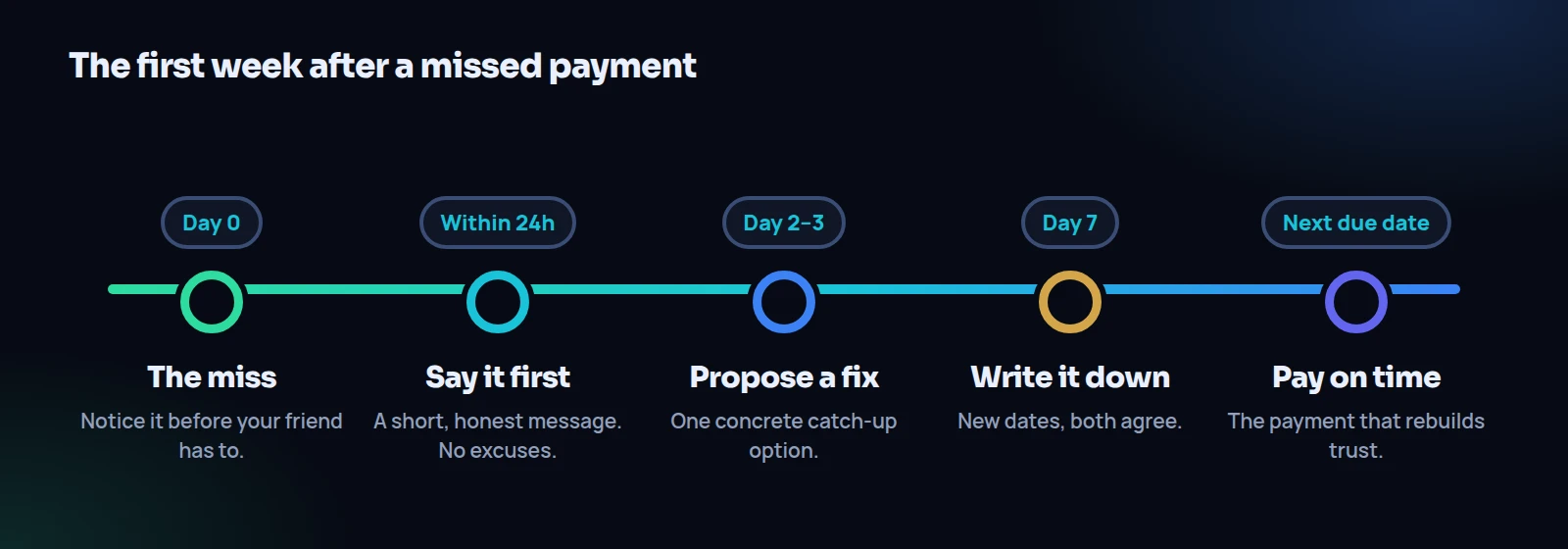
The worst move after a missed payment is waiting until you can fix it completely before saying anything. Every quiet day makes the eventual message harder to send and gives your friend more time to imagine the worst. Say something within 24 hours, even if you don’t have a plan yet.
Why one miss is fixable
A personal loan from a friend runs on trust, not on contracts and collection letters. That cuts both ways. Your friend has no automatic late fee and no collections department, which is a relief. But they also have no system telling them what’s going on, so they fill the gap with guesses. Some of those guesses (“they’ve forgotten,” “they think I won’t mind,” “they’re avoiding me”) are worse than the truth.
That’s why the fix is mostly about information. When you’ve missed a loan payment, the money matters, but what your friend needs most is to know three things: that you know, that you care, and what happens next. Give them those quickly and a missed payment usually becomes a small footnote in the loan.
The seven-step playbook
These steps assume you’re the borrower. If you’re the lender waiting on a missed payment, skip to the section for lenders further down; the same plan works from your side with different words.
1. Get your facts straight
Before you message anyone, write down what you owe in total, which payment you missed, how much it was, and when the next one is due. Check your bank records to be sure the payment really didn’t go out. It takes ten minutes and keeps you from guessing in the conversation.
What can go wrong: you apologize for missing $200 and it turns out an earlier payment was also short. Know the full picture first.
2. Tell them first
Message your friend before they have to ask. Own it in one line, without a long story. You can explain more if they want, but lead with the fact and with your intention to fix it.
What can go wrong: the message turns into three paragraphs about your month. Keep it short; long explanations read like excuses even when they’re true.
3. Figure out what you can really pay
Look at your next two or three paychecks and the bills already coming. Work out how much you can put toward the loan without missing rent or something else. Be honest; an optimistic number here just sets up the next miss.
What can go wrong: promising to catch up all at once because it feels like the right thing to say, then missing again. A second miss hurts far more than a slower plan.
4. Offer one concrete option
Don’t ask “what do you want me to do?” That hands your friend a problem to solve. Propose a specific plan with numbers and dates, and make clear you’re open to their ideas.
What can go wrong: offering four options at once. It looks like you haven’t decided. Pick the one you can keep, and mention one alternative at most.
5. Put the new plan in writing
Once you agree, send a short message that lists the new amounts and dates, or update your written agreement. Both of you should be looking at the same version.
What can go wrong: a verbal “sure, sounds fine” that each of you remembers differently a month later.
6. Make the next payment on time, no matter what
The first payment after a miss is the most important one in the whole loan. It shows the new plan is real. If you can, pay a day early.
What can go wrong: treating the new plan as flexible because your friend was kind about the first miss. Kindness is not a standing extension.
7. Set up something that stops it happening again
Most missed payments aren’t about money; they’re about timing and memory. Move the due date to the day after payday, set reminders, or schedule an automatic transfer.
What can go wrong: fixing the plan but not the reason it broke. If the date was wrong before, it will be wrong again.
What to say when you missed a loan payment
Here are the messages for steps 2, 4 and 5, using an illustrative example. Drew borrowed $1,200 from Robin, to be repaid at $200 on the 1st of each month from January to June. Drew paid January and February, then missed March 1 after an unexpected vet bill. $800 is left.
Message: step 2, owning it
Hey Robin, I missed the $200 on the 1st and I’m sorry, I should have told you before the date. I’m sorting out a plan to catch up and will send it to you by Thursday.
Message: step 4, proposing a fix
Here’s what I can do: $300 on April 1 and May 1, then the usual $200 on June 1. That covers the missed $200 and still finishes in June. If you’d rather I just add it to the end, that works for me too.
Message: step 5, confirming in writing
Great, thanks so much for being flexible. Just to confirm: $300 on April 1, $300 on May 1, $200 on June 1. That makes $800 and we’re done. I’ll set a reminder for the day after payday.
Notice the rhythm: short apology, clear commitment, concrete plan, written confirmation. None of it needs to be dramatic. Your friend mostly wants to know that you’re still taking the loan seriously.
Picking a catch-up plan
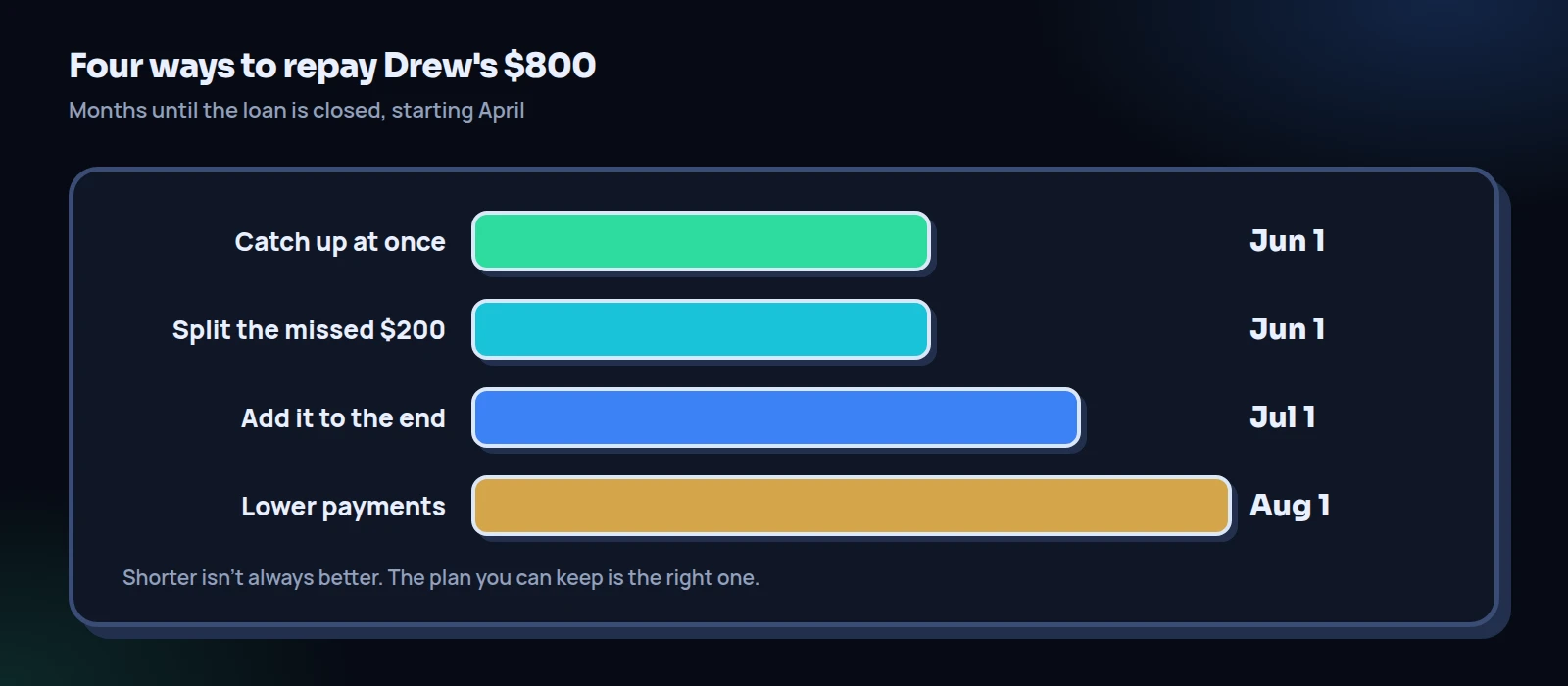
Drew has four realistic ways to repay the remaining $800. Each one is fair; the right choice depends on what Drew can afford over the next few months.
| Catch up at once | Split the missed $200 | Add it to the end | Lower payments | |
|---|---|---|---|---|
| Payments | $400 Apr 1, $200 May 1, $200 Jun 1 | $300 Apr 1, $300 May 1, $200 Jun 1 | $200 on Apr 1 to Jul 1 | $160 on Apr 1 to Aug 1 |
| Finishes | June 1 | June 1 | July 1 | August 1 |
| Hard part | One big month | Two slightly bigger months | One extra month | Two extra months |
| Pick it if | The miss was a one-off timing problem | You can stretch a bit but not double | Money is tight for a while | Your income dropped |
We’d usually pick the split. It finishes on the original date, so your friend loses nothing, and each payment only grows by half. Catching up all at once sounds noble but is the option most likely to cause a second miss.
Tip
If the miss happened because the due date sits before your payday, fix that in the new plan. Moving from the 1st to the 16th costs your friend nothing and removes the reason the payment slipped.
How Drew’s loan finished
| Date | Planned | Paid | Left |
|---|---|---|---|
| Jan 1 | $200 | $200 | $1,000 |
| Feb 1 | $200 | $200 | $800 |
| Mar 1 | $200 | $0 (missed) | $800 |
| Apr 1 | $300 | $300 | $500 |
| May 1 | $300 | $300 | $200 |
| Jun 1 | $200 | $200 | $0 |
The loan closed on the original date. Robin would struggle to remember the March miss a year later; what stuck was that Drew owned it within a day and then never missed again.
If you’ve missed more than one
Two or more missed payments is a different situation. Your friend has probably started to wonder whether the loan will be repaid at all. The same steps still apply, but step 4 deserves more care: the new plan should be clearly easier than the one that failed, not the same plan with new dates.
When you’ve missed a loan payment more than once, be open about what changed. “My hours were cut in February and they’re not coming back until summer” helps your friend understand why the new plan looks the way it does. You don’t owe them your whole budget, but a sentence of context turns a broken promise into a problem you’re solving together.
If even a smaller plan isn’t possible right now, say so and suggest a short pause with a date to revisit: “Could we pause for April and talk again on May 1?” That is far better than missing quietly.
When the lender is family
Missing a payment to a parent, sibling or grandparent can feel worse than missing one to a friend, because family money comes wrapped in history. A parent may say “don’t worry about it” and mean it, or say it and quietly worry. A sibling may bring it up at the next holiday dinner. The steps are the same; the delivery needs a little more care.
Two adjustments help. First, call rather than text for step 2, then follow up in writing. Family members often want to hear your voice, and a call makes it easier to read whether “it’s fine” really means fine. Second, be extra clear in step 5. Family loans are where verbal changes get remembered differently, especially when other relatives hear a version of the story. A two-line message with the new dates protects everyone, including you.
If a relative offers to forgive the missed payment, or the whole loan, thank them and ask them to say so in writing, so it’s clearly a gift and not something that resurfaces later. Our guide on gift or loan explains why that line matters.
For lenders: when your friend missed a loan payment
If you’re on the other side, your job is simpler: make it easy for your friend to come back. Give them a day or two after the due date in case it’s a slip. Then send one calm message that asks a question rather than making a point.
Message: lender’s check-in
Hi Drew, I didn’t see the $200 from the 1st. Everything okay? If this month’s tight, let’s just agree a new plan, no big deal. Can you let me know by the weekend?
Then let them propose the fix. A plan the borrower chooses is one they’re more likely to keep. Our guide on how to remind someone to pay you back has messages for every stage after this, and if things keep slipping, what to do when a friend can’t pay you back lays out kinder options than chasing.
One thing we’d avoid: adding a penalty after the first miss. It turns a fixable slip into a grievance. If you’re weighing that, read late fees between friends first.
A missed payment is a dent. Going quiet is the crash.
Preventing the next miss
Once the new plan is agreed, spend five minutes making the next miss unlikely. If you missed a loan payment because of a date or a forgotten transfer, this is where you fix it for good. A few small changes do most of the work:
- Line up the due date with payday. The day after is ideal.
- Automate it. A recurring transfer from your bank removes memory from the equation.
- Use reminders. In IOUEZ, both people get a reminder as each payment comes due, and an overdue notice if a date passes, so neither of you has to keep track in your head.
- Record every payment. Log the date, amount and method the day you pay. Our guide to proof of repayment explains why this matters later.
- Agree a “heads-up rule”. If a payment will be late, you message before the due date. That single rule prevents most of the awkwardness.
If the bigger problem is too many debts at once, not one slipped date, our decision guide for when you owe money to several people can help you set priorities. And you can rebuild the schedule in a minute with the installment tool on our calculators page.
Frequently asked questions
I missed a loan payment to a friend. Should I call or text?
Text first, within a day, so they have it in writing and can reply when ready. If the conversation gets complicated or emotional, offer a call. Then confirm whatever you agree by text.
I missed a loan payment. Should I pay the missed amount immediately?
Only if you can do it without missing something else. Splitting the missed amount across the next two payments is often safer and still finishes on time.
Will a missed payment to a friend affect my credit score?
Personal loans between friends usually aren’t reported to credit bureaus, so a single missed payment normally won’t show up there. The cost is to trust, which is why speed and honesty matter.
What if my friend is angry?
Let them be upset without arguing. Acknowledge it (“You’re right, I should have told you sooner”), then move to the plan. Most anger fades once there’s a concrete fix on the table.
Can we change the whole repayment plan, not just catch up?
Yes, if you both agree. Write down the new amounts and dates and keep the record of what was already paid, so the history stays clear.
What if I can’t pay anything for a while?
Say so before the next due date and propose a pause with a specific date to talk again. A planned pause keeps trust; repeated silent misses destroy it.
Sources
- Federal Trade Commission, How To Get Out of Debt, contacting the people you owe early and working out a modified payment plan.
- Federal Trade Commission, Coping With Debt, realistic budgeting and talking to creditors before you fall further behind.
- Consumer Financial Protection Bureau, Your Money, Your Goals: Debt getting in your way? Get a handle on it, tools for tracking debts and planning payments.