
Texting is how most of us handle money between friends now, so it makes sense to ask for money back by text too. It is quick, it leaves a record, and it lets the other person answer when they are ready. It also makes it very easy to sound colder than you mean, or to send a message that sits on “Read” for a week. The fix is in the wording.
Example
Riley bought two concert tickets in May and Dev said they’d pay their $60 “this weekend.” Three weekends later, Riley has typed and deleted the same message five times: once too jokey, once too stiff, once with a passive-aggressive “lol” at the end. They don’t want the friendship to wobble over $60. They just want the $60. This is an illustration, but you probably know the feeling.
Should you ask for money back by text at all?
For most amounts between friends, yes. A text puts the details in writing, gives the other person time to check their balance before answering, and spares both of you a face-to-face moment that can feel bigger than it is. It also creates a timestamped trail, which helps if you ever need to remember who agreed to what.
Why text works
- Clear record of the amount and what it was for
- The other person can reply when they’ve checked their account
- Easy to include your payment handle or a request link
- Feels lighter than a phone call for small amounts
Where text falls short
- Tone is easy to misread, especially short replies
- Messages get buried under memes and group chats
- Read receipts can make silence feel personal
- Hard conversations about real hardship deserve a call
So yes, in most cases you can ask for money back by text and it will land fine. A rough rule: if the conversation is about logistics (an amount, a date, a payment handle), text it. If it is about feelings or real financial trouble, call or meet, then follow up by text with what you agreed.
What every good text to ask for money back has
The messages that get paid share the same four parts. They don’t need to be long; most of the scripts below are under 40 words.
- A normal greeting. Whatever you’d usually say. Don’t suddenly become formal.
- The amount and what it was for. “$60 for the concert ticket”, not “that thing from before.”
- How to pay. Your Venmo, Zelle email or Cash App tag, right there in the message.
- An easy out. “No rush” or “next week is fine too.” It makes replying painless, which makes replying likely.
Tip
Put your payment handle in the very same message. Every extra step between “oh right” and “sent” is a chance for the other person to get distracted. Venmo, PayPal and Cash App also let you send a payment request, which shows up as a tap-to-pay notification.
Small amounts you fronted
Concert tickets, a shared ride, the pizza you covered. These are the easiest to ask about because both of you know the money was always meant to come back. Send it within a day or two while everyone still remembers the evening.
Message: the next-day ask
Hey! Last night was so fun. Your share of the pizza came to $18, my Venmo is @riley-p whenever you get a sec.
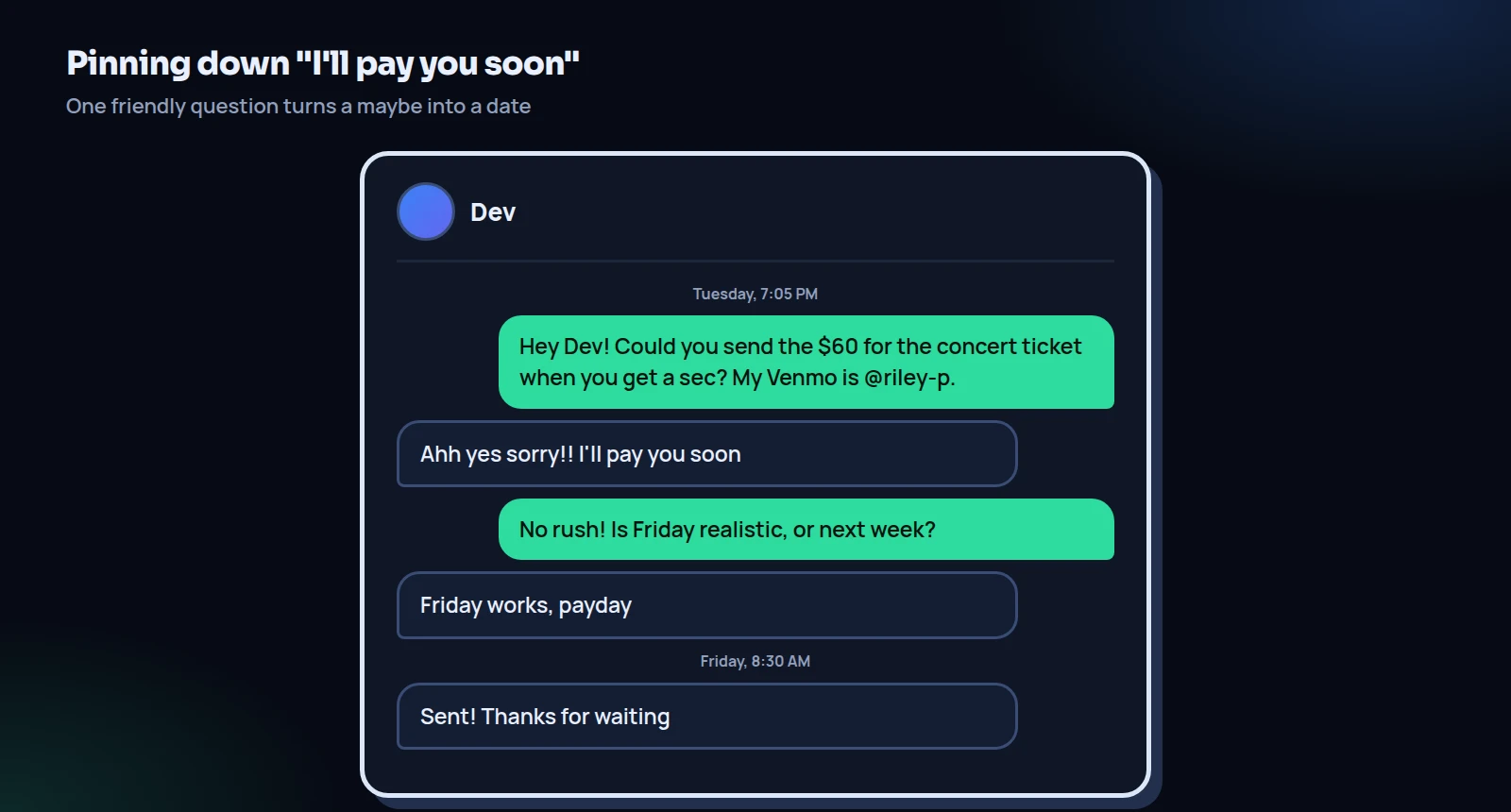
(A few weeks later) Hey Dev! Could you send the $60 for the concert ticket when you get a sec? My Venmo is @riley-p.
If several people owe you for the same thing, message each of them separately rather than asking the group chat. Our guide to splitting office lunches and group gifts has more scripts for shared costs, and settling a whole trip at once is covered in settling up after a vacation.
A payment on a real loan
If you lent a larger amount with a repayment plan, your text is a reminder of something already agreed, not a fresh request. Keep it as plain as a calendar alert and mention the plan so it reads as routine.
Message: installment reminder
Hi Dev, quick heads-up that the $200 payment for the laptop loan is due Friday. Same as usual, Zelle to my email is perfect. Thanks!
Better still, let the reminder come from somewhere else. When a loan is set up in IOUEZ with due dates, both people get a reminder as each payment comes due, so you only need to text when something is off. If you are working out what a fair plan looks like, the calculators page builds a schedule in a minute.
“I’ll pay you soon”: turning maybe into a date
This reply feels like progress and usually isn’t. “Soon” can mean tomorrow or never. Don’t argue with it; just offer two specific choices. Questions with options are easier to answer than open ones.
Message: pinning down “soon”
No rush at all. Is Friday realistic, or would next week be easier?
(If they pick a day) Perfect, Friday it is. Thanks Dev!
That second line matters. Repeating the agreed day back turns a vague promise into a small commitment, and it’s in writing for both of you.
WhatsApp, blue ticks and the art of not overreading
A WhatsApp message to ask for money comes with extra signals: two blue ticks, “last seen” times, “typing…” that appears and disappears. They are tempting to read like tea leaves. Mostly, they mean nothing. People open messages while walking, driving or juggling a toddler, and plan to answer later.
Read receipts can also be switched off in the settings of most messaging apps, so the absence of ticks doesn’t prove anything either. Give a seen-but-unanswered message at least two or three days before you assume it was ignored.
| SMS / iMessage | WhatsApp or Messenger | ||
|---|---|---|---|
| Best for | Quick reminders | Friends who live in the app | Final notes and summaries |
| Shows it was read | Sometimes | Often (if receipts are on) | Usually not |
| Risk | Gets buried | Group chats nearby | Feels formal |
| Use it when | That’s how you usually talk | That’s where you agreed the loan | Text has gone quiet |
Voice notes are fine for chatting, but not for money. A voice note can’t be skimmed, searched or screenshotted, and the amount gets lost in the middle. Type the numbers.
Watch out
Never ask for money back in a group chat, even jokingly. “Still waiting on that $60 Dev 👀” in front of eight friends is a public call-out, and people dig in when they feel embarrassed. Message privately every time.
Seen, no reply
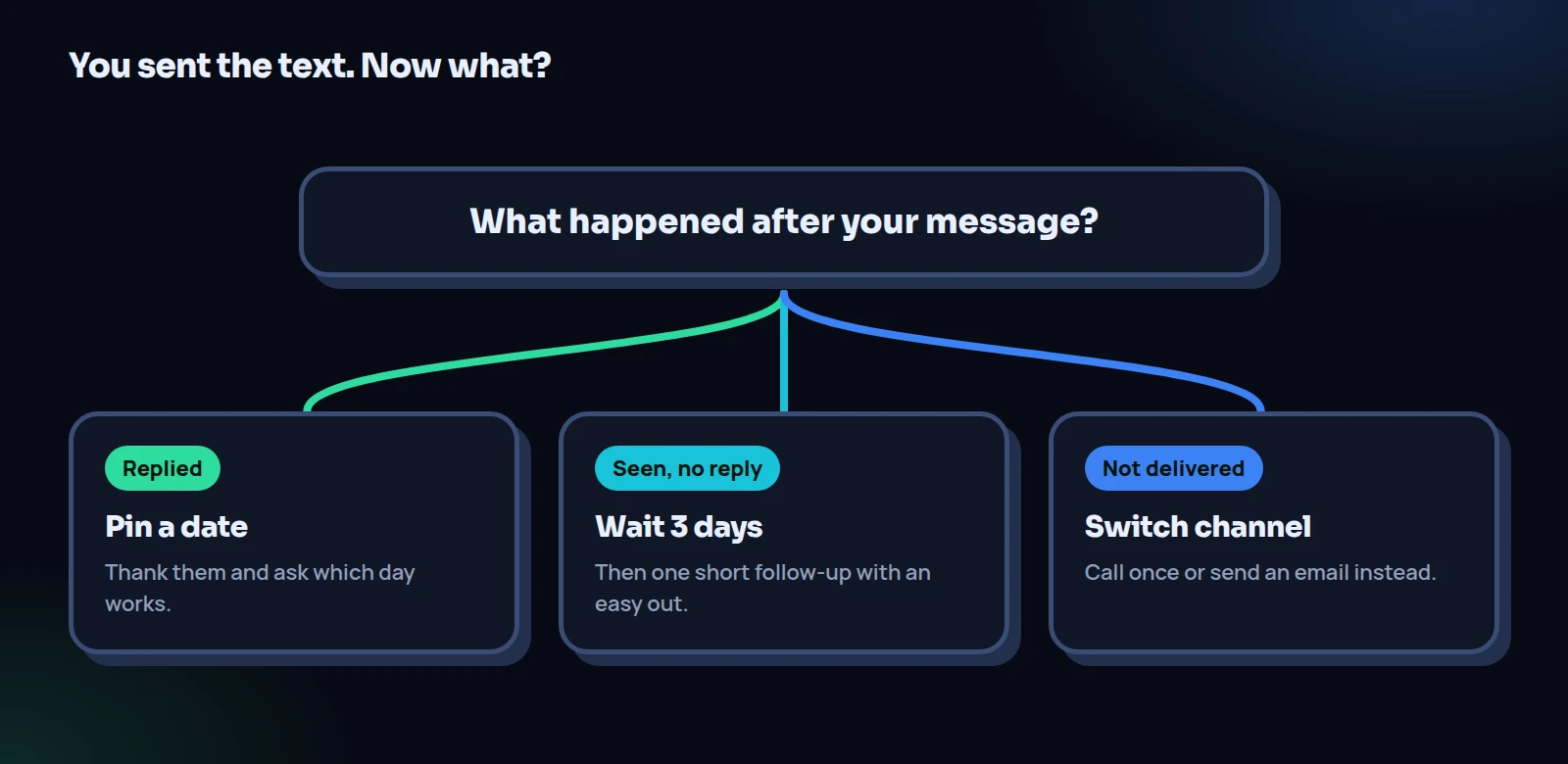
Three days have passed since your text was read. Send one follow-up that lowers the bar for answering. You are not repeating the request; you are making it easier to respond.
Message: the gentle follow-up
Hey, just bumping this in case it got buried. Even a quick “next week” is totally fine, I just like to know where things stand.
If that doesn’t get a reply within a week, change channel once. Call, or send a short email. A different notification sometimes reaches someone who has muted a thread out of embarrassment. The flowchart below shows the three common outcomes.
A coworker, neighbor or someone you know less well
With a friend you can lean on shared history. With a coworker who borrowed $40 for a lunch order, or a neighbor you fronted $75 for a shared fence repair, you have less goodwill to draw on and more reason to keep things tidy. Be a touch more formal, keep it short, and mention exactly when the money changed hands so there is no confusion.
Message: someone you know less well
Hi Jordan, hope your week’s going well. Just a reminder about the $40 I covered for Tuesday’s lunch order. Zelle to this number works, or cash next time we’re both in. Thanks!
Offering cash in person as an option helps here. Some people would rather hand over two twenties than add a coworker on a payment app, and making it easy matters more than the method. When you ask for money back by text from someone outside your close circle, an easy option beats a perfect one.
Asking a family member
Family loans carry history, which can make a plain text feel blunt. Add one line of warmth, keep the money part just as specific, and offer a call if they would rather talk.
Message: a sibling or cousin
Hi! Hope the new job is going well. I wanted to check in about the $400 from March. Could we set up a plan for it? Even $100 each month would be great. Happy to talk on the phone if that’s easier.
If the family member is a parent or grandparent, a call first and a summary text after usually goes better than a text alone. The text then becomes the record: “Great chatting today. Just to confirm, $100 on the 1st of each month starting in November.”
When it’s been months
The longer a debt sits, the more awkward the first mention feels. It is still worth doing: a calm message now is kinder to the friendship than another six months of quiet resentment, and the person who owes you may be relieved someone finally said it out loud. Acknowledge the gap honestly instead of pretending it’s routine, and keep the tone clean of resentment.
Message: picking it back up
Hey Dev, this is a bit awkward since it’s been a while, but I wanted to bring up the $300 from last winter. I’d love to get it settled so it’s not hanging over either of us. Would a few smaller payments work better than one?
“So it’s not hanging over either of us” does a lot of work. It frames repayment as something good for both people, not a favor you are demanding. For a structured way to do this, see our full guide on how to remind someone to pay you back.
The partial payment thank-you
When part of the money arrives, say thanks and confirm what’s left. People who feel noticed for paying something are more likely to pay the rest.
Message: confirming the balance
Got the $150, thank you! That leaves $150. Same time next month work for the rest?
Screenshot or note every payment the day it lands. A text to ask for money back proves you asked; a payment record proves what was paid. Our guide to keeping proof of repayment covers which records are worth keeping.
What not to send
Most of the damage people do when they ask for money back by text comes from a handful of messages sent in frustration. These almost always make things worse, however tempting they feel at 11 p.m.:
- Sarcasm. “Glad you could afford the beach trip 🙂” reads as an attack and ends the conversation.
- Screenshots of their spending. Even if you saw the new sneakers, using them as evidence feels like surveillance.
- Ultimatums you won’t follow through on. “Pay by Friday or else” with no “else” teaches them deadlines are flexible.
- A wall of text. If your message needs scrolling, it needs a phone call.
- Late-night messages. Even debt collectors aren’t allowed to contact people before 8 a.m. or after 9 p.m. without their agreement, according to the FTC. A friend can manage the same courtesy.
Those collector rules don’t apply to you as a friend; the federal Fair Debt Collection Practices Act covers people who collect debts owed to others. But the CFPB’s Regulation F also requires collectors who text or email to offer a simple way to opt out of those messages. It’s a useful reminder that a stream of texts can feel like pressure, even when each one is polite.
Short, specific and easy to answer beats clever every time.
If the person tells you they truly can’t pay right now, stop sending reminders and talk about a new plan instead. Our playbook on restarting repayments after a missed payment walks through a fair reset, step by step.
Rather not be the one sending texts at all? Put the loan and its due dates in IOUEZ and the reminders go to both of you automatically.
Set up a loan with remindersFrequently asked questions
Is it rude to ask for money back by text?
No. For most amounts between friends, a text is the most considerate way to ask: it gives them time to check their account and reply when they’re ready. Keep it private, short and specific.
How long should I wait to follow up after I ask for money back by text?
Two or three days after a message is read, or about a week if you can’t tell. Send one gentle follow-up, then change channel once before moving on to a firmer conversation.
Should I use a payment request instead of a text?
Both work well together. A request in Venmo, PayPal or Cash App makes paying one tap away, and a short text alongside it adds the warmth a bare request lacks.
What if they reply angrily?
Don’t match the tone. Reply once, calmly: “I’m not upset, I just want us to agree a plan.” If it stays heated, suggest talking in person later in the week.
Do debt collection laws limit how often I can text a friend?
Federal debt collection rules cover debt collectors, not individuals asking a friend to repay a personal loan. They are still a sensible guide to what feels like harassment, so keep follow-ups spaced out and at reasonable hours.
Should I save the messages?
Yes. Keep the thread, and record each payment with its date and amount. If there’s ever a disagreement, the messages show what was agreed and the records show what was paid.
Sources
- Federal Trade Commission, Debt Collection FAQs, collectors’ 8 a.m. to 9 p.m. contact window and stopping texts or emails on request.
- Consumer Financial Protection Bureau, § 1006.6 Communications in connection with debt collection, the Regulation F opt-out requirement for electronic messages.
- Consumer Financial Protection Bureau, What laws limit what debt collectors can say or do?, who the FDCPA covers.