
“Only lend what you can afford to lose” is good advice that leaves out the useful part: the number. This page turns it into a calculation. Three figures from your own budget tell you how much money to lend, and one figure from the borrower tells you whether that amount can actually come back on a sensible schedule.
The rule, in one line
Your lending limit is the money left after you protect your floor and cover what you already know is coming. In formula form:
Lendable = Savings − Floor − Known costs
Then you take that number and run it past two checks: would you be fine if it became a gift, and can the borrower repay it at a pace that works? The smallest of those answers is how much money to lend. Not what they asked for, not what feels generous in the moment. The smallest.
Why a number beats a feeling
When someone you care about asks for help, the amount you feel you can lend is usually tied to how much you love them and how bad their situation sounds. Both are real. Neither says anything about your rent. A number you worked out on a quiet evening holds up much better when the conversation gets emotional.
It also makes the conversation easier for the borrower. “I worked out what I can lend without touching my emergency savings, and it’s $1,200” sounds considered and final. “Um, maybe a thousand-ish?” sounds negotiable, and it usually gets negotiated. Deciding how much money to lend before you talk means the talk is about the plan, not the amount.
The three numbers from your budget
Number one: your savings
Count only money you can reach within a few days without penalties: checking above what this month’s bills need, savings accounts, money market accounts. Leave out retirement accounts, home equity and anything you would have to sell. If lending would require you to cash out a 401(k) or put the loan on a credit card, the answer to “how much” is already zero.
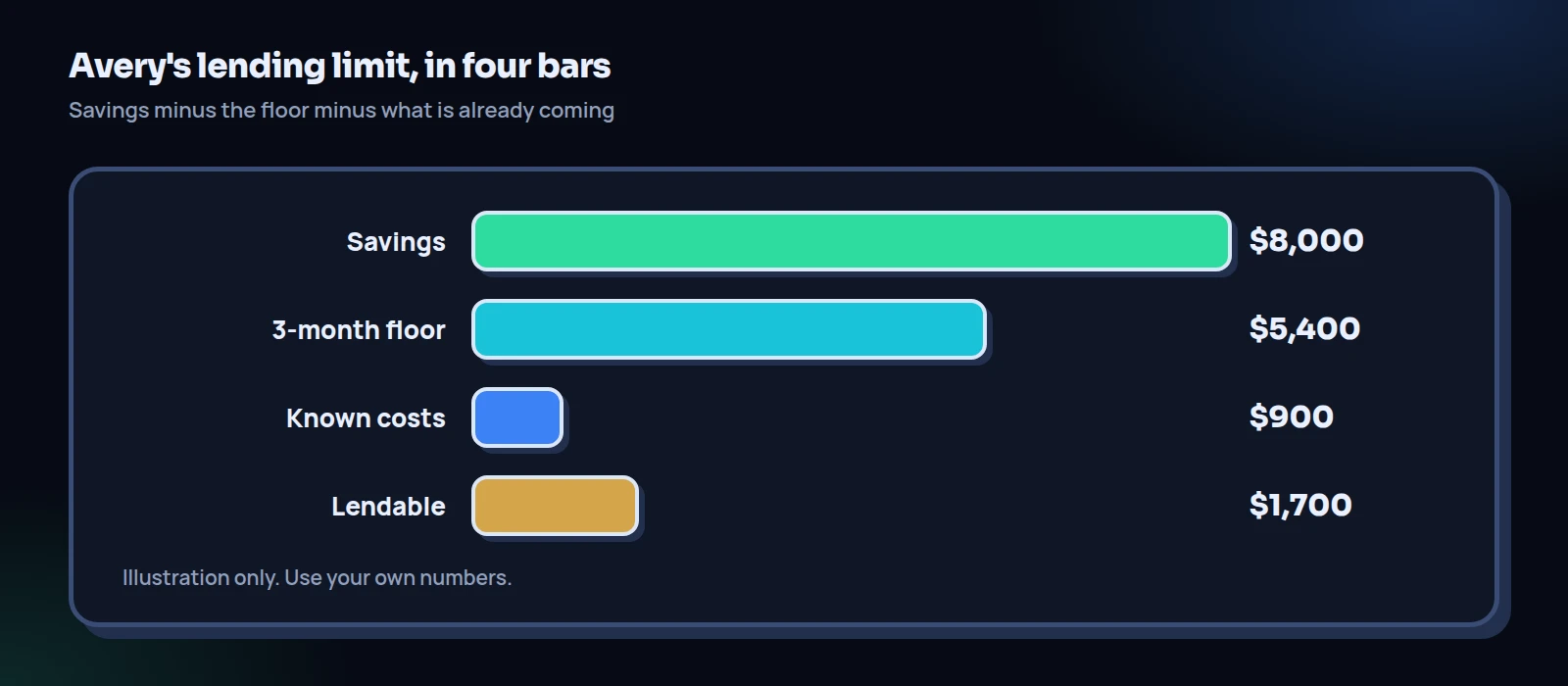
For our example, Avery has $8,000 in savings and a checking balance that just covers this month. Avery’s cousin Quinn has asked to borrow $2,500 to catch up on rent and a utility bill after a gap between jobs.
Number two: your floor
Your floor is the cushion you refuse to go below. It is your emergency fund, ring-fenced. The Consumer Financial Protection Bureau suggests sizing an emergency fund by looking at the unexpected expenses you have actually had and what they cost. That is a practical way to set a floor for lending too.
We like a simpler starting point: three months of essential costs. Essentials means rent or mortgage, utilities, groceries, insurance, transportation, minimum debt payments. Not streaming, not dinners out. If your income is irregular, or you support other people, use more months, not fewer.
Avery’s essentials come to $1,800 each month. Three months makes a floor of $5,400.
Number three: known costs
These are the bills you can already see coming in the next few months that are not part of normal monthly spending. Car registration. A dental crown. A friend’s wedding you have already booked flights for. Property tax. A security deposit if you are moving.
Avery has a $350 registration renewal and a $550 dental bill on the calendar, so $900 in known costs.
Avery’s calculation
| Line | Amount |
|---|---|
| Savings | $8,000 |
| Minus floor (3 × $1,800) | −$5,400 |
| Minus known costs | −$900 |
| Lendable, at most | $1,700 |
Quinn asked for $2,500. The math says the most Avery can lend without dipping into the floor is $1,700. That is already a useful answer: the full request is off the table, and Avery knows exactly why.
Check one: the gift test
The formula gives you a ceiling. The gift test shrinks it to something you can live with emotionally. Ask yourself: if this money never came back and I never mentioned it again, which amount would I be truly fine with? Not “fine in theory.” Fine in the sense that you would still enjoy dinner with this person.
That amount is the money you can afford to lose. For a lot of people it is noticeably lower than the formula, and it is often the truest answer to how much money to lend. Avery’s honest answer is $1,200. Above that, they know they would start keeping score.

Watch out
Do not count the repayments as if they were already back in your account. Until the last payment lands, the full loan is out of your savings. Plan your floor as if none of it returns on time.
Check two: what they can repay
Now flip the calculation. The borrower’s budget is the last input on how much money to lend. A loan only works if the borrower can pay it back without missing their own rent. Ask them, kindly and directly, what they can put toward it each month after their essentials. If they have not worked it out, help them.
Quinn’s new job pays $2,900 each month after tax. Rent, utilities, phone, insurance, food and transit come to $2,650. That leaves $250, and Quinn suggests $200 each month so there is a little slack. At $200 each month:
How long each amount takes at $200 each month
| Loan | Payments | Paid off in |
|---|---|---|
| $2,500 (the request) | 12 of $200, then $100 | 13 months |
| $1,700 (the ceiling) | 8 of $200, then $100 | 9 months |
| $1,200 (the gift test) | 6 of $200 | 6 months |
Thirteen months is a long time for life to get in the way. Six months is short enough that both people can see the finish line from the start.
Avery offers $1,200, repaid in six payments of $200 on the 2nd of each month, the day after Quinn’s paycheck. Quinn finds the remaining $1,300 through a payment plan with their landlord. Everyone has a number they can live with.
Your lending limit is the smallest of three answers: the formula, the gift test, and their monthly budget.
Interest changes the math, a little
Most loans between friends carry no interest, and for amounts like these we would skip it. If you do charge some, it is smaller than people expect. Say Avery charged 5% a year, simple interest on the unpaid balance, on the $1,200 loan repaid at $200 each month. The balance starts at $1,200 and drops by $200 every month, so the six monthly balances add up to $4,200. Multiply by 5% and divide by 12, and the total interest comes to $17.50 over the whole loan.
That is the honest scale of it: interest on a small, short loan barely moves your lending limit. What it does do is add complexity, and interest you receive is taxable income. If you are curious how a flat fee compares, simple interest vs a flat fee runs both on the same loan.
How much money to lend when the ask is small
Not every request needs the full calculation. If a friend needs $60 for gas until Friday, nobody should be opening a spreadsheet. For small, short asks, a quicker test works: would you spend this amount on a nice dinner for them without thinking twice? If yes, lend it or simply give it. If no, the full math is worth five minutes.
The catch is frequency. Five $60 loans in a year is $300, and small amounts are the ones nobody writes down. If small asks keep coming from the same person, add them up and treat the total like a single larger loan when you decide how much money to lend next time.
How much money to lend when you are lending to more than one person
The formula is about your total exposure, not one loan at a time. If you already have $600 out with a sibling and $400 with a friend, those count. Avery’s $1,700 ceiling would become $700 for any new request.
This is where a single list of everything you have lent helps more than any rule. It is easy to lend $300 here and $500 there and only realize at tax time that $2,000 of your emergency fund is scattered across four people. In IOUEZ each agreement shows its balance, so you can see your total owed to you at a glance and decide from real numbers.
Tip
Set a yearly lending budget the same way you might set a gift budget, for example “no more than $1,500 out at once.” When someone asks, the question becomes “is there room in the budget?” rather than “do I love this person enough?”
Where the tax lines sit
For the amounts in this article, federal tax rules are unlikely to come into play. Two numbers are still worth knowing.
- $10,000. IRS Publication 550 says the below-market loan rules generally do not apply to gift loans between individuals on any day the total outstanding between them is $10,000 or less, as long as the money is not used to buy income-producing assets. Above that, an interest-free loan can have tax effects for the lender.
- $19,000. The IRS annual gift tax exclusion for 2026. If you forgive a loan, the IRS can treat that as a gift, and amounts up to the exclusion per person per year are not taxable gifts.
If your lending limit math ever produces a number near either line, talk to a tax professional before the money moves.
The same math with a bigger cushion
The formula scales, which is the point of it. Suppose Avery had $22,000 saved instead of $8,000, with the same $5,400 floor and $900 of known costs. The ceiling jumps to $15,700. Does that mean Avery should lend Quinn $2,500 without a second thought?
Not quite. The ceiling now clears the request easily, so the binding limit becomes Quinn’s ability to repay: $200 each month still means 13 months for the full $2,500. Avery might lend the full amount and accept the longer timeline, or lend $1,200 and give $500 outright as help with the utility bill. A bigger cushion gives you more choices. It does not change which of the three answers is smallest, and it does not make a 13-month plan any shorter.
Common ways the math goes wrong
Counting next month’s paycheck as savings
Income you expect is not money you have. Jobs change, hours drop, and the loan is still out. Use today’s balance.
Lending the floor “just for a few weeks”
Short loans have a way of stretching. If the money is part of your floor, a two-week delay can collide with your own car repair. Lend from above the floor or not at all.
Ignoring the second ask
People who borrow once often need a little more later. Before you lend your full ceiling, consider leaving room for a smaller follow-up you might want to say yes to. Or decide now that there will not be one, and say so.
Rounding up to be kind
If the math says $1,200, offering $1,500 because $1,200 “feels stingy” undoes the whole exercise. A clear $1,200 with a plan is kinder than $1,500 you will worry about. If you are torn, our decision guide for lending to family walks through the other factors, and these scripts help when the answer is less than they hoped.
Saying the number out loud
Working out how much money to lend is the private half. The public half is telling the borrower, especially when your number is lower than their request. Lead with what you can do, give the reason in one sentence, and attach the plan, so the conversation moves straight to dates instead of lingering on the gap.
Avery’s version to Quinn: “I sat down with my budget, and I can lend you $1,200 without touching my emergency savings. If $200 each month on the 2nd works for you, we can write it down tonight. And I’m happy to help you ask the landlord about the rest.” No apology for the shortfall, no long explanation of the floor. Quinn hears a real number, a real schedule and a real offer.
Try it with your numbers
Grab your banking app and fill in the four lines: savings, floor, known costs, and any loans already out. Then do the gift test honestly and ask the borrower for their monthly figure. If all three answers point to the same range, you have found how much money to lend. If they do not, go with the smallest.
Once you know the number, the rest is about making the loan clear: written down, signed by both of you, with a schedule that matches their payday. How to lend money to a friend takes it from here, and the calculators page can help you lay out the payments.
Know your number? Set up the agreement and the installment plan in IOUEZ, and let reminders handle the due dates.
Set up a loanFrequently asked questions
How much money to lend a friend is too much?
Any amount that would dip into your emergency fund or make you resent your friend if it were late. Use the formula and the gift test, and take the smaller answer.
Should I use a percentage of my savings instead?
A percentage is easy to remember but ignores your floor and your upcoming bills. Someone with $5,000 saved and $5,000 of essentials has nothing to lend, whatever the percentage says.
Is how much money to lend different for family than for friends?
The math is the same. What changes is the gift test: many people are comfortable losing more to a parent or sibling than to a friend. Decide that honestly, then apply the same formula.
Does a bigger salary mean I can lend more?
Only if it means more money left above your floor. Income that goes straight to bills does not change your lending limit.
What if the borrower can’t repay the amount I can afford?
Lend less, or lend for longer with smaller payments. A loan that needs the borrower to skip their own rent will not be repaid on time.
Should I lend from my emergency fund if it’s a real emergency?
That is your call, but go in knowing your own cushion is now smaller. Many people choose a smaller gift from above the floor instead.
Sources
- Consumer Financial Protection Bureau, An essential guide to building an emergency fund, sizing savings by the unexpected expenses you have had.
- Internal Revenue Service, Publication 550 (2025), Investment Income and Expenses, below-market loans and the $10,000 exception for gift loans.
- Internal Revenue Service, Frequently asked questions on gift taxes, forgiving a debt and the $19,000 annual exclusion for 2026.