
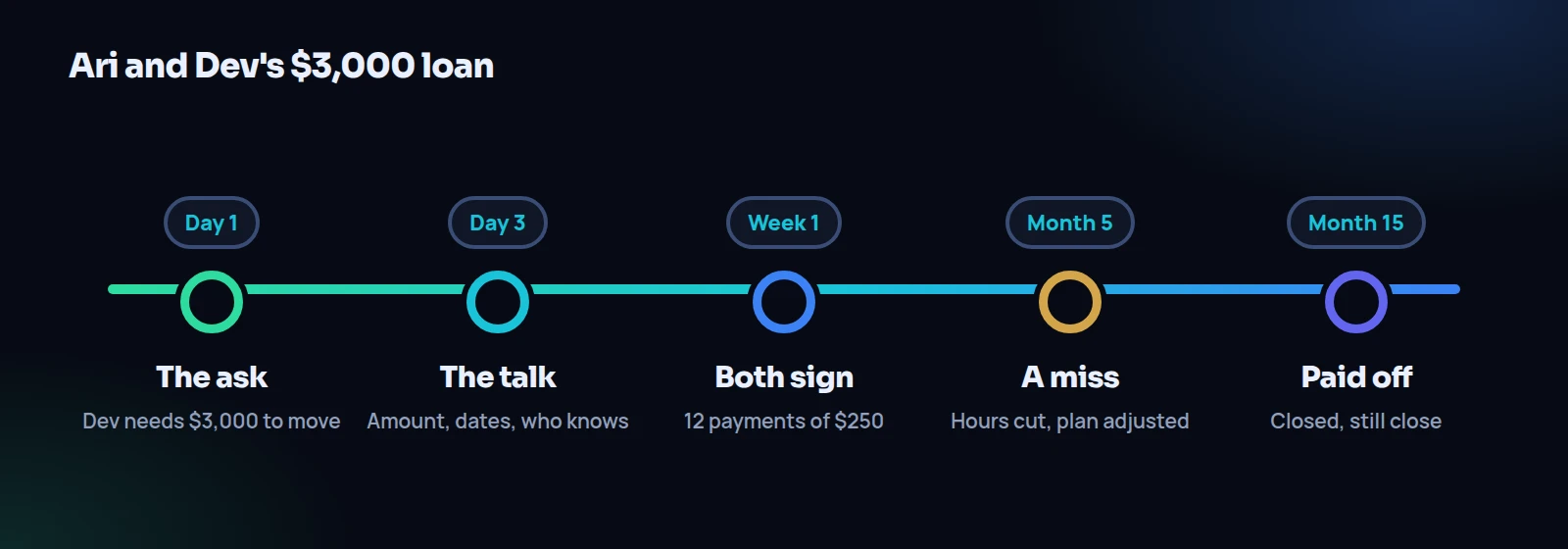
Siblings know exactly which buttons to press, and money is one of the biggest. When you lend money to a sibling, you are also lending into a shared history, shared parents and a lifetime of holidays together. This is the story of one illustrative loan between two siblings, Ari and Dev, from the first text to the last payment, with what each step teaches.
Day 1: the text
It is a Tuesday night when Ari’s phone lights up. “Hey, weird question. Can we talk about money this week?” Dev, three years younger, has just been offered a job in Denver that starts in five weeks. The pay is good. The problem is getting there: first month’s rent, a deposit, a moving truck and a few weeks before the first paycheck. Dev has added it up to $3,000 and has about $400 saved.
The ask, and why Ari didn’t answer right away
Ari’s first instinct was to say yes immediately. It was a good reason, Dev sounded nervous, and older siblings tend to feel they should fix things. It is the instinct most people have the first time they lend money to a sibling, and it is worth resisting for a day. Instead Ari wrote back: “Of course we can talk. Let me look at my numbers tonight and call you Thursday.”
Two days was enough to check what Ari could actually afford. With $11,600 in savings and about $2,400 a month in essential costs, Ari kept a three-month floor of $7,200 and had $1,100 of known bills coming. That left $3,300 above the floor: enough to cover $3,000 with a little room, and an amount Ari could honestly live without if things went badly.
Lesson
A delay is not a no. It is the difference between deciding with your budget and deciding with your guilt. If you want the full method, work out how much money to lend before you answer.
Day 3: the conversation that made the loan work
Day 3: the call
On Thursday, Ari opened with the answer and the condition together: “I can do this. I can lend you the $3,000. Can we agree how you’ll pay it back, so we never have to have a weird conversation about it?” Dev, relieved, had already sketched a budget for Denver: rent, transit, groceries, and about $300 left each month once the paychecks started.
What matters is how they talked about it. Over about twenty minutes they covered five things.
- The amount: $3,000, sent in one transfer the following Monday.
- The schedule: $250 on the 20th of each month, starting the month after Dev’s first full paycheck. Twelve payments.
- Interest: none. Neither of them wanted the complication.
- If a payment would be late: Dev would message Ari before the 20th, and they would agree a new plan together.
- Who else knows: nobody, unless Dev chose to tell their parents.
That last point surprised Dev. It mattered to Ari more than anything else on the list.
The parent question nobody talks about
When you lend money to a sibling, there is almost always a third party in the room: your parents. They may ask how Dev afforded the move. They may hear about it from one of you and form opinions. In some families, a parent will even quietly offer to “cover” the loan, which can feel like help and turn into a new tangle of who owes whom.
Ari’s rule was simple. The loan is between the two of them. If parents ask, Dev decides what to share. Ari will not bring it up at family dinners, will not mention it to the other siblings, and will not let a parent take it over.
Watch out
Do not complain about a sibling loan to your parents or other siblings, even when you are frustrated. It turns a two-person agreement into a family story, and the borrower will hear about it.
A sibling loan stays small as long as it stays between two people.
Week 1: writing it down without making it weird
Plenty of people who lend money to a sibling skip the paperwork, and Dev half-expected Ari to do the same. “It’s me,” they joked. Ari’s answer was the one that tends to land best: “That’s exactly why I want to write it down. If it’s on paper, we never have to rely on who remembers what.”
Week 1: signing
Ari set up the agreement in IOUEZ: $3,000, no interest, twelve installments of $250 due on the 20th, and a note that late payments would be discussed before the due date. Dev got a request to review it, read it on the bus, and signed. Once both had signed, the terms locked. Ari sent the money the next morning and recorded the transfer in the same place.
If you would rather use paper, the habit is identical: the amount, the dates, the interest choice, what happens if a payment slips, and both signatures. Our personal loan agreement template has the wording. The point is that both siblings are looking at the same document.
Months 1 to 4: the easy part
The first four payments arrived like clockwork. Two days before each due date, Dev got a reminder. When the money landed, Dev recorded the payment and Ari saw the balance drop: $2,750, $2,500, $2,250, $2,000. Ari replied to each one with a short “got it, thanks!” and nothing else.
That tiny thank-you does more work than it looks like. It tells the borrower the payment was noticed and appreciated, and it keeps money conversations short and warm. When you lend money to a sibling, the routine payments are where trust builds quietly, so let them be boring.
Month 5: the payment that didn’t come
Month 5: the message
On the 16th, four days before the fifth payment, Dev’s hours were cut after a project ended early. Dev did what they had promised on Day 3 and wrote to Ari before the due date. It was not easy to send.
Dev’s message
Hey, I need to be upfront. My hours got cut this month and I can’t make the $250 on the 20th. I’m really sorry. I should be back to full hours in a month or two. Could I skip this one and do smaller payments for a bit?
Ari’s reply: Thanks for telling me early, that’s exactly what we agreed and I appreciate it. Let’s skip this month, do $125 for four months, then go back to $250. Sound OK? I’ll update the plan.
That exchange took ten minutes. Ari did not ask for proof, did not say “I knew this would happen,” and did not mention it to anyone. Dev did not disappear or make up a reason. The early message is what made the kind reply easy. A missed payment that arrives as silence feels like a broken promise; the same missed payment, announced four days early, feels like life.
The adjusted schedule
| Months | Payment | Balance after |
|---|---|---|
| 1 to 4 | $250 each | $2,000 |
| 5 | Skipped (agreed) | $2,000 |
| 6 to 9 | $125 each | $1,500 |
| 10 to 15 | $250 each | $0 |
The loan now finishes in month 15 instead of month 12. Three extra months, no extra stress. Ari updated the agreement so the new plan was on record, and Dev confirmed it.
If a missed payment ever turns into weeks of silence in your own sibling loan, these kind options for when someone can’t pay you back work for a brother or sister as well as for friends.
Month 8: the holiday dinner
Month 8: the dinner
At a family dinner, one of their parents asked Dev how Denver was going and whether money was tight. Dev said, “It’s been a bit tight, but I’m OK, I’ve got a plan.” Ari said nothing and passed the potatoes. Later, a cousin mentioned wanting to borrow from Ari for a vacation. Ari just said, “I’m not lending right now,” and changed the subject.
This scene is where many sibling loans go wrong, and here it went right because of two earlier choices: the “nobody else needs to know” rule from Day 3, and Ari’s habit of treating the loan as finished business between payments. Ari did not need to be reassured in public. The record already showed what was paid.
Month 15: closing the loan
Month 15: the last payment
The final $250 landed on the 20th. The balance read $0, and the agreement showed as paid. Ari sent a message: “That’s it, all paid! Thank you for being so solid about it, especially in the spring. Proud of you.” Dev replied with a photo of their new apartment and a promise to cook the next time Ari visited.
Close the loan clearly. It is the last step when you lend money to a sibling, and the one most often skipped. Mark it paid, say thank you, and do not mention it again. If your sibling ever wants a record that they paid in full, it is there. And if you decide partway through to forgive what is left, say so in writing too; the IRS can treat a forgiven debt as a gift, though for amounts like this one the annual exclusion, $19,000 per person in 2026, means no gift tax return is needed.
What Ari would do differently
Asked afterward, Ari would change two small things. First, they would have set the due date a few days later. Dev was paid on the 15th and the 30th, and the 20th sometimes landed right after rent. A due date of the 17th, two days after payday, would have made every payment easier.
Second, Ari would have agreed in advance what a missed payment would look like, rather than inventing the $125 plan on the spot. It worked out fine, but a sentence like “if you ever need to, we’ll halve the payment for a few months” would have made Dev’s month-5 message less painful to write. Borrowers find it much easier to raise a problem when they already know the answer will be reasonable.
Neither change is dramatic. That is the point. When you lend money to a sibling, the big decisions are easy to remember. The small mechanics, like which day and what happens if, are what make the next fifteen months smooth.
If you are the sibling borrowing
Dev’s side of the story has its own lessons, and they are worth reading even if you are the one lending. Dev came to Ari with an exact number and a reason. Dev had already looked for another source and found one. Dev agreed to the paperwork without taking it personally. And when things went wrong, Dev wrote before the due date, not after.
If your brother or sister is lending to you, those four habits are the whole job. Ask for a specific amount. Show you have thought about repayment. Treat the written record as a favor to both of you. And send the hard message early. A sibling who lends to you once will usually lend again if the first loan felt easy; one who had to chase you will not, and should not.
What made this sibling loan work
Stripped of the story, the lessons are short. When you lend money to a sibling, these habits did the heavy lifting:
- Ari answered with a budget, not with guilt. Two days made the yes a safe one.
- They agreed the five things out loud: amount, schedule, interest, what happens if a payment slips, and who else knows.
- They both signed the same record, so nobody relied on memory, even through a change of plan.
- Dev raised the problem before the due date, and Ari rewarded that with an easy yes.
- The parents stayed out of it, by agreement rather than by luck.
- Small courtesies kept it light: reminders did the asking, and every payment got a thank-you.
None of these require special skill. They require deciding, before the money moves, how you will both behave when things are easy and when they are not. If you are still deciding whether to lend at all, the broader guide to lending money to family covers that decision.
Checklist: before you lend money to a sibling
- I took a day or two to check my own budget.
- The amount comes from above my emergency floor.
- We agreed the amount, dates, interest (or none) and what happens if a payment slips.
- We agreed who else knows, including parents.
- We both signed a written record.
- Reminders are set so I never have to chase.
- I will not complain about the loan to family members.
- We will close it clearly when it is paid, or forgiven.
Frequently asked questions
Is it a bad idea to lend money to a sibling?
Not if you can afford it and you agree the details in writing. Sibling loans go wrong mostly through unclear terms and other family members getting involved, both of which you can prevent.
Should I tell my parents I lent money to my brother or sister?
Agree it with your sibling first. Many people find it simplest to keep the loan between the two of you and let the borrower decide what to share.
What if my sibling misses a payment?
It happens to most people who lend money to a sibling for long enough. Ask calmly, offer a pause or smaller payments, and write down the new plan. Agreeing in advance that late payments get flagged before the due date makes this much easier.
Should a sibling loan have interest?
Most do not. For smaller amounts, keeping it interest-free is simpler. For larger interest-free loans, check the IRS rules or ask a tax professional.
Do I need a written agreement to lend money to a sibling?
You do not strictly need one, but we strongly recommend it. A short signed record of the amount, dates and what happens if a payment slips is what keeps two people with the same parents from remembering two different deals.
What if my parents offer to pay my sibling’s loan?
Thank them and keep it between you and your sibling. If a parent takes over the debt, you now have a three-way arrangement, which is harder to keep clear.
Sources
- Internal Revenue Service, Frequently asked questions on gift taxes, forgiving a debt as a gift and the $19,000 annual exclusion for 2026.
- Internal Revenue Service, Publication 550 (2025), Investment Income and Expenses, below-market (interest-free) loans between individuals.
- Consumer Financial Protection Bureau, An essential guide to building an emergency fund, keeping your own cushion before you lend.