Late fees between friends come up the moment a loan has a schedule. You’re lending $1,500, the plan says $150 on the 1st, and a voice in your head asks: what if they’re late? Banks charge late fees, landlords charge them, so why not you? Before you add one to the agreement, it helps to separate what people assume about late fees from what’s actually true.
Why the question comes up at all
A late fee is really an answer to a fear: that the loan will drift, payments will slip, and you’ll have no way to say “this matters to me” without a fight. That fear is reasonable. The question is whether a fee is the best tool for it, and between friends it usually isn’t. There are gentler tools that do the same job with less risk to the friendship.
We’ll use one illustrative loan throughout. Taylor is lending Sky $1,500 for moving costs, repaid at $150 on the 1st of each month for ten months, no interest. Taylor is wondering whether to add “a $25 late fee” to the agreement.
Myth 1: a late fee makes people pay on time
Myth: If there’s a fee, my friend will make sure they’re never late.
Fact: A fee only helps when lateness is about forgetting. When it’s about money, the fee makes the shortfall bigger.
Think about why a friend’s payment is usually late. Sometimes they forget, and a reminder fixes that for free. More often, rent came out first, the car needed something, or a paycheck was smaller than expected. In that situation, a $25 fee doesn’t produce money that wasn’t there. It just means next month Sky owes $175 instead of $150, which makes the next payment harder too.
There’s also a quieter cost. A fee changes how a late payment feels to the borrower. Without one, a slip is a small problem to sort out with a friend. With one, it’s a debt that just grew, and people who feel they’re falling further behind tend to avoid the conversation rather than start it. That’s exactly the opposite of what you want.
Reminders and well-placed due dates do far more for on-time payments. A due date the day after payday, plus a reminder as each payment comes due, solves most lateness before it starts. That’s the approach we recommend in our guide on how to remind someone to pay you back.
Myth 2: whatever fee you write down, you can enforce
Myth: If Sky signs an agreement with a $100 late fee, a court would make them pay it.
Fact: Courts generally refuse to enforce penalty clauses: charges for breaking a contract that are unreasonably high compared with the actual harm.
Contract law draws a line between “liquidated damages,” an agreed amount that’s a reasonable estimate of the real loss caused by a breach, and a “penalty,” an amount designed to punish. As the Legal Information Institute at Cornell explains, liquidated damages clauses are generally enforceable, but penalty clauses are not.
For a friend who pays $150 a few days late, your actual loss is usually close to nothing. A large fee looks a lot more like punishment than compensation. Rules and outcomes vary by state, but the practical lesson holds anywhere: a modest fee tied to a real cost is defensible, and a big one probably isn’t.
Myth 3: a late fee isn’t interest, so interest limits don’t matter
Myth: Rate limits only apply to interest, so I can charge whatever fees I like.
Fact: Usury limits are set by state law and vary by state, and depending on the state and the facts, some fees can be counted when deciding whether a loan’s cost is too high.
Most personal loans between friends are nowhere near any legal limit, especially interest-free ones like Taylor’s. But stacking fees on top of interest can push the true cost of a small loan higher than you’d expect. If you’re charging interest and fees together, add them up and look at the total as a yearly rate. Our article on simple interest vs a flat fee shows how quickly small charges become large rates on short loans.
Myth 4: charging any fee to a friend is never okay
Myth: Real friends don’t charge each other late fees, period.
Fact: A small fee can be fair when it’s agreed up front, covers a real cost, and only kicks in when there’s no warning.
There are honest reasons a lender might want one. Maybe Taylor’s own rent depends on Sky’s payment arriving, and a late payment would trigger Taylor’s landlord’s fee. In that case, passing on that real, specific cost isn’t greedy. It’s fair, as long as Sky agreed to it before borrowing and it only applies when Sky gives no warning.
The test we’d use: could you explain the fee to a mutual friend without it sounding like a punishment? “If the payment is late without warning, Sky covers the $15 my bank charges me” passes. “Sky pays $50 every time they’re late” doesn’t.
Myth 5: percentage fees are automatically fairer
Myth: A percentage late fee scales with the loan, so it’s always the fair choice.
Fact: What matters is how big the fee is next to the payment it’s attached to. A flat fee can be small or huge depending on that.
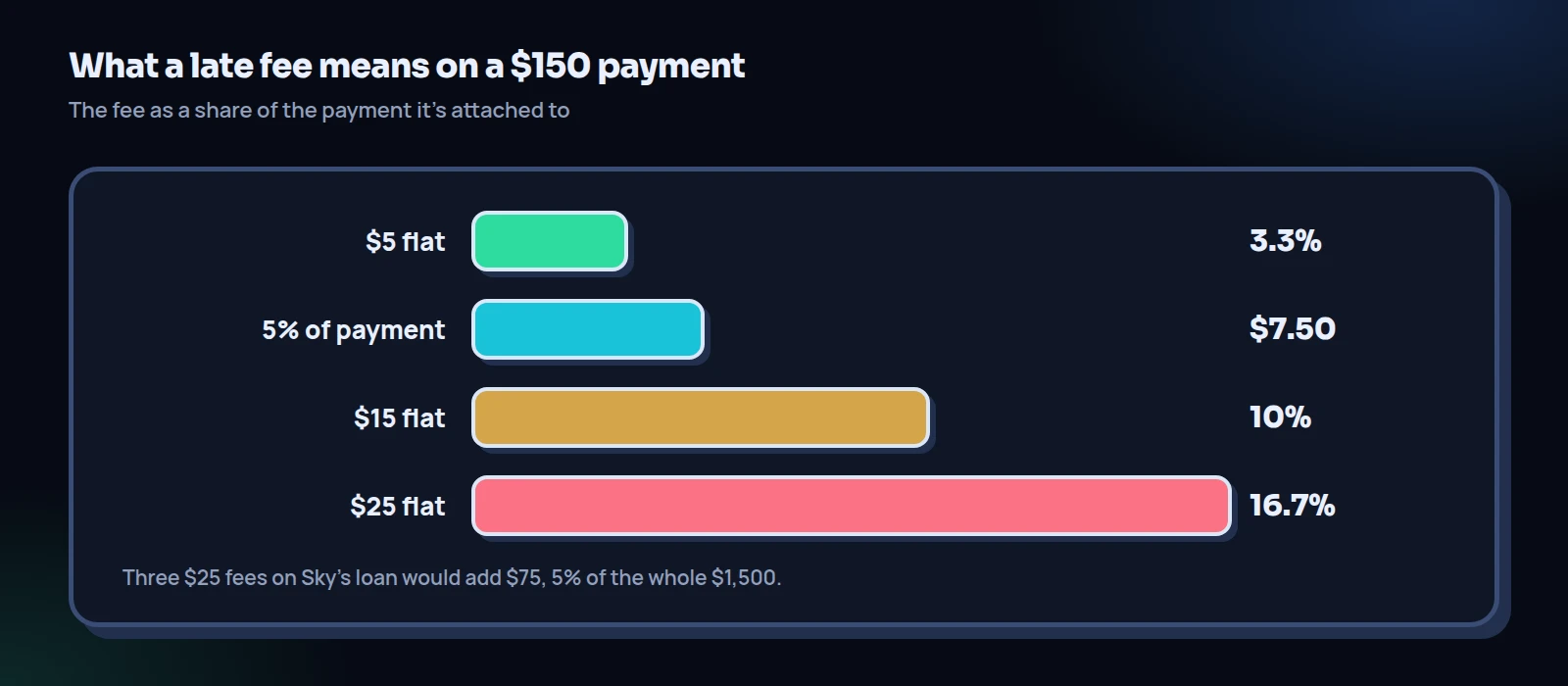
Here’s what different fees mean on one of Sky’s $150 payments:
Three late payments with a $25 fee would add $75 to a $1,500 loan, which is 5% of the whole amount, for being a few days late three times. That’s more than a year of interest at many savings rates, charged to someone who was probably already short on cash.
Myth 6: I can add a late fee after they’re already late
Myth: If Sky keeps paying late, Taylor can just announce a late fee from now on.
Fact: A loan’s terms are what both people agreed. Changing them takes both people agreeing again.
Announcing a fee mid-loan turns the agreement into something one person controls, and it lands as a punishment no matter how you phrase it. If late payments keep happening, the better move is to talk about why and reset the plan: different dates, smaller payments, or a pause. Our playbook on restarting repayments after a missed payment covers how. If you both decide a fee belongs in the new plan, write it into the new version and both sign.
Myth 7: debt collectors add fees, so I can too
Myth: Collection agencies tack on fees all the time, so it must be normal.
Fact: Even professional debt collectors can’t add interest, fees or charges unless the original agreement or state law allows it.
The FTC explains that, under the Fair Debt Collection Practices Act, collectors can’t try to collect fees or other charges on top of what’s owed unless the contract or state law allows them. That law covers debt collectors, not friends collecting their own loan, but the principle is a good one to borrow: charges belong in the agreement from day one, or not at all.
Watch out
Once a fee becomes the topic, the conversation stops being about the $150 and starts being about if you’re being fair. Sky may pay the fee and quietly resent it for years. If the friendship matters more than $25, that’s a bad trade.
What works better than late fees between friends
Whatever you think of late fees between friends, the real goal is on-time payments and a calm way to handle the occasional slip. You can usually get both without a fee. These do that without the sting:
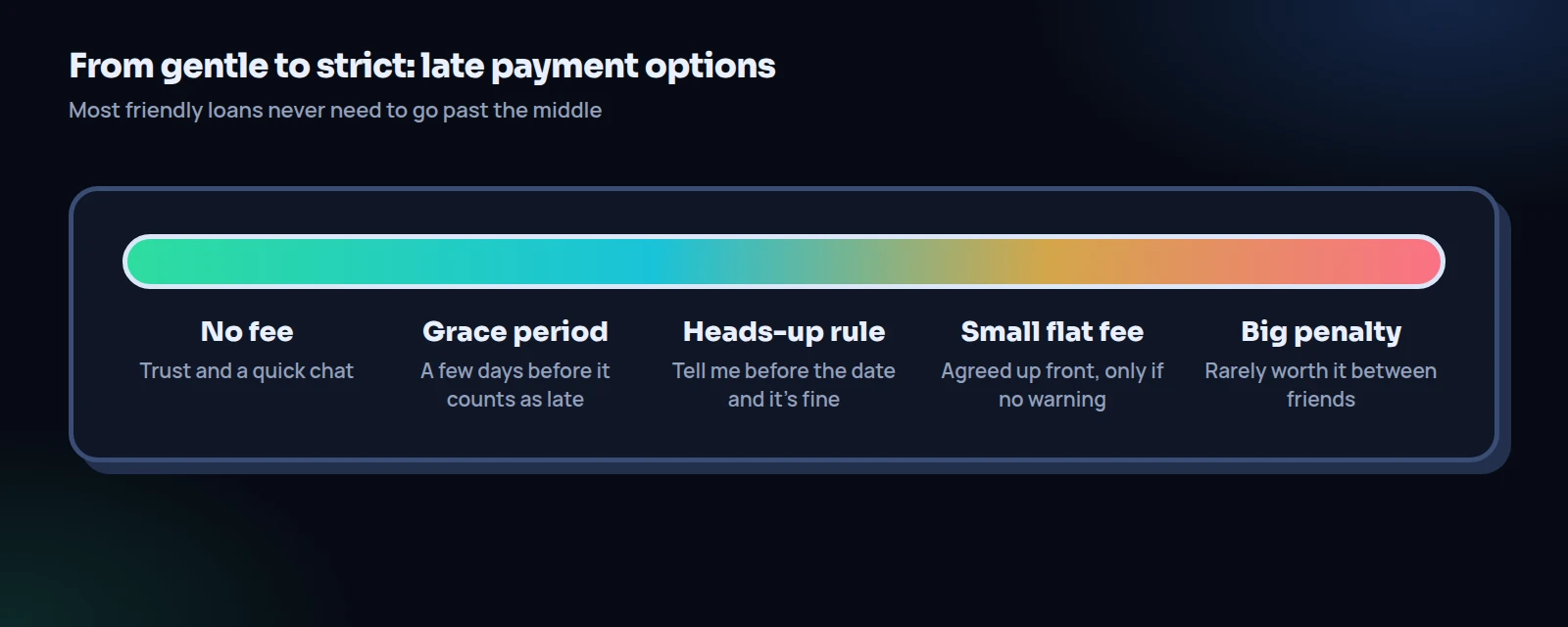
- A grace period. A payment isn’t “late” until, say, three days after the due date. It removes the stress of weekends and bank delays.
- The heads-up rule. If a payment will be late, the borrower messages before the due date and you agree a new date. No penalty, ever, when there’s warning.
- Late money moves to the end. A missed payment is simply added after the last one, so the loan runs a month longer.
- Payday-aligned dates. Due the day after payday, not the day before.
- Automatic reminders. In IOUEZ, both of you get a reminder as each payment comes due and an overdue notice if a date passes, so lateness from forgetting mostly disappears.
Tip
If you still want a fee, make it conditional: it only applies when a payment is late and there was no heads-up. That keeps the fee as a backstop for silence, not a punishment for hardship.
Talking about lateness without sounding like a bank
Whether or not you add a fee, the conversation about late payments should happen before the money moves, not after the first slip. Raised early, it’s planning. Raised late, it’s an accusation. Keep it light and put it in terms of making life easy for both of you.
Message: setting expectations up front
One more thing before I send it: if a payment’s ever going to be late, just give me a heads-up before the 1st and we’ll move it, no problem at all. I only ask because my own rent goes out on the 3rd, so I’d rather know early than be surprised.
That message does everything a late fee is supposed to do. It tells Sky the date matters, explains why, and gives a clear, free way to handle a problem. Most people respond much better to “tell me early” than to “you’ll pay $25.”
A case where a fee made sense
Here’s a different illustration. Taylor’s cousin borrows $4,000 to buy a used car and asks for a two-year plan. Taylor is paying their own car loan with the money that would otherwise sit in savings, and a late payment from the cousin would mean Taylor’s own payment bounces, with a $35 returned-payment fee from Taylor’s bank.
They agree a three-day grace period, the heads-up rule, and a $35 fee only for a payment that’s more than three days late with no warning, matching exactly what Taylor would be charged. It’s small next to the loan, tied to a real cost, agreed before any money moved, and avoidable with one text. That’s about as fair as late fees between friends or family get. In two years, it never comes up.
A fairer late payment clause
Here’s a clause you can adapt for your own agreement. It leans on a grace period and the heads-up rule, with an optional small fee only for silent misses. Fill in the brackets, delete the fee line if you don’t want one, and make sure both people agree before signing.
Template: late payment clause
Late payments
1. A payment counts as late if it has not arrived
   [3] days after its due date.
2. If [Borrower] expects a payment to be late, they
   will tell [Lender] before the due date, and we
   will agree a new date in writing. No fee applies.
3. A late payment with no notice is added to the
   end of the schedule.
4. (Optional) A late payment with no notice also
   carries a one-time fee of $[amount], to cover
   [real cost, e.g. my bank's overdraft fee].
5. Any change to these terms must be agreed by
   both of us in writing.
For the rest of the agreement, our personal loan agreement template walks through every clause, and you can set up the schedule with the installment tool on our calculators page.
Frequently asked questions
Are late fees between friends legal?
A modest late fee that both people agreed to up front is generally allowed, but enforceability depends on state law. Courts generally won’t enforce penalties that are unreasonably high compared with the actual harm, and states set their own limits on interest and fees.
How much should a late fee be?
If you use one, tie it to a real cost you’d face, like a bank fee, and keep it small next to the payment. On a $150 payment, a $25 fee is 16.7%, which is a lot for a few days.
What is a grace period?
A few days after the due date during which a payment isn’t counted as late. It covers weekends, holidays and bank delays without anyone needing to send a message.
Can I add a late fee to an existing loan?
Only if both of you agree to change the terms. Announcing one on your own usually feels like a punishment and can damage the friendship more than the late payment did.
What should I do instead of charging late fees between friends?
Align due dates with payday, use reminders, agree a heads-up rule and add missed payments to the end of the schedule. These fix most lateness without any fee.
Sources
- Legal Information Institute, Cornell Law School, penalty clause, courts generally do not enforce penalty clauses.
- Legal Information Institute, Cornell Law School, liquidated damages, an agreed amount must be a reasonable estimate of the harm.
- Legal Information Institute, Cornell Law School, usury, interest ceilings are defined by state statutes and differ between states.
- Federal Trade Commission, Debt Collection FAQs, collectors can’t add fees or charges unless the contract or state law allows it.