A loan between two people who like each other usually goes wrong in one of two places: what was agreed, or what was paid. A short written agreement fixes the first, and a payment record fixes the second. Below is a free personal loan agreement template in plain English, with each clause explained so you know why it is there and what to write in it.
Key takeaways
- Nine clauses cover almost every friendly loan: who, how much, interest, repayment, lateness, changes, forgiveness, records and signatures.
- Be specific. Exact amounts and calendar dates prevent nearly every later argument.
- Choose interest on purpose, even if the choice is zero, and keep it within your state’s legal limit.
- Electronic signatures count. Under federal law, a signature cannot be denied legal effect only because it is electronic.
- The agreement is half the job. Recording every payment is the other half.
Why a short agreement beats a long one
You can find twelve-page loan contracts online, full of words like “indemnify” and “severability.” Between friends or relatives, that kind of document mostly creates a new problem: nobody reads it, so nobody remembers it. A one-page loan agreement between friends that both people actually read out loud is worth more than a long one that sits unopened in an email.
What you want is a record that answers the questions people will ask later. How much was it? When is the next payment? Did we say anything about interest? What did we agree would happen if a payment slipped? If the document answers those, it has done its job.
Think of it as a note to your future selves. In eight months, neither of you will remember whether the first payment was due in April or May, and neither of you should have to. A personal loan agreement template gives you the shape, so all you supply is the details. Nobody is preparing for a fight here. You are making sure a fight never has anything to be about, which is also why we suggest writing it before the money moves rather than after.
What to include in a loan agreement, clause by clause
Here is what each part of the personal loan agreement template is for, in the order it appears. Read this once, then the template itself will make sense at a glance.
1. The people
Full legal names, plus a way to reach each person. Use the name on their ID, not a nickname. If either person moves or changes numbers during the loan, update it, because a record that cannot reach the borrower is a record that cannot remind them.
2. The loan itself
The exact amount in dollars, the date the money moves, and how it moves. “$1,800 sent by bank transfer on March 4” is perfect. Adding the purpose is optional, but we like it: six months later, “car repair” reminds both of you why this mattered.
3. Interest
Most loans between friends carry no interest, and that is fine. Write “no interest” explicitly so nobody wonders. If you do charge interest, state it as a yearly simple rate on the unpaid balance, and check your state’s maximum first. The Legal Information Institute at Cornell explains that usury limits are set by state statutes and differ from one state to another.
There is a tax angle too. The IRS treats interest you receive as income, and for interest-free loans above $10,000, the below-market loan rules in IRS Publication 550 may apply. Under that line, with no investment purchases involved, they generally do not.
4. Repayment
This is the clause people get wrong most often, because “pay me back when you can” feels generous. Turn it into a repayment schedule instead: how many payments, how much each, which day of the month, and the final date. Line the due date up with the borrower’s payday. Add that early or extra payments are welcome without penalty, so paying off faster never feels like breaking the rules.
5. Late or missed payments
Agree now on what happens later, while everyone is calm. Our default: the borrower tells the lender before the due date, and both agree a new date in writing. A late fee is optional. If you add one, keep it small and fixed; late fees between friends explains why most people skip them.
6. Changes
Plans change. This clause says any change to the agreement must be written down and confirmed by both people. It sounds formal, but it is what stops “you said I could skip June” from turning into a disagreement.
7. Forgiveness
If the lender ever decides to forgive part or all of the loan, they say so in writing. That protects the borrower from a debt resurfacing years later, and it gives the lender a clear record. Forgiving a debt can count as a gift for federal gift tax purposes, and for 2026 the IRS annual exclusion is $19,000 per person.
8. Records
A sentence saying each payment will be recorded with its date and amount, and that both people keep a copy. The agreement is the plan. The payment record is what actually happened.
9. Signatures
Both people sign and date. A witness is optional; some people add one as extra evidence that both parties signed. Signing on your phones works too. The federal ESIGN Act, 15 U.S.C. § 7001, says a signature or contract may not be denied legal effect solely because it is in electronic form.
Watch out
Do not leave blanks. An unfilled “[date]” in a signed agreement is an argument waiting for a calendar. If a term really is undecided, write how and when you will decide it.
The free personal loan agreement template
This personal loan agreement template fits on one page. Copy it into a document, fill in every bracket, and delete the options you did not choose. Keep the wording simple. If you are changing a lot, that is a sign you may need a lawyer rather than a template.
Template: personal loan agreement
PERSONAL LOAN AGREEMENT

Date: [date]

1. THE PEOPLE
Lender:   [full name], [address], [phone or email]
Borrower: [full name], [address], [phone or email]

2. THE LOAN
The Lender lends the Borrower $[amount] (the "Loan").
The money is sent on [date] by [method].
Purpose (optional): [what the money is for]

3. INTEREST (keep one option)
[ ] No interest is charged on this Loan.
[ ] Simple interest of [rate]% per year is charged
    on the unpaid balance.

4. REPAYMENT
The Borrower repays the Loan in [number] payments of
$[amount], due on the [day] of each month,
starting [date]. The final payment is due [date].
Payments are made by [method].
The Borrower may pay early or pay extra at any
time, with no penalty.

5. LATE OR MISSED PAYMENTS
If a payment will be late, the Borrower tells the
Lender before the due date, and both agree a new
date in writing.
[Optional: A late fee of $[amount] applies if a
payment is more than [number] days late.]

6. CHANGES
Any change to this agreement is made in writing
and confirmed by both parties.

7. FORGIVENESS
If the Lender forgives part or all of the Loan,
the Lender says so in writing.

8. RECORDS
Each payment is recorded with its date and amount.
Both parties keep a copy of this agreement.

9. WHOLE AGREEMENT
This is the full agreement between the parties
about this Loan.

Lender:   ______________________  Date: ________
Borrower: ______________________  Date: ________
Witness (optional): ____________  Date: ________
Five mistakes people make filling it in
We have seen the same handful of slips turn a good personal loan agreement template into a vague one. All of them are easy to avoid once you know to look.
- Rounding the amount. “About $2,000” when $1,940 actually moved. Write the exact number that left your account, and keep the transfer receipt with the agreement.
- Using “monthly” without a day. Monthly on the 1st and monthly on the 28th are very different for someone paid on the 15th. Name the day.
- Payments that do not add up. Six payments of $300 is $1,800. Check the math before signing; a schedule that ends $40 short creates an awkward last conversation.
- Ticking both interest boxes, or neither. Delete the option you did not choose so the signed copy has exactly one answer.
- One copy, kept by the lender. If only one person has the document, the other person has to take their word for what it says. Both keep a copy, or both use a shared record.
If your loan is small and quick, say $150 until Friday, the full template may be more than you need. A two-line IOU with the amount, the date and both signatures still beats a text that says “thx, will pay u back.” Our guide on how to write an IOU covers that lighter version.
A filled-in example
Here is how the important parts read once filled in. Morgan lends Jamie $1,800 for a car repair. They agree no interest and six payments, timed to land the day after Jamie’s monthly paycheck.
Morgan and Jamie’s repayment schedule
| Payment | Due | Amount | Balance after |
|---|---|---|---|
| 1 | April 16 | $300 | $1,500 |
| 2 | May 16 | $300 | $1,200 |
| 3 | June 16 | $300 | $900 |
| 4 | July 16 | $300 | $600 |
| 5 | August 16 | $300 | $300 |
| 6 | September 16 | $300 | $0 |
Clause 4 reads: “The Borrower repays the Loan in 6 payments of $300, due on the 16th of each month, starting April 16. The final payment is due September 16. Payments are made by bank transfer.” Clause 5 keeps the default and skips the late fee. Clause 3 says “No interest is charged on this Loan.” That is the whole negotiation.
How to use the template without making it awkward
The awkward part is not the personal loan agreement template itself. It is the moment you bring it up. Try framing it as protection for the friendship rather than for the money: “I’m happy to do this. Can we write down what we agreed so neither of us has to remember it?” Almost nobody objects to that.
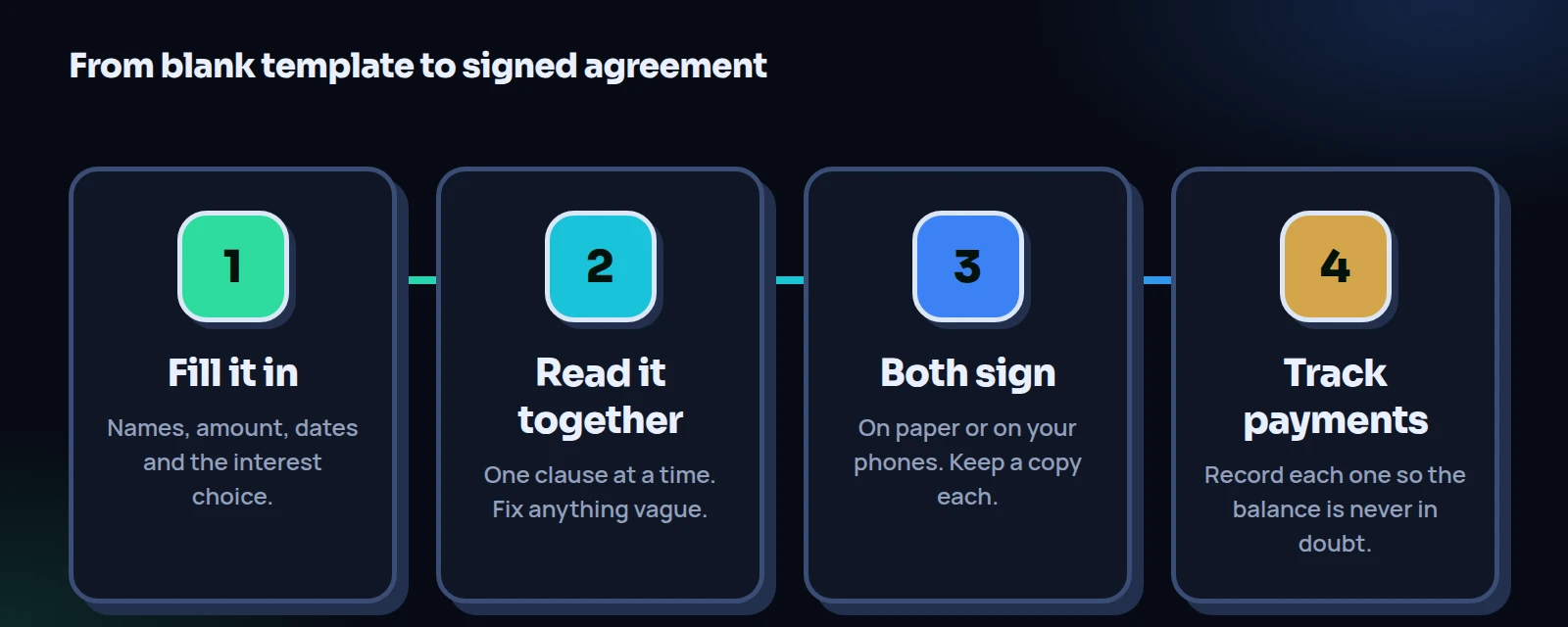
Then read it together. Not silently, not “just sign here.” Go clause by clause, out loud, and change anything that does not match what you both meant. It takes ten minutes, and it is the single best way to make sure your personal loan agreement template becomes an agreement both people actually understand.
Tip
Send the borrower the filled-in draft a day before you sign. People read more carefully when nobody is watching them read, and any questions come up while they are still easy to fix.
Finally, store the signed personal loan agreement template somewhere both of you can find it. A photo of a paper copy in a shared folder works. So does an app. In IOUEZ, the agreement is created with the same details as the template, both people sign on their own device, and the terms lock once both have signed. Payments are recorded against the balance, and an installment plan shows what is due next. You can read more on the how it works page.
When a template is not enough
A personal loan agreement template handles everyday loans well. A few situations deserve more than a fill-in-the-blanks page:
- Large amounts, especially interest-free loans above $10,000, where federal tax rules can apply.
- Loans secured by property, such as a car title or a home. Those involve extra state paperwork.
- Loans to a business rather than a person; read lending money to a friend’s business first.
- A mortgage down payment, where the mortgage lender will ask whether the money is a gift or a loan.
- Anything where you would actually go to court if it went wrong.
For those, a short meeting with a local attorney or tax professional is cheap compared with what is at stake.
Rather not copy and paste? Create the same agreement in IOUEZ, send it for signature, and let reminders handle the due dates.
Create a free agreementFrequently asked questions
Is a personal loan agreement template legally binding?
A filled-in, signed agreement is much stronger evidence than a verbal promise. Whether a particular agreement is enforceable depends on your state and the details, so for large amounts ask an attorney.
Does a loan agreement between friends need to be notarized?
Many simple personal loan agreements are signed without a notary. Requirements can differ by state and by type of loan, so for secured or large loans check locally.
Can we sign the agreement on our phones?
Yes. Under the federal ESIGN Act, a signature or contract cannot be denied legal effect only because it is electronic. What matters is that both people clearly intend to sign.
What interest rate should I put in?
For most friendly loans, zero. If you charge interest, use a simple yearly rate and check your state’s usury limit. Interest you receive is generally taxable income.
What if we need to change the repayment schedule later?
Agree the change and write it down, with both people confirming it. That is exactly what clause 6 is for. Keep the original and the change together.
Should the purpose of the loan go in the personal loan agreement template?
It is optional. We include it because it gives the loan context later and makes it easier to show the money was meant as a loan, not a gift.
Sources
- U.S. Code, 15 U.S.C. § 7001, General rule of validity (ESIGN Act), Legal Information Institute, Cornell Law School.
- Legal Information Institute, usury, interest limits set by state statutes that differ from state to state.
- Internal Revenue Service, Publication 550 (2025), Investment Income and Expenses, below-market loans and the $10,000 gift loan exception.
- Internal Revenue Service, Topic no. 403, Interest received, interest is generally taxable income.
- Internal Revenue Service, Frequently asked questions on gift taxes, forgiving a debt and the $19,000 annual exclusion for 2026.