
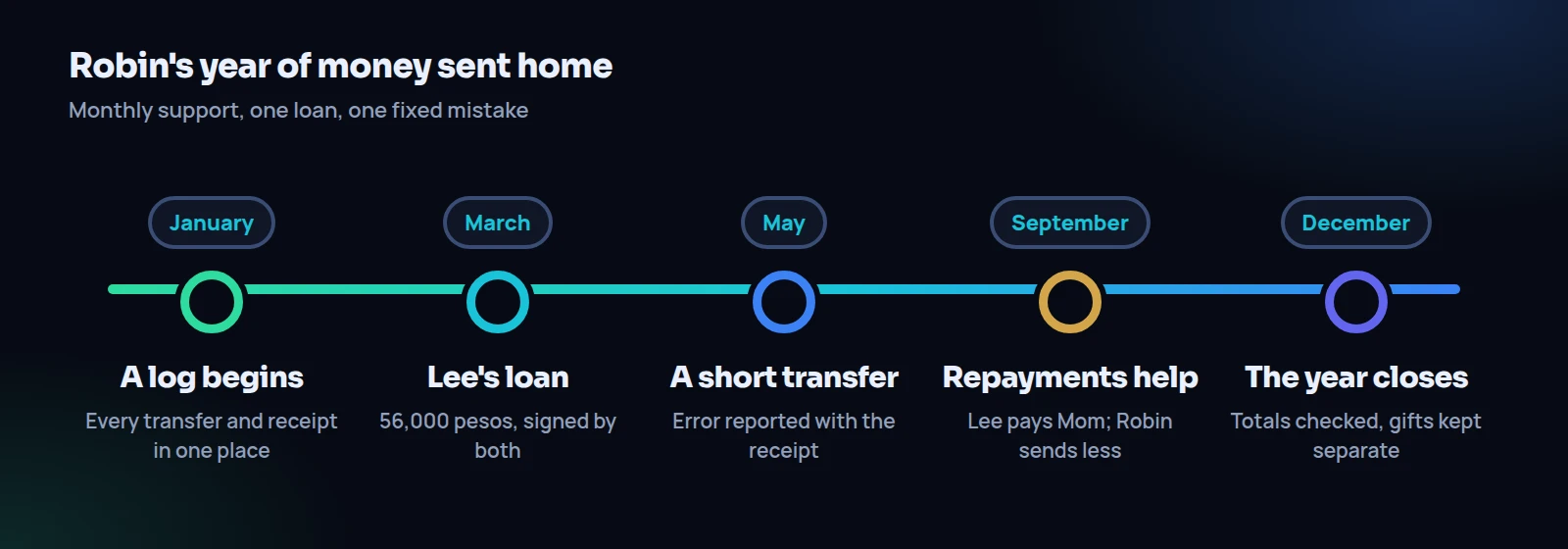
Robin works as a nurse in Houston and has sent money to family in the Philippines every month for six years. Last January Robin decided to track money sent home properly for the first time, after a phone call where nobody could agree whether March’s transfer had covered the electricity bill or the school fees. What follows is one illustrative year: the log Robin started, the loan to a sibling that got its own signed record, the transfer that arrived short, and the habits that made December’s family call a lot shorter.
The starting point
Robin sends $300 to their parents on the first Friday of each month, through a remittance provider’s app, and occasionally extra for emergencies. Robin’s younger sibling, Lee, drives deliveries and wants a motorbike of their own instead of renting one. Mom keeps cash in an envelope and a rough tally in a notebook. Robin keeps nothing except the provider’s app history, which only goes back so far. Everyone is honest. Nobody has the full picture.
January: why bother keeping a log at all
The phone call that started it was small. Robin’s mother said the December money “went to the clinic”. Robin remembered sending extra in December for the clinic, on top of the usual $300. Was the clinic money the extra, or the usual, or both? Nobody was wrong, exactly. There just wasn’t a record that everyone could look at.
When you track money sent home, you’re not auditing your parents. You’re protecting the relationship from the same thing that strains loans between friends: two honest memories that disagree. A log also helps you budget. Robin had a vague sense of sending “about $4,000 a year”. The real number, once added up, was higher.
So Robin set up three things in January:
- Week 1
A simple monthly log (a spreadsheet; the template is further down) with one row per transfer: date, amount sent in dollars, fee, exchange rate, amount received in pesos, what it was for, and the receipt reference.
- Week 1
A folder on their phone called “Receipts home”, where every remittance receipt goes as a screenshot or PDF the day it’s sent.
- Week 2
A short message to the family chat: “I’m keeping a list of what I send so we never have to guess. If something’s for a specific bill, tell me and I’ll write it down.”
The receipt is the most useful thing you get
Here’s something many people who send money abroad don’t know. In the US, most remittance transfers come with legal protections. Under the Consumer Financial Protection Bureau’s remittance transfer rule, a provider generally has to tell you, before you pay, the exchange rate, the fees and the amount your family should receive, and then give you a receipt with the same details plus the date the money will be available. The rule generally covers transfers of more than $15 sent by consumers in the US to people in other countries.
That receipt is the backbone of the log. It already has the exchange rate and the amount received, so Robin doesn’t have to look anything up. Copying four numbers off it takes about thirty seconds.
Tip
Save the receipt the moment you send, not at the end of the month. Provider apps change, accounts get closed, and history screens don’t always go back far enough. A screenshot in your own folder lasts.
March: a loan is not support
In March, Lee asked for help buying a used motorbike for deliveries, 56,000 pesos. Robin wanted to help but couldn’t simply give that much on top of the monthly support. They agreed it would be a loan: 56,000 pesos, repaid at 7,000 pesos a month for eight months, no interest.
This is the moment where many families blur things, and where the log needed a firm line. The monthly $300 to their parents is a gift: nobody expects it back. Lee’s motorbike money is a loan: it’s expected back, on a schedule. Mixing them in one list would make both harder to follow. Our guide on gift or loan: how to make it clear from day one goes deeper on that distinction.
So the loan went into IOUEZ, not the spreadsheet. Lee created an account, Robin linked Lee as a contact by email, and Robin created a shared agreement: They owe me, amount 56,000, currency PHP, description “Motorbike for deliveries”, due date the final payment month, and a note: “8 payments of 7,000 PHP. Late? Lee tells Robin before the date.” Both signed on their phones, about 8,000 miles apart. Once both signatures were in, the amount and currency locked.
Why pesos, when Robin earns dollars? Because Lee earns pesos, and Robin was willing to absorb some exchange rate movement in exchange for Lee never having to think about it. That trade-off is the core decision in any cross-border loan, and we work through the numbers in lending money in different currencies.
The May surprise
Robin’s May transfer receipt promised 16,800 pesos to Mom. Mom’s bank showed about 14,000. Robin’s first instinct was to send the difference and forget it. Instead, Robin opened the receipt, found the provider’s contact details and reported the problem that evening, with a screenshot of Mom’s bank entry.
May: when a transfer arrives short
This is where keeping receipts paid for itself. The CFPB explains that if something goes wrong with a remittance transfer, such as the wrong amount arriving or the money not arriving at all, you generally have 180 days from the date the money was promised to be available to report the error to the provider. The provider then generally has 90 days to investigate and must tell you the result. For certain errors, you may be able to get a refund or have the transfer sent again.
In our illustration, the provider found that a correspondent bank had taken an extra charge it shouldn’t have, and credited the difference about two weeks later. Robin wrote “error reported May 9, fixed May 24” in the log’s notes column. Without the receipt, Robin would have had nothing to show except a hunch.
A few details make error resolution go faster. Report in writing if the provider allows it (an in-app message or email leaves a trail). Include the receipt reference, the amount promised, the amount that arrived and evidence from the recipient’s side, such as a screenshot of the bank entry. Then note the date you reported it in your log, so you know when the provider’s answer is due. If you track money sent home in one place, all of that is already at your fingertips; if you don’t, it’s an evening of digging through old messages.
Watch out
You generally have 30 minutes after paying to cancel a remittance transfer for a full refund, unless the money has already been picked up or deposited. If you notice a typo in the recipient’s name or account right after sending, act inside that window, not the next morning.
The monthly log Robin used
Nothing fancy. One row per transfer, one sheet per year. Copy it into a spreadsheet or a notes app and keep the column order the same each year, so you can compare.
Template: money sent home log
MONEY SENT HOME: [YEAR]

Date | Sent (USD) | Fee | Rate | Received
| Recipient | For | Receipt ref | Notes

Example row:
Jan 5 | $300.00 | $4.99 | 56.10 | PHP 16,830
| Mom | Monthly support | TX-48213
| Receipt saved

Monthly check (first weekend):
[ ] All receipts saved in "Receipts home"
[ ] Amount received matches the receipt
[ ] Specific bills noted in "For"

Year end:
Total sent: $[sum]   Total fees: $[sum]
Largest single gift to one person: $[amount]
Keep loans out of this log. A loan has its own lifecycle (signed, partly paid, paid), which a spreadsheet handles badly and IOUEZ handles well. The log is for the gifts; the agreement is for the debt.
September: repayments that help both sides
By September, Lee had made five payments on time, recording each one in IOUEZ with the bank transfer reference. Then Lee suggested something clever: instead of sending 7,000 pesos to Robin, Lee would hand it to their parents, and Robin would send 7,000 pesos less to their parents that month. No transfer fees on either side, and the money ends up where it’s needed anyway.
It works, as long as everyone writes it down. Lee records the payment in IOUEZ with the method set to “Other” and a note: “Given to Mom in cash, Sep 6, confirmed by Mom.” Robin sends a smaller transfer that month and writes in the log’s notes column: “Reduced by 7,000 PHP: Lee’s loan payment given to Mom directly.” Mom texts a photo of the cash. Three people, one transaction, three matching records.
The rule that made it safe: the loan payment is only recorded once Mom confirms she received it. Everyone agreed to that before the first swap.
December: closing the year
On the last weekend of December, Robin added up the year. Total sent home to their parents, total fees, and the largest amount given to any one person. Lee’s agreement showed 56,000 pesos paid in full and the agreement marked settled; Robin saved a PDF copy of it with every payment listed.
The family video call was different this year. When Mom said “the December money went to the roof repair,” Robin could look at the log and say “the extra $200, great,” and everyone agreed. That’s the whole point when you track money sent home: the conversation moves from “what happened” to “what’s next”.
When you track money sent home, the family call is about plans, not about remembering.
A note on gift tax
Money you give your family is generally a gift for US tax purposes. For most people sending regular support, it never adds up to a tax issue, but there’s one threshold worth knowing. For 2026, the IRS annual exclusion is $19,000 per recipient: you can give up to that much to any one person in a year without having to file a gift tax return. Give one person more than that, and you generally need to file Form 709, even though tax is rarely actually due.
That’s why Robin’s log template has the “largest single gift to one person” line. Note that it’s per recipient: support split between two parents counts separately for each, depending on who actually receives it. Loans that are genuinely repaid aren’t gifts, which is another reason to keep Lee’s agreement signed and separate. If a family loan is later forgiven, the forgiven amount can be treated as a gift.
What Robin would tell you to start with
Robin’s advice, if you only do three things: save every receipt the day you send, keep gifts and loans in separate places, and check the amount received against the receipt once a month. Everything else is detail. If you also lend money within the family, our core guide on how to lend money to a friend applies just as well to siblings and cousins.
Checklist: track money sent home
- One log, one row per transfer, saved somewhere you control.
- Every remittance receipt saved the day you send.
- Amount received checked against the receipt each month.
- Errors reported to the provider with the receipt, well inside 180 days.
- Gifts in the log; loans as signed agreements in IOUEZ.
- Any “pay Mom instead” swap confirmed by the person receiving the cash.
- Year-end totals added up, including the largest gift to one person.
Frequently asked questions
What’s the simplest way to track money sent home?
A spreadsheet with one row per transfer, filled in from the provider’s receipt, plus a folder of saved receipts. Ten minutes to set up, thirty seconds per transfer.
Should I put monthly family support into IOUEZ?
We wouldn’t. IOUEZ is built for money that’s owed back, with signatures and payments. Keep gifts in a log and use agreements for loans.
What can I do if a transfer arrives short?
Contact the provider with your receipt. Under the CFPB’s remittance rule, you generally have 180 days from the promised availability date to report an error, and providers generally have 90 days to investigate.
Can I cancel a transfer I just sent?
Generally yes, within 30 minutes of paying, unless the money has already been picked up or deposited. The provider must refund you within three business days of your request.
Do I have to pay tax on money I send to my parents?
Gifts generally don’t create tax for the giver below the annual exclusion, which is $19,000 per recipient for 2026. Above it, you generally file a gift tax return. Check with a tax professional for your case.
Can a family member repay my loan by giving money to someone else?
Yes, if everyone agrees and it’s written down. Record the payment only once the person receiving the money confirms it.
Sources
- Consumer Financial Protection Bureau, What is a remittance transfer and what are my rights?, on disclosures, receipts, the 30-minute cancellation right and the 180-day error window.
- Consumer Financial Protection Bureau, How do I notify the remittance transfer provider about a mistake with my money transfer?, on reporting errors and the provider’s investigation.
- Consumer Financial Protection Bureau, 12 CFR § 1005.34, Procedures for cancellation and refund of remittance transfers, the 30-minute cancellation and three-business-day refund rules.
- Internal Revenue Service, Gift tax, on gifts, forgiven loans and gift tax returns.
- Internal Revenue Service, IRS releases tax inflation adjustments for tax year 2026 (IR-2025-103), which keeps the annual gift exclusion at $19,000.