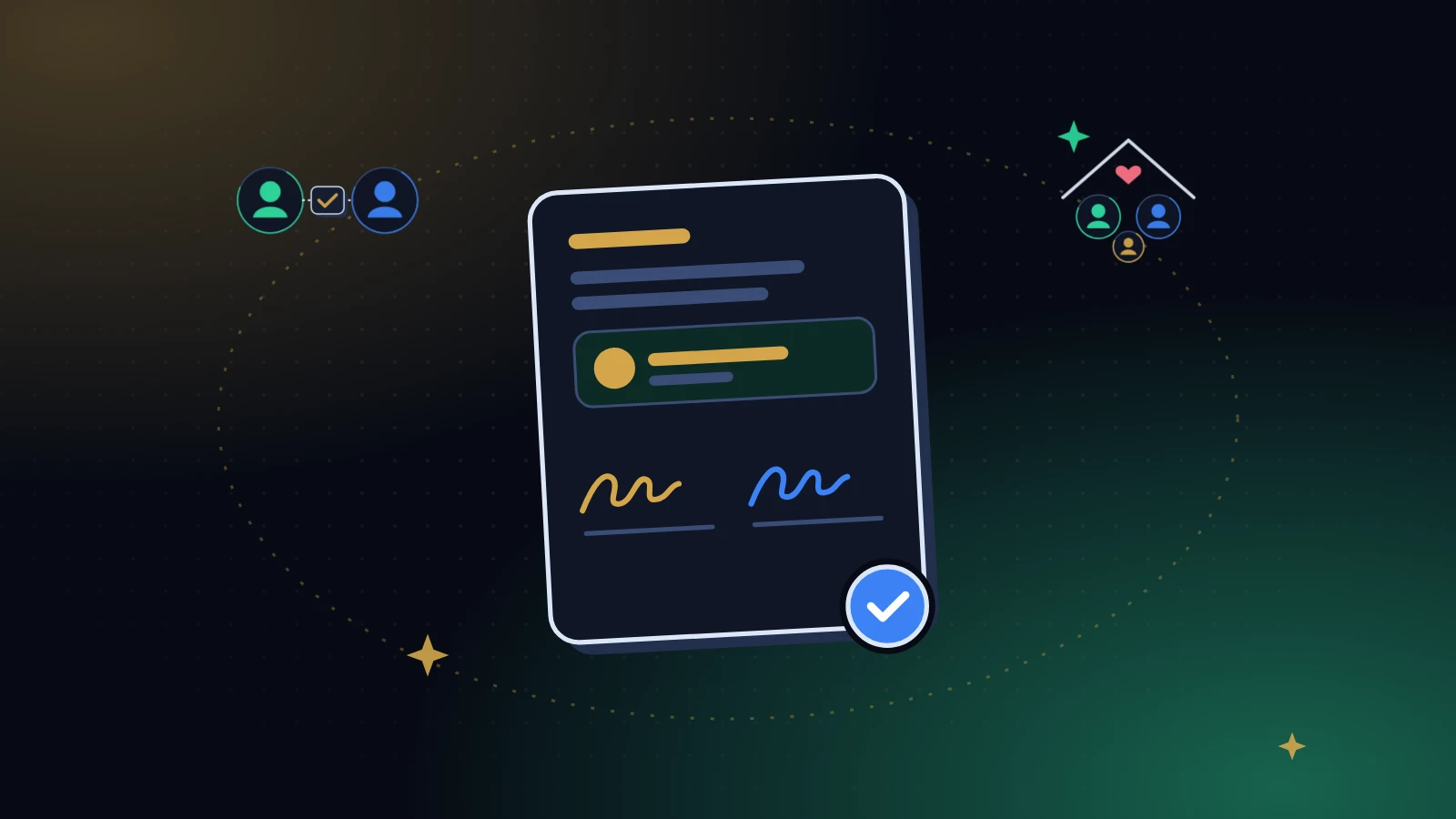
Most IOUs get one signature: the borrower’s, scrawled at the bottom while the lender waits. It feels like enough. This is the story of a loan where it was not, and why we now think both people sign an IOU or nobody should call it finished. The names and numbers are an illustration, but the shape of the problem is very common.
The setup
Quinn and Ari have been friends since college. In October, Ari’s landlord sells the building and Ari needs $2,000 for a deposit on a new place. Quinn has it in savings and is happy to help. Over dinner they talk it through: no interest, Ari pays it back monthly, starting in January once a new job settles in. Ari writes “I, Ari Lindqvist, owe Quinn Hart $2,000, lent October 12, 2026, to be repaid monthly from January 2027,” signs it, and hands it across the table.
Chapter 1: The handshake version
Nothing about that dinner was careless. They were specific about the amount, the date and the start month. What they left vague was the one number that would matter most: how much each month. Quinn remembers saying “$200 each month should work, right?” Ari remembers “maybe $100 or $200, we’ll see what the new job pays.” Both memories are honest. Both are now on a single sheet with only Ari’s name at the bottom.
Here is the first lesson, and it is easy to miss. A signature does two jobs. It shows who agreed, and it shows what they agreed to at that moment. When only the borrower signs, the document proves Ari accepted the debt. It says nothing about whether Quinn accepted the same terms, or whether the terms were complete.
A single signature proves a debt. Two signatures prove a deal.
Chapter 2: The helpful edit
A week later, Quinn takes out the IOU to put it in a drawer and thinks, “We should have written the amount.” So Quinn adds a line in pen: “$200 monthly.” It feels like tidying up. Quinn genuinely believes that was the plan.
This is the moment the IOU quietly stops being a shared document. It now holds one line Ari signed and one line Ari never saw. If both people sign an IOU after every change, this kind of good-faith edit is impossible to make alone, because the other person’s signature would be missing from the new version.
Watch out
Never add to a signed IOU on your own, even to “clarify” something you both discussed. To a stranger, a one-sided addition after signing looks like an alteration. Write a new note and have both people sign and date it instead.
Chapter 3: April
January and February go fine. Ari sends $100 each time, and Quinn, slightly puzzled, says nothing. In March, Ari pays $100 again. In April, Quinn finally asks.
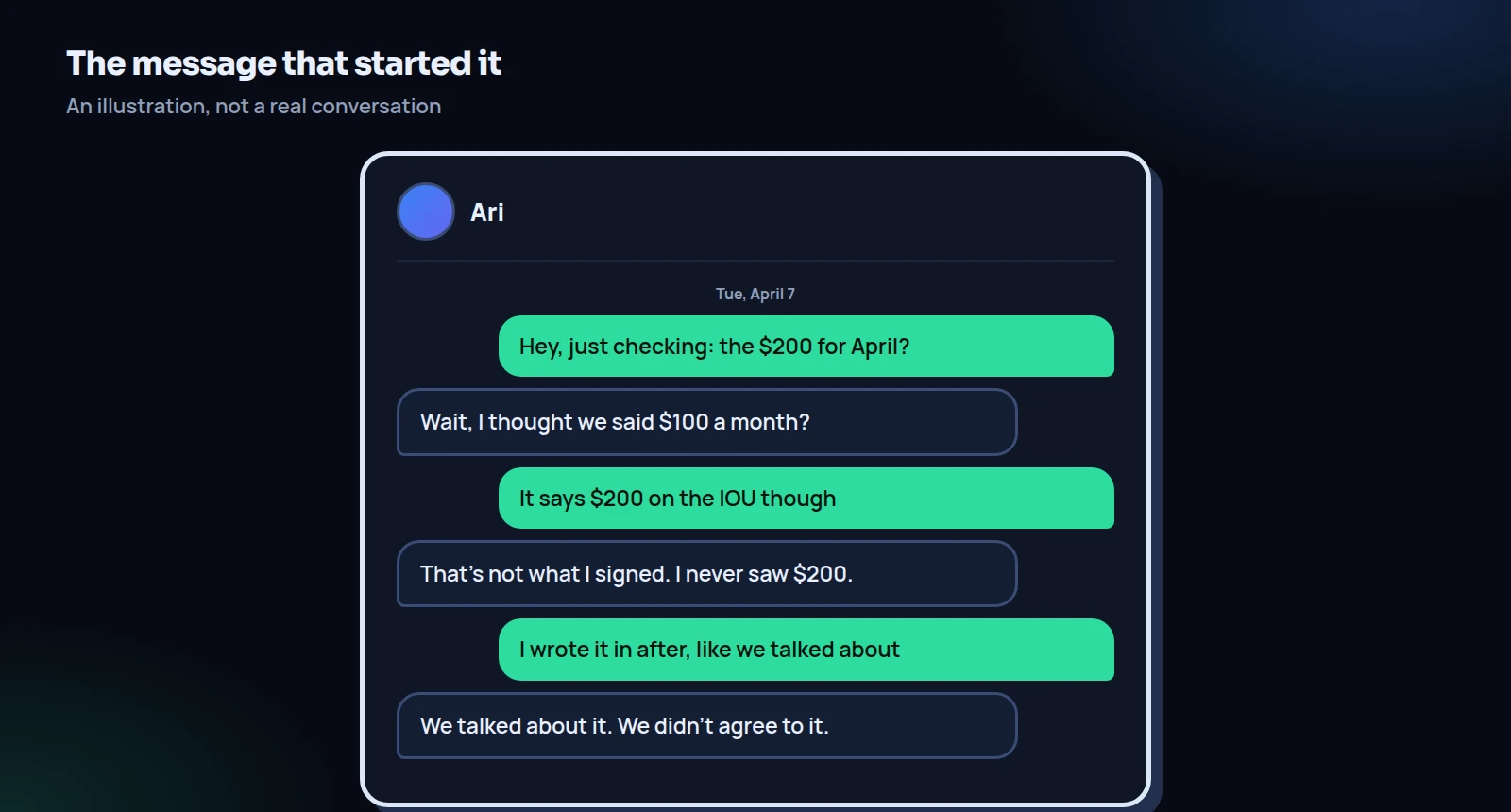
Look at Ari’s last line. It is not a dodge. Ari is pointing at something true: there was a conversation, not an agreement. Quinn is also right that $200 was mentioned. The IOU cannot settle it, because only one of them signed it, and the line in question was added after that signature.
Lesson: why both people sign an IOU when only one has to
Legally, the borrower’s signature is the essential one. The rule known as the statute of frauds, which requires certain contracts to be in writing, focuses on the signature of the person being bound, and for a loan that is the borrower. So why bother asking the lender to sign?
Because the lender’s signature does practical work that the borrower’s cannot:
- It freezes a version. Two signatures on the same page, each dated, show that both people saw that exact text at that time. Anything added afterward is visibly outside the deal.
- It shows the lender accepted the terms. If the IOU says $100 each month, the lender’s signature shows they agreed to $100, not $200.
- It covers the lender’s promises. Many IOUs include something the lender agrees to, like “no interest,” “early repayment allowed” or “we will agree a new date if a payment is late.” Those promises mean more when the lender has signed them.
- It changes the conversation. Asking “can we both sign this?” invites the borrower to read it properly, which is when vague numbers get noticed.
That last point is the one that would have saved Quinn and Ari. When both people sign an IOU, both people read it. Ari, reading the document as a co-signer rather than handing it over, would very likely have said, “Wait, how much each month?”
Chapter 4: How they fixed it
Quinn and Ari did the grown-up thing, which was also the awkward thing. They met for coffee and wrote a new note. It referred to the original IOU, recorded the $300 Ari had already paid, and set out the rest: $1,700 remaining, paid at $150 on the 5th of each month (two days after Ari’s payday) from May, with a final payment of $50. Both signed. Both dated. Both took a photo of the page before leaving, so each had an identical signed copy.
The new note, in their words
“This replaces the payment terms of the IOU dated October 12, 2026. Ari has repaid $300 so far. The remaining $1,700 will be paid as $150 on the 5th of each month from May 5, 2027, with a final payment of $50 on April 5, 2028. No interest. Any change will be written and signed by both of us.” Signed: Ari Lindqvist, Quinn Hart. Dated: April 12, 2027.
Quinn did not get $200 each month. Ari did not get to keep it at $100 forever. They met in the middle, and the new document said so with both names on it. That is all a good agreement needs to do. If you are in a similar spot, our guide to changing the terms of an IOU fairly walks through it step by step.
What each signature proves, side by side
It helps to see the three possibilities laid out next to each other. The table below uses Quinn and Ari’s loan, and asks what a stranger, such as a mediator or a small claims judge, could reasonably conclude from the paper alone.
Worked example: one IOU, three ways of signing it
| Who signed | What it shows | What it leaves open |
|---|---|---|
| Borrower signature only | Ari accepted a $2,000 debt to Quinn on October 12 | Whether Quinn agreed to the same terms, and whether any line was added later |
| Lender signature only | Quinn’s version of the deal | Almost everything: it does not show Ari accepted any of it |
| Both, on one page, each dated | The debt, the terms, and that both accepted that exact text on those dates | Only what happens after, which payment records answer |
The middle row is the trap people forget. A note signed only by the lender is just the lender’s notes. It can still help as a record of what the lender believed, but it does not bind the borrower to anything.
Notice what the bottom row does to the April conversation. With both signatures on the original, either “$200 each month” would have been on the page when both signed, or it would not. There would have been nothing to argue about except whether to change it, which is a much friendlier conversation than “you changed it.”
Why the borrower benefits too
It is tempting to think that having both people sign an IOU is protection for the lender alone. In this story, the person who most needed the lender signature was Ari. Ari’s position was “I never agreed to $200,” and the only way to prove a negative like that is a signed copy showing what the agreed version actually said. A borrower who asks the lender to sign is protecting themselves from exactly the kind of well-meant edit Quinn made.
The same goes for anything the lender promises. “No interest,” “early repayment allowed,” “we will agree a new date if you are short” are all promises that run in the borrower’s favor. A borrower signature alone does not hold the lender to any of them.
Lesson: how to ask without sounding suspicious
Agreeing that both people sign an IOU is easy in theory. The hard part is rarely the signing. It is asking for it without implying “I do not trust you.” The trick is to make the second signature about protecting both of you, not about checking up on one of you.
Message: asking for both signatures
Before I send the money, can we both sign the note? That way we’re looking at the same numbers and neither of us has to remember them. I’ll sign first if that’s easier.
If they hesitate: Totally fair. It’s as much for you as me. It means I can’t change the terms either.
Offering to sign first helps. So does pointing out that the lender’s signature limits the lender too. If you are on the borrowing side, you can raise it yourself: “Can you sign it as well, so we both have the same version?” Borrowers who ask for that tend to come across as organized, not difficult.
When both people sign an IOU on their phones
The same logic applies when the IOU is electronic. Electronic signatures are generally valid under the federal ESIGN Act and state laws based on the Uniform Electronic Transactions Act, so signing on two phones can work as well as signing one sheet of paper. The difference is that apps can enforce the habits Quinn and Ari learned the hard way.
In IOUEZ, a shared agreement is not complete until both people have signed it, each from their own account. Each signature is stored with a name and date. Once both have signed, the amount, interest and due date are locked, so nobody can add “$200 monthly” a week later. Payments are recorded against the agreement, so the $100 versus $200 question would have shown up in January rather than April. More on the legal side in electronic signatures for personal loans.
Lesson: when both people sign an IOU, sign the same thing
One last trap. “Both people signed” only helps if they signed the same document. Two separate copies, each signed by one person, can drift apart just as easily as Quinn’s pen edit. Sign one version, then copy it. On paper, that means one sheet with two signatures, photographed before anyone leaves. Electronically, it means one agreement that both people sign, not two files emailed back and forth.
And when terms change later, the rule repeats: both people sign the change. That one habit covers most of what can go wrong. If you want the full list of details worth including, the IOU details that matter goes through dates, amounts and witnesses one at a time.
Key takeaways from Quinn and Ari
- One signature proves the debt; two signatures prove both people accepted the same terms.
- When both people sign an IOU, both read it, which is when vague numbers get caught.
- Never edit a signed IOU alone. Write a new note and both sign and date it.
- Sign one version, then copy it, so there is never a “your copy” and “my copy.”
- Ask for the second signature as protection for both, and offer to sign first.
Frequently asked questions
Is it legally required that both people sign an IOU?
Usually not. The borrower’s signature is the key one, because the borrower is the person taking on the debt. The lender’s signature is a strong practical safeguard: it shows both people accepted the same terms at the same time.
What if the borrower signed and the lender did not?
The IOU can still be good evidence of the debt. If the terms are clear and nobody disputes them, you may be fine. If there is any doubt, write a short follow-up note confirming the terms and have both people sign and date it.
Should both people sign an IOU even for small amounts?
For anything you would be upset to argue about, yes. It takes seconds. For a $20 lunch, a text that says “owe you $20, paying Friday” is plenty.
Can I add details to an IOU after it was signed?
Not on your own. Additions made by one person after signing look like alterations to anyone else. Write a new dated note that both people sign, and keep the original with it.
Do electronic signatures count when both people sign an IOU on their phones?
Generally yes, under the federal ESIGN Act and state electronic transaction laws, as long as each person intended to sign. Sign from your own device and account so it is clear who signed what.
Does a witness replace the lender’s signature?
No. A witness can confirm that the borrower signed, but only the lender’s own signature shows that the lender agreed to the terms. For most personal loans, two signatures matter more than a witness.
Sources
- Legal Information Institute, Cornell Law School, Statute of frauds (Wex), on contracts that must be in writing and signed by the party to be bound.
- Legal Information Institute, Cornell Law School, 15 U.S. Code § 7001, General rule of validity (ESIGN Act).
- Uniform Law Commission, Electronic Transactions Act, the uniform state law on electronic records and signatures.
- Legal Information Institute, Cornell Law School, Pre-existing duty doctrine (Wex), background on how changes to existing agreements are treated.