“Don’t worry about it” and “pay me back whenever” sound almost the same when you say them. Six months later they mean completely different things. When money moves between family members, the most useful thing you can do is decide whether it is a gift or loan before it leaves your account, and then say so in words nobody can misremember.
| Gift | Loan | |
|---|---|---|
| Comes back? | No, and nobody should expect it to | Yes, on dates you both agreed |
| Paperwork | Optional; a short note helps | A signed agreement and a payment record |
| Follow-up | None | Reminders and recorded payments |
| Federal gift tax | Not a taxable gift up to $19,000 per person in 2026 | Usually none; large interest-free loans can have gift elements |
| If it is never repaid | Nothing changes | May be a deductible bad debt if you can show it was a real loan |
| Mortgage lender’s view | Allowed for some loans with a signed gift statement | Counts as a debt the borrower owes |
| Best when | You can spare it and do not want it back | You need it back, or it is too large to give |
The problem with “sort of a loan”
The trouble rarely comes from a clear gift or a clear loan. It comes from the in-between. A parent hands over money and says “we’ll figure it out later.” The child hears “it’s a gift, but be grateful.” The parent means “pay it back when you’re settled.” Neither is wrong about what they heard, and both are now holding different versions of the same event.
Then something changes. The parent retires and needs the money. A sibling asks for the same help and wants to know if it was a gift or loan for their brother. The child buys a new car and the parent wonders why the old “loan” never came up. All of it is avoidable with one sentence on day one.
Example
Noor gives their adult child Kai $6,000 toward a used car after Kai’s old one dies two weeks into a new job. Noor says, “Don’t stress about paying it back fast.” Kai hears “it’s a gift.” Eighteen months later, Noor’s furnace fails and they mention, carefully, that the $6,000 would help. Kai is stunned. Nobody lied. Nobody said whether it was a gift or loan. This scene is an illustration, but it is the most common shape of family money trouble.
When a gift is the better choice
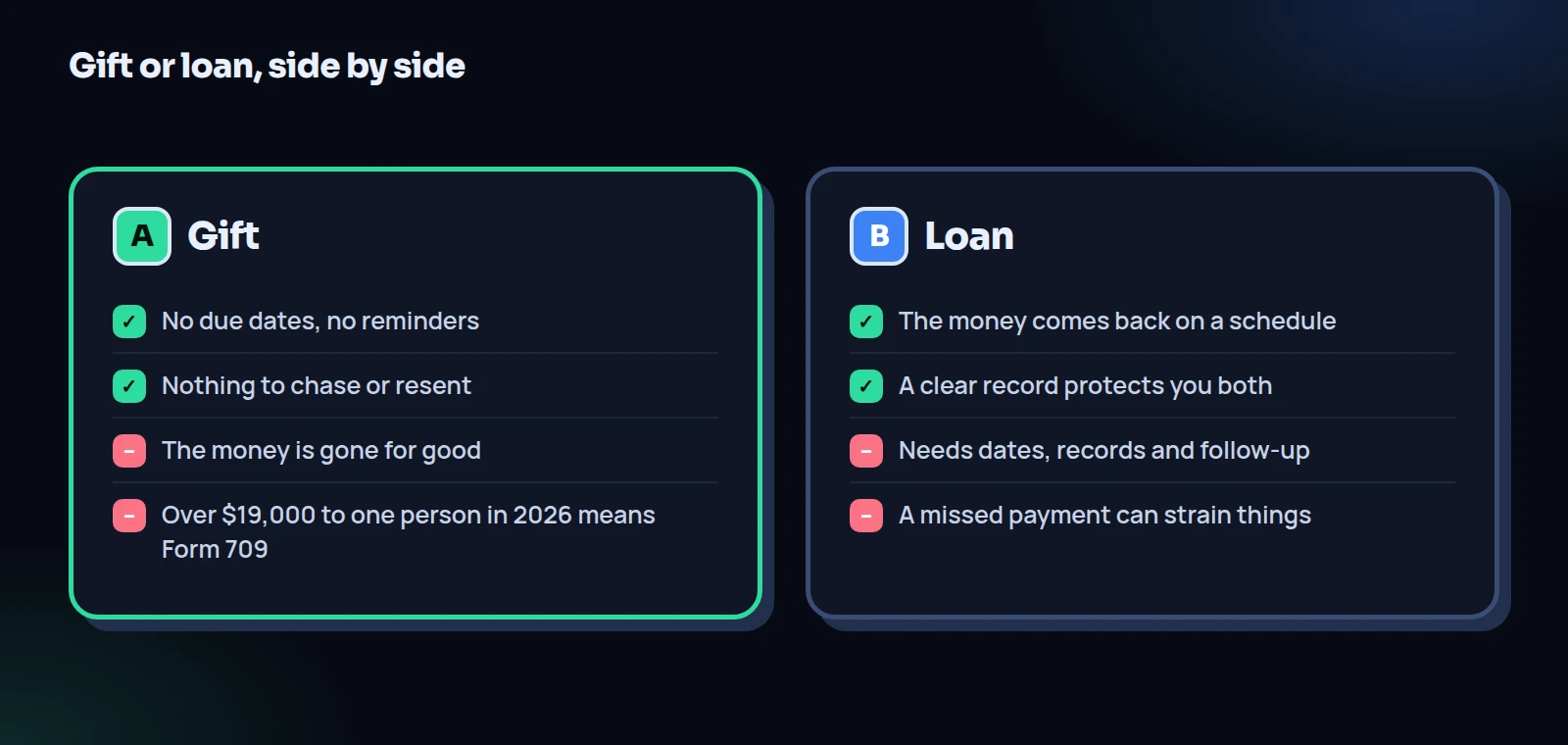
A gift is the simpler and often kinder option when you can genuinely spare the money. There is nothing to track, nothing to remind anyone about, and no slow build-up of awkwardness if a payment is late. For a parent helping an adult child, a grandparent helping with tuition, or anyone helping with a one-time crisis, a gift is often the right answer.
Why a gift works
- No due dates, no reminders, no chasing.
- The recipient owes nothing, so there is nothing to resent.
- Under federal rules, the person receiving a gift generally does not owe income tax on it.
- Easy to describe in one sentence.
What to accept first
- The money is gone for good, even if your situation changes.
- Other family members may expect the same.
- Large gifts can mean filing a federal gift tax return.
- You give up any say in how it is spent.
The test is simple: if you would be fine never seeing this money again and never mentioning it, it is a gift. Call it one.
When a loan is the better choice
A loan makes sense when you need the money back, when the amount is too large to give away, or when the person receiving it would genuinely prefer to repay. Some people feel better borrowing than receiving charity, and that is worth respecting.
A loan only works if it is treated as one: an exact amount, a repayment schedule, both people signing, and a record of each payment. Without those, a loan slides back toward “sort of a loan.” Our personal loan agreement template covers the clauses; should you lend money to family? helps with the decision itself.
Where the rules care about gift or loan
For everyday amounts, the distinction mostly matters to your relationship. A few rules do care about the difference, and it helps to know them before you choose.
The annual gift tax exclusion
The IRS says that for 2026 you can give up to $19,000 to any one person without it being a taxable gift. Above that, you generally file Form 709, a gift tax return. Filing is not the same as paying: the IRS sets a much larger lifetime basic exclusion amount, $15,000,000 for 2026, before any gift tax is actually due. The giver, not the recipient, is generally responsible for gift tax.
Interest-free loans
A loan is not a gift just because it has no interest, but large interest-free loans can contain a gift. IRS Publication 550 explains that the below-market loan rules generally do not apply to gift loans between individuals on any day the total outstanding is $10,000 or less, as long as the money is not used to buy income-producing assets. Above that line, talk to a tax professional.
Forgiving a loan later
The IRS lists forgiving a debt among the transfers the gift tax can apply to. So if you lend $6,000 and later forgive it, that becomes a $6,000 gift, comfortably under the annual exclusion. For the borrower, IRS Topic 431 lists amounts canceled as gifts among the exceptions to canceled-debt income.
A loan that never comes back
If a real loan goes unpaid, you may be able to deduct it as a nonbusiness bad debt. IRS Topic 453 is blunt about family loans: you must show that, at the time, you intended a loan and not a gift, and if you lent to a relative or friend with the understanding they may not repay it, it is a gift. A signed agreement made on day one is exactly how you show intent.
The mortgage gift letter
This is where gift or loan stops being a feeling and becomes paperwork. If a family member is helping with a down payment, the mortgage lender will want to know which it is, because a loan is a debt the buyer has to repay and a gift is not.
The Consumer Financial Protection Bureau explains that for some loans, gifts can be used toward a down payment as long as you can show where the money came from and provide a signed statement that it is a gift and not a loan. That signed statement is usually called a gift letter. The CFPB also notes that some loan types do not allow gift funds, so the buyer should ask their lender early.
Watch out
Never sign a gift letter for money you actually expect to be repaid. Calling a loan a gift on mortgage paperwork misleads the lender. If you want it back, tell the lender it is a loan and let them work out what that means for the application.
Say it out loud: exact words
Whichever you choose, gift or loan, say it in plain language, and then put it in writing. Text is fine for a gift. A loan deserves a signed agreement.
Message: making it a gift
I want to give you $6,000 toward the car. This is a gift, not a loan. Please don’t pay me back, and please don’t feel like you owe me anything. I’m just glad I can help.
Message: making it a loan
I’m happy to lend you $6,000 for the car. I will need it back, so let’s agree a schedule that fits your paycheck, maybe $250 each month starting in March. I’ll write it up so we’re both looking at the same thing, and we can both sign it.
The second message is not cold. It is generous and clear at the same time. In IOUEZ, Noor could create that agreement, Kai could review and sign it on their own phone, and both would see each payment reduce the balance. Reminders before each due date mean Noor never has to raise the subject.
A one-paragraph gift note
For larger gifts, or any gift where you want a record without the formality of a mortgage gift letter, a short signed note settles it. Keep a copy each.
Template: simple gift note
GIFT NOTE

On [date], I, [giver's full name], gave
[recipient's full name] $[amount] by [method].

This money is a gift. It is not a loan, and I do
not expect it to be repaid in any form.

Giver:     ______________________  Date: ________
Recipient: ______________________  Date: ________
If a mortgage lender is involved, use their gift letter form instead; they usually have one with the specific details they need.
A middle path: say both, on purpose
Some families want something between a pure gift or loan, and that is fine as long as the in-between is written down. Two arrangements work well because each one has a clear rule.
A loan with planned forgiveness. Noor lends Kai $6,000 with a schedule of $250 each month, and agrees in writing that whatever is still owed after two years will be forgiven. Kai has a real reason to pay, Noor gets a good part of the money back, and nobody wonders what happens at the end. Each year’s forgiven amount counts as a gift, which for most families sits far under the annual exclusion.
A split. “Half of this is a gift, half is a loan.” Kai receives $6,000, owes $3,000 on a schedule, and the other $3,000 is never mentioned again. It sounds fussy. In practice it is a very clear way to be generous and careful at the same time.
What does not work is a third option nobody names. “We’ll see” is not a middle path. It is the “sort of a loan” from the top of this page, waiting for a furnace to break.
Changing your mind later
Turning a loan into a gift is easy and often lovely. Say it clearly, in writing: “I’ve decided to forgive the rest of the car loan, $3,500. You don’t owe me anything more.” Close the loan in your records so it does not resurface. If the amount is large, remember the forgiven balance counts toward that year’s gift exclusion.
Turning a gift into a loan is the one move that rarely works. If you called it a gift, the other person made decisions based on that. If your circumstances change and you need help, ask for help openly rather than reclassifying the past. And if a loan you made is stuck, our options for when a friend can’t pay you back apply to family too.
Pick a gift if… pick a loan if…
If you are still torn between a gift or loan, these are the situations where each one wins.
Pick a gift if you could spare the money without touching your emergency savings, you do not want to track or remind, the recipient is in a crisis where repayment would add stress, or a mortgage lender needs gift funds and you truly do not expect anything back.
Pick a loan if you need the money back by a certain date, the amount is too large to give away comfortably, the other person would rather repay, or you are helping several family members and want to keep things even. If you are not sure how large is too large, work out how much money to lend with your own numbers first.
And if you honestly cannot decide whether it should be a gift or loan, that is your answer for now: wait a day before the money moves.
Frequently asked questions
How do I decide between a gift or loan for family?
If you would be fine never seeing the money again, make it a gift and say so. If you need it back or the amount is large, make it a loan with a written schedule both of you sign.
Do I have to pay tax if I give my child money?
Gifts up to $19,000 per person in 2026 are not taxable gifts. Above that you generally file Form 709, but tax is usually due only after the much larger lifetime exclusion is used up.
Does the person receiving a gift pay tax on it?
Generally no. The IRS says the giver is responsible for any gift tax, and a gift is not usually income for the person who receives it.
Can a gift or loan from family affect my mortgage application?
Yes. A lender treats a loan as a debt you owe, and gift funds usually need a signed gift letter and proof of where the money came from. Tell your lender which it is early.
What is a gift letter?
A signed statement, usually for a mortgage lender, saying the money is a gift and not a loan. The CFPB notes that some loans allow gift funds with this kind of statement and proof of where the money came from.
Can I forgive a loan and call it a gift?
Yes. Say it in writing and close the loan. Forgiving a debt can count as a gift for federal tax purposes, so larger amounts count toward the annual exclusion.
Is an interest-free family loan secretly a gift?
Not for most everyday amounts. Under IRS rules, gift loans between individuals of $10,000 or less generally fall outside the below-market loan rules. Larger ones can include a gift element.
Sources
- Internal Revenue Service, Frequently asked questions on gift taxes, the $19,000 annual exclusion and $15,000,000 basic exclusion for 2026, forgiving a debt, who pays.
- Internal Revenue Service, Gifts & inheritances, gift tax responsibility of the giver.
- Internal Revenue Service, Publication 550 (2025), Investment Income and Expenses, below-market loans and the $10,000 exception.
- Internal Revenue Service, Topic no. 431, Canceled debt, amounts canceled as gifts.
- Internal Revenue Service, Topic no. 453, Bad debt deduction, loan versus gift intent for loans to relatives.
- Consumer Financial Protection Bureau, Where can I get money for a down payment on a home?, gift funds and signed gift statements.