If you owe money in more than one place, the question isn’t just how much to pay but where to send each extra dollar. The two best-known answers are the snowball and the avalanche. Snowball vs avalanche comes up in almost every conversation about getting out of debt, and the usual summary (“avalanche saves money, snowball feels better”) is true but incomplete, especially when one of the debts is to a friend.
| Debt snowball | Debt avalanche | |
|---|---|---|
| Extra money goes to | Smallest balance first | Highest interest rate first |
| Total interest | Usually higher | Usually lowest |
| First debt paid off | Sooner | Often later |
| Best for | People who need early wins | People motivated by the math |
| In our example | $605.30 interest, 13 months | $469.31 interest, 12 months |
The ground rules both methods share
Snowball and avalanche agree on almost everything. List every debt with its balance, interest rate and minimum payment. Pay the minimum on all of them, every month, without fail. Then take whatever extra you can find and put it toward one debt at a time. When that debt is gone, add its whole payment to the next one.
That rolling-over step is the engine of both methods. Each paid-off debt frees up its payment, so the amount aimed at the next target keeps growing. The only real disagreement is the order of the targets.
The CFPB describes both approaches in its guidance on reducing debt: the snowball focuses on your smallest debt so you see progress quickly, while the highest-interest-rate method can save you money in the long run but may not feel like progress for a while. That’s the trade-off in one sentence. The rest of this article puts numbers on it.
Step zero: build your list
Before you can compare snowball vs avalanche for your own debts, you need an honest list. Pull up the latest statement for every card and loan and write down three numbers for each: the current balance, the interest rate (the APR on a card statement), and the minimum payment. For money owed to friends or family, the “rate” is usually 0% and the “minimum” is whatever you agreed.
Watch for two things while you’re at it. First, promotional rates: a card at 0% today may jump to a much higher rate when the promotion ends, so note the end date. Second, debts you’ve been avoiding looking at. They count too, and leaving them off the list means the plan is built on the wrong numbers.
Then work out your monthly debt budget: all the minimums added together, plus a fixed extra amount you can commit to every month. That extra amount is the fuel for both methods. Even $50 makes a difference, and a focused 30-day push can find more.
Meet the example: Casey’s three debts
Here’s an illustration. Casey owes money in three places and has worked out that they can put $506 each month toward debt: the $256 of minimum payments plus $250 extra.
Casey’s debts at the start
| Debt | Balance | Interest rate | Monthly minimum |
|---|---|---|---|
| Loan from their friend Lee | $900 | 0% | $100 (agreed) |
| Personal loan | $1,500 | 11% APR | $60 |
| Credit card | $3,200 | 22% APR | $96 |
To keep the math clear, we charge each month’s interest as the yearly rate divided by 12 on the balance, keep minimums fixed, and assume no new spending on the card. Real cards recalculate minimums and interest daily, so actual numbers will differ a little.
How the debt snowball plays out
The debt snowball lines up debts from smallest balance to largest, ignoring interest rates: Lee’s $900, then the $1,500 personal loan, then the $3,200 card.
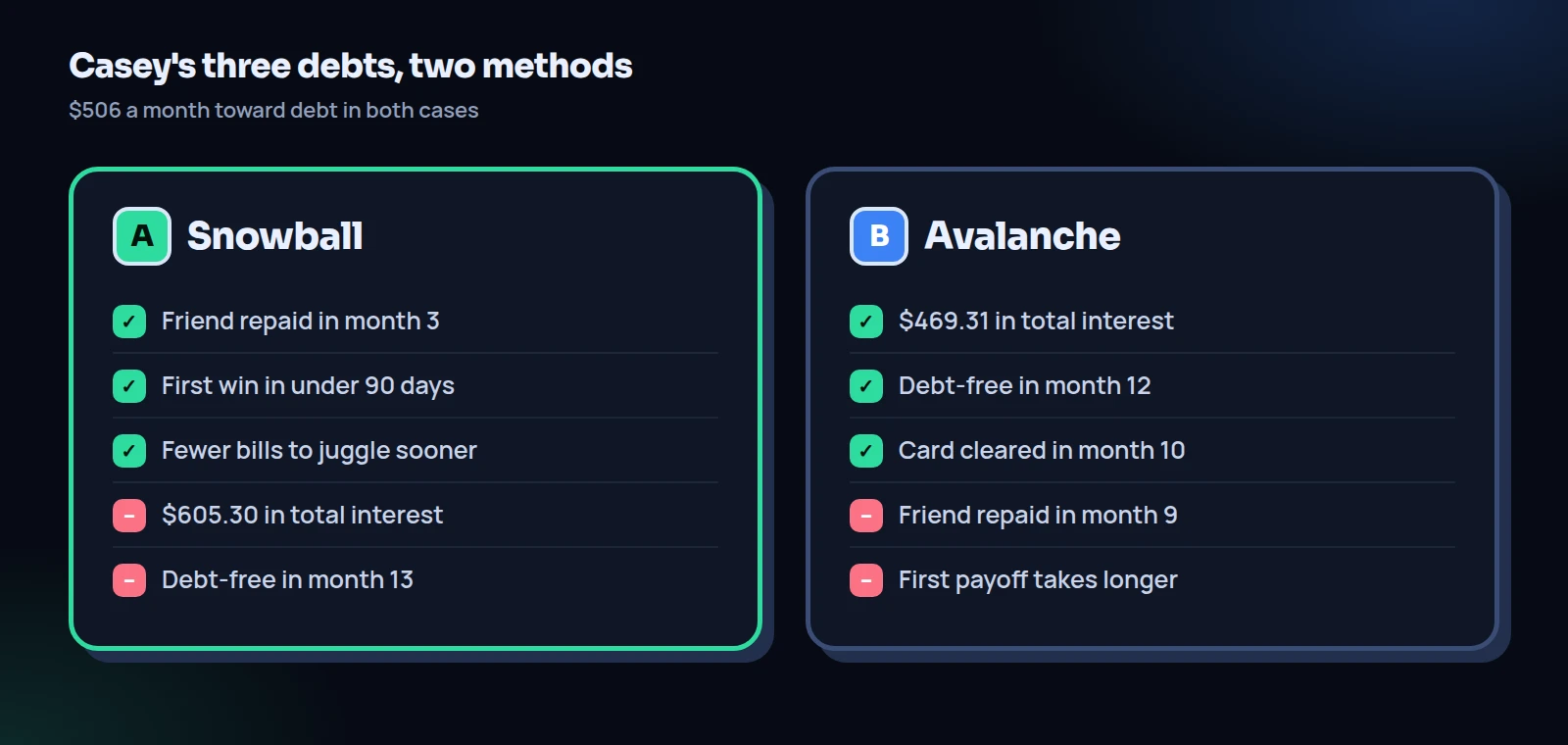
- Months 1–3: Casey pays the minimums on the loan and card and sends everything else to Lee: $350 in months one and two, then the last $200. Lee is fully repaid in month 3.
- Months 3–7: Lee’s payment rolls onto the personal loan, which gets $410 each month and is cleared in month 7.
- Months 7–13: The whole $506 hits the credit card, which finally reaches zero in month 13 with a last payment of $133.30.
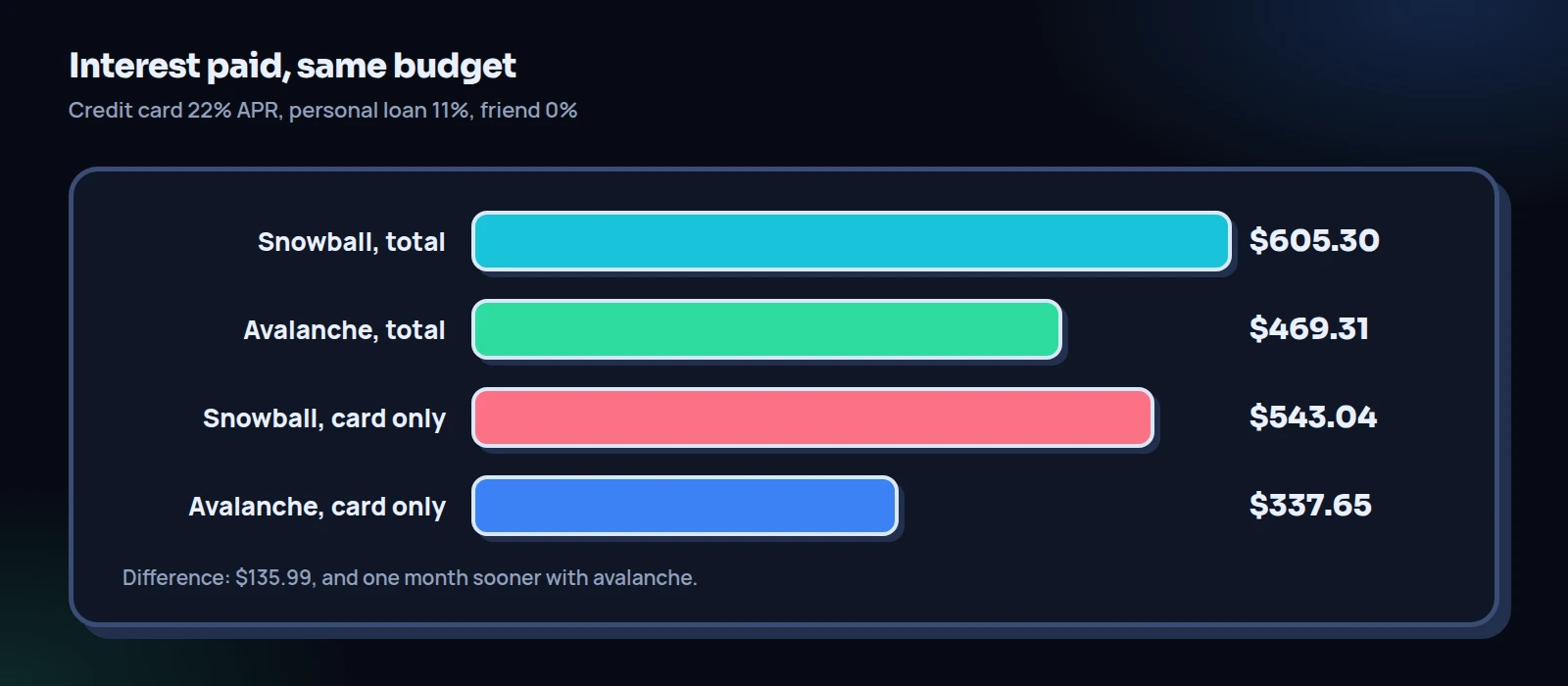
Total interest paid: $605.30. Most of that, $543.04, is credit card interest, because the card sat near its full balance for six months while Casey cleared the smaller debts.
How the debt avalanche plays out
The debt avalanche orders debts by interest rate, highest first: the 22% card, then the 11% personal loan, then Lee’s 0% loan.
- Months 1–10: Casey keeps paying Lee $100 and the personal loan $60, and sends $346 each month to the card. The card is cleared in month 10.
- Month 9: Lee is repaid on schedule, just through the agreed $100 each month.
- Months 10–12: Everything rolls onto the personal loan, which is gone in month 12.
Total interest paid: $469.31. That’s $135.99 less than the snowball, and Casey is debt-free a month sooner.
Snowball vs avalanche: what the numbers actually say
On paper, the avalanche wins, and it nearly always will, because it attacks the debt that grows fastest. The size of the win depends on how far apart your interest rates are and how big the expensive balances are. With a 22% card and a 0% friend loan, the gap is large. If all your debts charged similar rates, the two methods would land within a few dollars of each other.
It’s also worth looking at the middle of the journey. After six months, snowball-Casey owes $2,967.73 in total and avalanche-Casey owes $2,911.09. The totals are within $57 of each other. What’s very different is the shape: the snowball has one debt left (plus $2.24 on the personal loan), while the avalanche still has all three open. Same money, very different feeling when you open your banking app.
But the numbers also show what the snowball buys. Under the snowball, Casey’s first debt is gone in month 3. Under the avalanche, Casey waits until month 9 for the first payoff and month 10 for the card. For six months, avalanche-Casey sees three balances that are all still open, and that’s where many plans quietly stall.
Where a friend loan changes the picture
Most snowball vs avalanche comparisons only include cards and bank loans. Real life often includes a parent, a sibling or a friend. A 0% friend loan always goes last in the avalanche, because it costs nothing. Financially, that’s correct. Socially, it can be a problem.
Money owed to a friend carries costs that don’t show up on a statement: the awkward pause when they mention their own bills, the reluctance to meet up, the sense that they’re quietly waiting. Paying Lee back in month 3 instead of month 9 cost Casey $135.99 in extra interest. For some people that’s a bargain. For others, the friend is perfectly relaxed and the $135.99 is better spent elsewhere.
Tip
If a friend loan is in your list, ask them how they feel about the timeline before you choose. “I can pay you back by March, or by summer if I clear my card first. Does either matter to you?” Their answer settles the question better than any formula.
Whatever you choose, keep every agreed payment to your friend on schedule. Both methods above do. Skipping a friend’s payment to throw more at a card is the one move we’d never make; the interest you save isn’t worth the trust you lose. If you’ve already missed one, our playbook on restarting repayments after a missed payment covers how to fix it.
The case for the snowball
Why people choose it
- A visible win in weeks, not months
- Fewer accounts to track sooner
- Easier to stick with if motivation is the weak point
- Clears small personal debts, like money owed to friends, early
What it costs
- More total interest when rates differ a lot
- Expensive balances sit untouched for longer
- Can take longer to be fully debt-free
If you’ve started and abandoned debt plans before, the snowball’s early wins may be worth more than the interest it costs. A plan you finish beats a better plan you quit.
The case for the avalanche
The avalanche is the efficient choice. If you’re the kind of person who’s motivated by watching total interest drop, or your highest-rate debt is also large and growing, it’s hard to argue with. It also keeps you focused on the debt that’s actively getting more expensive every month.
The risk is patience. If your most expensive debt is also your biggest, months can pass without anything being fully paid off. One way to keep going: track the total you owe across all debts, not individual balances, and watch that single number fall every month.
A middle path
You don’t have to be a purist. Some people clear one small balance first for a quick win, then switch to the avalanche for the rest. With Casey’s numbers, that would mean repaying Lee early, then going straight for the card. Others use the avalanche but pay a friend loan a little faster than agreed as a goodwill gesture.
The best payoff method is the one you’re still following in month nine.
What matters most is the part both methods share: every minimum paid on time, a fixed extra amount every month, and every freed-up payment rolled into the next debt instead of back into spending.
If there’s no extra money at all
Both methods assume you can put something beyond the minimums toward debt. If you can’t, the first job is different: make sure every minimum is paid on time, and talk to the people you owe before you fall behind. The FTC’s advice on getting out of debt is to contact creditors as soon as payments become hard, explain the situation, and try to work out a modified plan that lowers payments to a manageable level.
The same applies to a friend. A message before the due date (“I can do $50 this month instead of $100, and I’ll add the difference at the end”) keeps a friend loan healthy while you get the rest under control.
Watch out
Be careful with companies that promise to settle or wipe out your debts for an upfront fee. The FTC warns that only scammers ask you to pay before they’ve settled any of your debts. Reputable nonprofit credit counselors can help you build a budget and a repayment plan, often for free or a small fee.
Keeping track while you pay
Whichever method you pick, the plan only works if you can see it working. Once a month, on the same day, update every balance on your list and note what was paid. Watching Casey’s total drop from $5,600 to $5,166.42 after one month and $4,731.73 after two is motivating, and it catches mistakes early, like a payment that didn’t go through.
For money owed to people rather than banks, record each payment with its date and amount so both of you see the same balance. If the loan is set up in IOUEZ, you log each payment and the remaining balance updates for both of you, which saves a lot of “wait, how much is left?” texts.
Snowball vs avalanche: pick this if…
- Pick the snowball if you’ve quit plans before, you have several small balances, or one of your debts is to someone you see every week and it’s weighing on you.
- Pick the avalanche if your interest rates are far apart, your highest-rate balance is large, and you’re motivated by total interest saved.
- Pick a hybrid if you want one early win and then the efficient path, or a friend has told you their timeline matters.
If you’re juggling debts to several people rather than banks, our decision guide on what to do when you owe money to several people covers the personal side in more depth. To find extra money for either method, the 30-day plan to pay back a friend faster has practical ideas, and the loan calculator shows how extra payments change any single debt.
Frequently asked questions
Snowball vs avalanche: which saves more money?
The avalanche, almost always, because it pays down the highest-interest debt first. In our example it saved $135.99 and finished a month sooner. The gap is small when your interest rates are similar.
Which is faster?
The avalanche usually finishes slightly sooner overall, but the snowball pays off its first debt much faster. In our example, the first debt was gone in month 3 with the snowball and month 9 with the avalanche.
Where does money I owe a friend fit in?
An interest-free friend loan goes last in the avalanche and often first in the snowball. Keep making the agreed payments either way, and ask your friend whether the timeline matters to them.
Should I stop paying minimums to speed things up?
No. Both methods depend on paying every minimum on time. Missed minimums usually add fees and can damage your credit, which cancels out any progress.
Does the debt snowball work for money owed to family?
Yes, and many people like it for exactly that reason: small family loans get cleared early, which can ease tension. Just keep paying the minimums on everything else and agree the timeline with your relative.
Can I switch methods halfway through?
Yes. Many people start with the snowball for a quick win and switch to the avalanche. The important part is keeping the same extra amount going toward debt every month.
Sources
- Consumer Financial Protection Bureau, How to reduce your debt, describes the snowball and highest-interest-rate methods with their pros and cons.
- Consumer Financial Protection Bureau, Your Money, Your Goals: Reducing debt worksheet, a template for listing debts, rates and payments.
- Federal Trade Commission, How To Get Out of Debt, budgeting and contacting creditors when payments are hard to make.