A group trip budget is mostly decided before anyone packs. The trips that go wrong over money usually skipped one conversation ten weeks out, and then tried to have it in a rental car at 11 p.m. This plan walks through the whole thing in order: the private budget poll, deposits, rules, a kitty, a five-minute daily habit, and a settle-up that, in our example, ends with four small payments.
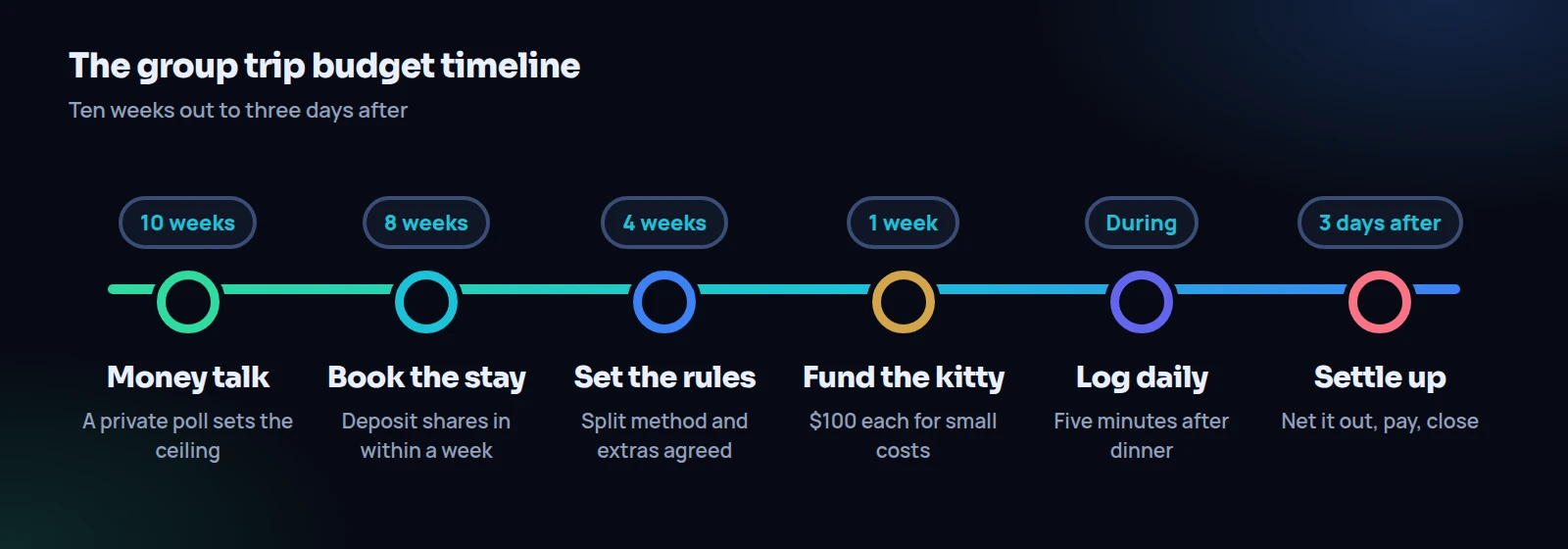
- 10 weeks before
The money talk. Everyone privately shares the most they can spend on shared costs. The lowest number becomes the ceiling.
- 8 weeks before
Book the place. Whoever books collects deposit shares from everyone within a week.
- 4 weeks before
Book activities and agree the split rules: what’s shared, what’s optional, who tracks.
- 1 week before
Fund a small travel kitty for groceries, rides and tips.
- Every day of the trip
Five minutes after dinner: log what was paid, by whom, for whom.
- Last night
Count the kitty, collect any missing receipts, refund leftovers.
- Within 3 days of getting home
Net everything out, send the payments, close the trip.
Our example trip
An illustration to keep things concrete. Alex, Riley, Jordan, Sam and Avery want four nights in New Orleans next March. They live in different cities and will each book their own travel to get there, so their group trip budget covers only what they’ll share once they arrive: lodging, group meals, activities and getting around town.
Five people, five incomes, five ideas of what “a reasonable trip” costs. Sam has been talking about a fancy dinner for months. Riley has just started paying off a car. Neither of them has said a number out loud.
10 weeks before: the money talk
The hardest part of any group trip budget is that the person with the tightest budget is usually the least likely to say so. Nobody wants to be the reason the trip got “cheap.” So don’t make them say it in front of everyone.
Run a private budget poll. One trusted person (or a simple anonymous form) collects one number from each person: the most they’re comfortable spending on shared costs for the whole trip, not counting their own travel. Only the lowest number gets shared with the group, and nobody learns whose it was.
Message: starting the budget poll
Before we book anything: can everyone DM me one number? The most you’d want to spend on shared stuff for the trip (house, group dinners, activities, rides), not counting flights or your own spending. I’ll only tell the group the lowest number, never who sent what. That becomes our ceiling.
If someone hasn’t replied after two days: Still need your number for the trip, no pressure on the amount. Even a rough one helps us book the right place.
In our example, the five numbers that come back are $1,200, $900, $1,000, $1,500 and $950. The ceiling is $900. Alex tells the group: “Our ceiling for shared costs is $900 each, so let’s plan for about $800 and keep a buffer.”
That last part matters. A group trip budget that uses every dollar of the ceiling will go over it; trips always cost a bit more than planned. Plan to around 90% of the ceiling.
Building the budget, line by line
With a ceiling of $900, the group fills in the shared costs. Here’s what they agree.
Worked example: the shared-cost budget
| Item | Group total | Per person |
|---|---|---|
| House, four nights | $2,000 | $400 |
| Breakfast groceries | $250 | $50 |
| Four group dinners (about $300 each) | $1,200 | $240 |
| Swamp tour and jazz club cover | $425 | $85 |
| Rides around town | $150 | $30 |
| Planned shared costs | $4,025 | $805 |
| Buffer, about 10% | $400 | $80 |
| Budget per person | $885 |
Check: $400 + $50 + $240 + $85 + $30 = $805, and $805 × 5 = $4,025. With the buffer, $885 sits under the $900 ceiling. Lunches, souvenirs and Sam’s fancy dinner are personal spending, outside this budget.
Notice what isn’t in there. Sam’s tasting-menu dream is still on, just as an optional extra for whoever wants it, paid by whoever goes. That’s the “equal base, opt-in extras” approach, and it’s how a group trip budget can include both the person on a tight month and the person who wants one big night. We compare it with four other methods in how to split trip costs.
When budgets are far apart
Sometimes the poll comes back with $600 and $3,000 in the same group. You can’t build one group trip budget that feels right to both, so don’t try. Build two layers instead.
The first layer is the shared core: a place to stay, a few group meals, one or two things everyone does together. Size it to the lowest number. The second layer is a menu of optional upgrades that people can join or skip with no explanation: the boat day, the spa, the restaurant with a dress code. The person with $3,000 to spend still has a great trip, and the person with $600 isn’t sitting alone at the house while everyone else is at the tasting menu, because the core plan already includes something good every day.
What we’d avoid: the person with the bigger budget quietly “covering” the difference for someone else without asking. It’s kind, but it changes the trip into a favor, and some people would rather pay their own way to a cheaper place. If you want to treat someone, say so plainly and let them accept or decline.
8 weeks before: book the place and collect deposits
Alex books the house: $2,000, paid in full on Alex’s card. From this moment Alex is lending the group $1,600, and nobody has said so.
Fix that the same day. Alex posts: “House is booked, $2,000 total. That’s $400 each. Can you send me your $400 by next Friday?” Deposit shares collected now mean Alex isn’t carrying a four-figure balance for two months, and anyone who was going to drop out finds out it’s real before the group plans around them.
Tip
Read the cancellation policy before you book, and share it with the group. If someone drops out after paying their share, you’ll need an agreed rule: do they get money back if the group finds a replacement? Decide now, while nobody is the one dropping out.
If one person can’t send their deposit share right away, write down a plan. Say Jordan can pay $200 now and $200 on payday in three weeks. Alex can set that up as an IOU in IOUEZ for the remaining $200, with one due date. Jordan signs it on their own phone, a reminder goes out before the date, and Alex doesn’t have to text “hey, about the house…” in the middle of the excitement.
4 weeks before: set the rules
Four weeks out, the group trip budget turns into bookings. Book the activities you need to reserve and agree the rules for money during the trip. Keep it to one short message that everyone answers with a thumbs-up:
- What’s shared: house, groceries, the four group dinners, rides, the tour, the jazz club.
- What’s optional: the tasting menu, the second bar, the extra museum. Paid by whoever goes.
- Who tracks: one person keeps the list (Riley volunteers, in exchange for never having to carry the cooler).
- How we pay as we go: dinners rotate between cards, small stuff comes from the kitty.
- When we settle: within three days of getting home.
Avery books the swamp tour for everyone ($55 each, $275 total). Jazz club covers will be paid at the door. Both go on the tracking list as “shared, everyone.”
1 week before: fund the travel kitty
The kitty is the part of the group trip budget you actually carry around.
A travel kitty handles the small, constant costs that are miserable to split one at a time: coffee runs, groceries, rideshares, tips for the tour guide. Each person sends $100 to Riley, the tracker, for a $500 kitty.
Keep it in a place that’s easy to spend from but not mixed with Riley’s own money. If it lives in a payment app balance, remember the CFPB’s warning that money held in a payment app may not have deposit insurance; it’s a good reason to keep the kitty small and empty it after the trip.
During the trip: the five-minute log
Every evening, after dinner, the tracker spends five minutes updating the list. Not a spreadsheet with formulas; just four columns: what, how much, who paid, who it was for. Everyone else sends a photo of any receipt they paid.
Here’s what the list looks like by the last night:
- House: $2,000, paid by Alex (deposit shares already collected), everyone.
- Dinners: Alex $310, Riley $280, Jordan $320, Sam $290, everyone. Total $1,200.
- Swamp tour: $275, paid by Avery, everyone.
- Jazz club: $150, paid by Sam at the door, everyone.
- Kitty: $400 spent on groceries ($250) and rides ($150). $100 left.
- Tasting menu: Sam and Avery, paid separately, not shared.
Watch out
If you travel abroad, card fees change the math. The CFPB describes a foreign transaction fee as a charge for purchases in a foreign currency or outside the US, and it’s usually a percentage. If one person’s card charges it and another’s doesn’t, agree whether the fee is shared or belongs to the cardholder, and agree one exchange rate for settling up.
The last night: count the kitty
Riley counts the kitty: $100 left. That’s $20 back to each person, sent before anyone gets on a plane. Then everyone checks the list for anything missing. It’s always the parking garage or the extra bag of ice.
The kitty is now settled: everyone put in $100 and got $20 back, so each paid $80 for groceries and rides. Since that’s equal, it drops out of the rest of the math.
Within 3 days: settle up
Now the main settle-up. Each person’s share of the shared costs (outside the kitty) is $400 house + $240 dinners + $85 activities = $725. Here’s who paid what, including the deposit shares collected eight weeks ago:
- Alex paid $2,000 for the house and $310 for a dinner, and received $1,600 in deposit shares. Net paid: $710. Owes $15.
- Riley paid $400 deposit share and $280 for a dinner: $680. Owes $45.
- Jordan paid $400 and $320: $720. Owes $5.
- Sam paid $400, $290 for a dinner and $150 at the jazz club: $840. Is owed $115.
- Avery paid $400 and $275 for the tour: $675. Owes $50.
Check: $15 + $45 + $5 + $50 = $115, exactly what Sam is owed. Four small payments, all to Sam, and the trip is closed. Because the big deposit was collected early, nobody is sending anyone hundreds of dollars after the trip. That’s the quiet win of doing things in this order.
For bigger groups or messier lists, netting balances first saves a lot of payments; we explain how in the guide to simplifying group debts. And for a full end-of-trip routine, from lost receipts to the friend who goes quiet, see settling up after a vacation.
How the group trip budget held up
Example
The final number for each person’s shared costs was $725 plus $80 from the kitty: $805, right on plan, with the whole $80 buffer unused. Riley, whose $900 had quietly set the ceiling, never had to say a word about the car payment. Sam got the tasting menu, with Avery, on their own dime. Alex didn’t spend two months floating a $2,000 house. And the group chat after the trip was about photos, not money.
A group trip budget doesn’t have to be precise to work. It has to be agreed early, small enough for the tightest wallet, and tracked lightly enough that nobody spends their vacation doing accounting.
Small things that blow up a group trip budget
A few that catch groups out, and how we’d handle each:
- Resort and cleaning fees. Check the total price, including fees, before you book. The headline nightly rate is rarely what you pay.
- The “let’s just get a round” night. Rounds are fun and uneven. Decide in advance whether bar tabs are shared or personal.
- Upgrades on the spot. “Should we get the bigger boat?” is a group decision only if everyone can say no without feeling cheap. Default to optional, paid by whoever wants it.
- The person who always pays. Rotating cards for dinners keeps any one person from fronting too much. Rotate, or use the kitty.
- Paying back through the wrong channel. The FTC warns that payment app transfers are very hard to reverse. Check the username before you send, especially to a friend you’ve never paid before.
Friends paying each other back for shared trip costs is personal money, not income; the IRS lists things like sharing the cost of a meal or a car ride as personal payments that shouldn’t be reported on a Form 1099-K. For quick per-person math on any single bill, the split calculator on our calculators page adds tax and tip for you.
Frequently asked questions
How do you set a group trip budget without embarrassing anyone?
Use a private budget poll. Each person sends their maximum to one trusted person, and only the lowest number is shared with the group, never who sent it. Plan the trip to about 90% of that number.
What should a group trip budget include?
Only shared costs: lodging, group meals, shared activities, groceries and local transport. Travel to get there and personal spending are usually each person’s own, which keeps the shared number simple.
Should we use a travel kitty?
For small, constant costs like groceries, rides and tips, yes. Keep it modest, one person holds it, and leftover money goes back before you leave.
When should deposits be paid?
Within about a week of booking. It stops one person from carrying a big balance for months and confirms who’s really coming.
What if someone goes over the budget?
If it’s their own optional spending, that’s their call and their money. If shared costs run over, pause and agree as a group before adding more, rather than discovering it at settle-up.
How long after the trip should we settle up?
Within three days. Receipts are still fresh, and the people who paid the most aren’t left waiting.
Sources
- Consumer Financial Protection Bureau, Credit card contract definitions, which defines a foreign transaction fee.
- Consumer Financial Protection Bureau, Is the money I keep in my payment app safe?, on deposit insurance and payment app balances.
- Federal Trade Commission, Mobile Payment Apps: How To Avoid a Scam When You Use One, on sending money safely.
- Internal Revenue Service, Understanding your Form 1099-K, on personal payments between friends.