Most roommate fights aren’t about money. They’re about money nobody talked about: the rent split someone resents, the internet bill one person always fronts, the deposit that was “sorted out later.” This playbook shows how roommates split rent and bills in seven steps you can do this week, with the actual math for a three-bedroom apartment and the exact words to send to the group chat.
Watch out
If you all signed one lease, your landlord probably doesn’t care how you divide the rent. Many leases make each tenant responsible for the whole amount, so if one roommate stops paying, the landlord can ask the others for the full rent. Read yours before you agree anything.
Before you start: what you need
Set aside 45 minutes with everyone in the same room (or on the same call), plus three things: a copy of the lease, the last bill for each utility, and a rough floor plan. A tape measure helps if you’re going to split rent by room size. Snacks help with everything else.
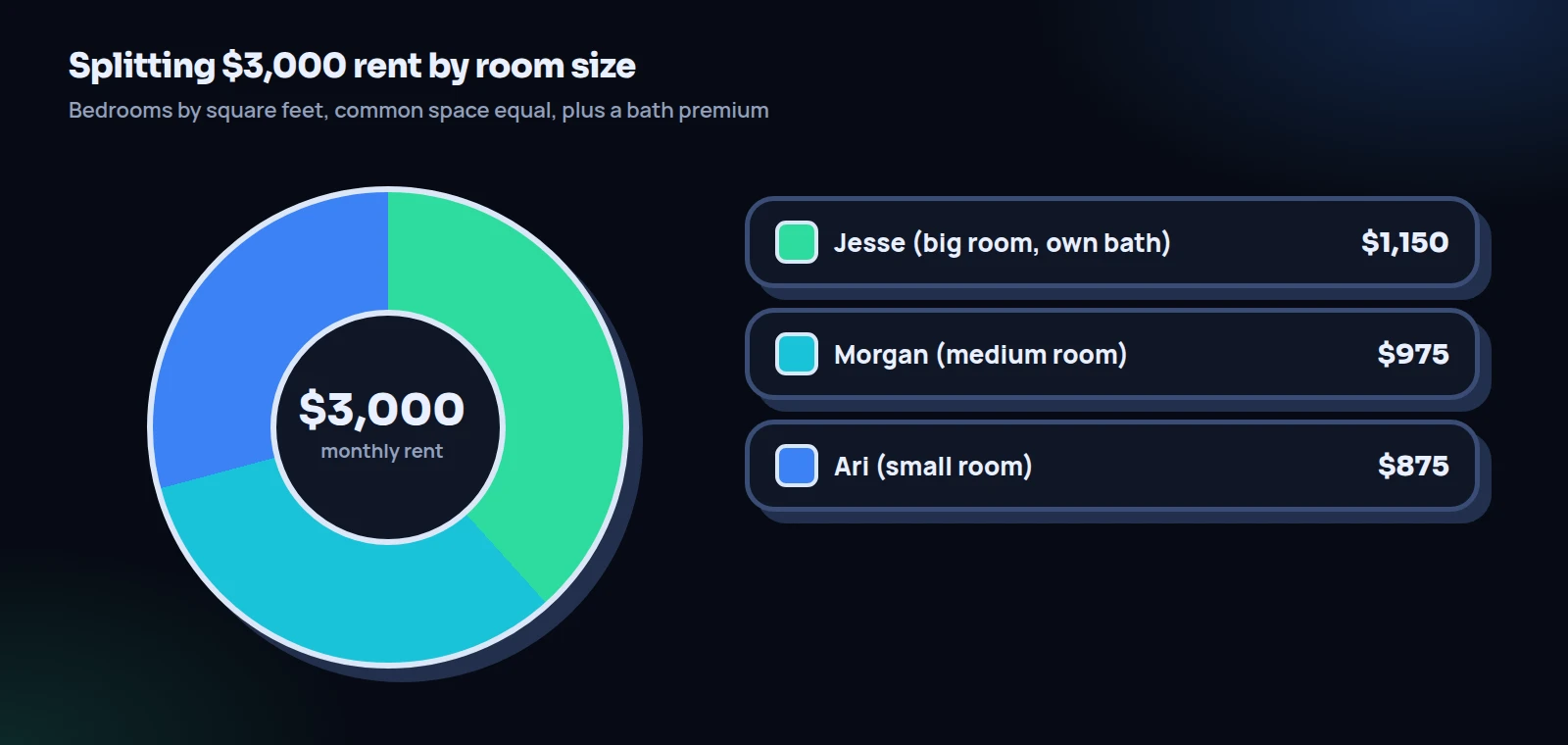
Our illustration of how roommates split rent: Jesse, Morgan and Ari are moving into a three-bedroom apartment. Rent is $3,000 a month. The apartment is 1,200 square feet. Jesse’s bedroom is 200 square feet with its own bathroom, Morgan’s is 160, and Ari’s is 120. The rest, 720 square feet of kitchen, living room, hallway and a shared bathroom, is common space.
The playbook: seven steps to help roommates split rent fairly
Read the lease together before you talk numbers
Find out who signed, what happens if someone leaves early, and how the rent is paid. One portal payment? Separate checks? This decides who has to front money every month. Nolo’s guide to roommate law explains “joint and several” liability plainly: each co-tenant can be on the hook for the entire rent, not just their share.
What can go wrong: one person is on the lease and the others aren’t. That person carries all the legal risk. If that’s you, the written agreement in step 5 matters even more.
Choose how roommates split rent
There are three common approaches. Equal: $1,000 each, simple, and fine when rooms are similar. Rent by room size: private space by square feet, common space shared equally. Features: equal base, with an extra amount for things like a private bathroom, a balcony or a parking spot.
What can go wrong: the person with the smallest room agrees to an equal split to be polite, then quietly resents it for 12 months. Do the math out loud, even if you end up choosing equal. Roommates split rent best when everyone has seen the numbers.
Give every bill an owner
Instead of one person paying everything, each roommate puts one bill in their name and pays it. Then you true up once a month so everyone has paid their share of the total.
What can go wrong: the person with the biggest bill is always the one waiting to be paid back. The monthly true-up fixes this, as long as it actually happens.
Pick one settle-up day each month
One date, a few days after everyone’s payday, when all the shares get sent. Not “whenever.” The same day every month.
What can go wrong: paydays don’t line up. If Ari is paid on the 1st and Morgan on the 15th, pick the 17th and pay the next month’s rent from it, or set up two smaller transfers.
Put fronted money in writing
Deposits, furniture bought for the shared space, the couch someone paid for: anything one person fronted for everyone goes in writing with an amount and a payback plan.
What can go wrong: “I’ll pay you back for the couch” becomes a dispute when someone moves out and wants to take the couch.
Decide the gray areas
Groceries, toilet paper, cleaning supplies, a partner who sleeps over five nights a week, a guest who stays for a month. Decide each one now, while nobody is annoyed.
What can go wrong: you skip this step because it feels petty. It’s the step that prevents the pettiest fights.
Plan the exit before anyone needs it
How much notice does someone give before leaving? Who finds a replacement? How is the security deposit split when it comes back?
What can go wrong: someone gets a job offer in another city and leaves with three weeks’ notice. Without a plan, the two who stay cover the gap.
Step 2 up close: the rent-by-room-size math
Here’s how Jesse, Morgan and Ari split rent by room size. It’s the method most roommates split rent with when the bedrooms are clearly different. First, find the rent per square foot: $3,000 divided by 1,200 square feet is $2.50.
- Private space: Jesse’s 200 sq ft costs $500, Morgan’s 160 costs $400, Ari’s 120 costs $300. That’s $1,200.
- Common space: 720 sq ft costs $1,800, split three ways: $600 each.
- Before features: Jesse $1,100, Morgan $1,000, Ari $900. Total $3,000.
Then the private bathroom. The three agree it’s worth $100 monthly to Jesse, so Jesse pays $100 more and Morgan and Ari each pay $50 less. Final split: Jesse $1,150, Morgan $975, Ari $875. Check: $1,150 + $975 + $875 = $3,000.
Is $100 the “right” bathroom premium? There’s no official number. It’s whatever the three of you agree feels fair. A quick gut check: would Morgan or Ari happily take Jesse’s room at $1,150? If both say yes, the premium is too low. If neither would, it’s probably too high.
Step 3 up close: how to split utilities without a spreadsheet war
Utilities change every month, so roommates who split rent neatly often fall apart here. The rent is a fixed number; the gas bill is a mood. The fix is the owner system plus one true-up.
In October, the bills are electricity $150 (in Jesse’s name), internet $75 (Morgan’s), and gas $45 (Ari’s). Total: $270, or $90 each. Jesse paid $150, so Jesse is owed $60. Morgan paid $75, so Morgan owes $15. Ari paid $45, so Ari owes $45. Two payments settle it: Ari sends Jesse $45 and Morgan sends Jesse $15.
We’d split utilities equally even when rent isn’t. Rooms differ in size, but people use about the same amount of hot water and Wi-Fi, and nobody wants to meter whose laptop is plugged in. The exception: one roommate runs a space heater all winter or works from home with three monitors. Talk about it; don’t silently adjust.
Worked example: the October settle-up
| Roommate | Rent share | Bills share | Paid in October | Result |
|---|---|---|---|---|
| Jesse | $1,150 | $90 | $3,000 rent + $150 electric | Is owed $1,910 |
| Morgan | $975 | $90 | $75 internet | Owes $990 |
| Ari | $875 | $90 | $45 gas | Owes $920 |
Jesse pays the full rent through the landlord’s portal, so Jesse fronts the most. Morgan sends $990 and Ari sends $920 on the 17th: $990 + $920 = $1,910, exactly what Jesse is owed. Two transfers, once a month.
Step 4 up close: the settle-up message
Roommates split rent once, at move-in, but they settle up twelve times a year. The settle-up day only works if someone posts the numbers. Rotate that job, or let the person who pays the rent do it. Keep it boring and specific.
Message: the monthly settle-up
October settle-up! Bills came to $270 ($90 each). With rent: Morgan owes $990, Ari owes $920, both to me. Bills are in the shared folder. Due on the 17th as usual. Thanks, you two.
Two days later, if someone hasn’t paid: Quick nudge on the October $920, Ari. If the 17th was tight this month, just tell me when works and I’ll note it.
When roommates split rent and bills this way, nobody has to remember who paid the internet in March. Everything is in one message per month, and the photos of the bills sit in a shared folder anyone can check. If a reminder ever needs to go further than a friendly nudge, our guide on how to remind someone to pay you back has more wording.
Step 5 up close: the security deposit
The deposit is the biggest sum most roommates ever share, bigger than any month’s bills, yet even roommates who split rent carefully often handle it, with a shrug. In our example the landlord asks for $3,000, one month’s rent. The simplest fair split matches the rent shares: Jesse $1,150, Morgan $975, Ari $875.
Ari is starting a new job and can’t cover $875 on move-in day, so Jesse fronts it. That’s a loan, and it should look like one. Jesse sets up an IOU in IOUEZ for $875 with five monthly payments of $175, due on the 17th alongside rent. Ari reviews and signs it on their own phone, reminders go out before each due date, and both see the balance drop as payments are recorded. Five payments of $175 is $875, paid off before the end of their first winter in the place.
Tip
Take dated photos of every room on move-in day and put them in the shared folder. When the deposit comes back, any deductions can be traced to a specific room, and the roommate whose room needed repainting pays for that part instead of everyone.
Paying each other back for rent and shared household bills is personal, not income. The IRS gives “getting repaid by a roommate for rent or a household bill” as an example of a personal payment that shouldn’t show up on a Form 1099-K. If your payment app asks, mark these transfers as personal or friends and family.
Step 6 up close: the gray areas
Even roommates who split rent and bills smoothly trip over the small stuff. Every apartment has its own, but these come up almost everywhere:
- Groceries. Shared staples (oil, coffee, spices, milk) go on a shared list, bought by whoever runs out and split monthly. Everything else is your own food, on your own shelf.
- Household supplies. A small monthly kitty works well: $20 each into a jar or shared balance for paper towels, soap and trash bags.
- Partners who stay over. If someone’s partner is there most nights, they’re using hot water, heat and Wi-Fi. Many apartments settle on a flat monthly contribution toward utilities. Agree the number with the roommate, not the partner.
- Long-term guests. One or two weeks is a visit. A month is a fourth roommate. Agree where the line is, and check your lease, which may limit guests.
Write it down: a roommate agreement you can copy
However roommates split rent, none of it works if it only lives in three people’s memories. A one-page roommate agreement is enough. It doesn’t replace your lease, and it doesn’t change what you owe the landlord, but it records what you agreed between yourselves.
Template: roommate money agreement
Roommate agreement for [address], from [start date]

Rent: $[total] per month, paid by [who] via [method].
Shares: [Name 1] $[amount], [Name 2] $[amount],
[Name 3] $[amount]. Reason: [equal / room size / other].

Bills: each roommate owns one bill:
[Name 1]: [bill]. [Name 2]: [bill]. [Name 3]: [bill].
Total split [equally / other] and settled monthly.

Settle-up day: the [day] of each month.
Who posts the numbers: [name or rotation].

Security deposit: $[total], paid as [Name] $[amount],
[Name] $[amount], [Name] $[amount]. Any money
fronted for someone is recorded as an IOU.

Shared supplies: $[amount] each per month.
Guests: up to [number] nights in a row; beyond that,
[rule]. Partners staying over: [rule].

Moving out: [number] days' notice. The leaving
roommate [finds a replacement / pays until filled].
Deposit refund split [how], after deductions
for damage in a specific room go to that roommate.

Signed: [Name 1] [date]  [Name 2] [date]
[Name 3] [date]
Each person keeps a copy. When something changes, like a new roommate or a rent increase, update it and sign again. If one person fronts money for another, the IOU sits alongside this agreement rather than inside it, which keeps each loan clear on its own. For the basics of writing one, see what an IOU is and how it works.
Checklist: move-in week money setup
- We all read the lease and know who signed it.
- We chose how roommates split rent here, and wrote down why.
- Every bill has an owner, and the total is split the way we agreed.
- We picked one settle-up day and who posts the numbers.
- Deposit shares are paid, or recorded as an IOU with dates.
- We agreed groceries, supplies, guests and partners.
- We agreed notice and replacement rules for moving out.
- Move-in photos are in the shared folder.
- Everyone signed the roommate agreement and has a copy.
Want to sanity-check how your roommates split rent and bills this month? The split calculator on our calculators page handles even splits in seconds. And if your household is also deciding how to share subscriptions, splitting streaming subscriptions follows the same owner-plus-true-up idea.
Frequently asked questions
What’s the fairest way for roommates to split rent?
When rooms are similar, equal is fair and simple. When rooms differ, split private space by square feet, share common space equally, and add a small agreed premium for extras like a private bathroom.
Should roommates split utilities equally?
Usually yes, even if rent isn’t equal. People tend to use similar amounts of water, heat and internet. If one roommate uses much more, for example working from home all day, agree a small adjustment openly.
When roommates split rent, who pays the landlord?
If the landlord accepts separate payments, each person pays directly and nobody fronts anything. If there’s one payment, rotate it or have the person who pays it receive the others’ shares on a fixed day a few days earlier.
What if roommates split rent and one can’t pay their share one month?
Talk the same day, not at the end of the month. If someone covers the gap, record it as a loan with a small payback plan and a date. Remember that under many leases, the landlord can ask any tenant for the full rent.
How do we split the security deposit when someone moves out?
Agree it in advance: usually the leaving roommate’s share comes back from the incoming roommate, and the final refund is split by original shares, minus damage traced to a specific room.
Do I need a written roommate agreement?
You don’t strictly need one, but a one-page agreement prevents most disputes and shows what everyone agreed. It doesn’t change your obligations under the lease.
Sources
- Nolo, Roommate Rights: Joint Liability and Rental Laws, on joint and several liability for co-tenants and roommate agreements.
- Internal Revenue Service, Understanding your Form 1099-K, which lists being repaid by a roommate for rent or a household bill as a personal payment.
- Federal Trade Commission, Mobile Payment Apps: How To Avoid a Scam When You Use One, on sending money safely through payment apps.