“Simplify debts” is the button in group expense apps that turns a tangle of who-owes-whom into a short list of payments. It sounds like magic, and it’s actually arithmetic you can do on a napkin. This guide explains the idea in plain English, defines every term you’ll run into, and works through one weekend that starts with eleven little debts and ends with three payments.
Example
Harper, Remy, Sage and Wren rent a cabin for a ski weekend. Harper books the cabin ($800). Remy buys groceries ($240). Sage buys lift tickets for the three skiers ($360; Harper is strictly a hot-tub person). Wren pays for the last dinner ($200). Four receipts, $1,600 in total. On the drive home, someone asks who owes what, and the car goes very quiet.
Why groups end up with so many little debts
Every expense creates a small debt from each person who benefited to the person who paid. The cabin creates three debts (Remy, Sage and Wren each owe Harper $200). The groceries create three more (Harper, Sage and Wren each owe Remy $60). The lift tickets create two (Remy and Wren each owe Sage $120). Dinner creates three (Harper, Remy and Sage each owe Wren $50).
That’s eleven separate payments if everyone pays back every expense on its own. Some of them go in circles: Harper owes Remy $60 for groceries while Remy owes Harper $200 for the cabin. Paying both is like two people handing each other twenty-dollar bills back and forth. To simplify debts is to cancel out all of that motion and keep only what actually needs to move.
The terms, in plain English
Group expense tools use a handful of words that sound more technical than they are. Here they are, in the order you’ll meet them.
- Expense
- One thing someone paid for on behalf of some or all of the group. The cabin is an expense; so is a $4 bag of ice.
- Payer
- The person who actually paid the bill at the time.
- Share
- The part of an expense that belongs to each person. It can be equal, a fixed amount, a percentage or a weighting. Harper’s share of the lift tickets is $0, because Harper didn’t ski.
- Gross debt
- A single “you owe me for this expense” amount, before any canceling out. The weekend creates eleven of them.
- Pairwise netting
- Canceling debts between two people only. If Remy owes Harper $200 and Harper owes Remy $60, after netting Remy owes Harper $140.
- Net balance
- What you paid in total minus what you used in total. Positive means the group owes you; negative means you owe the group. Across a group, all net balances add up to zero.
- Creditor
- Someone with a positive net balance. They paid more than their share and should receive money.
- Debtor
- Someone with a negative net balance. They used more than they paid for and should send money.
- Debt simplification
- Replacing all the gross debts with a smaller set of payments that leaves everyone’s net balance at zero. This is what “simplify debts” means in most apps.
- Rerouting
- A side effect of simplification: you may end up paying someone you never owed directly, because it saves a payment somewhere else.
- Settle up
- Making the final payments so every net balance is zero, and marking the group as square.
- Rounding remainder
- The cent or two left over when an amount doesn’t divide evenly. Someone has to absorb it; agree who.
Step one: the net balance for each person
Everything that follows starts with one number per person. First, add up each person’s share of every expense:
- Harper: cabin $200 + groceries $60 + lift tickets $0 + dinner $50 = $310
- Remy: $200 + $60 + $120 + $50 = $430
- Sage: $200 + $60 + $120 + $50 = $430
- Wren: $200 + $60 + $120 + $50 = $430
Check: $310 + $430 + $430 + $430 = $1,600, the whole weekend. Then subtract each share from what that person paid.
Worked example: net balances after the ski weekend
| Person | Paid | Share | Net balance |
|---|---|---|---|
| Harper | $800 | $310 | +$490 (is owed) |
| Remy | $240 | $430 | −$190 (owes) |
| Sage | $360 | $430 | −$70 (owes) |
| Wren | $200 | $430 | −$230 (owes) |
The balances add up to zero: $490 − $190 − $70 − $230 = $0. If they don’t, something is missing from the list. That zero check is the single most useful habit in group money.
From 11 payments to 6 to 3
Now compare the three ways the group could pay back the weekend.
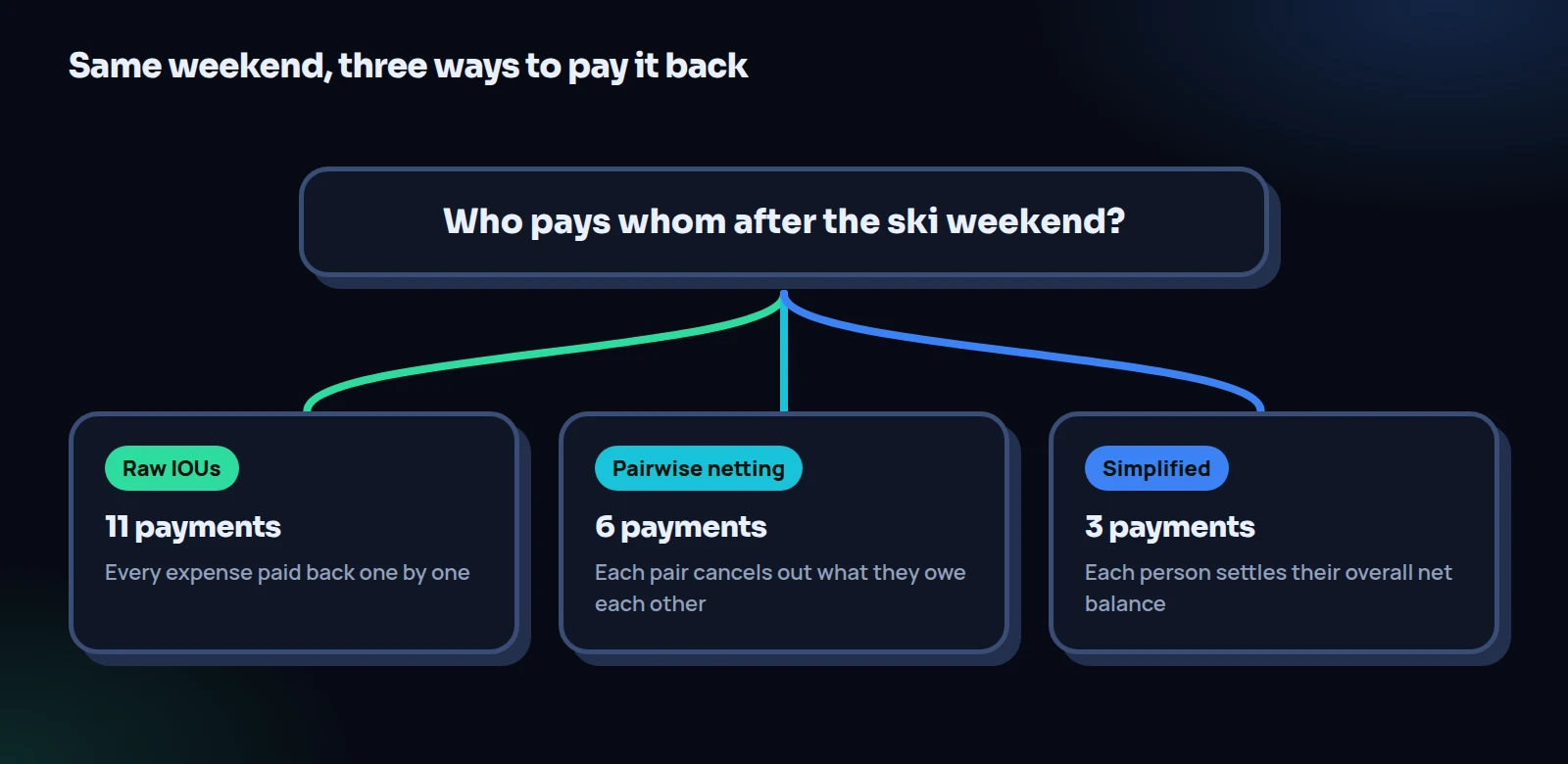
Raw: 11 payments
Everyone pays back every expense separately. Correct, exhausting, and full of circles. Harper would send Remy $60 and Wren $50, while receiving $200 from each of them.
Pairwise netting: 6 payments
Each pair of friends cancels out what they owe each other. Remy owes Harper $140 ($200 − $60). Sage owes Harper $200. Wren owes Harper $150 ($200 − $50). Remy owes Sage $60 ($120 − $60). Wren owes Remy $10 ($60 − $50). Wren owes Sage $70 ($120 − $50). Six payments, and each one still matches a real debt between two specific people.
Simplified: 3 payments
Ignore who owed whom for what, and settle the net balances. Harper is owed $490; the other three owe $190, $70 and $230. The simplest set of payments: Remy pays Harper $190, Sage pays Harper $70, Wren pays Harper $230. Check: $190 + $70 + $230 = $490. Three payments. Done before the car reaches the highway.
That’s what it means to simplify debts: the same money ends up in the same places, with fewer transfers. Nobody pays a cent more or less than their net balance says.
How to simplify debts by hand
For small groups you don’t need an app, and doing it once by hand makes every app’s answer easier to trust. A pen and the following routine handle almost any trip, household or event. Here it is with a slightly messier five-person example, where River and Shay are owed money and Frankie, Dakota and Rory owe it.
List every expense
What it was, how much, who paid, who it was for. Include refunds as negative expenses.
Work out each net balance
Paid minus share, per person. Say the result is River +$120, Shay +$80, Frankie −$90, Dakota −$60, Rory −$50.
Check the zero
$120 + $80 − $90 − $60 − $50 = $0. If it isn’t zero, find the missing expense before going further.
Match the biggest debtor to the biggest creditor
Frankie owes the most ($90), River is owed the most ($120). Frankie pays River $90. River is still owed $30.
Repeat until everyone is at zero
Dakota ($60) pays Shay, who is owed the most now ($80). Shay is still owed $20. Rory’s $50 goes $30 to River and $20 to Shay. Four payments, and every balance is zero.
This “biggest to biggest” method is the greedy approach, and for friend-sized groups it does the job well. Each payment clears at least one person completely, so a group of n people never needs more than n − 1 payments: three for the ski weekend’s four friends, four for five people. Finding the absolute minimum for large groups is a genuinely hard math problem, but with the number of friends who fit in a cabin, you won’t notice the difference.
When simplifying feels unfair (even when it isn’t)
Look again at the ski weekend. Under pairwise netting, Remy owed Harper $140 and owed Sage $60, and was owed $10 by Wren. Under the simplified plan, Remy pays Harper $190 and nothing to Sage. Sage, meanwhile, pays Harper only $70 instead of $200, and gets nothing from Wren.
Mathematically it’s identical. Emotionally, Remy may wonder why they’re paying Harper for “Sage’s” lift tickets. This is rerouting, and it’s the one part of debt simplification that needs a sentence of explanation. Something like: “We netted everything out, so it’s three payments instead of eleven. Your total is exactly what you owe the group overall.”
Watch out
Only simplify debts that belong to the same group and the same occasion. Don’t fold a personal loan, a business expense or someone’s share of rent into a trip settle-up. Rerouting money between separate agreements makes it impossible to tell later which debt was paid, and that’s exactly the record you’d want if something were ever disputed.
When not to simplify debts at all
Simplifying is great for shared spending: trips, households, events. It’s the wrong tool in a few situations.
- Signed loans. A loan with an agreed amount, dates and signatures should be repaid as its own thing, so both people can see its balance shrink. Mixing it into a group pot hides that.
- Different currencies. Convert everything to one currency at an agreed rate first. Netting dollars against euros at “roughly” a rate is how cents turn into arguments.
- Someone wants the trail. If a group member needs records for an employer or a reimbursement claim, they may need payments that match specific expenses. Ask before you simplify.
- Very lopsided trust. If one person is reliable and another historically isn’t, routing the reliable person’s money through the unreliable one is a bad idea. Keep the payments direct.
Simplifying changes how many payments you make, never how much anyone owes.
Three mistakes that make simplified debts go wrong
The arithmetic is easy. Most groups that try to simplify debts get the math right and the inputs wrong: a missing receipt, a forgotten refund, a payment rounded to a friendlier number. The trouble comes from what goes into it. These three cause most of the “wait, that can’t be right” moments.
Simplifying before the list is finished
Someone runs the numbers on the drive home, three people pay, and then a parking receipt turns up. Now one person’s balance is wrong and the neat three-payment plan needs a fourth. Wait until everyone confirms the list is complete, even if that means settling a day later.
Forgetting money that came back
The cabin refunds a $100 cleaning deposit to Harper a week later. That money belongs to the whole group, so it reduces the cabin to $700 and changes every share. If the refund arrives after you settled, Harper sends it back out in proportion to the cabin shares, $25 each, rather than keeping it as a quiet bonus.
Paying “about” the right amount
Rounding $230 to “$200 now, rest later” without writing down the rest is how a group ends up a month later with nobody sure what’s still open. Pay the exact net balance, or record exactly what’s left. The point of trying to find the fewest payments is that each one is clean and final.
Making the payments
Once the list is short, actually send the money. Post the net balances and the payment list in the group chat, so everyone sees the same numbers and can check the zero themselves. Pay within a few days; a settle-up that waits a month has a way of drifting into “did you ever pay me for that cabin?”
A few practical points:
- Check the recipient. The FTC warns that payment app transfers are hard to reverse, so confirm the username before you send.
- Mark it personal. The IRS says personal payments like paying back your share of a shared cost aren’t income and shouldn’t be on a Form 1099-K; many apps let you mark a transfer as friends and family.
- Move it out of the app. The CFPB notes that money left sitting in a payment app may not have deposit insurance. If you’re the creditor receiving $490, transfer it to your bank.
Sometimes a debtor can’t settle their part right away. If Wren needs a month to pay Harper the $230, write that down as a small loan with a date rather than a vague promise. In IOUEZ, Harper can create an IOU for $230 with two payments of $115, Wren signs it on their own phone, and reminders arrive before each due date. Recording each payment keeps the balance visible to both of them.
Where simplifying fits in the bigger picture
To simplify debts is the last step of splitting group costs, not the first. Before it come two decisions: how to split each expense (equal, itemized, by shares), and what counts as shared at all. We compare the common splitting methods in how to split trip costs, and walk through an entire post-trip routine in settling up after a vacation. For households, where the same few people settle every month, how roommates split rent and bills shows a monthly version of the same netting.
And if you only need a quick per-person number for a single bill, with tax and tip, use the split calculator on our calculators page.
Frequently asked questions
What does “simplify debts” mean?
It means replacing all the separate who-owes-whom debts in a group with the smallest practical set of payments that leaves everyone’s net balance at zero. The total each person pays or receives doesn’t change.
Is it fair to simplify debts if I end up paying someone I didn’t owe?
Yes, as long as the amount you pay equals your overall net balance. You’re paying the group what you owe; the simplification just picks the shortest route. If it bothers anyone, explain the net balances and agree before paying.
How many payments does a group need to settle up?
At most one fewer than the number of people with a non-zero balance. Four people need at most three payments, often fewer.
What’s the difference between pairwise netting and simplifying?
Pairwise netting cancels debts within each pair of people, so every payment still matches a real debt between two specific friends. Full simplification nets across the whole group, which usually means fewer payments but some rerouting.
What if the net balances don’t add up to zero?
Something is missing or double-counted: an expense entered twice, a refund forgotten, or a share that doesn’t add up to the expense. Fix the list before anyone pays.
Should I simplify debts across different trips?
We wouldn’t. Settle each trip or event on its own, so each one closes cleanly and old balances don’t get buried in new ones.
Sources
- Internal Revenue Service, Understanding your Form 1099-K, on personal payments between friends and family.
- Federal Trade Commission, Mobile Payment Apps: How To Avoid a Scam When You Use One, on checking recipients and how hard it is to reverse app payments.
- Consumer Financial Protection Bureau, Is the money I keep in my payment app safe?, on deposit insurance for payment app balances.