
Dev lives in Chicago and earns dollars. Ari, Dev’s college roommate, lives in Mexico City and needs 30,000 pesos to cover a deposit. Simple favor, until you notice that “30,000 pesos” and “about $1,600” can drift apart by more than $100 while the loan is open. Lending money in different currencies comes down to four decisions you make before anyone sends a cent: which currency the debt is in, which exchange rate and date count, who pays the transfer fees, and who carries the risk if the rate moves. Here’s the math, in dollars first.
The one decision that changes everything: the loan’s currency
Every cross-border loan has a currency of account, the currency in which the debt is counted and repaid. It’s tempting to leave it vague (“I’ll send you the pesos, you pay me back the dollars”), but vague is exactly where the trouble starts. The exchange rate will move between the day you lend and the day you’re repaid, and someone absorbs that move.
If the loan is in US dollars, Dev is protected: $1,621.62 out, $1,621.62 back. Ari carries the risk, because if the peso weakens, Ari needs more pesos to buy those dollars. If the loan is in pesos, Ari is protected: 30,000 out, 30,000 back. Dev carries the risk, because those pesos may convert to fewer dollars later.
Neither is wrong. What’s wrong is not deciding. Our rule of thumb when lending money in different currencies: denominate the loan in the currency the borrower earns in if you can afford to absorb a swing, and in your own currency if you can’t. The person who earns in that currency is the one who can repay it without doing a currency conversion every month.
Lending money in different currencies: three ways the rate can go
All rates below are illustrative, chosen to make the math easy. Real rates change daily; check a live rate on the day you send.
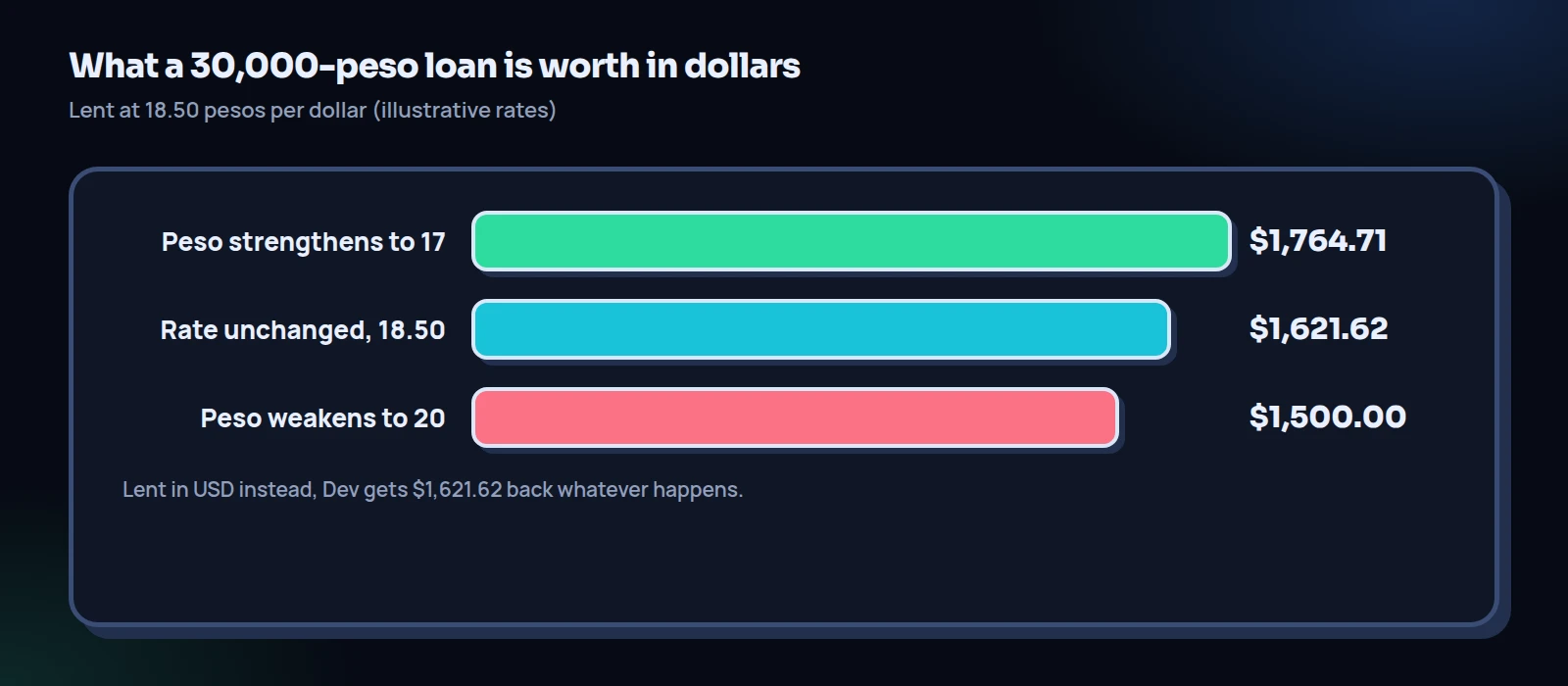
Worked example: Dev lends Ari 30,000 pesos at 18.50
| Rate at repayment (MXN per USD) | Loan in pesos: Dev gets back | Loan in dollars: Ari pays |
|---|---|---|
| 17.00 (peso stronger) | 30,000 ÷ 17.00 = $1,764.71 | $1,621.62 × 17.00 = 27,567.54 MXN |
| 18.50 (no change) | 30,000 ÷ 18.50 = $1,621.62 | $1,621.62 × 18.50 = 30,000.00 MXN |
| 20.00 (peso weaker) | 30,000 ÷ 20.00 = $1,500.00 | $1,621.62 × 20.00 = 32,432.40 MXN |
Read across a row and you’ll see the same swing landing on different people. At 20.00, a peso loan costs Dev $121.62. A dollar loan costs Ari 2,432.40 extra pesos. The total “loss” is the same size; the only question is whose pocket it comes from.
A checklist of four questions before you send
Before lending money in different currencies, ask these out loud, together, and write the answers in one message you both reply “agreed” to:
- What currency is the debt in, and what exact amount?
- If repayments are made in the other currency, which rate counts, and from what source and date?
- Who pays the fees to send the loan, and who pays the fees on each repayment?
- At what point would a big rate move make us sit down and revisit the plan?
If any of the four has a fuzzy answer, wait a day. The money will still be needed tomorrow, and the conversation is far easier before the transfer than after it.
Option three: share the risk on purpose
Some friends prefer to meet in the middle. Two simple ways to do it:
- Fix the rate in writing. “The loan is $1,621.62. Ari may repay in pesos at a fixed 18.50 per dollar.” Now both people know the exact peso amount (30,000), and neither cares what the market does. In practice this is a peso loan with a dollar label, so Dev still carries the risk.
- Split the difference. “At repayment, we use the rate on that day, and split any difference from 18.50 in half.” With the peso at 20.00, Dev’s $121.62 shortfall becomes $60.81 each. Fair, but it needs arithmetic every time, so keep it to loans with one or two repayments.
For a loan repaid in many small installments, we’d avoid split-the-difference arrangements entirely. Pick one currency and stick with it.
| Loan in USD | Loan in pesos | Fixed rate | |
|---|---|---|---|
| Who carries currency risk | Borrower | Lender | Lender |
| Lender knows the dollar outcome | Yes | No | No |
| Borrower knows the peso outcome | No | Yes | Yes |
| Math needed at each payment | Borrower converts | Lender converts | None |
| Pick this if… | You can’t afford a loss in dollars | You’d rather the borrower never worries about rates | You want one simple number in each currency |
Which exchange rate, and on which date?
“At today’s rate” sounds precise until you notice there are many “today’s rates”: the one on a news site, the one your bank gives you, the one the transfer service quotes after its margin. Name the source in writing.
Three sensible choices, in our order of preference for personal loans:
- The rate on the transfer receipt. If Dev sends money through a remittance provider, the receipt shows the exchange rate actually used. It’s real, documented and agreed by the act of sending.
- A published reference rate for a named date. The Federal Reserve publishes the H.10 release with daily exchange rates of major currencies against the dollar, based on noon buying rates in New York. Writing “the H.10 rate for the payment date” is precise, though it comes out weekly, so you may wait a few days for the number.
- A rate you both screenshot on the day. Fine for small amounts. Save the screenshot with the agreement.
For taxes, the IRS says it has no official exchange rate and generally accepts any posted rate that is used consistently. That’s a useful principle for friends too: pick one source and use it every time.
Transfer fees: who pays, and how much really arrives
Sending money abroad costs something, and it’s not always obvious what. There may be an upfront fee, and there’s usually a margin built into the exchange rate itself. The good news for US senders: under the Consumer Financial Protection Bureau’s remittance transfer rule, providers generally must tell you the exchange rate, the fees and the amount the recipient should receive before you pay, and give you a receipt. The rule generally covers transfers of more than $15 sent by consumers in the US to people abroad.
So use those disclosures. Suppose the provider shows a $6 fee and an exchange rate of 18.20 instead of the 18.50 you saw online. To deliver 30,000 pesos, Dev pays 30,000 ÷ 18.20 = $1,648.35, plus $6, for $1,654.35 in total. Compared with the reference rate, the transfer costs about $32.73. Not huge, but not nothing, and it needs an owner.
Tip
Agree who pays the transfer costs, both ways. A common fair split: the lender pays to send, the borrower pays to send back. Or add the sending costs to the loan, so the loan is $1,654.35 and Ari repays that. Either way, write it down.
The CFPB also explains two rights worth knowing. You generally have 30 minutes after paying to cancel a transfer for a full refund, unless the money has already been picked up or deposited. And if something goes wrong, such as the wrong amount arriving, you generally have 180 days from the promised availability date to report the error to the provider. Keep the receipt; it’s your evidence.
Recording a cross-currency loan in IOUEZ
When you’re lending money in different currencies, the record matters even more than usual, because the numbers on each side can look different. Here’s how to set it up so they never contradict each other.
IOUEZ lets you choose the currency for each agreement, from US dollars to Mexican pesos, euros, rupees and more. It keeps each currency separate and doesn’t convert between them, which is exactly what you want for a loan with a fixed currency of account.
- Create the agreement in the loan’s currency. If you agreed a peso loan, choose MXN in the Currency field and enter 30,000. If it’s a dollar loan, choose USD and enter 1,621.62.
- Write the exchange terms in the notes. For example: “Loan in USD. Ari may repay in pesos at the rate shown on the transfer receipt on the payment date. Dev pays fees to send, Ari pays fees to return.”
- Record each payment in the agreement’s currency. If Ari repays a dollar loan in pesos, record the dollar amount it bought, and put the peso amount, the rate and the provider’s reference in the payment notes and Reference field.
- Expect separate totals. The dashboard shows balances one currency at a time, with buttons to switch, so a peso loan won’t be mixed into your dollar totals.
Once both people sign a shared agreement, the currency locks along with the amount, interest and due date. That’s a feature: nobody can later “remember” the loan as being in the other currency. Your default currency for new agreements lives in Settings, under Profile.
Watch out
Don’t record a peso loan as a dollar agreement “for convenience” and do the math in your head. Six months later, nobody will remember which rate you meant, and the signed record will show the wrong currency. Match the agreement to the deal.
A quick word on interest across currencies
Interest gets slippery when currencies move. If Dev charges 5% on a peso loan, the dollar value of that interest swings with the rate too. Keep it simple: if you charge interest at all, charge it in the loan’s currency and treat it as a flat amount. In IOUEZ, the interest field is a flat percentage of the amount, so 5% on 30,000 pesos means 31,500 pesos total. Our comparison of simple interest and a flat fee explains the difference if you’re deciding between them.
US tax basics worth knowing
Most personal loans between friends never raise a tax question, but cross-border ones touch a few rules that are good to have heard of.
- Report in dollars. The IRS says amounts on a US tax return must be expressed in US dollars, generally using the rate prevailing when you receive or pay the item. Interest you receive on a loan is generally taxable income.
- Small personal currency gains. Under the tax code’s rules for personal foreign currency transactions, an exchange gain of $200 or less on a personal transaction generally isn’t taxed; above $200, it is. Most friendly loans won’t get near this, but a large loan repaid after a big rate move might.
- Foreign accounts. If you lend from a bank account you hold abroad, note that US persons generally must file an FBAR when the combined value of their foreign financial accounts exceeded $10,000 at any time during the year.
Dev and Ari’s final terms
Here’s what they agreed, in four lines. The loan is in US dollars: $1,654.35, which includes Dev’s sending costs. Ari repays it in six monthly payments of $275.73 (the last payment is $275.70), converting pesos with any provider they like and paying their own fees. The exchange rate used for each payment is the one on Ari’s transfer receipt, and the receipt reference goes into IOUEZ. If the peso weakens past 21, they’ll talk about switching the rest to a peso schedule.
That last line is the kind of thing that keeps friendships intact when lending money in different currencies. It doesn’t predict the future; it just agrees in advance when to have the conversation. For the bigger relationship questions, our core guide on how to lend money to a friend still applies, and if the money is going to family rather than as a loan, see tracking money sent home.
Try the math with your own numbers: amount in their currency, divided by today’s rate, then again at a rate 10% weaker. If the gap would bother you, make the loan in dollars.
Open the loan calculatorsFrequently asked questions
Which currency should a cross-border loan be in?
The one the person carrying the risk can afford to carry. Dollars protect the US lender; the borrower’s currency protects the borrower. Decide before sending, and write it down.
Can IOUEZ convert between currencies for me?
No. Each agreement has one currency and totals are kept per currency. Record exchange rates and provider references in the payment notes.
Is lending money in different currencies legal?
Personal loans across borders are common, but the other country may have its own rules on money coming in or going out. Check both sides for large amounts. This is not legal advice.
Who should pay transfer fees?
Whatever you agree. A simple default is that each person pays to send their own transfers, or that the lender’s sending costs are added to the loan.
What if the transfer arrives short?
Contact the provider with your receipt. Under the CFPB’s remittance rule, you generally have 180 days from the promised availability date to report an error.
Which exchange rate is “official”?
There isn’t one for personal loans. The IRS says it has no official rate and accepts posted rates used consistently. Name your source in the agreement.
Sources
- Consumer Financial Protection Bureau, What is a remittance transfer and what are my rights?, on disclosures, the 30-minute cancellation right and the 180-day error window.
- Consumer Financial Protection Bureau, 12 CFR § 1005.31, Disclosures, the rule on pre-payment disclosures and receipts for remittance transfers.
- Board of Governors of the Federal Reserve System, Foreign Exchange Rates, H.10, Historical Rates, daily rates of major currencies against the US dollar.
- Internal Revenue Service, Yearly average currency exchange rates, on translating foreign currency into dollars and the IRS having no official exchange rate.
- U.S. Code, 26 U.S.C. § 988, Treatment of certain foreign currency transactions, including the $200 rule for personal transactions in subsection (e).
- Internal Revenue Service, Report of Foreign Bank and Financial Accounts (FBAR), on the $10,000 aggregate threshold.