
The moment you let customers pay later, your profit and your cash stop moving together. You can have a great month on paper and still struggle to make payroll on Friday, because the money is sitting in your customers’ accounts instead of yours. This plain-English glossary explains cash flow for small businesses that give credit: the terms you’ll hear from accountants and lenders, what each one means for you, and a six-week example that shows them all at work.
Why credit changes everything about cash
A shop that only takes cash or card has simple cash flow: a sale today is money today. Once you offer house accounts, net 30 terms, installment plans or small loans, there’s a gap between earning the money and having it. During that gap you’re still paying rent, suppliers and staff.
The SBA describes cash flow as the money coming in and going out of a business and, just as important, the timing of those movements. For a business that gives credit, timing is the whole game. The terms below are the vocabulary for managing it.
A quick illustration. Say you sell $10,000 of work in March, all on net 30, and your costs for that work are $7,000, paid in March. On paper, March shows a $3,000 profit. In your bank account, March shows $7,000 going out and nothing coming in. The $10,000 arrives in April, if everyone pays on time. Do that for three months in a row while sales grow, and you’ll be running a profitable business that always feels broke. That isn’t bad management; it’s what credit does to timing, and it’s why the forecast later in this guide matters so much.
The core terms
- Cash flow
- The money that actually moves into and out of your bank account and cash drawer over a period. Not sales, not profit: dollars you can spend.
- Profit
- What’s left after expenses, on paper. A business can be profitable and still run short of cash if customers haven’t paid yet.
- Accounts receivable (AR)
- Money customers owe you for goods or services already delivered. Every open house account, unpaid invoice and loan balance is part of it.
- Accounts payable (AP)
- Money you owe suppliers and others for things you’ve already received. If your suppliers give you 30 days and your customers take 45, you’re financing the difference.
- Net 30 (or net 15, net 60)
- Payment terms: the full amount is due 30 (or 15, or 60) days after the invoice or statement date. Longer terms mean more of your money waiting outside the business.
- Cash method
- An accounting method that records income when payment is received and expenses when they’re paid. The SBA’s guide notes it’s one of the two common methods.
- Accrual method
- Records income when the sale is made and expenses when they’re incurred, whether or not cash has moved. Accrual books can look healthy while the bank account is thin.
Measuring how fast you get paid
One number tells you more about cash flow for small businesses that give credit than almost any other: how many days, on average, it takes customers to pay.
Worked example: days sales outstanding (DSO)
| Item | Amount |
|---|---|
| Accounts receivable today | $18,000 |
| Credit sales in the last 90 days | $54,000 |
| DSO = AR ÷ credit sales × 90 | $18,000 ÷ $54,000 × 90 = 30 days |
On average, customers take 30 days to pay, which matches net 30 terms. Now imagine sales stay at $54,000 per quarter but AR creeps up to $27,000. DSO becomes $27,000 ÷ $54,000 × 90 = 45 days. Same sales, same profit, but $27,000 − $18,000 = $9,000 more of your money is now sitting with customers instead of in your account.
Tip
Calculate DSO on the same day every month and write it down. The trend matters more than any single number. A DSO that drifts up by a few days every month is an early warning long before any account looks like a problem.
Terms for planning ahead
- Days sales outstanding (DSO)
- The average number of days customers take to pay, worked out as above. Compare it with your payment terms: if you offer net 30 and DSO is 45, customers are paying two weeks late on average.
- Aging report
- A list of what customers owe, grouped by how late it is: current, 1–30, 31–60, 61–90 and over 90 days. It shows which balances need attention first.
- Cash flow forecast
- A week-by-week (or month-by-month) estimate of the cash you expect in and out, with the balance at the end of each period. It’s how you see a shortfall before it happens.
- Cash cushion
- The minimum balance you want to keep in the bank at all times, to cover surprises. Many owners set it at a few weeks of fixed costs.
- Working capital
- Roughly, what you have that will turn into cash soon (cash, receivables, inventory) minus what you owe soon (payables, short-term debt). Giving credit increases receivables, which looks good on paper but isn’t spendable until collected.
- Bad debt
- A receivable you’ve concluded won’t be paid. The IRS notes that a business using the cash method generally can’t deduct unpaid amounts it never counted as income, so ask your tax preparer how a write-off affects you.
- Deposit or prepayment
- Money collected before you deliver. The opposite of credit: it moves cash timing in your favor, which is why deposits on special orders help cash flow so much.
A six-week cash flow forecast, worked through
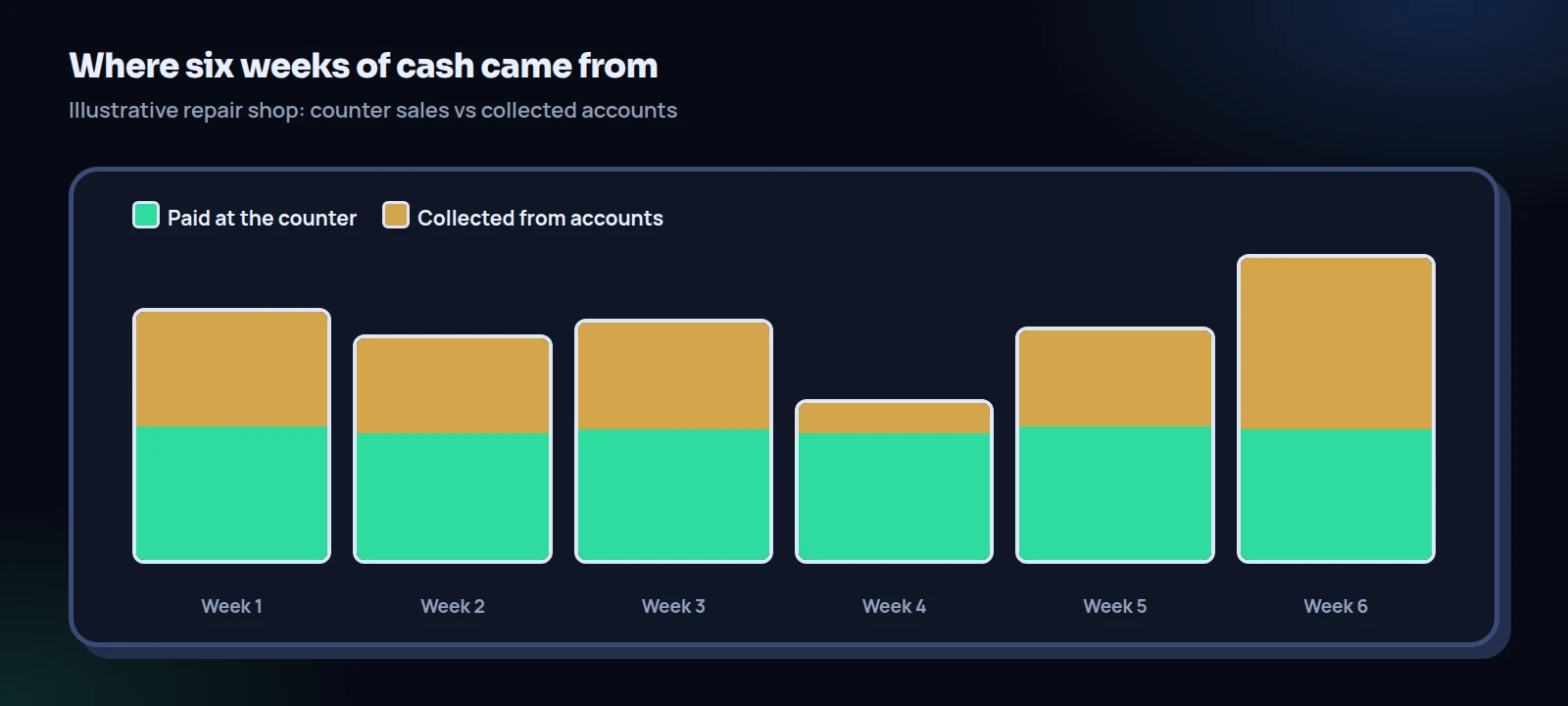
Jamie runs a fictional auto repair shop. Walk-in customers pay at the counter; two local delivery companies have fleet accounts on net 30 terms. Payroll of $4,000 goes out every other week, parts suppliers take about $2,200 a week, other costs run about $1,000 a week, and rent of $2,500 is due in week 3. Jamie wants to keep at least $6,000 in the bank as a cash cushion.
Worked example: Jamie’s six-week forecast
| Week | Opening cash | Cash in | Cash out | Closing cash |
|---|---|---|---|---|
| 1 | $8,000 | $6,500 | $7,200 (payroll, parts, other) | $7,300 |
| 2 | $7,300 | $5,800 | $3,200 (parts, other) | $9,900 |
| 3 | $9,900 | $6,200 | $9,700 (payroll, parts, rent, other) | $6,400 |
| 4 | $6,400 | $4,100 | $3,200 | $7,300 |
| 5 | $7,300 | $6,000 | $7,200 | $6,100 |
| 6 | $6,100 | $7,900 | $3,200 | $10,800 |
Each week: opening + in − out = closing. Week 1: $8,000 + $6,500 − $7,200 = $7,300. Week 3: $9,900 + $6,200 − $9,700 = $6,400. Week 5: $7,300 + $6,000 − $7,200 = $6,100. In week 4, one fleet customer paid late, so collections from accounts fell to $800 (cash in was $3,300 at the counter plus $800 collected). That payment arrives in week 6, which is why collections jump to $4,500. Jamie’s closing cash came within $100 of the $6,000 cushion in week 5, without any change in sales.
That’s the point of a forecast, and the heart of cash flow for small businesses that sell on credit. Nothing about Jamie’s business got worse in weeks 4 and 5; one customer just paid two weeks late. But a second late payer at the same time would have pushed the balance below the cushion right before a payroll week. Seeing that three weeks ahead gives Jamie time to call the fleet customer, delay a parts order or ask the other account to pay a little early.
Watch out
Don’t count receivables as cash in your forecast until they’re actually due, and be honest about which customers pay late. A forecast that assumes everyone pays on the due date will be wrong in exactly the weeks you most need it.
When the forecast shows a gap
A forecast is only useful if it changes what you do. When one of the next six weeks dips below your cushion, work through the options in this order, from cheapest to most expensive:
Collect first. Look at the aging report and call anyone past due, starting with the largest balances. A friendly call about an invoice that’s ten days late often brings in money the same week. In Jamie’s case, one call to the late fleet customer in week 4 might have moved $2,000 forward.
Ask for timing, not favors. Suppliers you’ve paid reliably for years will often agree to a short delay on one invoice if you ask before it’s due, not after. Be specific: “Could we pay invoice 8812 on the 20th instead of the 12th?”
Pause what can wait. Equipment purchases, a big inventory order, a new hire’s start date: move anything that isn’t urgent past the dip.
Stop opening new credit. Until the gap closes, new customers pay at the counter. It’s a temporary rule, and you can say so.
Borrow last, and on purpose. If you need outside money to bridge a gap, arrange it before you need it, compare the full cost, and know exactly how it gets repaid from the cash coming in later in the forecast. The SBA’s resource partners offer low- or no-cost help with budgeting and financing questions if you want a second opinion.
Managing cash flow for small businesses that give credit is mostly this loop: forecast, spot the dip, act early, repeat next Monday.
A few more terms you’ll hear
- Line of credit
- An arrangement with a lender that lets you borrow up to a set amount when you need it and repay as cash comes in. Useful for bridging timing gaps; costly if it quietly becomes permanent.
- Collection period
- Another name for the time it takes to turn a sale on credit into cash. DSO is the usual way to measure it.
- Seasonality
- Regular ups and downs in sales across the year. A business with a busy summer and a slow winter needs a bigger cash cushion going into winter, especially if customers buy on credit during the busy months.
- Write-off
- Formally giving up on collecting a balance and removing it from receivables. Decide on purpose, record the reason and date, and ask your tax preparer how to handle it.
Cash flow for small businesses: five habits that help
Good cash flow for small businesses that give credit is mostly about habits, not tools. These five do most of the work:
Update the forecast every Monday
Fifteen minutes: roll it forward one week, replace estimates with actuals, and look at the lowest balance in the next six weeks. If it’s under your cushion, act now, not in that week.
Invoice and post payments the same day
Every day an invoice waits to be sent adds a day to when you’re paid. Every payment not posted makes your receivables look worse than they are, and your decisions worse with them.
Match your terms to your suppliers’
If suppliers want payment in 15 days, offering customers 45 means you’re always financing the gap. Shorten customer terms, or negotiate longer supplier terms, until the two are closer.
Remind before the due date
A short heads-up two or three days before an invoice is due costs nothing and pulls cash forward. Our scripts for payment reminders for small businesses have wording you can copy.
Limit how much credit is out
Set a limit for each customer, and a total you’re willing to have outstanding at once. Our guide to setting credit limits for customers shows the math.
Keeping receivables visible
The hardest part of managing receivables is simply knowing, on any given morning, who owes what and when it’s due. A spreadsheet works if someone updates it daily. If you track customer balances or small loans in IOUEZ, each one is a signed agreement with its own due dates; payments, including partial ones, are recorded against it, and reminders go out the day before and on the due date. A weekly summary email lists what you’re owed and what’s due, which is a handy input for your Monday forecast.
Small lenders, co-ops and employers that run many loans can see what the organization plans cover and compare them on the pricing page. For the bigger picture of tracking many loans, start with our guide to loan tracking for small lenders.
Finally, keep the records behind every number. The IRS generally expects you to keep records supporting your tax return for 3 years, and 7 years if you claim a bad debt deduction. Your forecasts, aging reports and payment records are part of that story.
Try it this week: list your cash on hand, every payment you expect to receive in the next six weeks (with realistic dates), and every bill you’ll pay. Add it up week by week. If any week dips below your cushion, you just found the call to make on Monday.
Frequently asked questions
What is cash flow for small businesses, in one sentence?
It’s the money that actually moves into and out of your business over a period, and when it moves, as opposed to the sales and profit you record on paper.
Why can a profitable business run out of cash?
Because profit counts sales when they’re made, while cash only arrives when customers pay. If customers take 45 days and your bills are due in 15, you can be profitable and still short of money for payroll.
How far ahead should a small business forecast cash?
A rolling six- to thirteen-week forecast, updated weekly, suits most small businesses that give credit. It’s short enough to be accurate and long enough to spot a crunch in time to act.
What’s a good DSO?
Close to your payment terms. If you offer net 30, a DSO around 30 days means customers pay roughly on time. A DSO well above your terms means money is arriving late and is worth investigating.
How big should my cash cushion be?
There’s no single right answer. Many owners aim for a few weeks of fixed costs such as payroll and rent. The more customers you give credit to, the bigger the cushion you’ll want.
Should I stop offering credit to improve cash flow?
Not necessarily. Credit can win loyal customers. Shorter terms, deposits on special orders, limits per customer and reminders before due dates often fix cash flow without ending credit altogether.
Sources
- U.S. Small Business Administration, Manage your finances, on cash flow timing and the cash and accrual methods.
- Internal Revenue Service, Topic no. 453, Bad debt deduction, on bad debts and why cash-method businesses generally can’t deduct unpaid amounts never reported as income.
- Internal Revenue Service, How long should I keep records?, the 3-year general rule and 7 years for bad debt claims.