A lending circle is one of the oldest ways people pool money: everyone pays in each month, and each month one person takes the whole pot. It works on trust, and trust works better with a notebook. Below, we follow one illustrative group of ten from its first $2,000 payout, through a missed payment, to a small member loan fund, and pull out the rules they wish they’d written down on day one.
Month 0: the kitchen-table meeting
Ari, a fictional community organizer, gathers nine neighbors and coworkers. Each will put in $200 every month for 10 months. Each month, one person receives the full $2,000. Ari proposes drawing names from a hat for the order, writing it on a sheet, and taking a photo of it on everyone’s phone. Rowan, a member who needs money for a car repair soon, asks if they can go early. The group agrees: Rowan takes month 2.
Lesson one: early in a lending circle means you’re borrowing
Here’s the part that’s easy to miss at the kitchen table. In a lending circle, the person who gets the pot first has effectively borrowed from everyone else, interest-free. The person who goes last has effectively saved, and lent to everyone ahead of them.
Worked example: the payout order and who owes whom
| Payout month | Paid in by then | Received | Position right after payout |
|---|---|---|---|
| 1 | $200 | $2,000 | Owes $1,800 in future payments |
| 2 (Rowan) | $400 | $2,000 | Owes $1,600 |
| 5 | $1,000 | $2,000 | Owes $1,000 |
| 9 | $1,800 | $2,000 | Owes $200 |
| 10 (last) | $2,000 | $2,000 | Owes nothing; saved all along |
The math is the same for everyone: 10 payments of $200 is $2,000 paid in, and one $2,000 payout comes back. What changes is timing. Right after Rowan’s payout in month 2, Rowan has received $2,000 and paid in $400, so Rowan owes the group the remaining 8 × $200 = $1,600.
That’s why the payout order is the most important decision a circle makes. Drawing lots is fair. Letting someone with a real emergency go early is kind. Either way, everyone should understand that early recipients carry a debt to the group until the last month, and the rules should say what happens if they stop paying.
Month 4: the first missed payment
Month 4
The first of the month comes and goes. Nine members pay; Rowan doesn’t. The pot is $200 short, and the month 4 recipient, Sage, gets $1,800 instead of $2,000. Ari texts Rowan, who explains that the car repair cost more than expected and money is tight until the 20th. Nobody had decided what happens in this situation, so the group chat fills with opinions.
Two things went wrong here, and neither was Rowan missing a payment, which is the most predictable event in any lending circle. First, there was no written rule for a late payment. Second, the person hurt by it, Sage, had no say and no protection.
Ari calls a short meeting. They agree on a catch-up plan for Rowan: $300 in month 5 and $300 in month 6, which covers the missed $200 plus the regular $200 each month ($300 + $300 = $600 = 3 × $200). Sage gets the missing $200 in month 5 from Rowan’s extra payment. Then they write rules, so the next late payment is a procedure, not a debate.
Template: lending circle rules
[GROUP NAME] LENDING CIRCLE RULES

Members: [10 names, phone numbers]
Contribution: $[200] per member per month
Due: by the [1st]; grace until the [5th]
Payout: $[2,000] on the [6th] to the member
  listed for that month
Payout order: [list], drawn by lot on [date].
  Members may swap slots only if both agree
  in writing and the organizer is told.
How to pay: [method]. No cash without a receipt.
Late payment: The organizer contacts the member
  on the [6th]. A missed amount is made up
  within [2] months on a written plan.
Early recipients: Anyone who has received the
  pot keeps paying until the final month.
If someone leaves: [They are repaid what they
  paid in, at the end / their slot is filled].
Records: The organizer posts who paid each
  month in the group chat by the [7th].
Changes: Only with agreement of all members.

Signed: _____________________ (each member)
Lesson two: write it down and have everyone sign
The rules above fit on a page, and every line answers a question that otherwise gets answered in an argument. The two most important lines are the late payment rule and the early-recipient rule. The record line matters more than it looks: a monthly “who paid” post in the group chat means nobody has to ask, and nobody can later claim they paid when they didn’t.
Month 10: the circle closes
Rowan catches up by month 6 and pays on time after that. The last payout goes out on schedule. Everyone has paid $2,000 and received $2,000. At the closing dinner, someone asks whether they could keep going, not as a rotation but as a small fund that members could borrow from when they need to. Ari says yes, cautiously, and offers to draft the rules.
From a circle to a member loan fund
A rotating lending circle has a built-in end and a fixed payout for everyone. A member loan fund is different: money stays pooled, members borrow different amounts at different times, and the group has to decide who gets a loan and what happens if one isn’t repaid. It’s more flexible, and it needs more structure.
Ari’s group sets up a club: each member pays $50 every month into a shared fund, members can borrow up to $500, repaid over five monthly payments of $100, and a small part of the fund is held back as a reserve in case a loan isn’t repaid. By month 6, with 20 members, the fund has $6,000.
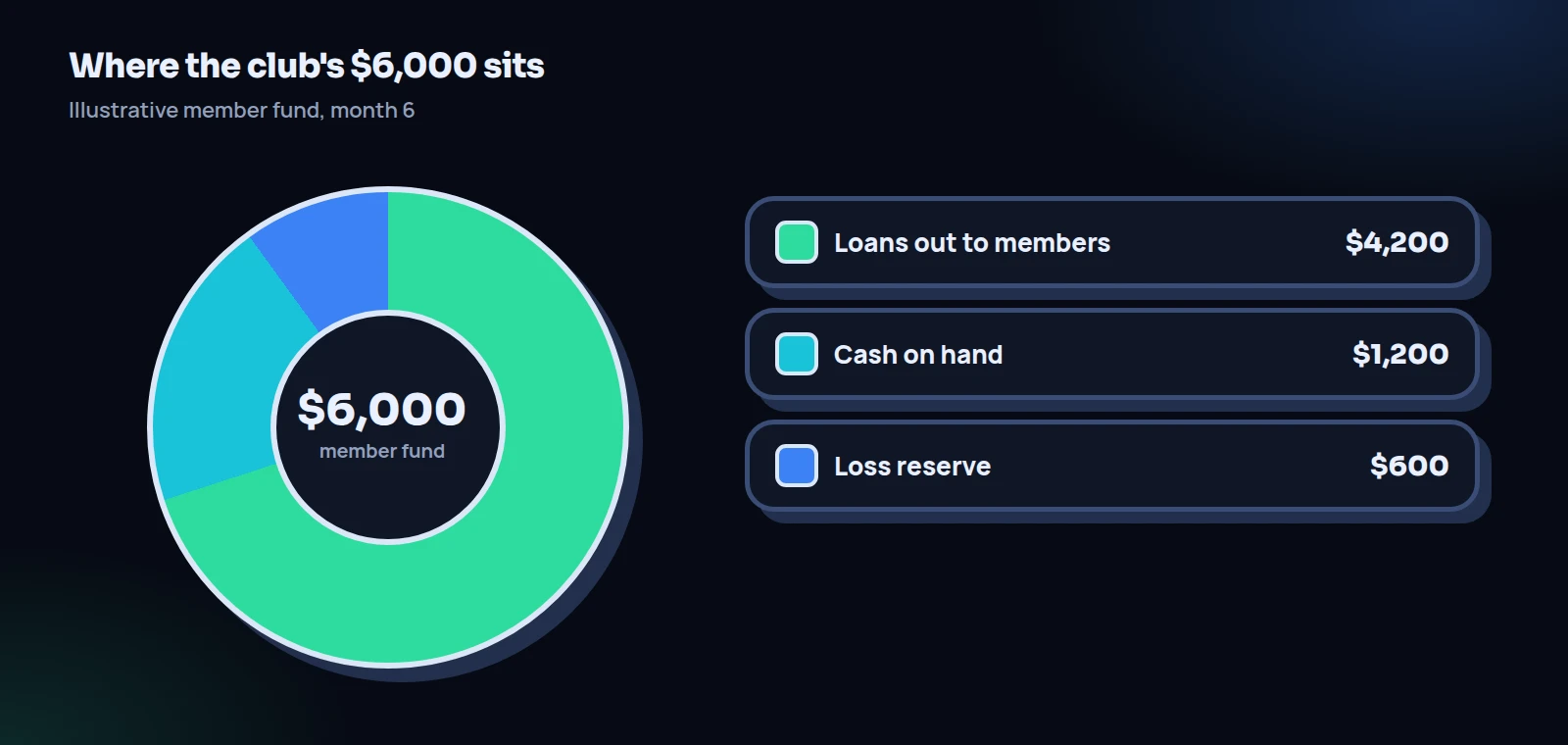
Check the split: 20 members × $50 × 6 months = $6,000. $4,200 + $1,200 + $600 = $6,000. With the cap at $500, $4,200 out means at least nine members currently have loans. The $600 reserve, 10% of the fund, would cover one full $500 loan going bad with room to spare.
Lesson four: write lending rules before the first request
The circle’s rules covered one fixed payout per person. The fund needs different ones, because now the group is deciding who gets a loan. Ari drafts them before anyone asks for money, so the first request isn’t judged on the spot:
- Who can borrow: members who have paid dues for at least three months and have no late dues.
- How much: up to $500, and only one loan at a time.
- Repayment: five monthly installments, due on the 15th, with a signed agreement for every loan.
- Who decides: two members review each request against these rules; neither may review their own family’s request.
- Loan reserve: 10% of the fund is never lent out. If a loan goes unpaid after a written plan fails, the loss comes out of the reserve, and the reserve is rebuilt from dues before new loans go out.
- No interest, no fees, at least for now, which keeps the club simple.
The loan reserve line is the one that saves friendships. Without it, a single unpaid loan becomes a fight about whose money was lost. With it, the loss was planned for, and the group can talk about the member instead of the money.
Watch out
Once a group pools money and makes loans, it’s worth asking whether any lending laws apply. Many states license businesses that make loans, and the rules depend on the state, who you lend to and whether you charge interest or fees. A small, interest-free club among members may be treated very differently from a group that lends to the public. Check with your state’s financial regulator before the fund grows.
The club’s monthly rhythm
A fund needs a calendar, a treasurer and a second pair of eyes. Ari becomes treasurer, and another member, Parker, reviews the books each month. The rhythm they settle on:
- 1st
Monthly dues of $50 due from every member.
- 5th
Grace period ends. The treasurer posts a list of anyone who hasn’t paid, with amounts, no commentary.
- 10th
Loan requests reviewed by two members against the written rules: membership length, current loans, the $500 cap.
- 15th
Loan installments due. Each loan has its own signed agreement and schedule.
- Last day
Treasurer’s report shared with everyone: fund total, loans out, cash, reserve, anyone late.
A member fund doesn’t fail because one loan goes bad. It fails when nobody can say how much is out, who has it, and when it’s coming back.
Lesson three: separate the group’s money from anyone’s own
Month 8
A member asks Ari, a bit awkwardly, why the fund’s money sits in Ari’s personal checking account. Nobody suspects anything. But if Ari got sick, moved away or simply made a mistake, the group’s $6,000 would be mixed up with Ari’s own. The club decides to open an account in the club’s name with two signers, which takes some paperwork but ends the question for good.
Money held for a group should be kept apart from any one person’s money, with at least two people able to see the account. Talk to a bank or credit union about what kind of account fits an informal club; some will want the group to have its own tax ID or a simple written agreement among members. If the club charges interest on loans, that interest is income to someone, so ask a tax professional how to report it.
When it might be time for a credit union
If the group keeps growing, and members want savings accounts, larger loans and protections the club can’t provide, the next step may be joining or forming a credit union. The NCUA describes a federal credit union as a member-owned, member-controlled, not-for-profit cooperative, formed so a group can save, borrow and take part in running it, with one vote per member regardless of how much they hold. Forming one is a formal chartering process with real requirements; the NCUA’s guide to starting a new federal credit union lays it out. For many groups, simply joining an existing credit union that serves their community or workplace gets most of the benefits without the paperwork.
Formal lending circles also exist. The CFPB has described programs, often run by nonprofits, where participants make monthly contributions and receive a loan on a rotating basis, sometimes with financial training and, in some programs, with payments reported to credit bureaus. An informal circle among friends doesn’t build anyone’s credit history, so if that’s a goal, look for a program designed for it.
Keeping member loans clear
Whatever stage your group is at, the habits are the same: one record per loan, a written schedule, and a record of every payment that everyone involved can see. For the club’s member loans, Ari’s group puts each one in IOUEZ as an agreement between the treasurer and the member, signed by both, with five monthly installments. Payments are recorded as they come in, both sides see the same remaining balance, and reminders go out the day before and on the due date, so the treasurer isn’t the one sending awkward texts. A printed or PDF copy of each signed agreement goes in the club’s records.
For larger groups, co-ops and member organizations, see what the organization plans include today and compare them on the pricing page. Our guide to loan tracking for small lenders covers the register, payment log and month-end close in more detail, and the statement template adapts well to a treasurer’s monthly report.
Frequently asked questions
How does a lending circle work?
Members agree to pay a fixed amount each month, and each month one member receives the whole pot, in an agreed order, until everyone has had a turn. Everyone pays in and receives the same total; what differs is when.
What happens if someone in a lending circle stops paying?
It depends on your written rules, which is why you need them. A common approach is a short grace period, then a written catch-up plan. Members who have already received the pot must keep paying until the final month.
How should a lending circle choose the payout order?
Many circles draw lots. Some let a member with a genuine emergency go early. Whatever you choose, write the order down, have everyone sign it, and require written agreement for any swaps.
Does a lending circle build credit?
An informal circle among friends doesn’t report to credit bureaus, so it doesn’t build credit history. Some formal programs run by nonprofits do report payments; look for one if building credit is the goal.
Do we need a license to run a member loan fund?
Possibly. Rules depend on your state, who you lend to and whether you charge interest or fees. Check with your state’s financial regulator before the fund grows, and get legal advice.
Where should a lending circle keep its money?
Ideally in an account in the group’s name with at least two people able to see it, not in one member’s personal account. Ask a bank or credit union what they need to open one for an informal group.
Sources
- National Credit Union Administration, Federal Regulation of Credit Unions, describing a federal credit union as a member-owned, member-controlled, not-for-profit cooperative.
- National Credit Union Administration, Starting a New Federal Credit Union, the chartering process for new credit unions.
- Consumer Financial Protection Bureau, Financial education programs serving immigrant populations (2016), describing lending circles and rotating savings and credit associations.
- U.S. Small Business Administration, Apply for licenses and permits, on state licensing that varies by activity and location.