
An employee’s car dies, a rent check bounces, a family emergency lands two days before payday. For a small business owner, offering an employee loan or a paycheck advance can be a kind and practical answer, and a good way to keep someone you’d hate to lose. It can also tangle you in payroll rules, taxes and awkward conversations if nothing is written down. These are the questions to answer before any money changes hands.
Quick answer
A small employee loan or paycheck advance is usually fine if you put it in writing, offer it under the same policy to everyone, get written authorization for any payroll deductions, and don’t charge interest or fees that eat into minimum wage. State rules on paycheck deductions vary, so check with your state labor office before the first deduction.
Should a small business offer employee loans at all?
It can, as long as you treat it as a business decision with a written policy rather than a favor. The upside is real: you help someone through a short crisis, they stay, and you avoid hiring and training a replacement. The risks are just as real: the employee leaves with a balance, coworkers feel it was unfair, or a payroll deduction breaks a state rule you didn’t know existed.
A written policy fixes most of that. Decide in advance who’s eligible (say, after 90 days of employment), the maximum amount (one or two weeks of pay is common for small employers), the longest repayment period, and how often someone can borrow. Then apply it the same way to everyone. If you can’t afford to lose the amount entirely, don’t lend it, policy or not.
What’s the difference between a paycheck advance and an employee loan?
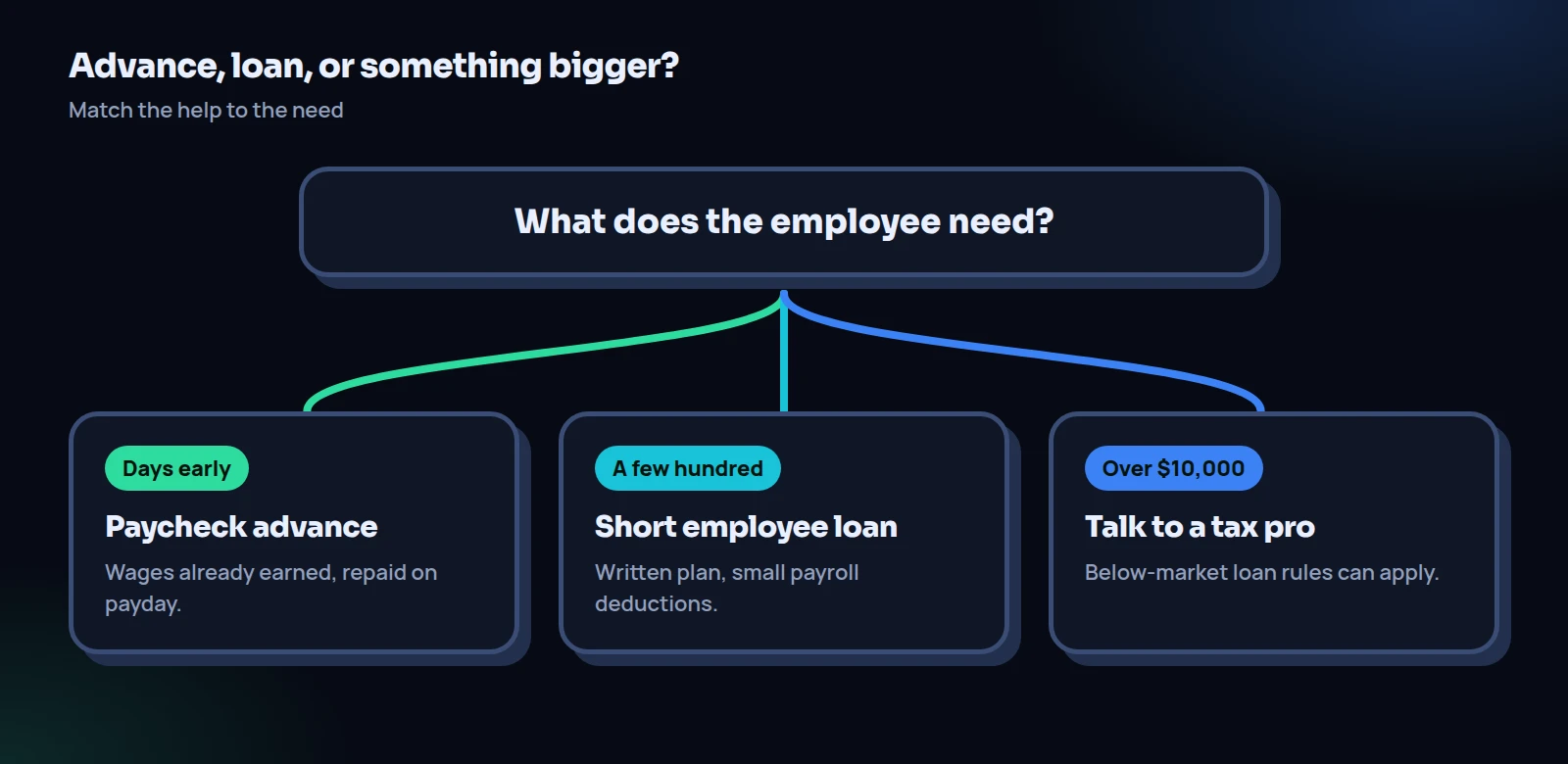
A paycheck advance pays an employee wages they’ve already earned, or will earn in the current pay period, a few days early. An employee loan is money beyond what they’ve earned, repaid over several paychecks.
The difference matters for paperwork. An advance is usually settled on the next payday: you simply pay the rest of the check. A loan needs a written agreement with the amount, the repayment schedule, what happens if they leave and whether any interest applies. Treat anything that takes more than one paycheck to repay as a loan.
Can I take repayments out of an employee’s paycheck?
Generally yes under federal law, with written authorization and within your state’s rules. Under the federal Fair Labor Standards Act, the U.S. Department of Labor’s guidance says the principal of a loan or advance can be deducted from wages even if the deduction cuts into the minimum wage or overtime due. Interest, “processing fees,” “bookkeeping costs” and similar add-ons are a different story: they can’t be deducted, or otherwise paid by the employee, to the extent they cut into required minimum wage or overtime pay.
That’s only the federal floor. Many states have their own wage-deduction rules, for example requiring a specific written authorization, limiting how much can be deducted per paycheck, or restricting deductions from a final paycheck. The Department of Labor itself points employers to their state labor office for those rules. Call or check that office before the first deduction, and keep the employee’s signed authorization in their file.
Worked example: a $1,200 employee loan repaid from payroll
| Item | Amount |
|---|---|
| Loan from Noor’s café to Lee (fictional) | $1,200 |
| Interest or fees | None |
| Lee’s weekly gross pay (40 hours × $18) | $720 |
| Weekly payroll deduction (signed authorization) | $100 |
| Number of deductions | 12 |
| Total repaid | 12 × $100 = $1,200 |
The $100 deduction is about 14% of Lee’s gross weekly pay ($100 ÷ $720 = 0.139). Noor chose an amount Lee could still live on, which matters more than any legal minimum: a deduction that leaves someone short every week tends to create the next emergency. Because there’s no interest or fee, only principal is being deducted, which keeps the federal minimum wage question simple. State rules may still cap the deduction, so Noor checked before signing.
Should I charge interest on an employee loan?
For small amounts, most employers don’t, and we’d skip it. Interest adds paperwork, can bring in state lending rules, and any fee that cuts into minimum wage can’t be deducted from pay anyway.
For larger amounts, interest-free has a tax angle. IRS Publication 15-A explains that if an employer lends an employee more than $10,000 at an interest rate below the applicable federal rate (AFR), the difference between the interest paid and the interest at the AFR is treated as additional compensation to the employee. That amount is subject to Social Security, Medicare and FUTA taxes, though not federal income tax withholding, and goes on the W-2. The rule can also apply to loans of $10,000 or less if avoiding federal tax is one of the main purposes. If you’re considering an employee loan above $10,000, talk to a tax professional first.
What if I decide to forgive the loan?
Forgiving an employee loan generally turns the forgiven amount into taxable pay. IRS guidance on additional wages says loan forgiveness given as compensation is included in income, subject to federal income tax withholding and Social Security and Medicare taxes, and reported on the employee’s Form W-2.
That doesn’t mean you shouldn’t forgive a loan. It means you should decide it on purpose, tell your payroll provider, and run it through payroll as wages, rather than just stopping the deductions and hoping nobody notices. If what you really want is to give the employee a bonus, call it a bonus from the start.
Watch out
Never quietly stop deducting and “let it go.” A forgiven employee loan is generally taxable wages. If it never reaches payroll, both you and the employee may end up with tax trouble that’s harder to fix later than it would have been to handle now.
What happens if the employee quits with a balance?
The agreement should say. A common approach: any remaining balance becomes due on a set schedule after the job ends, and the employee can keep paying at the same rate by transfer. Whether you can deduct the balance from a final paycheck depends heavily on state law; some states restrict it and many have their own timing rules for final pay. Check before you rely on it.
In practice, the kinder and safer path is usually to keep the original schedule and switch from payroll deduction to direct payments. Lee leaving after six of twelve deductions would still owe $600; at $100 a week by transfer, that’s six more payments. A signed agreement and the payment record make that conversation short.
What should the written agreement say?
Keep it to one page. It should be signed by both of you before the money goes out, and the payroll deduction authorization should be its own clearly worded section (or form) so it can’t be missed.
Template: employee loan agreement
EMPLOYEE LOAN AGREEMENT

Employer: [Business name]
Employee: [Name]
Date: [MM/DD/YYYY]

1. Amount: The employer lends the employee
   $[amount], paid on [date] by [method].
2. Interest: [None. / [X]% per year, simple.]
   No fees are charged.
3. Repayment: $[amount] per [paycheck/week],
   starting [date], for [number] payments.
4. Payroll deduction: The employee authorizes
   the employer to deduct $[amount] from each
   paycheck for this loan until it is repaid.
   The employee may cancel this authorization
   in writing and pay directly instead.
5. Early repayment: Allowed at any time, with
   no extra cost.
6. If employment ends: The remaining balance is
   repaid at $[amount] per [week/month] by
   [method], starting [date], unless state law
   requires otherwise.
7. Records: Each payment is recorded and the
   employee can see the balance at any time.

Employer signature: ____________  Date: ______
Employee signature: ____________  Date: ______
Tip
Let the employee choose the deduction amount within your policy’s range. People who pick their own number are far more likely to stick with it, and it shows the loan is a plan you made together, not a garnishment.
How do I keep it fair across the team?
Fairness is mostly about consistency and privacy. Use the same written policy for everyone: eligibility, maximum amount, repayment period and how often someone can borrow. Make decisions based on that policy, not on who asked most persuasively or who you like most. If you turn down one employee and help another in a similar situation, you should be able to point to the policy as the reason.
Keep loans private. Only the people who run payroll need to know, and the agreement belongs in a confidential file, not the shared drive. Coworkers finding out about a colleague’s loan is embarrassing for the borrower and, depending on the circumstances, can raise its own problems.
And record everything. Each deduction should appear on the employee’s pay stub as a loan repayment, separate from taxes and benefits. Keep the agreement, the authorization and the payment history with your payroll records; the IRS says employment tax records should be kept for at least 4 years after the tax is due or paid, whichever is later.
Are there better options than a loan?
Sometimes, yes, and it’s worth asking before you write a check. A loan solves a cash gap. If the real problem is something else, a different kind of help may serve the employee better and leave you with nothing to collect.
- Extra hours or shifts. If you have the work, paid hours this week can close a small gap without anyone owing anything.
- Paying wages already earned a few days early. For a short squeeze, a paycheck advance of earned wages is simpler than an employee loan and settles itself on payday.
- Paying the bill directly. For a specific expense, such as a car repair the employee needs to get to work, some employers pay the shop directly and set up a short repayment plan. It keeps the money tied to its purpose.
- A one-time bonus. If you want to help and don’t want the money back, say so and run it through payroll as a bonus. It’s taxed as wages either way, and it avoids the slow awkwardness of a loan you’ll never chase.
- Pointing to other help. Local assistance programs can cover some emergencies; dialing 211 in most of the US connects people to community services.
None of these replaces a fair loan when a loan is the right tool. They just make sure it’s a choice, not a reflex.
How can I track employee loans without extra work?
Pair your payroll records with a shared record of the loan itself. In IOUEZ, you can set up each employee loan as an agreement both of you sign on your phones or on the web, with an installment schedule. Each payroll deduction is recorded as a payment, so the employee sees exactly the same remaining balance you do, and reminders go out before each due date if they’re paying directly. Once both sides sign, the amount, interest and due date are locked, which helps if anyone later remembers it differently.
For businesses that make several staff loans a year, see what the organization plans offer, and compare them on the pricing page. If your business also lends to customers, our guide to loan tracking for small lenders covers registers and month-end checks, and the free installment calculator builds a repayment schedule in seconds.
Frequently asked questions
Is an employee loan taxable to the employee?
A genuine loan that’s being repaid generally isn’t income. It can become taxable if it’s forgiven, or if it’s over $10,000 at an interest rate below the applicable federal rate, in which case the forgone interest is treated as extra compensation. Ask a tax professional for larger loans.
Can I deduct an employee loan from their final paycheck?
It depends on your state. Federal rules allow deducting loan principal from wages, but many states restrict deductions from final pay or require specific written authorization. Check with your state labor office first.
How much should a small business lend an employee?
Many small employers cap loans at one or two weeks of pay and repayment at a few months. Set the cap in a written policy and only lend what the business could afford to lose.
Do I need a written agreement for a paycheck advance?
A short written note and signed deduction authorization is wise even for an advance repaid next payday. Anything repaid over more than one paycheck should have a full written agreement.
Can I charge a fee for an employee loan?
Fees and interest can’t be deducted from pay to the extent they cut into minimum wage or overtime, and they can bring in other rules. Most small employers skip fees entirely.
What if the employee asks for a second employee loan?
Follow your written policy. Many employers require the first loan to be repaid, or mostly repaid, before a new one. If someone keeps needing loans, a conversation about hours, pay or other support may help more.
Sources
- U.S. Department of Labor, Wage and Hour Division, Field Operations Handbook, Chapter 30, on deducting loan and advance principal from wages and the limits on interest and fees.
- U.S. Department of Labor, Fact Sheet #16: Deductions from wages under the FLSA, on deductions that reduce pay below minimum wage.
- U.S. Department of Labor, State Payday Requirements, which directs employers to state labor offices for state rules.
- Internal Revenue Service, Publication 15-A, Employer’s Supplemental Tax Guide, section on below-market loans to employees over $10,000.
- Internal Revenue Service, Additional wages, on loan forgiveness as taxable compensation reported on Form W-2.
- Internal Revenue Service, How long should I keep records?, on keeping employment tax records for at least 4 years.