
Collecting money at work is a small job with a surprising number of ways to go wrong: the suggested amount that feels like a bill, the coworker who never pays for their sandwich, the boss’s birthday where nobody knows the rules. Below are ready-to-copy messages for each moment, from how to split a group gift for a colleague who’s leaving to posting the numbers after a team lunch, plus what to do when someone doesn’t reply.
Situation 1: starting a collection for a coworker
Jamie is leaving after six years, and Bailey has volunteered to organize a gift. Fourteen people on the team. The goal is a gift Jamie will love and a collection nobody resents.
Three rules make any collection for a coworker feel friendly instead of mandatory. Make the amount a suggestion, not a price. Say clearly that zero is fine. And keep contributions private: never post who gave what.
Message: starting the collection
Hi all! Jamie’s last day is Friday, and I’m putting together a gift and a card from the team. If you’d like to chip in, the suggested amount is $10, but any amount (or none) is completely fine. You can send it to me directly or drop cash in the envelope on my desk. Card is there to sign too. I’ll order the gift Thursday at noon.
For a smaller or more senior team: Planning something for Jamie’s last day. If you’d like to contribute, reply to me privately and I’ll send details. Signing the card is the main thing.
Why a suggested amount at all? Because without one, people either guess high and feel annoyed, or guess low and feel embarrassed. A clear, modest number removes the guessing. When you split a group gift, the suggestion should be small enough that the most junior person on the team can give it without thinking twice.
How it adds up when you split a group gift
Here’s how Bailey’s collection actually came out. Twelve of fourteen people chipped in, two didn’t, and nobody asked who.
Worked example: the farewell gift for Jamie
| Contribution | People | Subtotal |
|---|---|---|
| $10 (the suggested amount) | 8 | $80 |
| $15 | 2 | $30 |
| $5 | 2 | $10 |
| Nothing (and that’s fine) | 2 | $0 |
| Collected | 12 of 14 | $120 |
Bailey spends $112 on a gift and $8 on a big card: $120, exactly what came in. Bailey picks the gift to fit the money collected, not the other way around, which is the easiest way to avoid a shortfall.
That last point matters. Decide the gift after you know the total, or set a budget range (“we’ll get something around $100”) and pick from a short list. Organizers who promise a $200 espresso machine before the first dollar arrives often end up paying the difference themselves.
Four ways to split a group gift, and when each fits
There’s more than one way to split a group gift, and the right one depends on how well people know the person and how even the team’s budgets are.
- Suggested amount, any amount welcome. What Bailey did. Our default for coworkers: it gives people a number without making it a fee.
- Fixed equal shares. “The gift is $120, that’s $10 each for 12 of us.” Fine for a small group of close friends who all want in. At work it can feel like an invoice, so we’d use it only when everyone has already said yes.
- Pay what you like, no number. Gentle, but people guess, and the total is hard to predict. Works for a card with a small gift card inside, where any total is fine.
- One person buys, others reimburse. Fast when the gift is time-sensitive. The buyer carries the risk, so they should post the price and the per-person share the same day, and accept that a few people may not reimburse.
What we’d skip: tiers by seniority (“managers $20, everyone else $10”). It makes pay grades visible in a birthday card, which nobody needs. When you split a group gift, keep the suggestion the same for everyone and let generous people give more quietly.
Situation 2: the office lunch, paid by one person
Different week, different job. Bailey orders lunch for eight through a delivery app and pays $208.80 on one card. Now seven people owe Bailey various amounts, and Bailey has a meeting in ten minutes.
For an office lunch, the simplest fair split is: your own item, plus an equal share of the fees, tax and tip. The order looked like this: items totaling $160, delivery and service fees $8, tax $12.80, tip $28. The extras come to $48.80, which is $6.10 per person across eight people.
- Bailey: $24 + $6.10 = $30.10
- Dakota: $16 + $6.10 = $22.10
- Logan: $22 + $6.10 = $28.10
- Peyton: $18 + $6.10 = $24.10
- Max: $20 + $6.10 = $26.10
- Kendall: $21 + $6.10 = $27.10
- Sasha: $19 + $6.10 = $25.10
- Ellis: $20 + $6.10 = $26.10
Check: the eight shares add up to $208.80. A purist would split tax in proportion to each item, which shifts things by a few cents. For lunch, nobody needs that level of precision. “Your item plus $6.10” is a sentence people can actually act on.
Message: posting the lunch numbers
Lunch is here! Total was $208.80. Easiest split: your item plus $6.10 each for fees, tax and tip. So Dakota $22.10, Logan $28.10, Peyton $24.10, Max $26.10, Kendall $27.10, Sasha $25.10, Ellis $26.10. Send whenever today works. Thanks, all!
Next morning, to anyone who hasn’t paid: Morning! Just a nudge on yesterday’s lunch, yours was $24.10. No rush, today or tomorrow is great.
Post the numbers while the food is still warm. Lunch debts that wait until Friday turn into lunch debts nobody remembers. For more on how tax and tip shift a shared check, see splitting a restaurant bill, which runs the math both equal and itemized.
Watch out
Collection requests are an easy target for impersonation. The FTC advises that if you get an unexpected request for money from someone you know, check with them directly that it’s really them before paying. If a “collection for the boss” arrives from an unfamiliar account or an odd email address, walk over and ask.
Situation 3: chasing contributions without nagging
Chasing is the part of trying to split a group gift that organizers dread most. One reminder is helpful. Two is the maximum. After that, the cost of chasing is higher than the money. For gifts especially, remember that contributions are voluntary: you’re reminding people of a deadline, not collecting a debt.
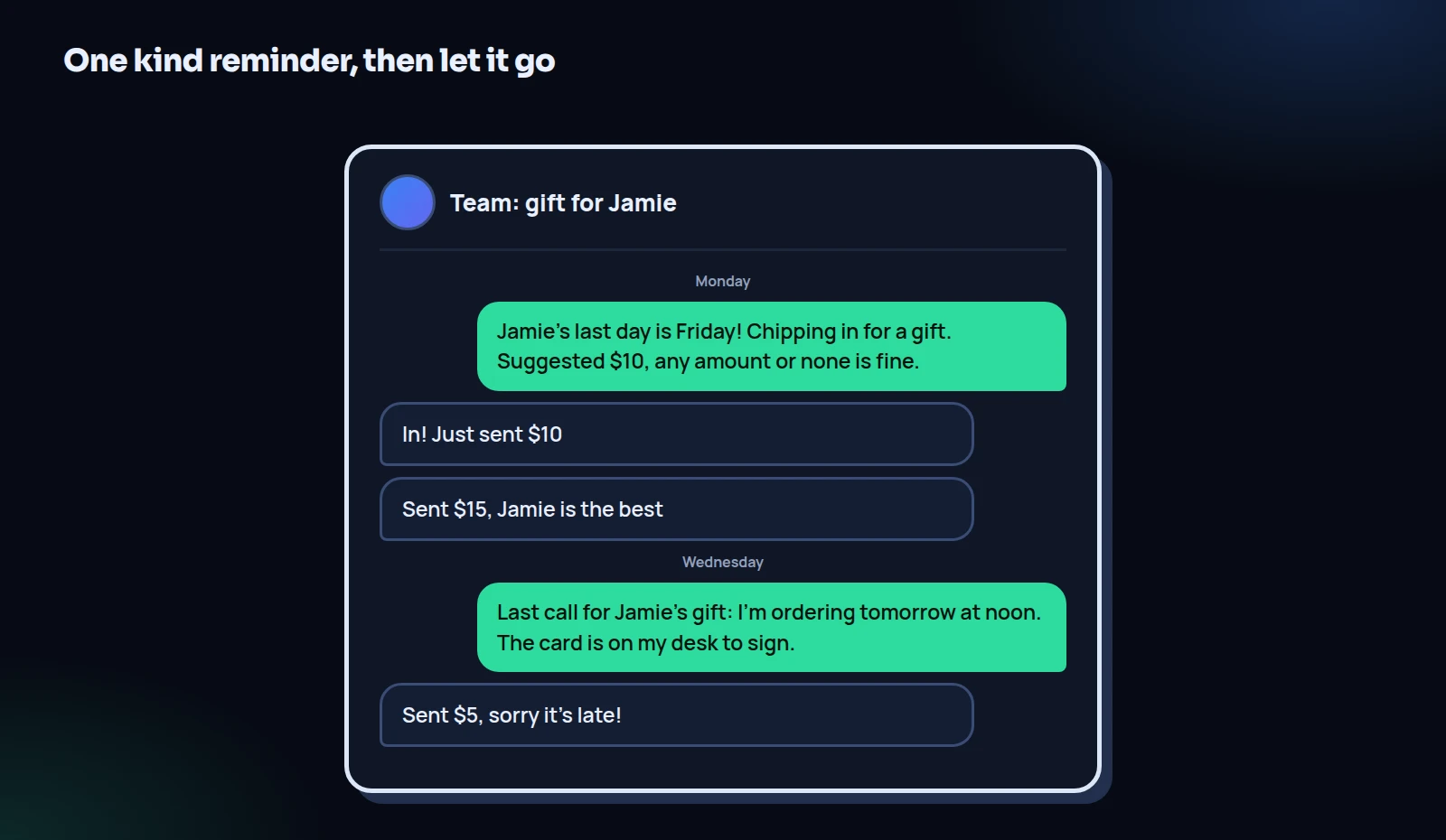
Message: the last call for a gift
Last call for Jamie’s gift! I’m ordering tomorrow at noon. If you’d like to chip in, send it before then. Either way, the card is on my desk to sign.
For a lunch someone forgot (sent privately, once): Hey! Small one: your lunch from Tuesday was $26.10. Totally fine if it slipped your mind.
Notice the difference. The gift reminder goes to the group, mentions no names, and offers the card as an alternative. The lunch reminder goes privately to one person, names the exact amount, and assumes good faith. A lunch is a small debt; a gift is a voluntary contribution. Treat them differently.
If a lunch debt keeps slipping, our guide on how to remind someone to pay you back has a gentle escalation path. For most offices, though, the real fix is a rule: whoever orders posts the numbers, everyone pays the same day.
Situation 4: when someone can’t or won’t contribute
Some people are on tight budgets. Some don’t know the colleague well. Some just don’t do office gifts. All of those are fine, and the way you respond decides whether the next collection feels friendly or tense.
Message: when someone says they’ll skip
No problem at all! The card is the main thing, it’s on my desk whenever you’re passing.
If someone apologizes for giving less: Thank you, that’s really kind. Every bit helps and Jamie will love it.
What you never do: mention who didn’t give, compare amounts, or say “everyone else chipped in.” When you split a group gift at work, the gift is from “the team,” and the team includes the people who signed the card and gave nothing.
Situation 5: a gift for the boss
Gifts that go up the org chart are where office collections get delicate, and the usual way to split a group gift needs adjusting. Junior staff can feel pressure to contribute to impress, and the boss may feel awkward receiving from people who earn much less. Many workplaces have a policy, so check it first.
If you work for the federal government, there are actual rules. Under the executive branch ethics regulations, employees can give a superior items worth $10 or less per occasion on occasional gift-giving occasions, like a birthday or holiday. For special, infrequent occasions such as a wedding, the birth of a child, or retirement, a gift appropriate to the occasion is allowed. The rules also address soliciting voluntary contributions for group gifts to a superior, so ask your agency’s ethics official before you start a collection.
Outside government, our advice is similar in spirit. For the boss, keep it small and optional, favor a card over cash, and save bigger gifts for real milestones like a retirement. Suggest $5 rather than $10, and don’t track who gave. A card full of signatures usually means more to a manager than the price of the gift.
Situation 6: the shortfall and the leftover
Even when you split a group gift carefully, collections rarely land on an exact number. If you come up short, either choose a cheaper gift or tell the group honestly. If you have money left over, say so and decide what happens to it.
Message: if you’re short, or have extra
Short: Update on Jamie’s gift: we collected $96, a little under the $120 I’d hoped. I’m going to get the smaller version of the same thing, and it still looks great. Thanks so much, everyone.
Extra: We ended up with $14 more than the gift cost. I’ve added a coffee shop gift card to the card for Jamie, unless anyone would rather I send their share back.
We’d avoid quietly covering a big shortfall yourself. It feels generous, but it sets a pattern where the organizer pays extra every time, and the next person who organizes will feel they have to as well.
Tip
For teams that celebrate every birthday, set up a small, optional birthday fund instead of a dozen separate collections. A few dollars from each person at the start of the year covers cakes and cards for everyone, and nobody has to ask for money twelve times. Keep a simple list of what’s in and what’s spent, visible to everyone who contributed.
The organizer’s job, kept small
Whoever ends up organizing should keep a short record: who contributed (privately), what came in, what was spent, and the receipt. It takes two minutes and answers every question anyone might ask later. Money people send you for a team gift or to repay their share of lunch is personal, not income: the IRS lists receiving money for birthday or holiday gifts and sharing the cost of a meal as personal payments that shouldn’t appear on a Form 1099-K. If your payment app asks, mark these as friends and family.
And if one coworker fronts a bigger amount for another, say covering a conference registration until payday, that’s no longer a lunch split. It’s a loan, and it’s kinder to both people to write it down. IOUEZ lets you set it up as an IOU the other person signs on their own phone, with a reminder before the due date, so nobody has to bring it up by the coffee machine. Our guide to lending money to a friend covers the basics, and they apply just as well to colleagues.
To split a group gift fairly, the formula is short: a modest suggestion, zero is fine, private amounts, one reminder, an honest update. For the math on any shared check, the split calculator on our calculators page adds tax and tip and handles the leftover cents.
The gift is from the team, and the team includes everyone who signed the card.
Frequently asked questions
How much should each person give to split a group gift at work?
Suggest a modest amount that the most junior person could give without strain, often $5 to $10 for a coworker, and say clearly that any amount or none is fine. Pick the gift after you know the total.
Is it OK not to contribute to an office gift?
Yes. Contributions should always be voluntary. Signing the card is a perfectly good way to take part, and a good organizer never mentions who gave.
How do you split an office lunch fairly?
Each person pays for their own item plus an equal share of delivery fees, tax and tip. It’s simple, close enough to exact, and easy to post in one message.
Should we buy the boss a gift?
Check your workplace policy first. If you go ahead, keep it small, optional and from the whole team, with a card. Federal employees have specific rules on gifts to superiors, so ask your ethics official.
What if we collect more than the gift costs?
Tell the group and suggest a use, like a small add-on gift card or the next team celebration, and offer to return shares to anyone who prefers.
How many reminders is too many?
One group reminder before the deadline is plenty for a gift. For a lunch debt, one private message with the exact amount usually does it.
Sources
- Electronic Code of Federal Regulations, 5 CFR 2635.304, Exceptions (gifts between federal employees), on the $10 per occasion limit and special, infrequent occasions.
- Federal Trade Commission, Mobile Payment Apps: How To Avoid a Scam When You Use One, on checking unexpected money requests with the person directly.
- Internal Revenue Service, Understanding your Form 1099-K, on personal payments such as gifts and sharing the cost of a meal.