
There’s no single right way to split wedding costs with family anymore. Tradition says one side pays for most of it; modern families have divorced parents, stepparents, very different budgets, and couples who’d rather pay their own way. What works is deciding who pays what with clear numbers and clear strings (or none), before the deposits start. This guide gives you a decision tree, a worked $30,000 example, and the words for the conversation.
How to split wedding costs: the decision tree
Answer these in order. Each one points to a section below.
Do you want to pay for it all yourselves, with no family money?
→Couple pays. Families give gifts if they like, with no say in the plan.
Do families want to help but hate spreadsheets?
→Ask for a fixed contribution: one number each, no matter what it pays for.
Is one side inviting far more guests than the other?
→Split per-guest costs by guest count.
Does someone want to pay for one specific thing?
→Let them own a cost: the rehearsal dinner, the flowers, the band.
Is a family member offering money they want back?
→That’s a loan. Write it down with dates, separately from the wedding budget.
You can mix branches. Plenty of couples ask one set of parents for a fixed contribution, let a grandparent pay for the cake, and cover the rest. The tree just makes sure each piece of money has a clear label.
Before you ask anyone: three numbers
The worst way to split wedding costs is to ask families for help before you know what you’re asking for. Get these three numbers first.
- The wedding budget. A realistic total, including the things couples forget: alterations, tips for vendors, the marriage license, postage.
- The guest count. Split into three lists: one family, the other family, and the couple’s own friends.
- The per-guest cost. Catering, bar, rentals and any per-head venue charge, divided by the number of guests. Everything else is a fixed cost that doesn’t change with headcount.
Our illustration: Parker and Reese are planning a $30,000 wedding for 120 guests. Per-guest costs come to $150 per head, so $18,000 for 120 people. Fixed costs (photographer $4,000, venue fee $3,500, music $2,000, flowers $1,500, attire and the rest $1,000) add up to $12,000. Check: $18,000 + $12,000 = $30,000.
Branch 1: the couple pays everything
More couples choose this than you might think, and it’s the simplest by far. Nobody else’s money means nobody else’s opinions about the seating chart. Families who want to help can give a gift, to the couple, which the couple can spend however they like.
The trade-off is obvious: it’s all on you. If that means a smaller wedding, many couples are glad of the trade. Just say it kindly, so a parent who offered doesn’t feel rejected: “We really appreciate it. We’ve decided to keep the wedding to what we can pay for ourselves, so it feels like ours. If you want to give us something, we’d love it toward the honeymoon.”
Branch 2: a fixed contribution from each family
Each family that wants to help names one number. The couple adds those numbers to their own savings, and that’s the budget. Nobody tracks which dollar paid for which napkin.
This is our favorite way to split wedding costs when families get along but have different budgets. It respects what each can afford without making it a competition. If Parker’s parents offer $7,500 and Reese’s parent Cameron offers $3,000, those are both generous gifts, and neither needs to be compared with the other in public.
Agree two things up front: when the money arrives (vendors want deposits months early) and whether it’s a gift with no strings. More on strings below.
Branch 3: split wedding costs by guest count
When one side’s list is much longer, a guest-count split feels fair to almost everyone. Each family covers the per-guest cost of its own guests; the couple covers their friends and the fixed costs.
Worked example: Parker and Reese’s guest-count split
| Who | Guests | Per-guest cost ($150) | Fixed costs | Total |
|---|---|---|---|---|
| Parker’s family | 50 | $7,500 | $0 | $7,500 |
| Reese’s family | 40 | $6,000 | $0 | $6,000 |
| Parker and Reese (friends) | 30 | $4,500 | $12,000 | $16,500 |
| Total | 120 | $18,000 | $12,000 | $30,000 |
Check: $7,500 + $6,000 + $16,500 = $30,000. Each family’s number follows its own guest list, which makes it easy to explain and easy to adjust: every guest added or removed changes that side’s total by $150.
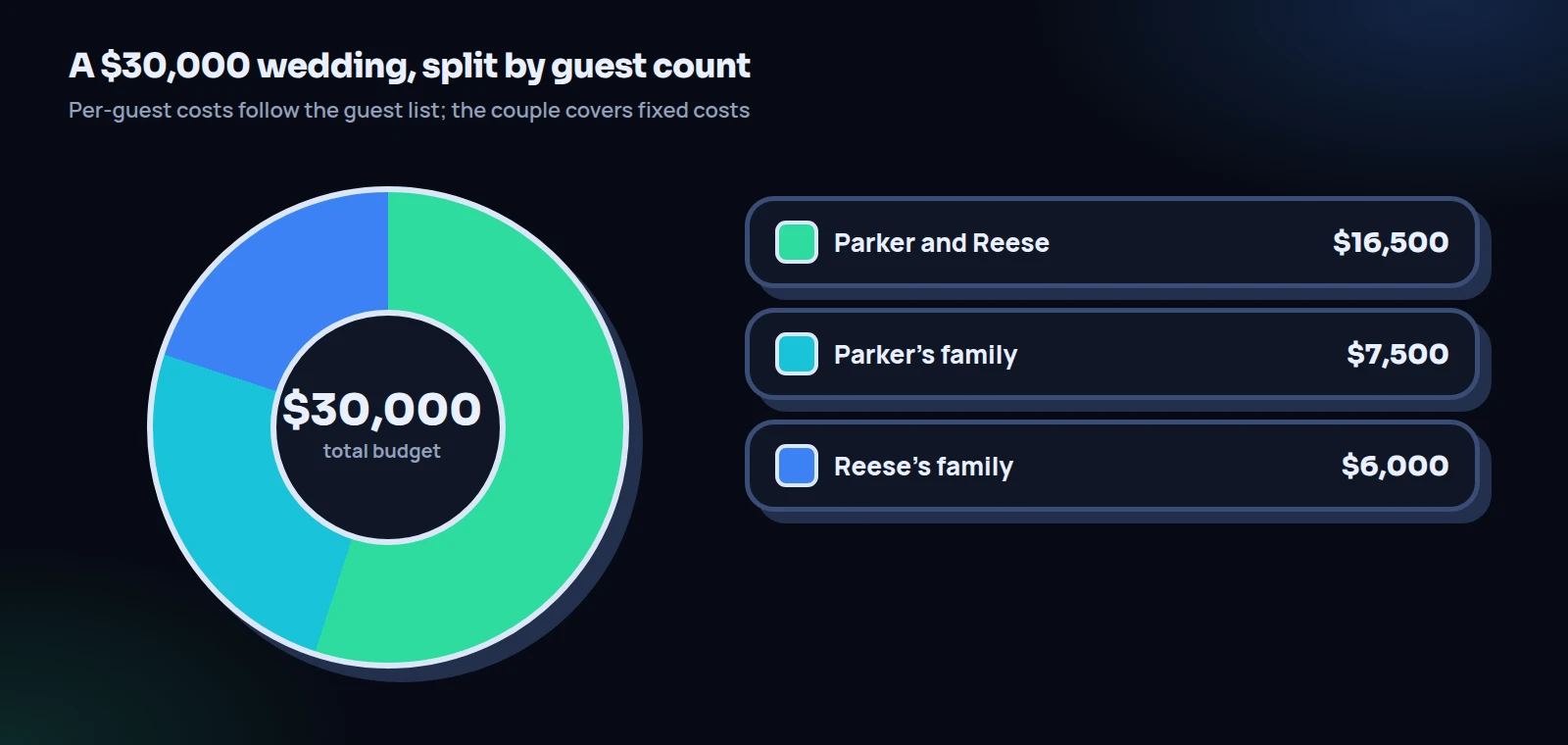
The guest-count split also gives everyone a lever. Suppose Cameron can contribute $3,000, not $6,000. Options: trim Reese’s family list from 40 to 20 ($3,000 at $150 per head), the couple covers the $3,000 gap, or a mix. None of those choices is wrong. The point is that it’s a choice made in the open, not a resentment discovered at the reception.
Branch 4: let people own a cost
Not everyone wants to split wedding costs as percentages. Some relatives would rather pay for one visible thing than send money into a pot: a grandparent who wants to buy the dress, an aunt who wants to host the rehearsal dinner, a parent who wants to cover the bar. Owning a cost can feel more personal, and for the couple it’s easy to track.
Two cautions. First, agree a budget for the owned item, because “we’ll pay for the flowers” can mean $600 or $6,000. Second, agree who chooses. If the aunt pays for the rehearsal dinner, does she pick the restaurant? Often she should; that’s part of the joy of hosting. Just settle it before the booking.
The conversation: words that work
Asking family for money, or turning down their money, is awkward for everyone. A clear script keeps it short and warm. Have the numbers in front of you, and talk to each family separately.
Message: asking for a fixed contribution
We’ve started planning, and we’re budgeting about $30,000 for around 120 guests. We’re covering most of it ourselves. If you’d like to contribute, we’d be really grateful for whatever feels comfortable, and there’s absolutely no expectation. It would help to know by March, since the venue deposit is due in April.
If they offer less than you hoped: Thank you so much, that’s really generous and it’ll go straight toward the venue. We’ll keep you posted on everything.
Notice what the script avoids: comparing families (“Reese’s parents are giving…”), naming a target number, or implying that how much someone gives says something about how much they care. For more on asking family for money without strain, see should you lend money to family, which covers the other side of the same conversation.
Strings attached: money and say
In many families, money comes with an unspoken vote. Parents who pay for the reception may expect to invite their friends, choose the band, or weigh in on the menu. That isn’t necessarily unreasonable, but it needs to be spoken.
Watch out
Before accepting a contribution, ask plainly: “Is there anything you’d like a say in?” If the answer is “the guest list,” you need to know that now. A contribution you’d have to give back halfway through planning is far more painful than one you turned down kindly at the start.
Some couples write a short note to each contributor confirming the amount, when it’s coming, and that it’s a gift. It sounds formal; it isn’t. It’s two sentences in a message that everyone can scroll back to later.
Gift or a loan? Make it clear
The most important label on family wedding money is whether it’s a gift or a loan. Sometimes a parent says “don’t worry about paying it back” and means “for now.” Sometimes a couple hears “gift” and a parent meant “advance on the house deposit.” Ask directly.
If it’s a gift, a few US tax facts help. The IRS sets an annual exclusion of $19,000 per recipient for 2026: each person can give up to that amount to each other person in the year without having to file a gift tax return. Because it’s per giver and per recipient, two parents giving to both members of a couple can each give up to $19,000 to each of them. Gifts above the exclusion generally mean the giver files a gift tax return, but tax is usually only owed after a very large lifetime exclusion is used up ($15 million per person for 2026). Gifts to your own spouse are generally not taxable gifts either, under the IRS rules.
If it’s a loan, treat it as one, separate from the wedding budget. Say Cameron lends the couple $5,000 to be repaid over 20 months. That’s $250 monthly. Write down the amount, the schedule and what happens if a payment is late. IOUEZ lets you record it as an IOU both of you sign, set up as installments with reminders before each due date, so nobody has to bring it up at a holiday dinner. Our guide to gift or loan family money goes deeper on making the label stick, and the CFPB has a short set of tips for managing lending and borrowing within families.
Four mistakes families make when they split wedding costs
Most wedding money trouble follows a handful of patterns. If you recognize one early, it’s easy to fix.
- Agreeing a percentage instead of a number. “We’ll cover half” sounds clear until the budget grows from $30,000 to $38,000 and half quietly becomes $19,000. If you split wedding costs by percentage, agree a cap too.
- Money arriving after the deposits. Venues and photographers often want deposits many months ahead. A contribution promised “closer to the date” can leave the couple fronting thousands on a credit card. Agree when each contribution arrives.
- Paying vendors directly without telling the couple. A generous aunt who pays the florist herself may not know the couple already put down a deposit. Route payments through one person, or keep one shared list of what’s paid.
- Using the budget as a scoreboard. When families split wedding costs unevenly, someone will be tempted to compare. Keep each contribution between the couple and that family, and thank everyone the same way.
None of these are about being stingy or controlling. They come from good intentions and fuzzy details. A short written note per contributor, with the amount, the date and the label (gift or loan), prevents nearly all of them.
Beyond weddings: the same rules for other big events
The same decision tree works for any family event with real money behind it: a milestone birthday party, a family reunion, a funeral, a graduation trip. Who’s paying, is it a fixed contribution or a share, does anyone own a cost, and is any of it a loan?
For reunions and trips where many households share costs, our comparison of ways to split trip costs covers equal, itemized and per-night splits. For one-off gifts that a group of relatives chips in for, splitting group gifts has scripts that work just as well with cousins as with coworkers.
Tip
Keep one shared list of every contribution and who it came from, with the date and whether it’s a gift or a loan. When you write thank-you notes months later, you’ll be glad you did, and nobody’s generosity gets forgotten in the blur of the day.
When you split wedding costs with family, the money is almost never the hardest part. The hard part is the silence around it. A decision tree, a few numbers and one honest conversation per family turn that silence into a plan. If you want help with the per-person math on smaller shared costs, like a bridal party splitting a rental house, use the split calculator on our calculators page.
Frequently asked questions
Who traditionally pays for a wedding in the US?
Traditions vary by culture and region, and many families no longer follow any of them. What matters is that the people paying agree on it openly. A fixed contribution, a guest-count split or the couple paying are all common today.
What’s the fairest way to split wedding costs between two families?
If guest lists are similar, fixed contributions that each family is comfortable with. If one side invites many more guests, split per-guest costs by guest count and let the couple cover fixed costs.
Do parents who pay get a say in the wedding?
Only if you agree that they do. Ask before accepting money whether there’s anything they’d like a say in, and decide together. A gift with no strings should be described that way.
Do we owe tax on money our parents give us for the wedding?
In the US, the IRS says the giver is generally responsible for any gift tax, not the recipient. For 2026 each person can give up to $19,000 to each recipient without filing a gift tax return. Check with a tax professional for larger amounts.
What if one family can’t contribute as much?
That’s normal, and it shouldn’t be compared publicly. With fixed contributions, each family gives what’s comfortable. With a guest-count split, the couple can cover the gap or the guest list can shrink, chosen openly.
How do we split wedding costs when parents are divorced?
Treat each household as its own contributor. Ask each separately, keep each contribution private, and avoid splits that require them to coordinate with each other.
Sources
- Internal Revenue Service, Frequently asked questions on gift taxes, on the annual exclusion, gifts to a spouse and who pays gift tax.
- Internal Revenue Service, IRS releases tax inflation adjustments for tax year 2026, including amendments from the One, Big, Beautiful Bill, which keeps the annual exclusion at $19,000 for 2026.
- Internal Revenue Service, What’s new: Estate and gift tax, on the 2026 basic exclusion amount.
- Consumer Financial Protection Bureau, Tips for managing family lending and borrowing.